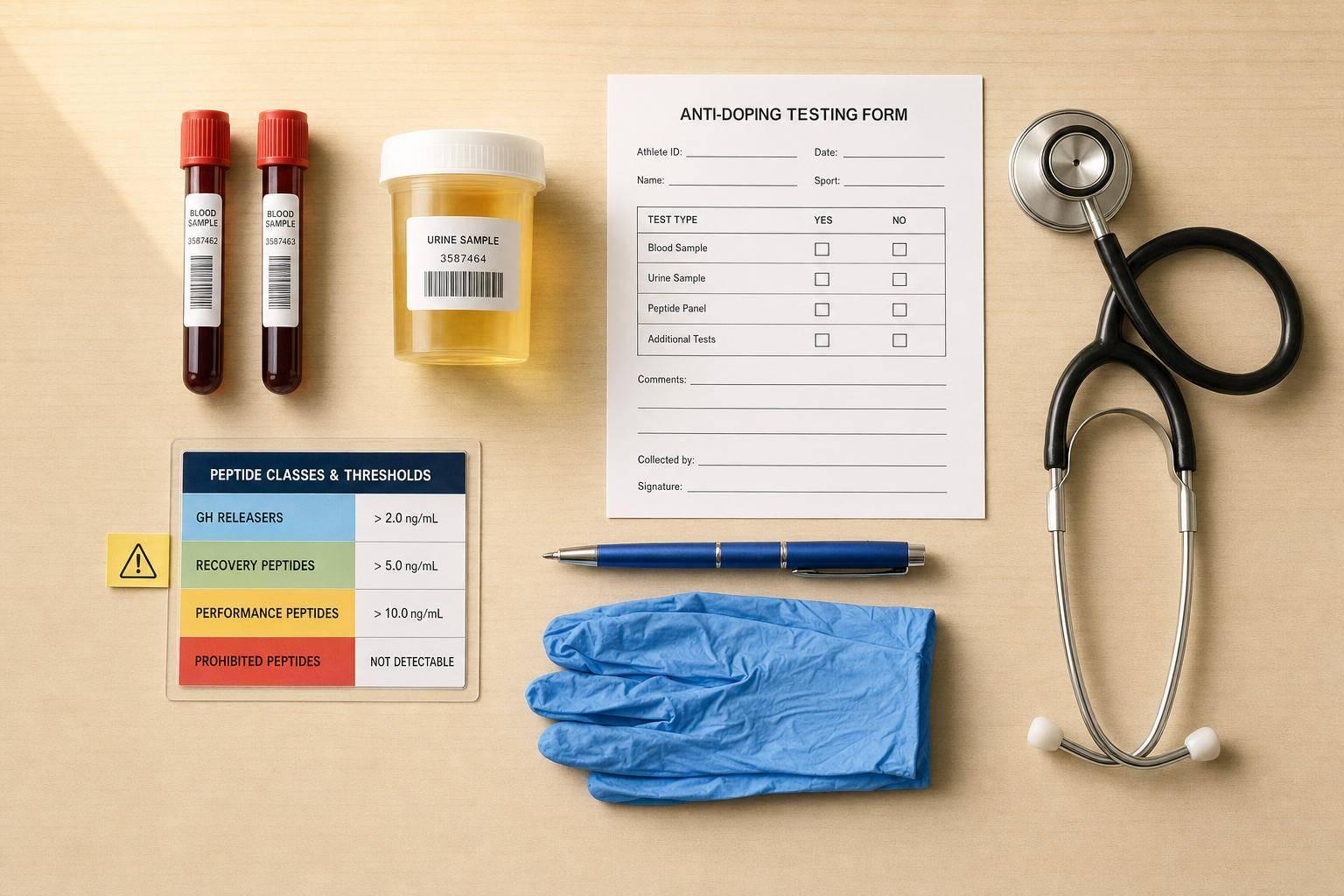
If you compete under WADA, USADA, NCAA, or league rules, many peptides can get you banned even with a prescription and even in the off-season.
I’d boil the article down to this: peptide risk in sport comes from rule status, lab detection, and product quality. The review shows that many compounds sold for recovery, body composition, or hormone support fall under S0, S2, or S4, which means they are banned at all times. It also shows that testing can detect some peptides at very low levels, with published urine limits as low as 0.01 ng/mL to 0.11 ng/mL for BPC-157, and detection windows that can last 4 to 5 days for some compounds. At the same time, many gray-market products have basic quality problems, including 30% wrong sequences, 65% endotoxin contamination in one analysis, and 41.6% failed lab reports in another dataset.
If I were giving you the short version, it would be this:
- A prescription does not protect an athlete from an anti-doping case
- Route of use does not matter: nasal, topical, oral, and injectable forms can all trigger the same rule problem
- BPC-157, TB-500, GHRPs, IGF-1 agents, and related compounds are high-risk for tested athletes
- Short half-life does not mean short detection window
- Labs use LC-MS/MS and LC-HRMS to detect many peptides and their metabolites
- Research peptides sold online may be mislabeled or contaminated
- A TUE is the only path when a banned drug is medically needed, and that path is limited
Here’s the plain-language takeaway: if you prescribe, use, or advise on peptides in U.S. sport, you need to check anti-doping status first, not after the fact.
| Topic | What the article shows |
|---|---|
| Rule status | Many peptide-related drugs are banned year-round under S0, S2, or S4 |
| Common examples | BPC-157, TB-500, ipamorelin, GHRP-2, IGF-1 agents, hCG, MK-677 |
| Detection | Some urine tests reach sub-ng/mL or even pg/mL ranges |
| Testing window | Can last from hours to several days, depending on the drug and metabolite |
| Health risk | Endocrine effects, hypoglycemia, edema, clot risk, contamination, and infection |
| Compliance point | Athlete status should be checked before prescribing |
| Legal/medical gap | FDA status and clinical use do not decide sport eligibility |
That’s the core message of the full review, and it frames every clinical and athlete decision that follows.
Banned Peptide Classes and U.S. Regulatory Context
S0, S2, and S4 Categories Most Relevant to Peptides
These broad categories start to make sense once you tie them to common peptide examples.
S2 covers peptide hormones, growth factors, related substances, and mimetics. That includes GHRH analogs, GHRPs, IGF-1, and thymosin-β4–related compounds such as TB-500. In plain English: these are the peptide groups most likely to lead to an anti-doping violation.
S0 is the catch-all category for non-approved substances. Any pharmacologic substance without current approval from a government health authority, including the FDA, may fall here. That’s why BPC-157, Semax, and Epitalon are prohibited even if they are not listed under S2. The category matters more than the brand name or peptide name. If a substance fits under S0, S2, or S4, it is prohibited at all times.
USADA Notices, FDA Status, and Route-of-Administration Misconceptions
USADA materials make it plain that peptide hormones, growth factors, and research peptides are prohibited no matter how they are made or delivered. A compounded nasal spray, topical cream, or injectable version of a banned peptide brings the same rule risk.
This is where people get tripped up. A peptide can be legal in medical care and still banned in sport. FDA approval and WADA status are two separate issues. Clinical legality does not equal sport eligibility.
For prescribers, the main question is not just whether a product is approved. It’s whether the compound is prohibited in sport.
Reference Table: Peptide Classes, WADA Categories, and U.S. Clinical Notes
The table below condenses the peptide classes most likely to matter in U.S. sports medicine.
| Peptide Class | Example Compounds | WADA Category | U.S. Clinical Note |
|---|---|---|---|
| GHRH Analogs | CJC-1295, sermorelin, tesamorelin | S2.1.1 | Tesamorelin is FDA-approved for lipodystrophy but still prohibited for athletes |
| GHRPs / GH Secretagogues | Ipamorelin, GHRP-2, hexarelin | S2.1.1 | Often compounded; USADA has sanctioned athletes for ipamorelin and GHRP-2 use |
| Growth Factors / GH Fragments | IGF-1, TB-500, AOD-9604 | S2.3 | TB-500 is explicitly named under S2.3; IGF-1 analogs such as LR3 and MGF are also covered |
| Non-Approved Research Peptides | BPC-157, Semax, Epitalon | S0 | WADA prohibition is independent of FDA status |
| Hormone & Metabolic Modulators | AICAR, MOTS-c, myostatin inhibitors | S4 | Relevant when stacked with peptide protocols; MOTS-c is explicitly named |
| Gonadotropins / LH Analogs | hCG, leuprolide, triptorelin | S2.2 | Prohibited for male athletes; relevant in TRT and hypogonadism management |
WADA testing remains active across sports, which shows these categories are being monitored in practice, not just listed in policy documents.
The next section explains why some of these substances remain difficult to detect.
sbb-itb-7164bd9
WADA's Stance on PRP and Peptides
Detection Methods, Detection Limits, and Laboratory Challenges
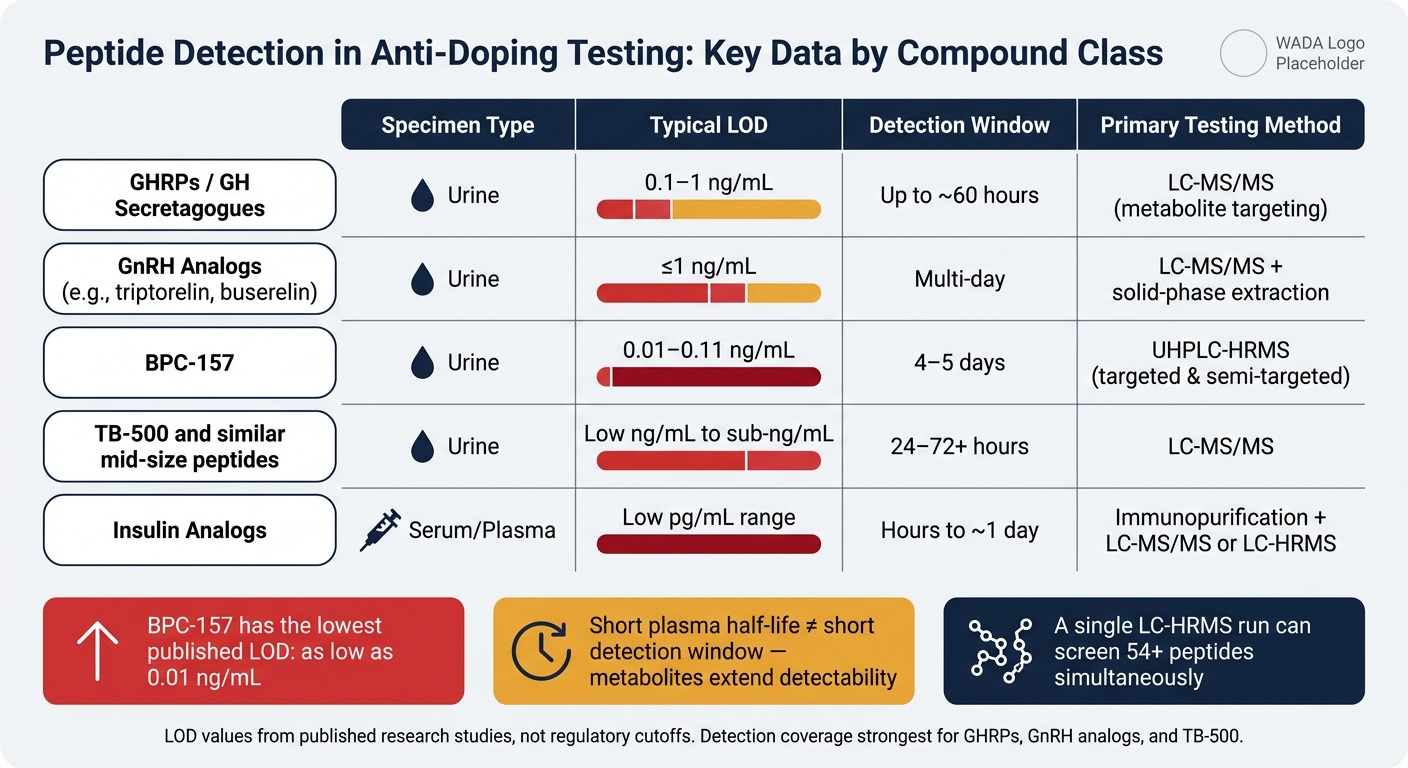
Peptide Anti-Doping Risk: Detection Limits & Ban Status by Class
LC-MS/MS and LC-HRMS as the Main Detection Tools
At this point, detection is what shapes the anti-doping risk of each peptide class. For clinicians, the issue isn't just whether a peptide appears on the prohibited list. It’s whether labs can still find it with current testing.
Anti-doping laboratories mainly use LC-MS/MS and LC-HRMS. In practice, urine is the main sample for short synthetic peptides, while blood or plasma is more common for larger targets.
For shorter peptides like GHRPs, GnRH analogs, TB-500, and AOD-9604, labs usually use solid-phase extraction and then run LC-MS/MS with targeted monitoring. In WADA-accredited laboratories, this workflow is mandatory for these compound classes.
For insulin and full-length IGF-1 analogs, labs often need to add immunopurification before LC-MS/MS or LC-HRMS. That extra step makes testing harder to offer across labs.
LC-HRMS is especially helpful for newer research peptides like BPC-157. It can support metabolite profiling while also handling targeted or semi-targeted screening in the same workflow.
Reported Sensitivity and Detection Windows in Published Studies
The testing method sets the upper limit of what a lab can detect. Published limits show that this ceiling can be quite low.
For common GHRP and secretagogue panels, published LC-MS/MS urine methods often reach limits of detection (LODs) around 0.1 to 1 ng/mL. That sits below WADA's MRPL of 2 ng/mL for many short synthetic peptides.
One 54-peptide LC-HRMS urine screening panel reported LODs of 0.20 to 0.92 ng/mL. So a single run can screen for a long list of prohibited peptides.
BPC-157 testing goes even lower. Specialized UHPLC-HRMS methods have reported urine LODs of 0.01 to 0.11 ng/mL, with quantitation from about 0.02 to 50 ng/mL. Earlier LC-MS/MS work found that both the parent peptide and a stable metabolite stayed detectable in urine for at least four days after administration. For GHRP-2, urinary metabolites have been detected for up to about 60 hours after a single 100 µg subcutaneous dose, with LODs around 20 pg/mL.
That leads to an easy mistake: assuming a short plasma half-life means a short testing window. It doesn't. Metabolite-focused methods can keep a compound detectable well past what a basic pharmacokinetic estimate might suggest.
Why Some Peptides Remain Difficult to Detect
Even with low LODs, detection still varies a lot by peptide class and by how stable its metabolites are. Many peptides circulate at very low levels, sometimes in the low picogram-per-milliliter range. Many are also cleared or metabolized fast, which can leave behind only trace metabolites that may not be fully mapped out yet. That helps explain why some compounds are easier to sanction than others, even when misuse patterns look similar.
Larger molecules like insulin and IGF-1 analogs may need immunopurification before mass spectrometry. That adds another layer of lab work and can introduce variation from one laboratory to another.
Some peptides also break down in the sample itself through hydrolysis, oxidation, or surface adsorption. When that happens, the signal can drop before the instrument even starts the analysis.
Newer or less-studied research peptides can create another problem: labs may not have certified reference materials. Without those, cross-laboratory method validation gets harder.
The table below gives a snapshot of published detection performance across major peptide classes.
| Peptide Class | Specimen | Typical LOD | Detection Window | Common Anti-Doping Method |
|---|---|---|---|---|
| GHRPs / GH Secretagogues | Urine | 0.1–1 ng/mL | Up to ~60 hours | LC-MS/MS targeting metabolites |
| GnRH Analogs (e.g., triptorelin, buserelin) | Urine | ≤1 ng/mL | Multi-day with optimized assays | LC-MS/MS with solid-phase extraction |
| BPC-157 | Urine | 0.01–0.11 ng/mL | 4–5 days | UHPLC-HRMS (targeted and semi-targeted) |
| TB-500 and similar mid-size peptides | Urine | Low ng/mL to sub-ng/mL | 24–72 hours or more | LC-MS/MS |
| Insulin Analogs | Serum/Plasma | Low pg/mL range | Hours to ~1 day | Immunopurification + LC-MS/MS or LC-HRMS |
These numbers come from published studies, not regulatory cutoffs. Detection coverage is strongest for GHRPs, GnRH analogs, and TB-500. By contrast, newer research peptides are still limited by assay availability and method development.
Misuse Patterns, Athlete Populations, and Health Risk Signals
What Prevalence and Sanction Data Show
Misuse shows up most clearly in sports where recovery demands are high and body composition matters a lot. That includes cycling, track and field, weightlifting, and bodybuilding. Sanction data from WADA, USADA, and other national anti-doping organizations most often involves GH, EPO, insulin, IGF-1, and GH secretagogues such as GHRPs and MK-677.
WADA-accredited labs processed more than 300,000 samples in 2023. Even so, peptide hormones and related substances made up only about 0.3% of AAFs. In 2020, the count was 48 AAFs, or about 3% of findings. On paper, those numbers look low. But that does not mean use is rare. More often, it points to testing limits and the ways athletes try to avoid detection.
Self-report surveys in bodybuilders and gym users show peptide use as part of broader multi-drug use. The usual goals are muscle gain, fat loss, and injury recovery. These surveys come with a catch, though. They rely on convenience samples and anonymous online responses, so the figures can't be applied to the broader U.S. athletic population. The same pattern appears with newer compounds sold as recovery aids.
Emerging Misuse of Research and Recovery-Oriented Peptides
BPC-157, TB-500, and MK-677 show up less often in sanctions than GH- or EPO-related agents. Still, they keep appearing in seizure reports, customs actions, and online marketplace monitoring. This section is about misuse frequency and how often sanctions make that misuse visible, not rule status, which was covered in the classification section above.
Online forums, podcasts, and influencer content often pitch BPC-157 and TB-500 as recovery shortcuts. MK-677 is often packaged with SARMs for muscle gain and sleep. On April 22, 2026, the FDA issued removal notices for BPC-157 and TB-500 from the Category 2 bulk drug substances compounding list. Even with that, actual prevalence is still unknown.
Health Risks Relevant to Prescribing Clinicians
For clinicians, one of the biggest red flags is gray-market peptide quality. One analysis found 30% wrong sequences and 65% endotoxin contamination. Another found that 41.6% of 6,285 lab reports failed identity, purity, or dose benchmarks, with TB-500 and CJC-1295 showing especially high identity failure rates. So the problem isn't just rule breaking. It's that the athlete may have no clear idea what they're putting into their body.
The endocrine and metabolic risks tied to classic agents are much better documented. Supraphysiologic GH and IGF-1 use is linked to soft-tissue edema, carpal tunnel syndrome, insulin resistance, and possible acceleration of latent malignancies. Insulin misuse in bodybuilding has led to severe hypoglycemia, seizures, and near-fatal events in otherwise healthy people. EPO and related agents increase hematocrit, blood viscosity, and thromboembolic risk, especially when paired with dehydration and other stimulants in endurance athletes.
The uncertainty gets even worse with newer research peptides. Human reports on BPC-157 and TB-500 are limited. Still, allergic reactions, injection-site infections, and systemic symptoms have been described, often suggesting contamination rather than the peptide itself. For U.S. clinicians counseling athletes, informed-consent discussions should stay grounded in the main risk signals: contamination, endocrine disruption, glucose effects, edema, and cardiovascular strain, especially when the athlete is subject to anti-doping rules.
Clinical-Prescribing Gap, Compliance Points, and Key Takeaways
Why Clinical Intent Does Not Override Anti-Doping Rules
Once a tested athlete is part of the picture, a medical issue can turn into an eligibility issue fast. For U.S. clinicians, the rule is simple: a valid prescription does not shield a tested athlete from an anti-doping violation. Under WADA and USADA rules, anti-doping works on a strict-liability basis. If a prohibited substance appears in an athlete's sample, the athlete is responsible, no matter who prescribed it or the reason for use.
That is the clinical-compliance gap in plain terms. A clinician may prescribe with good medical intent, but that does not change anti-doping status. Compounding does not change it either, and product labeling does not overrule classification. The only path that can align treatment with competition eligibility is a TUE, and that path is narrow. It may apply in cases like insulin for type 1 diabetes, selected GLP-1 agents, or recombinant growth hormone for documented adult GH deficiency. By contrast, research-grade peptides such as BPC-157 and TB-500 are generally not eligible because they do not have recognized therapeutic approval.
Documentation and Counseling Points for U.S. Peptide Prescribers
Because of that, screening needs to happen before the prescription is written. Intake forms should directly ask whether the patient is subject to drug testing under WADA, USADA, the NCAA, a professional league, or another anti-doping program.
Documentation should be short, clear, and able to stand up to review. At a minimum, record:
- The patient's WADA, USADA, NCAA, or league testing status
- The substance's prohibited-list classification
- That strict-liability counseling was provided
- Referral to team medical staff or an anti-doping officer to confirm eligibility
- The patient's informed decision
Conclusion: Main Findings from the Literature and Policy Review
The main point from the literature and policy review is straightforward: because anti-doping rules use a strict-liability system, tested athletes need prescribing that is screened, documented, and compliance-aware. When a prohibited peptide is medically necessary, only a formally granted TUE can align treatment with competition eligibility.
FAQs
Can I be banned for a peptide I was legally prescribed?
Yes. Many peptides are banned for competitive athletes under the World Anti-Doping Agency (WADA) Prohibited List, no matter their FDA status or whether a doctor legally prescribed them.
That’s the key point: a peptide’s legal or compounding status is separate from anti-doping rules. A legal prescription does not protect an athlete from a competition ban.
How long can peptide use show up on an anti-doping test?
The research does not give a precise detection window for peptides on anti-doping tests. How long a peptide can be found may change based on the exact substance, the dose, how it was taken, and the person’s metabolism.
Because peptides on the WADA Prohibited List are banned for competitive athletes, any use may violate WADA rules regardless of FDA status.
Which peptides pose the biggest risk for tested athletes?
For tested athletes, the main risk is simple: using a substance banned under the WADA Prohibited List.
Common examples people bring up include BPC-157, TB-500 (Thymosin Beta-4), and growth hormone-releasing peptides such as CJC-1295 and Ipamorelin.
For competitive athletes, these peptides are prohibited no matter the clinical reason for use or their current FDA status. That’s the part that can trip people up. A treatment plan that seems fine in a clinic can still trigger an anti-doping rule violation in sport.
Because of that, clinicians should use extreme caution when treating patients who compete in organized, tested sports.