
If the injury is small, clear, and easy to reach, local delivery often makes more sense. If recovery needs involve more than one area, systemic delivery is often the simpler fit.
I’d boil the article down like this:
- Local delivery aims treatment at one injured spot, such as a tendon, ligament, muscle area, or joint.
- Systemic delivery spreads through circulation, usually by subcutaneous injection, and fits diffuse pain, multi-site rehab, or simpler scheduling.
- The route choice should match:
- injury pattern
- tissue depth
- access to the target
- rehab phase
- athlete needs and compliance , which requires thorough patient counseling on injection technique
- Accuracy matters for local injections. The article notes 95%–96% accuracy for ultrasound-guided intra-articular knee injections vs. 78%–83% with landmark guidance. It also cites 74.36% accuracy for ultrasound-guided patellar tendon injection vs. 11.54% with palpation alone.
- Human research on peptides like BPC-157 and TB-500 is still limited, so they should be treated as an add-on to rehab, not the whole plan.
- For tested athletes, anti-doping rules matter: TB-500 is banned under S2, and BPC-157 is also flagged.
My takeaway: route selection is less about the peptide itself and more about where the injury is, how easy it is to hit safely, and what stage of rehab the athlete is in.
The Truth About BPC 157 Peptide in Sports Medicine: What You Need to Know
sbb-itb-7164bd9
Quick Comparison
| Criteria | Local Delivery | Systemic Delivery |
|---|---|---|
| Main goal | High exposure near one lesion | Body-wide distribution |
| Best fit | Focal, accessible injury | Multi-site or diffuse recovery needs |
| Common route | Peritendinous, periarticular, intra-articular, or nearby IM | Usually subcutaneous |
| Main limit | Precision, depth, anatomy, imaging needs | Lower concentration at one spot |
| Workflow | More procedure time and skill | Simpler day-to-day use |
| Rehab use | Often for a structure still holding progress back | Often used when more than one area needs support |
| Charting focus | Exact site, depth, technique, guidance used | Reason for whole-body approach and response tracking |
So if you’re deciding between local and systemic peptides in sports rehab, the short answer is simple: pick local for a clear target, pick systemic for broader recovery needs based on patient selection criteria, and document the reason with anatomy, timing, safety, and outcome measures in mind.
Local vs Systemic Delivery: Reach, Precision, and Practicality
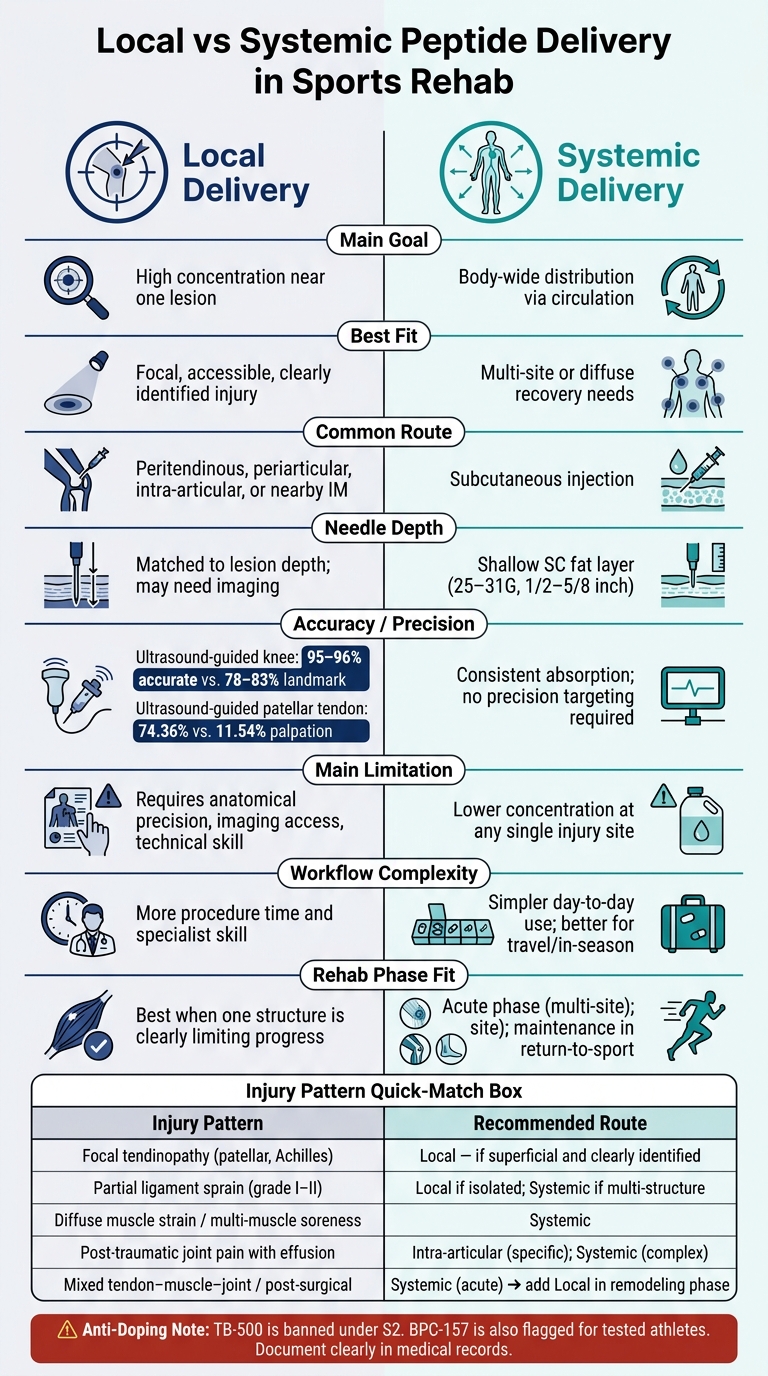
Local vs Systemic Peptide Delivery in Sports Rehab: Key Differences
The main tradeoff is simple: high concentration at one spot vs. broader reach through the whole body.
Use this comparison:
| Feature | Local Delivery | Systemic Delivery |
|---|---|---|
| Target concentration | High at the lesion site | Distributed via circulation |
| Tissue reach | Focal - near the lesion | Body-wide; supports multi-site recovery |
| Practicality | Requires anatomical precision and accessibility | Simpler; standard subcutaneous site |
| Common scenarios | Focal tendon tear, single-joint injury | Diffuse overuse, multi-site rehab |
| Major constraints | Technical precision, tissue depth | Lower site-specific concentration |
That table makes route choice much easier to match to the injury pattern.
If local delivery is the plan, accuracy becomes the big issue. Ultrasound guidance improves intra-articular knee injection accuracy to 95%–96%, compared with 78%–83% using landmarks.
When Local Delivery Fits a Focal Sports Injury
For focal injuries, the next step is figuring out whether the target is accessible enough for precise placement. Local delivery makes sense when the lesion is clear, reachable, and can be targeted with confidence. A palpable Achilles tendon lesion, a confirmed intra-articular pathology, or a focal ligament sprain with a clear pain source all point in that direction.
In those cases, putting the peptide near the involved structure can make practical sense. But local delivery gets harder when the target sits deep or when the anatomy is tricky enough that accurate placement is hard without image guidance.
When Systemic Delivery Fits Broader Recovery Goals
Sometimes the rehab problem isn't tied to one structure. In that case, systemic delivery tends to fit the plan better. Athletes dealing with diffuse overuse symptoms or multi-site involvement often don't have one clear lesion to chase down, so systemic delivery sends the peptide through circulation to support recovery across more than one area.
It's also the simpler option when rehab has to work around travel, in-season demands, or spotty adherence. For diffuse or multi-site rehab, that ease of use can matter just as much as route selection itself.
Those same limits around access and precision also shape injection planning and rehab timing.
Route Selection by Injury Pattern
Once the route tradeoffs are clear, the next step is the injury pattern itself. The goal is simple: match the route to the problem in front of you instead of using the same approach for every case. That’s what makes peptide planning usable in an actual sports rehab setting.
Tendon and Ligament Injuries
If imaging or the physical exam shows a discrete lesion, local delivery is usually the first move. That includes cases like mid-portion Achilles tendinopathy, focal patellar tendinopathy, or a partial MCL sprain with a clear pain generator.
For superficial tendons, local treatment is often straightforward. The patellar tendon and distal Achilles, for example, can usually be reached with peritendinous or shallow intramuscular injection. Deeper structures are a different story. The proximal hamstring tendon or hip ligaments are harder to target safely, so systemic delivery often makes more sense there. It can also cover more than one site without turning one session into multiple injections.
Muscle and Joint Injuries
With muscle and joint injuries, the decision shifts a bit. It’s less about where the lesion is and more about tissue depth and access to the compartment.
A focal grade II hamstring strain with ultrasound-visible fiber disruption is a fair candidate for local injection near the injury. But when soreness is diffuse or spread across more than one muscle, systemic delivery usually fits better. If there isn’t one structure clearly driving the limitation, local treatment starts to lose its edge.
Joint injuries bring another layer: depth and compartment limits. Intra-articular routes can provide high local exposure in the synovial environment. But that route also calls for precise technique, sterile conditions, and often imaging guidance. In practice, that usually means specialist use and narrow indications. If the case involves complex joint pain, more than one compartment, or a large effusion, systemic delivery is often the cleaner option.
Mixed or Multi-Structure Rehab Cases
Complex rehab cases often need the route to change as the athlete moves through rehab. In the acute phase, systemic delivery can cover several structures at once, cut down on procedure load, and keep administration simpler.
Later, during remodeling, local treatment can be added for the structures still slowing progress while systemic therapy continues at a lower maintenance dose. By the return-to-sport phase, if peptides are still being used, systemic support usually fits better than repeated local injections.
| Injury Pattern | Route Consideration |
|---|---|
| Focal tendinopathy (patellar, Achilles) | Local if superficial and clearly identified |
| Partial ligament sprain (grade I–II) | Local if isolated; systemic if multi-structure |
| Diffuse muscle strain or multi-muscle soreness | Systemic |
| Post-traumatic joint pain with effusion | Intra-articular for specific indications; systemic for complex cases |
| Mixed tendon–muscle–joint / post-surgical | Systemic (acute); add local in remodeling phase as needed |
Injection Planning, Tissue Depth, and Rehab Timing
Once you’ve picked the route, the next step is more hands-on: where to inject, how deep to go, and when that plan fits the rehab timeline.
Site Selection and Depth Considerations
Start by mapping the injury site. Site choice should follow anatomy, not convenience. A superficial target - like a tendon border, periarticular soft tissue area, or subcutaneous tissue - is often easier to reach with a short needle. Deeper targets, such as muscle tissue or injuries sitting under thicker tissue layers, may need a longer needle and, in some cases, imaging support.
Depth shapes almost every other choice. Standard subcutaneous placement usually uses 25–31G needles that are about 1/2 to 5/8 inch long, with the injectate placed in the fat layer under the skin. Intramuscular placement needs more reach - often 1 to 1 1/2 inches in adults, depending on body habitus - to get into true muscle tissue. And that’s where things get practical fast: a needle length that works well for one patient may miss the target in another. In plain terms, depth can decide whether a local plan makes sense at all or whether systemic delivery is the cleaner option.
For local delivery, the goal is simple: place the injectate as close to the lesion as safely possible. That usually means choosing a site next to the involved tendon, ligament, periarticular tissue, or muscle region, while steering clear of unintended intralesional placement and nearby structures that add risk. Ultrasound makes sense when the anatomy is unclear, the target sits deep, or nerves and vessels are close by. The difference in precision can be huge. In cadaveric data, ultrasound-guided patellar tendon injections reached 74.36% accuracy, compared with 11.54% for palpation-guided attempts.
| Factor | Local Injection Planning | Systemic Injection Planning |
|---|---|---|
| Placement | Near the lesion; peritendinous, periarticular, or muscle-adjacent; often image-guided for precision | Standard SC or IM site chosen for absorption and convenience |
| Depth | Matched to lesion depth; may require imaging for deeper tissue planes | Shallow SC fat or true IM depth depending on protocol |
| Practical barriers | Anatomic complexity, imaging access, technical skill requirements, time burden, and patient tolerance | Body habitus, needle length selection, patient comfort, and less lesion-specific exposure |
That anatomic plan should line up with the rehab phase too. Otherwise, even a well-placed injection can feel out of step with what the athlete needs at that moment.
Matching Route to Rehab Phase
Route choice should shift as the main rehab problem shifts.
In the acute phase, local delivery fits best for a focal lesion, while systemic delivery fits better when the injury is diffuse or involves more than one structure.
In the subacute phase, local delivery only helps if one structure is still holding progress back and the placement can be done safely. As the athlete moves into the remodeling phase, route choice should follow the main limiting factor. Many protocols hold off on strengthening until about 2 weeks, with heavier loading saved for remodeling.
That same phase-based approach also shapes what should be charted and when the plan needs to change.
Practical Limits, Charting Points, and Key Takeaways
The biggest constraint here is simple: human data is thin. Most of what we know about BPC-157, TB-500, and similar peptides in musculoskeletal rehab comes from animal research and small, uncontrolled cohorts. So these agents should be used only as an add-on to a structured rehab plan, not as a stand-alone fix.
With evidence this limited, route selection can't be casual. It needs to line up with the anatomy involved, the rehab phase, and the outcome measures you're tracking in the chart.
There’s also a product quality issue. Compounded products can differ in potency, purity, sterility, and labeling. In an athlete’s recovery plan, that kind of variation matters a lot. It affects whether a protocol can be carried out the same way each time. For that reason, document the pharmacy, lot number, and concentration for every product. Counseling should also cover the off-label status, the limited human data, and possible risks, including theoretical pro-angiogenic concerns in patients with active or recent malignancy.
For competitive athletes, anti-doping has to be handled as its own discussion. TB-500 is banned under S2, and BPC-157 is also flagged for tested athletes. That can change return-to-play planning, so it should be documented clearly in the medical record.
In other words, documentation isn't busywork. It's part of the safety plan.
What to Document in the Medical Record
The chart should make it clear why a route was chosen and how response will be measured. Start with a specific diagnosis that includes laterality and severity, such as "partial-thickness proximal hamstring tendon tear, right, subacute." Then add a clear reason for local versus systemic delivery based on anatomy, tissue depth, and rehab phase. Baseline measures should be there too, including NRS or VAS pain scores, a validated functional scale such as the LEFS or DASH, and sport-specific load tolerance tests.
Consent notes should state the peptide’s off-label or investigational status, the mainly preclinical nature of the supporting data, and the risks that were reviewed. Follow-up should be documented at week 1, week 2, and weeks 8–12, along with stop/continue criteria. PeptidePrescriber's dosing protocols, calculators, and injection guides can help support that workflow.
| Chart Element | What to Include |
|---|---|
| Diagnosis | Specific injury, structure, laterality, acuity (e.g., grade II MCL sprain, left, subacute) |
| Route rationale | Local vs. systemic choice tied to anatomy, tissue depth, and rehab phase |
| Informed consent | Off-label status, evidence gaps, risks, patient acknowledgment |
| Pharmacy, peptide, concentration, lot number, needle size, site | Full product and administration details for every injection |
| Outcome measures | Pain scores, functional scales, load tolerance, return-to-play milestones |
| Follow-up plan | Scheduled intervals with specific metrics and stop/continue criteria |
Key Points for Route Selection
Route choice works only when it fits both tissue access and the rehab phase. And it shouldn't stay static if the rehab stage changes. The chart should show that progression plainly.
A strong note ties peptide timing to a named rehab stage and spells out which outcome measures are being tracked. Given the limited evidence and the variability in compounded products, that level of detail matters. At each follow-up, the record should connect the diagnosis, the route rationale, and the patient’s response in a way that another clinician can follow without guesswork.
FAQs
How do I choose local vs systemic delivery?
It depends on where the injury is and how the peptide works.
For BPC-157, a subcutaneous injection near the injury is often the go-to choice for musculoskeletal issues like tendon or ligament injuries. The idea is pretty simple: when the problem is close to the surface, placing the injection near that area is often preferred.
For deeper areas, such as the rotator cuff, systemic delivery through a standard site like the abdomen or deltoid can also work well.
TB-500 is different. It works systemically, so the injection site matters much less. In most cases, standard injection sites like the abdomen or thigh are enough.
When is ultrasound guidance needed?
Ultrasound guidance is used before a procedure to check the surgical site and document that the structure is intact.
For follow-up, ultrasound or MRI is used at 8 to 12 weeks after the procedure to confirm structural healing before a patient returns to full activity.
Subcutaneous BPC-157 or GHK-Cu injections near the injury site do not usually need ultrasound guidance unless it's specifically needed to see the target tissue.
Are BPC-157 and TB-500 allowed for tested athletes?
No. BPC-157 and TB-500 are prohibited by the World Anti-Doping Agency (WADA), so using them is an anti-doping rule violation for athletes who fall under WADA rules.
For clinicians working with athletes, this banned status should be one of the first things checked before starting any peptide protocol in sports.