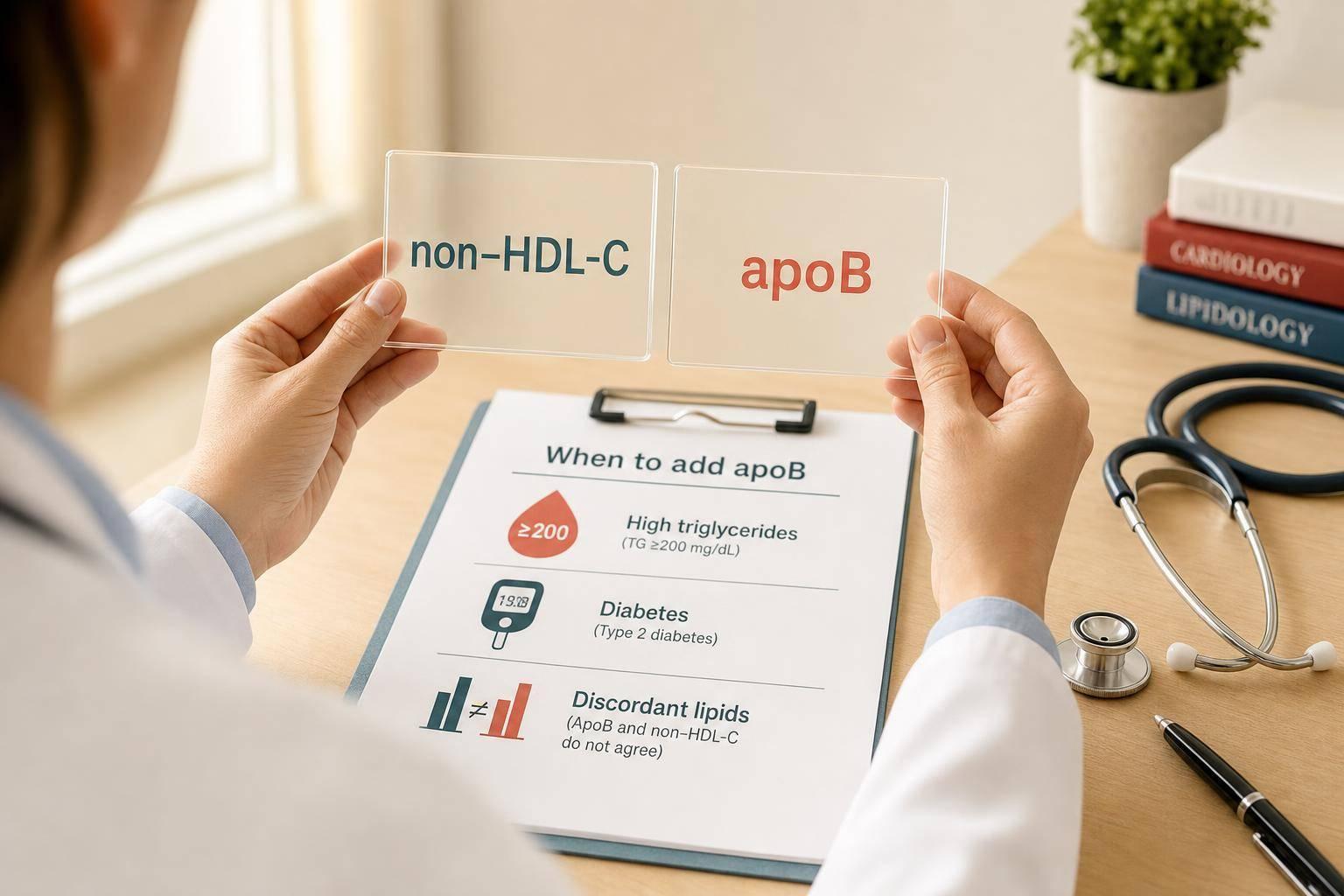
If I need one simple answer, it’s this: I start with non-HDL-C, and I add apoB when triglycerides are high, LDL-C looks “okay,” or the risk picture doesn’t fit the lipid panel.
Metabolic syndrome can double ASCVD risk, and it often comes with high triglycerides, low HDL-C, insulin resistance, and small cholesterol-poor LDL particles. That means LDL-C can look better than the particle burden actually is. In that setting:
- ApoB tells me how many atherogenic particles are in circulation
- Non-HDL-C tells me how much cholesterol those particles carry
- The two can disagree, especially when triglycerides are high
- Non-HDL-C is the easy first step because it comes from a standard lipid panel
- ApoB is the add-on test I use when the result could change treatment
If I’m looking at a patient with triglycerides ≥200 mg/dL, diabetes, obesity, metabolic syndrome, or residual risk after LDL-C reaches goal, apoB can help show risk that non-HDL-C may not fully show.
Does ApoB Trump Non-HDL Measurements?
sbb-itb-7164bd9
Quick Comparison
| Marker | What I’m measuring | Best use | Main limit | Practical point |
|---|---|---|---|---|
| ApoB | Particle number | Sorting out discordance and residual risk in insulin resistance or high triglycerides | Needs a separate blood test | Often costs about $25–$70 in the U.S. |
| Non-HDL-C | Cholesterol in all atherogenic particles | First-pass risk review and routine follow-up | May understate risk when particles are small and cholesterol-poor | Included in a standard lipid panel |
A few numbers shape how I read these tests:
- ApoB ≥130 mg/dL is listed by ACC/AHA as a risk-enhancing factor
- ApoB treatment goals are often around <70 mg/dL for high-risk patients and <60 mg/dL for very high-risk patients
- Matching non-HDL-C goals are often about 100 mg/dL and 85 mg/dL
One more point: nonfasting testing is usually fine for both markers, but if triglycerides are 400 mg/dL or higher, I’d want a fasting repeat lipid panel.
So the short version is simple: non-HDL-C is my low-cost starting point; apoB is my tie-breaker when particle-cholesterol mismatch is likely. The rest of the article explains when that mismatch matters and how I would use each result in day-to-day U.S. practice.
What ApoB and Non-HDL-C Each Measure
ApoB: A Count of Atherogenic Particles
ApoB measures the number of atherogenic particles in the blood. Each major atherogenic particle - LDL, IDL, VLDL and its remnants, and lipoprotein(a) - usually carries one apoB100 molecule. So when a lab reports apoB, it’s basically reporting how many of those particles are circulating.
That one-particle, one-apoB link is especially helpful in metabolic syndrome. Insulin resistance pushes the liver to make more VLDL and shifts LDL toward smaller particles that carry less cholesterol. So you can end up with a lot of particles, even when each particle holds only a small amount of cholesterol. In that setting, apoB gives a better read on particle burden.
Non-HDL-C looks at that same risk pool from a different angle.
Non-HDL-C: Total Cholesterol in Atherogenic Particles
Non-HDL-C measures cholesterol content, not particle number. It’s calculated by subtracting HDL-C from total cholesterol, and it reflects the cholesterol carried by all atherogenic lipoproteins. Because it includes cholesterol from triglyceride-rich lipoproteins and remnants - not just LDL-C - it tells you more than LDL-C alone when triglycerides are high.
Why ApoB and Non-HDL-C Can Diverge
Both markers deal with the same atherogenic lipoprotein pool, but they answer different questions. ApoB asks how many particles are present. Non-HDL-C asks how much cholesterol those particles carry. In metabolic syndrome, those answers don’t always line up.
Two patients can have the same non-HDL-C and still have very different particle burdens.
| Pattern | What It Suggests |
|---|---|
| High apoB, acceptable non-HDL-C | Many cholesterol-poor particles; common in insulin resistance, obesity, metabolic syndrome |
| High non-HDL-C, relatively lower apoB | Fewer particles carrying more cholesterol per particle |
| Both elevated | High particle count and high cholesterol burden |
When these two markers don’t match, it isn’t a lab mistake. It shows real differences in lipoprotein size and composition. And that gap is the main issue when deciding which marker gives a better read on risk in metabolic syndrome.
Once the measures are clear, the next step is figuring out which one adds more clinical value.
ApoB vs Non-HDL-C: Strengths, Limits, and Direct Comparison
In metabolic syndrome, apoB and non-HDL-C answer two different questions. ApoB tells you about particle count. Non-HDL-C tells you about cholesterol load. That gap matters most when triglycerides are high and each particle carries less cholesterol than usual. In those cases, the issue isn't only what each marker measures. It's whether that extra detail changes what you do next.
| Feature | ApoB | Non-HDL-C |
|---|---|---|
| What it measures | Atherogenic particle count | Cholesterol carried by atherogenic lipoproteins |
| Direct particle-count signal | Direct | Indirect |
| Direct cholesterol signal | No | Direct |
| Main drawback | Requires a separate assay and can miss particle burden when particles are cholesterol-poor | Can underestimate particle burden when particles are small and cholesterol-depleted |
| Best use | Clarifying residual risk and discordance | Practical secondary target for routine monitoring |
Once those measurement differences are clear, the day-to-day issues come into focus: testing workflow, cost, and how easy each result is to interpret.
When ApoB Adds Useful Information
In metabolic syndrome with elevated triglycerides, apoB can show residual particle burden even when non-HDL-C looks only mildly abnormal.
That's why apoB is often worth considering in people with metabolic syndrome, type 2 diabetes, obesity, elevated triglycerides, suspected small, dense LDL predominance, or residual risk despite LDL-C and non-HDL-C reaching treatment goals. Recent guidance also points to apoB as a useful option for assessing residual ASCVD risk after LDL-C and non-HDL-C goals have been met, especially in people with elevated triglycerides or established cardiovascular disease.
Put simply: if the standard numbers look decent but the clinical picture still feels off, apoB can help explain why.
When Non-HDL-C Is Often Enough
Non-HDL-C has a big practical edge. It comes from the standard lipid panel, needs no separate assay, and doesn't add another lab step. The National Lipid Association has noted that non-HDL-C generally requires no extra cost compared with a routine lipid profile, unlike apoB, which requires a separate laboratory measurement.
It also holds up better than calculated LDL-C when triglycerides are elevated because it includes cholesterol in LDL and triglyceride-rich remnant particles that LDL-C can miss. For routine screening, follow-up over time, or cases where the overall ASCVD risk picture is already clear, non-HDL-C is a strong and well-supported choice. That edge shows up most in routine follow-up and broad risk monitoring, where simplicity matters.
Limits That Apply to Both Markers
Neither marker gives the full picture by itself. Non-HDL-C can understate particle burden when LDL particles are small and cholesterol-depleted. ApoB does not show how much cholesterol each particle carries, and it does not sort out every cause of dyslipidemia.
So these markers work best as part of a bigger picture, alongside LDL-C, triglycerides, glycemia, blood pressure, kidney function, smoking history, and family history. Neither one replaces full ASCVD risk assessment.
The next question is which marker is easiest to order, interpret, and pay for in routine U.S. practice.
Testing, Cost, and Interpretation in U.S. Practice
After you compare what each marker measures, the next step is more practical: how these tests fit into U.S. ordering patterns, fasting rules, cost, and follow-up.
Testing Workflow and Fasting Requirements
Non-HDL-C comes from a standard lipid panel. ApoB is different. It has to be ordered as its own lab test, and it's often billed under CPT code 82172.
For routine risk assessment, nonfasting testing is usually fine. Non-HDL-C works especially well in the nonfasting state because total cholesterol and HDL-C don't change much after a meal. ApoB can also be checked without fasting since it uses a direct assay.
That said, fasting still matters in a few settings. If a nonfasting triglyceride result comes back at or above 400 mg/dL, the ACC/AHA guideline advises repeating the lipid panel while fasting. A fasting sample also makes sense when triglycerides stay high, when a genetic lipid disorder is on the table, or when treatment decisions depend on a steadier LDL-C starting point.
Once the blood draw itself is simple, the next hurdle is often cost.
Cost and Insurance Coverage
Non-HDL-C is already part of the lipid panel, so there is no extra test to add. ApoB is separate, and cash prices often fall around $25 to $70. The exact price depends on the lab, the health plan, the region, and whether apoB is packaged into a larger cardiovascular panel.
Insurance coverage for apoB is not consistent across U.S. health plans. Payment may depend on the insurer's policy, the reason documented in the chart, whether the lab is in-network, and whether the patient has met a deductible. A clear reason for testing - such as hypertriglyceridemia, metabolic syndrome, diabetes, or residual risk despite LDL-C improvement - may help support coverage, but it still does not promise payment. It's smart to check with both the plan and the lab before ordering.
Cost matters, of course. But the bigger issue in clinic is simpler: when does apoB tell you something non-HDL-C doesn't?
Interpreting Results by Clinical Scenario
The best way to read these markers is through risk-based targets, not one-size-fits-all cutoffs. The 2018 ACC/AHA guideline lists apoB at or above 130 mg/dL as a risk-enhancing factor. The National Lipid Association uses lower goals for patients at higher risk. For example, apoB targets are about 70 mg/dL for high-risk patients and about 60 mg/dL for very high-risk patients, with matching non-HDL-C goals of 100 mg/dL and 85 mg/dL.
In day-to-day care, the key question isn't which marker wins in every situation. It's which one is more likely to change what you do next.
| Clinical scenario | Testing and interpretation approach |
|---|---|
| Borderline LDL-C with metabolic syndrome features | ApoB can help sort out particle burden, while non-HDL-C stays the lower-cost default. If LDL-C looks only mildly off, but obesity, hypertension, hyperglycemia, low HDL-C, and high triglycerides point to more risk, apoB may show a particle count that the standard lipid panel doesn't fully show. |
| Elevated triglycerides | Start with non-HDL-C and add apoB when particle burden is still unclear. ApoB testing is especially supported when triglycerides are at least 200 mg/dL. |
| Diabetes or obesity | Both markers can help flag risk that LDL-C alone may understate. ApoB becomes more useful when triglycerides are high or when treatment choices are still uncertain after looking at LDL-C and non-HDL-C. |
| Residual risk after LDL-C improvement | When LDL-C is at goal but triglycerides stay high, or when the patient also has metabolic syndrome, diabetes, or ASCVD, apoB may help gauge residual atherogenic particle burden and support stronger treatment. |
| Treatment monitoring | Repeat the same marker under similar conditions and give the treatment enough time to work. Non-HDL-C is handy for routine follow-up. ApoB fits best when particle number is likely to add more than LDL-C and non-HDL-C alone. |
Neither marker should stand alone. Acute illness, large shifts in diet or weight, alcohol use, medications, and uncontrolled metabolic disease can all affect the result. If one result looks out of character, it's worth checking again before making a move. And whichever marker you use, it needs to be read in the context of the patient's full risk picture, including blood pressure, glycemic status, kidney function, smoking history, family history, and ASCVD history.
Choosing the Right Marker: A Decision Framework and Key Takeaways
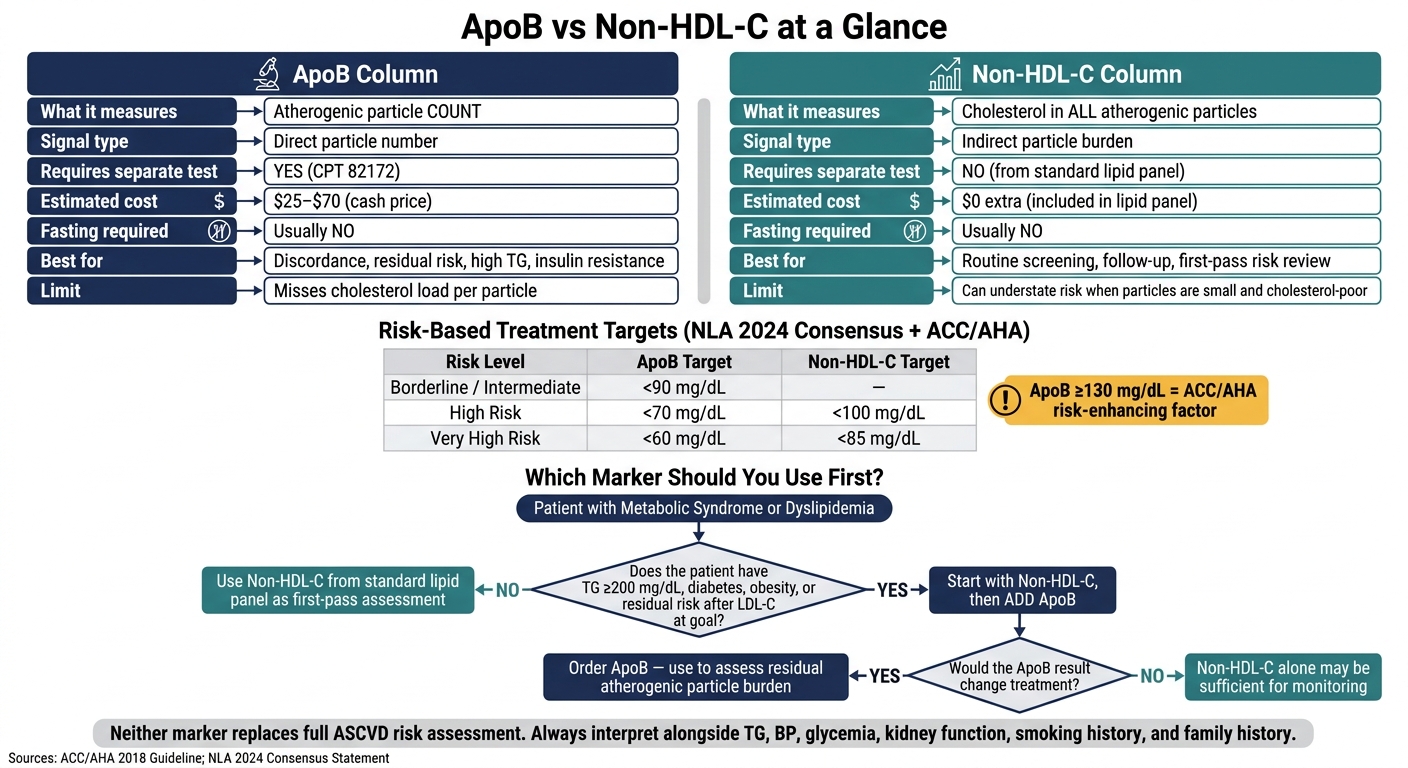
ApoB vs Non-HDL-C: Which Lipid Marker to Use in Metabolic Syndrome
A Step-by-Step Approach for Metabolic Syndrome
Once you get past test access and cost, the next question is pretty simple: which marker should you use first?
Start with non-HDL-C from a standard lipid panel. It’s easy to get and gives you a solid first read on atherogenic cholesterol. Then bring in apoB when metabolic syndrome, diabetes, obesity, or high triglycerides make particle-cholesterol mismatch more likely. This matters most in hypertriglyceridemia and insulin resistance, where cholesterol levels can look fine even when particle burden is still high.
ApoB makes the most sense to order when:
- Triglycerides are ≥200 mg/dL
- LDL-C appears controlled, but residual risk still seems to be on the table
- The result would change treatment
Current AHA/ACC guidance backs selective apoB testing for residual-risk assessment after LDL-C or non-HDL-C goals have been met. Once you have the result, step back and reassess treatment intensity using the full clinical picture. Don’t lean on either marker alone.
This becomes most useful when apoB and non-HDL-C don’t line up. If they disagree, give more weight to apoB when you’re judging residual particle burden in metabolic syndrome.
For day-to-day care, the easiest rule is this: start with non-HDL-C, then move to apoB when discordance could affect the next step.
Key Takeaways for Prescribers
Non-HDL-C reflects atherogenic cholesterol. apoB reflects atherogenic particle number. In metabolic syndrome, that difference can shape which test matters more, especially when hypertriglyceridemia or insulin resistance makes particle burden the bigger issue.
The National Lipid Association's 2024 consensus uses apoB targets of <90 mg/dL for borderline/intermediate risk, <70 mg/dL for high risk, and <60 mg/dL for very high risk. These are treatment targets, not diagnostic cutoffs.
FAQs
Why would apoB be high if my LDL-C is normal?
ApoB can be high even when LDL-C looks normal. Here's why: LDL-C measures how much cholesterol is inside LDL particles, while apoB shows the number of atherogenic particles.
That difference matters.
In metabolic syndrome, small, dense LDL particles are often more common. These particles may not push LDL-C up by much because they carry less cholesterol per particle. But each particle still has one ApoB molecule.
So you can end up with normal-looking LDL-C and higher apoB at the same time. In plain English, the cholesterol amount may seem fine, while the particle count tells a different story. And that can point to higher cardiovascular risk.
When should I ask for apoB instead of relying on non-HDL-C?
Ask for apoB when you need a more precise read on atherogenic particle burden, not just cholesterol content. That matters most when triglyceride-rich lipoproteins or metabolic syndrome patterns make non-HDL-C a less exact signal.
In practice, clinicians often order it with a baseline lipid panel. They may also repeat it during follow-up when non-HDL-C doesn’t clearly show residual risk.
Do I need to fast before checking apoB or non-HDL-C?
Yes. Before a lipid panel that includes apoB and non-HDL-C, fast for 8 to 12 hours and drink only water.
For the most accurate results, schedule the blood draw between 7:00 AM and 10:00 AM. Also stop biotin supplements at least 72 hours beforehand, since biotin can interfere with some lab tests.