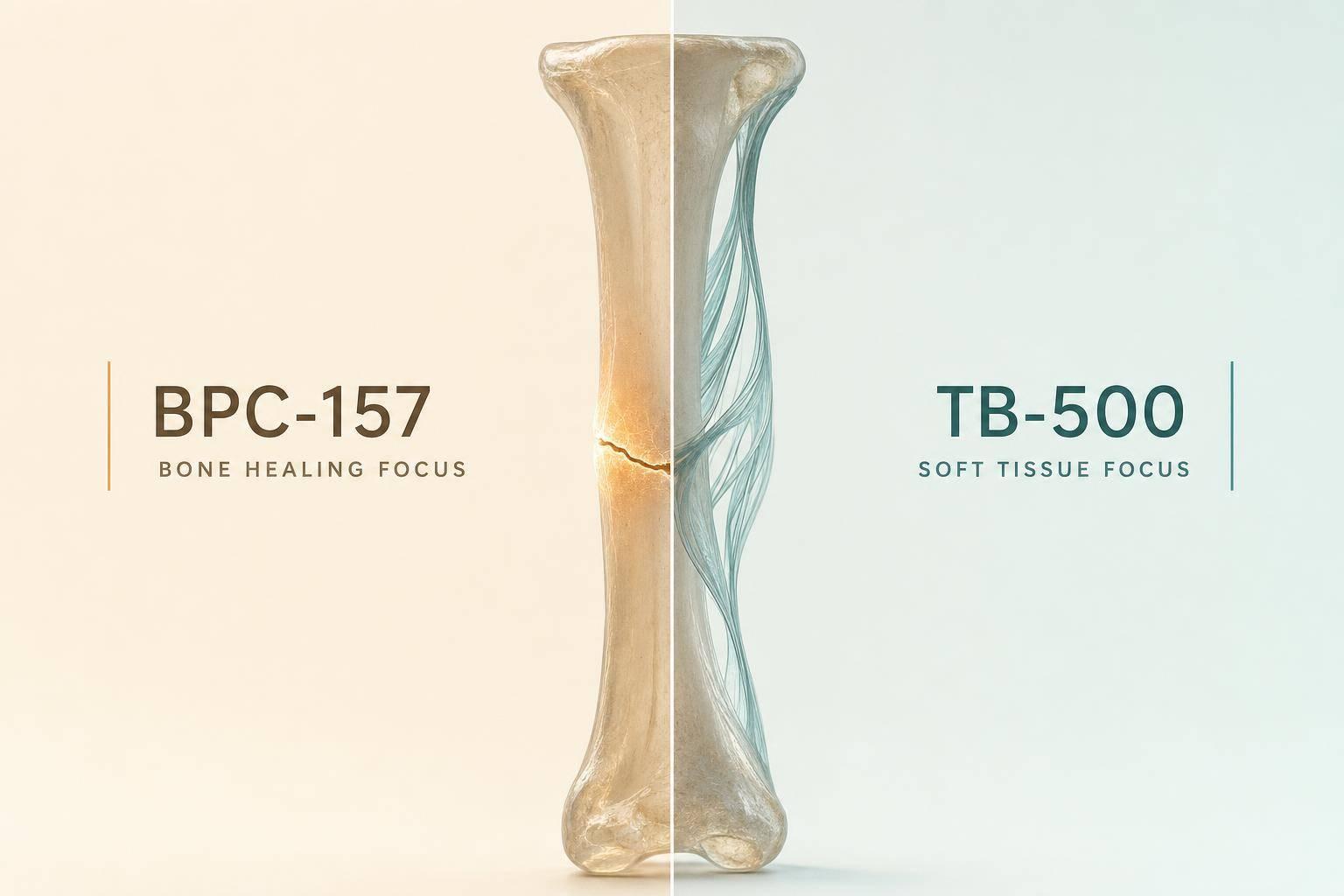
If you want the short answer: neither BPC-157 nor TB-500 has human trial proof that it improves bone fracture healing. From what I see in the article, BPC-157 has more direct animal bone data, while TB-500 is tied more to soft-tissue repair around a fracture. That means neither one has been shown to improve outcomes like radiographic union, time to weight-bearing, nonunion risk, reoperation, or function in people.
Here’s the plain-English takeaway:
- BPC-157: more bone-focused in preclinical research
- TB-500: more indirect, with a soft-tissue angle
- Human evidence: no randomized fracture-healing trial for either peptide
- Regulatory status: neither is FDA-approved for fracture healing
- Clinical use: if discussed at all, it should be framed as investigational
- Standard fracture care still matters most: reduction, fixation or immobilization, imaging follow-up, rehab, nutrition, and risk-factor control
A few facts stand out:
- A 2025 review found 35 preclinical BPC-157 studies and 1 clinical study
- For TB-500, the article notes no identified human fracture studies
- In one mouse fracture model with full-length Tβ4, researchers reported a 31% increase in new-trabecular-bone fraction at 21 days - but that is not the same thing as TB-500 in people
- In a rat wound model, thymosin-beta-4-related data showed 42% faster dermal wound healing, which still does not prove faster bone union
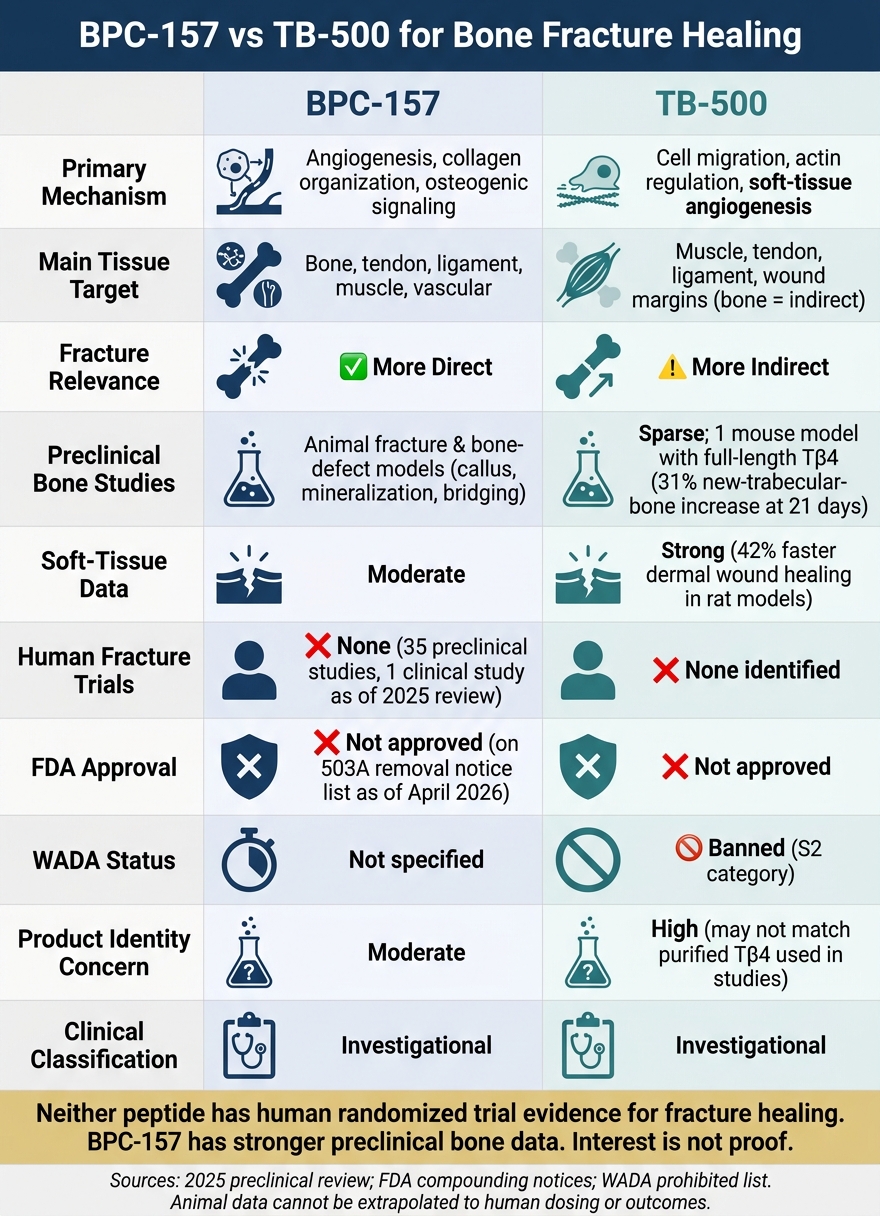
BPC-157 vs TB-500 for Bone Fracture Healing: Evidence Comparison
What Is the Wolverine Stack? BPC-157, TB-500 and the Evidence
sbb-itb-7164bd9
Quick Comparison
| Criteria | BPC-157 | TB-500 |
|---|---|---|
| Main angle | Bone and tissue repair | Soft-tissue repair around injury |
| Fracture relevance | More direct | More indirect |
| Best support | Animal bone-defect and fracture models | Animal soft-tissue data; limited bone data |
| Human fracture data | No high-quality trial | No identified human fracture studies |
| Product issues | Dose, route, formulation not validated | Added concern about product identity and match to Tβ4 studies |
| FDA approval | No | No |
My read: if you are comparing these two only for bone fracture healing, BPC-157 is the closer fit on theory, but neither has human proof for fracture outcomes. So the article’s main point is simple: interest is not proof, and stacking the two does not fix the evidence gap.
The rest of the article then walks through the animal data, mechanism claims, product-quality issues, charting steps, and the legal limits a U.S. clinician should review before even talking about use.
BPC-157: Bone-Specific Rationale and Current Evidence
Proposed Mechanism and Tissue Targets in Fracture Repair
BPC-157 is a 15-amino-acid peptide that has been studied in bone-injury models more directly than most recovery peptides. Researchers have proposed several ways it might affect fracture healing, including angiogenesis, inflammatory modulation, matrix remodeling, and osteoblast activity.
In lab and animal work, these effects have been linked to VEGF, VEGFR2, Akt, and eNOS signaling. That matters because fracture healing depends on blood vessel ingrowth early on, followed by callus formation, mineralization, and later remodeling. In plain terms, these are the kinds of pathways you’d expect to matter if something were going to help bone repair.
Still, biologically plausible is not the same as clinically proven. So while BPC-157 has a more direct connection to fracture repair than peptides aimed only at soft tissue, that does not mean it has been shown to improve fracture outcomes in people.
Preclinical Fracture and Bone-Defect Findings
The most relevant published data comes from rabbit segmental bone-defect models. In one study, researchers gave BPC-157 intramuscularly at 10 micrograms per kilogram and 10 nanograms per kilogram for 14 days, then looked at radiographic callus surface, microphotodensitometry, and quantitative histomorphometry.
The treated defects showed better callus-related measures and more organized bone formation. That included mostly lamellar bone instead of fibrous scar tissue. In some endpoints, results in this model were similar to local bone-marrow or grafting controls.
That sounds promising on paper. But there’s a catch: this was a specific animal defect model, not proof that BPC-157 works like grafting or marrow-based treatment in human care.
| Model | Intervention | Endpoint | Reported Finding | Key Limitation |
|---|---|---|---|---|
| Rabbit segmental bone defect | BPC-157 IM, 14 days | Radiographic callus, mineralization, histomorphometry | Improved callus measures; more lamellar bone vs. fibrous tissue; some endpoints similar to bone-marrow or grafting controls | Animal defect model; not evidence of efficacy in routine human fractures |
| Rat tibial fracture | BPC-157 vs. saline or untreated control | Callus formation, mineralization, mechanical recovery | Several preclinical reports describe increased callus development or improved healing-related outcomes | Rodent fracture biology and healing rates do not establish a human regimen |
| Laboratory/molecular models | BPC-157 exposure in cell systems | VEGF-related signaling, osteoblast activity, collagen or matrix markers | Findings support possible angiogenic and osteogenic pathways | Molecular changes may not translate into union, strength, or patient benefit |
Animal doses and routes are listed here only to show how the studies were set up. They should not be used to calculate a human protocol.
So the current preclinical picture supports interest. It does not support routine use in people with fractures.
Practical Limits for Clinicians
No adequately powered randomized controlled trial has shown that BPC-157 improves fracture union, weight-bearing, revision rates, or patient-reported function in humans. And the basics still aren’t settled for fracture use in people: route, dose, timing, duration, formulation, sterility, identity, and concentration all remain unvalidated.
That’s a big problem in practice. Fracture healing doesn’t happen in a vacuum. It’s shaped by fixation, smoking, diabetes, vascular disease, infection, corticosteroid use, osteoporosis, malnutrition, and fracture severity. With that many moving parts, it’s hard to argue that a peptide by itself could carry the load.
There’s also the regulatory side. BPC-157 is not FDA-approved for any human indication, and as of April 2026, it was included on an FDA removal notice list for 503A compounding, which affects access through standard compounding channels.
The practical read is pretty straightforward: BPC-157 has a more direct preclinical bone-repair rationale than most recovery peptides, but it has not met the bar for routine human fracture treatment.
TB-500 has much less direct bone evidence, so the next section shifts away from bone-specific data and toward an indirect tissue-repair rationale.
TB-500: Soft-Tissue Rationale, Bone Relevance, and Evidence Gaps
TB-500 is a commercial thymosin beta-4–related peptide, not the native protein. And that detail matters.
A commercial TB-500 product may not match the research material used in published studies. So when people point to thymosin beta-4 data, they’re often making a jump from one substance to another. That makes TB-500 an indirect option in fracture recovery, not a bone-targeted one.
Its main rationale sits with the soft tissues around a fracture: muscle, fascia, tendon, ligament, skin, and wound margins. If those tissues recover better, the area around the fracture may function better too. But that is not the same thing as proving faster bone union.
Direct Bone Evidence Versus Adjacent Tissue Evidence
The core issue is simple: does better soft-tissue healing lead to better fracture union? Right now, that link hasn’t been shown in people.
| Evidence Area | Finding | Key Limitation |
|---|---|---|
| Mouse fracture model (Tβ4) | Improved callus histomorphometry at 21 days, including a 31% increase in new-trabecular-bone fraction | Animal study; full-length Tβ4, not a standardized TB-500 product |
| Adjacent soft-tissue evidence | Experimental rat wound models reported 42% faster dermal wound healing; preclinical tendon and ligament repair data exist | Wound closure and tendon repair are not bone consolidation; different tissue biology limits extrapolation |
| Human fracture outcomes | No completed, well-controlled human fracture trials | Cannot estimate benefit, dose, timing, or risk |
That table tells the story pretty well. There’s a signal in animal work with full-length Tβ4. There’s also some support from wound, tendon, and ligament research. But bone healing is its own process. Skin closing faster doesn’t automatically mean a fracture knits together sooner.
So TB-500 remains investigational for fracture healing.
Clinical and Product Standardization Limits
Another problem is product matching. A study that used purified Tβ4 does not automatically support a commercial TB-500 product if its amino-acid sequence, purity, concentration, or stability is different. In plain English: if the material isn’t the same, the results can’t just be copied over.
There’s also no fracture-specific monitoring protocol and no validated human dosing schedule for this use. That leaves basic clinical questions unanswered, including how much to use, when to use it, and what to watch during treatment.
Safety is still only partly mapped out. The same pro-angiogenic and cell-migration effects that make TB-500 sound useful in repair also create concern in patients with active malignancy. Why? Because tumor growth and spread can use those same vascular and migratory pathways. Pregnancy and breastfeeding safety have not been studied. TB-500 is not FDA-approved for any indication, and the World Anti-Doping Agency (WADA) bans it under the S2 category.
For fracture healing, those limits keep TB-500 in the investigational category. That becomes even more important when TB-500 is compared with BPC-157 for fracture-specific use.
BPC-157 vs TB-500: Bone Healing Relevance, Combination Use, and Evidence Quality
BPC-157 has the stronger preclinical bone signal. TB-500 is still more of an indirect soft-tissue option.
The table below separates direct bone data from indirect soft-tissue data.
Side-by-Side Comparison of BPC-157 and TB-500
| Domain | BPC-157 | TB-500 |
|---|---|---|
| Mechanism and tissue targets | Angiogenesis, tissue repair, collagen organization, and possible osteogenic signaling; targets include bone, tendon, ligament, muscle, gastrointestinal, and vascular tissues | Thymosin-beta-4-related cell migration, angiogenesis, and actin regulation; targets are primarily soft tissue - muscle, tendon, ligament, wound, and vascular; bone relevance is indirect |
| Direct fracture evidence | Animal fracture and bone-defect models report more callus, mineralization, bridging, and mechanical strength | Direct bone evidence is sparse; most support comes from adjacent soft-tissue models. Any fracture benefit would be indirect and unproven |
| Human fracture evidence | No high-quality human fracture trial | No identified human fracture studies |
| Route and formulation uncertainty | Animal routes and doses vary substantially and cannot be converted into human regimens | Product identity, route, formulation, and relationship to thymosin beta-4 may vary, creating additional uncertainty |
| Safety uncertainty | Long-term safety, immunogenicity, drug interactions, and possible pro-angiogenic risks remain uncharacterized | Same uncertainties apply, with added concern about product standardization and labeling |
| Chart documentation role | Document as investigational; record evidence discussed, consent, product details, and objective fracture endpoints | Document the same elements; do not rely on commercial summaries as primary evidence; clearly separate soft-tissue rationale from any unsupported bone-union claim |
A 2025 review found 35 preclinical BPC-157 studies and one clinical study, which shows how thin the human evidence still is. No human TB-500 fracture studies have been identified. Those numbers do not support a treatment claim for fracture healing.
Combination Use and Stacking with Other Peptides
Stacking doesn't fix the evidence problem for fracture union. Right now, combination use is still hypothetical. There are no clinical data showing better union, function, or safety than either peptide alone.
That point matters. The key outcome is union, not just soft-tissue repair around the fracture site. A treatment can sound promising on paper, but if it doesn't improve fracture healing itself, the claim falls apart.
Using more than one investigational agent at the same time also makes interpretation messy. If a patient improves, it's hard to know which compound helped. If something goes wrong, it's just as hard to know which one caused it. Consent gets more complicated too, because each product brings its own unknowns. This complexity underscores the need for a solid clinical overview of peptide therapy before integration into practice.
If combination use is documented, each product should be listed separately with its own rationale. It should not be recorded as a generic "peptide stack."
How to Assess the Strength of Claims
For any claim, ask a simple set of questions: what endpoint, in what model, at what dose, against what comparator?
Use this hierarchy when weighing any claim about either peptide:
| Evidence level | Type | Relevance to fracture claims |
|---|---|---|
| 1 | Human randomized or controlled trials | No established fracture-healing trials for either peptide |
| 2 | Prospective observational studies | Limited; useful for real-world signals but vulnerable to confounding |
| 3 | Case reports and case series | Signal detection only; not proof of efficacy |
| 4 | Systematic reviews of animal studies | Helpful for consistency; still indirect for human outcomes |
| 5 | Individual animal fracture or bone-defect models | Biological plausibility and hypothesis generation |
| 6 | In-vitro studies | Cellular effects only; does not confirm whole-organism healing |
| 7 | Clinician summaries, testimonials, commercial articles | Useful for identifying claims to investigate; inadequate as primary evidence |
When a claim points to an animal study, dig a little deeper. What species was used? What injury model? What dose and route? What comparator? And what was the actual endpoint - callus volume, mineralization, cortical bridging, mechanical strength, or weight-bearing?
That distinction is a big deal. A larger callus in a rodent model does not automatically mean faster radiographic union in a human patient.
Holding every claim to that standard - whether it's about BPC-157, TB-500, or both together - is the most practical tool a clinician has. It's also the standard that should be documented before any investigational discussion.
The next step is documentation: record the investigational rationale, product details, and fracture endpoints before any use.
Documentation, Regulatory Boundaries, and Clinical Takeaways
Required Documentation and Safety Review
Once investigational use comes up, documentation moves to the front of the line. The chart should note fracture location, pattern, open or closed status, injury date and mechanism, imaging, fixation or immobilization, weight-bearing limits, rehab plan, and delayed-union risk factors such as smoking, diabetes, malnutrition, vascular disease, corticosteroids, and high-energy injury.
If peptide use is under consideration, write down the exact product identity, source pharmacy, lot number, concentration, route, schedule, beyond-use date, and certificate of analysis. Skip vague labels like "healing peptide." The record should also state current FDA status and product-quality concerns, including immunogenicity, impurities, and uncertain product identity.
After product identity is logged, document consent and monitoring terms. Consent should be plain and direct: these are not FDA-approved treatments for fracture healing, and product quality may differ with compounded preparations. The chart should also note that any improvement may reflect normal healing or rehabilitation rather than the peptide itself.
Before treatment starts, set stop criteria in advance. That includes suspected infection, systemic allergic reaction, worsening alignment, neurovascular symptoms, or product-quality concerns.
Predefine the endpoints too, such as:
- Pain score
- Weight-bearing tolerance
- Range of motion
- Scheduled radiographic healing review
It also helps to share a short summary with orthopedics and rehab. Document peptide use as adjunctive, and do not change loading limits without orthopedic clearance. Check current federal and state compounding rules before prescribing. Online availability or pharmacy marketing is not proof of legality.
Conclusion: What the Current Evidence Supports
With the paperwork and legal boundaries in place, the practical takeaway is straightforward: BPC-157 has the stronger preclinical bone rationale, while TB-500 is more indirect. Neither has validated human fracture-healing evidence, and combined use is still unsupported by validated clinical data.
FAQs
Why is BPC-157 considered more relevant to bone healing than TB-500?
BPC-157 tends to get more attention for bone healing because preclinical research shows a more consistent upside in musculoskeletal recovery, including fracture models.
Why does that matter? Bone repair depends heavily on blood vessel growth at the injury site and organized collagen formation. Those are two areas where BPC-157 appears to play a direct role. That makes it especially relevant for bone repair and tendon-to-bone healing.
TB-500 is also used for tissue repair, but the published effects tied to it are broader and more body-wide. Its main focus is usually cell migration and anti-inflammatory activity, rather than the more localized repair processes linked with BPC-157.
Can either peptide shorten fracture healing time in humans?
There’s no clinical proof that BPC-157 or TB-500 shortens fracture healing time in humans.
Animal research suggests that BPC-157 may help speed bone and soft-tissue repair. But that finding has not been confirmed in controlled human trials. For TB-500, human research on fracture healing is either extremely limited or not there at all.
That line matters. Preclinical results can look promising, but they are not the same as proven human outcomes. Clinicians should keep that distinction clear, especially since human safety data and dose-response data are still unresolved.
What should clinicians document before discussing these peptides?
Clinicians should document informed consent in plain language. That means clearly spelling out the gap between preclinical findings and human data, while also noting that BPC-157 and TB-500 are investigational and not FDA-approved. The record should cover material risks, other treatment options, and what the patient can reasonably expect over time.
The chart should also include a solid baseline before treatment starts: imaging, physical exam findings, and labs such as CBC, CMP, inflammatory markers, and nutrient levels. On top of that, clinicians should record the peptide source, the 503A pharmacy name, lot number, Certificate of Analysis, and the patient’s stated understanding that this therapy is being used off-label.