
I start with one rule: use 503A for a named patient; consider 503B for office stock where permitted. Before placing either order, I check the exact peptide’s eligibility, the compounder’s status, and the regulatory landscape and laws in each state involved.
Neither pathway makes a compounded peptide FDA-approved. FDA registration alone does not establish product eligibility or compliance.
Quick Comparison
| Check | 503A | 503B |
|---|---|---|
| Ordering | Patient-specific prescription, with limited advance compounding allowed | Office-stock or patient-specific orders |
| Clinic use | For the named patient - not unrestricted inventory | Office inventory and administration where permitted |
| Federal oversight | Exempt from CGMP requirements only if all 503A conditions are met | FDA registration, CGMP requirements, and inspection |
| Peptide eligibility | Check ingredient rules, commercial-copy limits, and shortage status | Check the clinical-need bulks list or shortage pathway, plus commercial-copy limits |
| Interstate supply | Check the statutory 5% limit and FDA’s current enforcement position | No equivalent 503A percentage cap; state permissions still apply |
| Records | Link prescribing, dispensing, and treatment records | Track receipt, storage, lots, administration, waste, and recalls |
My next step is to <u>document the legal basis before ordering</u>. That includes dated FDA sources, state permissions, product quality records, and any patient-specific rationale required. I also review take-home dispensing separately and repeat these checks when the peptide, supplier, route, or destination changes.
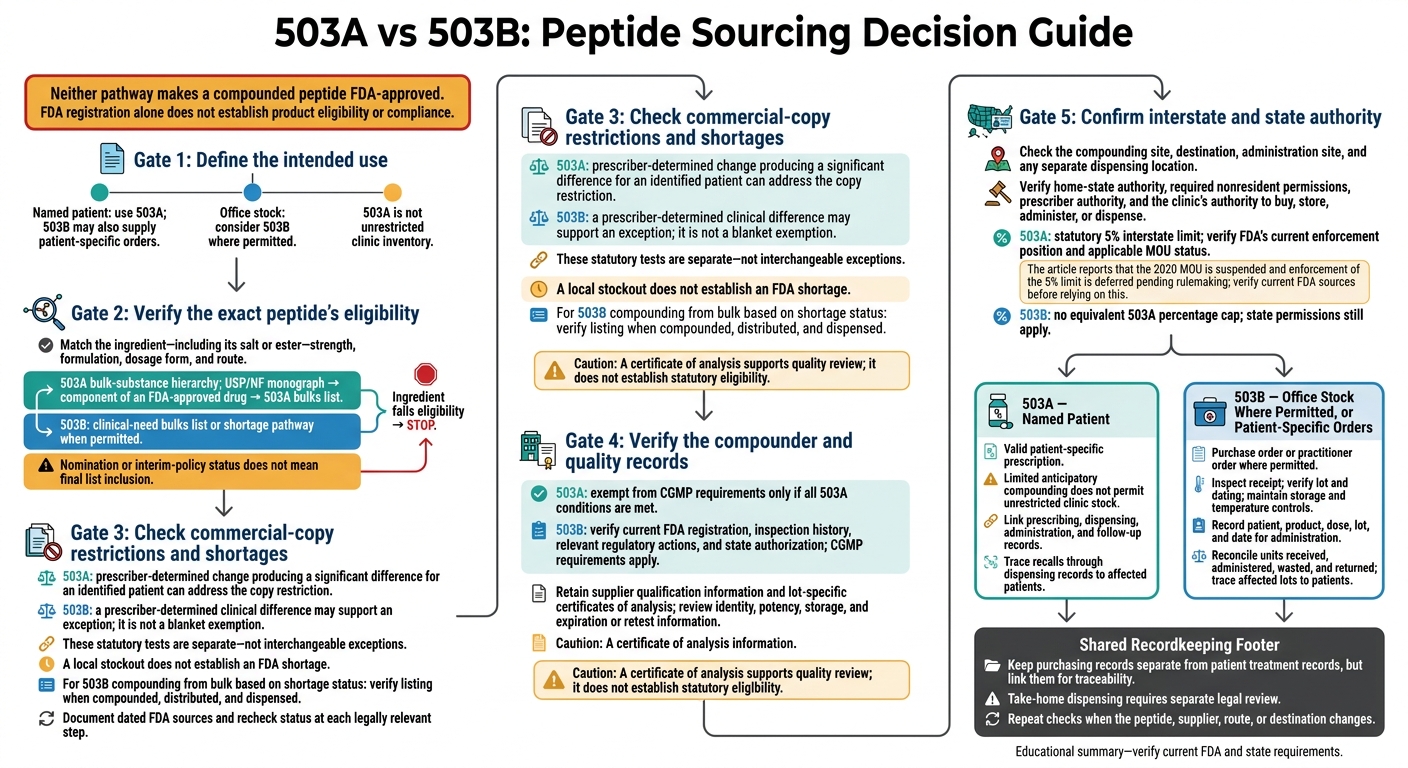
503A vs 503B: Peptide Sourcing Decision Guide
IPS Webinar | 503A Pharmacies vs. 503B Outsourcing
sbb-itb-7164bd9
Prescription Requirements and Practice Workflows
Keep purchasing records separate from patient treatment records. For peptide therapy, the legal distinction shapes the workflow: 503A requires patient-specific prescribing, while 503B requires inventory control and separate administration records.
| Workflow step | 503A responsibilities | 503B responsibilities | Documentation |
|---|---|---|---|
| Clinical evaluation | Assess the named patient’s suitability for compounded treatment | Evaluate each patient before administration | Assessment and consent, when required |
| Formulation selection | Specify the patient’s formulation and regimen | Match stocked product to the treatment plan | Clinical rationale |
| Ordering | Send a valid patient-specific prescription | Submit a purchase order or practitioner order where permitted | Prescription or order |
| Receipt | Coordinate patient-specific delivery | Inspect shipment and verify lot and dating | Receiving log |
| Storage | Follow pharmacy labeling and handling instructions | Maintain controlled storage and temperature monitoring | Storage log |
| Administration | Record clinic administration linked to the prescription | Record patient, product, dose, lot, and date | Medication administration record with lot and date |
| Follow-up | Reassess the patient and authorize refills | Reorder inventory based on demand and reassess each patient separately | Follow-up note |
| Recall tracing | Identify and notify affected patients through dispensing records | Trace affected lots to patients | Recall log |
503A: Prescribe for a Named Patient
The prescription should name the patient and specify the drug, concentration, dosage form, dose, route, frequency, quantity, and refills. Confirm ingredient eligibility with the pharmacy. Keep a dated record of your review, including the FDA sources used to determine eligibility. Coordinate delivery, counseling, storage instructions, and refill authorization.
When commercial-copy restrictions apply, document the comparable commercial product, the patient-specific problem, the requested change, and the prescriber’s determination that the change produces a significant difference for that patient. Share this information with the pharmacy as needed. A general preference for compounded medication does not meet the patient-specific determination requirement.
Limited anticipatory compounding may let a pharmacy prepare limited quantities before receiving prescriptions, provided it has a documented history of valid prescriptions and an established relationship. Confirm the pharmacy’s basis for preparing medication in advance. This allowance does not permit unrestricted clinic stock.
503B: Order Office Stock and Record Administration
Before ordering peptide office stock, compare expected demand with product dating. Verify the facility’s current FDA registration, inspection history, relevant regulatory actions, and state authorization. Document the product and quality information provided, and set aside damaged or temperature-compromised shipments. FDA registration is not FDA approval or a guarantee of compliance.
Reconcile units received, administered, wasted, and returned. Maintain a recall process that tracks products by lot. Take-home dispensing requires a separate legal review.
Neither workflow establishes peptide eligibility: each peptide must still meet commercial-copy and bulk-substance rules.
Peptide Eligibility, Commercial Copies, and Shortages
Once the workflow is set, check whether the exact peptide can legally be compounded.
Legal eligibility, clinical fit, and quality control are separate checks. A peptide may suit a patient’s needs but still be unlawful to compound. This distinction is critical when understanding peptide therapy from a clinical and regulatory perspective. Testing cannot fix that eligibility problem.
How Commercial-Copy Rules Differ
| Issue | 503A | 503B |
|---|---|---|
| Copy restriction | Restricts compounding drugs that are essentially copies of commercially available products. | Restricts compounding drugs that are identical or nearly identical to an FDA-approved drug, unless an applicable exception applies. |
| Patient-specific difference | A prescriber-determined change that produces a significant difference for an identified patient can address the copy restriction. | A prescriber-determined clinical difference may support an exception, but it does not provide a blanket exemption. |
| Shortage exception | FDA shortage status can change the copy analysis. Verify current conditions and timing. | The identical-or-nearly-identical exception depends on qualifying shortage status. When shortage status is the basis for compounding from bulk, the drug must be on the shortage list when compounded, distributed, and dispensed. |
| Supporting records | Product comparison, a patient-specific determination where applicable, and dated shortage evidence if relied upon. | Analysis of the applicable copy restriction, clinical-difference documentation where relevant, and shortage evidence at each required stage. |
For prescribers, this check determines whether they can source the desired formulation at all.
These statutory tests are separate - not interchangeable exceptions. Changing the concentration, excipient, dosage form, or administration method is not automatically enough. The record must link that change to a medically supportable patient need.
A local stockout does not establish an FDA shortage. When FDA resolves a shortage, check the live record again rather than assuming compounding remains permitted.
Which Bulk Ingredients Qualify Under Each Pathway
| Check | 503A | 503B |
|---|---|---|
| Bulk-substance pathway | Follow the 503A hierarchy: USP/NF monograph first, then a component of an FDA-approved drug, then the 503A bulks list. | Use the 503B clinical-need bulks list or the shortage pathway when permitted. |
| Ingredient standards | Meet applicable monograph and compounding standards. Verify the exact molecular form - not just the peptide name. | Meet applicable ingredient requirements. The facility must also meet 503B manufacturing requirements. |
| Source documentation | Verify the supplier’s identity and qualification where applicable, and retain a lot-specific certificate of analysis. | Verify the supplier’s identity and qualification where applicable, and retain a lot-specific certificate of analysis. |
| List status | Nomination, advisory recommendations, and interim-policy categories do not mean final inclusion on the 503A list. | Nomination or interim enforcement-policy status does not mean final inclusion on the 503B clinical-need list. |
If the ingredient fails this test, the workflow stops, regardless of patient need or office demand.
Ask the compounder to retain supplier qualification records, lot-specific identity and potency results, storage conditions, and expiration or retest information. A certificate of analysis supports quality review; it does not establish statutory eligibility. Research-use-only labeling, purity claims, and marketing language do not prove that an ingredient is suitable for human compounding.
Check Each Peptide Against Dated FDA Sources
Match each ingredient - including its salt or ester - strength, formulation, dosage form, and route against approved-product information, FDA shortage records, and the applicable bulks framework. Document the compounder’s legal basis and the date-specific FDA sources used.
Recheck shortage status before each legally relevant step. An earlier listing does not establish continued eligibility.
Use October 19, 2026, as the review date only if verification took place that day. Record each source’s title, date, access date, and finding. Distinguish final rules and lists from any interim policy relied upon separately.
Interstate Supply and State-Law Requirements
Once a peptide is eligible, the next question is where it can legally be shipped - and what that means for prescribing and ordering.
503A Shipping Limits vs 503B Distribution Rules
Neither pathway allows unrestricted nationwide fulfillment. A valid prescription or FDA outsourcing-facility registration does not replace destination-state authorization. The rules depend on the shipping state, the destination state, and whether the source operates under 503A or 503B.
| Issue | 503A pharmacy | 503B outsourcing facility | State-law checks |
|---|---|---|---|
| Interstate volume | A statutory 5% limit applies when the shipping state has not entered the applicable FDA MOU framework; verify how orders are counted. | No equivalent 503A percentage cap; applicable 503B conditions still apply. | Check shipping-state rules, MOU status, destination-state authorization, and any separate reporting or distribution limits. |
| Office stock | Patient-specific prescribing only. | May supply office stock under applicable requirements. | Confirm that the recipient may legally buy, hold, administer, or dispense the product. |
| Resale or transfer | Verify authority for the proposed transfer. | Generally, only the facility that compounded the drug may sell or transfer it, with exceptions for administration in a health care setting and dispensing under a valid prescription. | Review the actual transaction; office administration is not wholesale distribution or clinic-to-clinic transfer. |
FDA says the 2020 MOU is suspended, and enforcement of the 5% limit is deferred pending rulemaking. Before relying on interstate supply, verify FDA’s current position and how out-of-state volume is counted. Consult regulatory counsel when interstate distribution questions are unclear.
Federal status is only the first layer. State law also determines whether a transaction can proceed.
Check the Rules in Each State Involved
Before ordering or administering a peptide, check the laws in every state involved. Map the compounding site, destination, and administration site, plus any separate dispensing location. Verify home-state authority and any required nonresident pharmacy or outsourcing-facility permissions. For 503B sources, check FDA’s live registration list, too: federal registration does not establish state authorization.
Confirm that the prescriber has authority where the patient is located and meets applicable telehealth rules. If controlled-substance rules apply, separately verify DEA and state registration, prescribing rules, recordkeeping, and secure storage.
For clinics, focus on whether the receiving site may legally store, administer, or dispense the product. Verify the delivery address before each order, and keep prescription or purchase records linked to administration records.
Require labeling, storage instructions, beyond-use dates, lot tracking, and temperature control. Keep written procedures for delayed deliveries, damaged packages, temperature excursions, quarantine, and recalls.
Once federal and state requirements are met, match the sourcing path to the clinic’s workflow.
Conclusion: Match the Pathway to Your Practice
Match sourcing to the patient’s needs and your practice’s workflow. First, confirm eligibility, interstate authority, and state law. Then use this table to choose the right sourcing path.
| Decision point | 503A | 503B |
|---|---|---|
| Order type | Patient-specific prescription | Office-stock order or patient-specific prescription |
| Prescription required | Generally before compounding; required for patient-specific dispensing | Not necessarily before distribution; clinical orders may still be required |
| Clinic use | Administer medication to the named patient; not unrestricted office stock | Hold and administer office stock where permitted; take-home dispensing requires separate legal review |
| Required records | Prescription, counseling, dispensing, administration, and follow-up | Purchase order, lot and dating, storage, administration, adverse events, and patient-specific clinical documentation |
These sourcing rules do not establish approval of any peptide.
Final Prescribing and Ordering Checklist
Confirm the order type, ingredient eligibility, compounder status and state authorization, interstate authority, and who handles each recordkeeping task.
Repeat this check whenever you change the peptide, supplier, route, or destination state.
Educational Resources and Regulatory Checks
PeptidePrescriber provides licensed healthcare professionals with monographs, dosing protocols, calculators, injection guides, regulatory references, and pharmacy-agnostic sourcing guidance. Use it for education only, and verify every decision against current FDA, state, and legal requirements.
FAQs
Can my clinic use both 503A and 503B peptide sources?
Yes. Your clinic can use 503A pharmacies for patient-specific medications and 503B outsourcing facilities for office-stock inventory. Each operates under a separate regulatory framework.
For each prescription, document the clinical need. Confirm that the peptide is permitted under the applicable FDA Bulks List, and verify that the facility holds the licenses or registration required for the product you’re ordering. Check current FDA databases for the status of both the pharmacy and the peptide.
What should I do if a peptide’s shortage status changes?
Before prescribing, check the drug’s current status in the FDA Drug Shortage Database. Shortage-related compounding exceptions and enforcement discretion may end once the shortage is officially resolved.
If the shortage is no longer active, stop relying on those exceptions and follow current federal requirements. Check the official FDA record directly - manufacturer-reported availability alone does not confirm a change in regulatory status.
How can I verify a compounder’s peptide eligibility claims?
Verify legal status and quality credentials yourself rather than relying on marketing claims. For 503A pharmacies, confirm licensure with the appropriate state board of pharmacy. For 503B outsourcing facilities, check FDA registration and review inspection history for unresolved observations.
Request a lot-specific Certificate of Analysis that includes third-party HPLC purity testing, identity confirmation by mass spectrometry, and endotoxin and sterility results. PCAB or ACHC accreditation can serve as another quality indicator.