
Peptide therapy is growing fast in U.S. healthcare, but keeping up with research, regulations, and protocols is tough for clinicians. AI tools are stepping in to simplify complex tasks like evidence review, dosing calculations, and risk checks, making workflows faster and more accurate. However, these tools have their limitations and require human oversight.
Key Points:
- Efficiency Gains: AI cuts prescription prep time from 25–35 minutes to 3–5 minutes.
- Evidence Accuracy: AI grades research quality, but clinicians must verify recommendations.
- Regulatory Risks: FDA changes, like reclassifying peptides, mean regulatory compliance is critical.
- Human Oversight: AI assists but doesn’t replace clinical judgment.
AI can save time and reduce errors, but it’s not foolproof. Combining AI with clinician review ensures safer and more effective peptide therapy.
1. AI-Powered Research Assistants
Evidence Synthesis
Peptide research is scattered across multiple sources like PubMed, FDA databases, ClinicalTrials.gov, and even grey-market reports - areas that traditional references, such as UpToDate, often miss. AI-powered research assistants simplify this process by pulling data from all these sources at once, reducing the time spent on literature reviews by up to 80%.
What sets purpose-built peptide AI apart is its ability to grade evidence by strength, from robust human randomized controlled trials (RCTs) to animal studies. This distinction is critical: only 24% of commonly researched peptides are backed by strong human trial data, while 62% rely on limited human studies, and 14% are based solely on animal models. Without clear visual cues to separate these tiers, clinicians risk relying on protocols that lack solid evidence.
To avoid AI "hallucinations" (errors in generated information), professional-grade tools link every recommendation directly to primary sources like PubMed IDs (PMIDs). This allows clinicians to verify claims quickly. For example, in an audit of 102 peptide-related claims, 11 were found to be incorrect initially and required corrections. This highlights the importance of a verification layer, even with advanced AI.
"Finally, a reference that covers the compounds my patients are actually asking about. UpToDate has nothing on grey-market peptides." - Dr. Sarah M., Integrative Medicine
This rigorous approach to evidence synthesis also enhances dosing precision, a critical factor in clinical care.
Dosing and Administration Support
Manual reconstitution calculations can lead to errors, such as writing 5 mg/mL instead of 2.5 mg/mL. AI tools eliminate these mistakes by automating calculations and flagging mismatched units (e.g., mg vs. mcg, IU vs. mg) or improper handling before the clinician reviews them.
AI assistants also calculate injection frequency based on plasma half-life data from published studies, rather than relying on anecdotal practices. Take CJC-1295 as an example: without DAC, it has a plasma half-life of about 30 minutes, requiring 2–3 daily subcutaneous doses. With the DAC modification, the half-life extends to 6–8 days, shifting the protocol to once-weekly injections.
"The AI derives dosing frequency directly from each compound's measured half-life." - Peptidify
Risk Mitigation
Accuracy in dosing is only part of the equation - managing risks is equally important. AI tools designed for clinical use follow a Human-in-the-Loop (HITL) model. This means the system generates draft recommendations, but no clinical actions - like auto-populating prescriptions - can proceed without explicit clinician approval. Some platforms even disable the "Approve" button until the clinician has reviewed all flagged risks and supporting evidence.
These tools also include real-time monitoring by up to 14 autonomous AI agents, which continuously scan FDA databases, ClinicalTrials.gov, and FAERS for new safety signals and regulatory updates. Considering the FDA's rapid actions on peptides like BPC-157 and TB-500, this kind of monitoring is becoming essential.
Workflow Efficiency
AI-assisted workflows significantly cut down the time required for peptide prescriptions - from 25–35 minutes to just 3–5 minutes. Clinics with AI-integrated pharmacy systems report 60–70% fewer clarification callbacks from compounding pharmacies and 40–50% fewer treatment gaps due to automated refill management.
Platforms like PeptidePrescriber are leading this shift by combining research tools, reconstitution calculators, dosing protocols, and injection guides in one package. As LUKE Health explains:
"The goal is not to replace clinical judgment. It is to give clinicians better tools for the decisions that matter - protocol selection, dosing adjustments, patient assessment - by automating everything else." - LUKE Health
sbb-itb-7164bd9
2. Manual Clinical Workflows
Evidence Synthesis
When clinicians rely on manual methods for evidence synthesis, they face the challenge of piecing together information from scattered sources. Unlike AI-driven systems that streamline and prioritize reliable data, manual approaches often depend on incomplete or inconsistent evidence. For instance, only 24% of peptides are backed by strong randomized controlled trials (RCTs). Take BPC-157 as an example: despite being one of the most commonly prescribed peptides, it had no human RCTs available as of early 2025. This over-reliance on animal studies or anecdotal reports contributes to what experts call an "evidentiary deficit."
Dosing and Administration Support
Manual dosing processes are another area where errors can easily occur. Without automated tools, providers often resort to mental calculations to determine the correct dose, leading to mistakes in converting peptide mass, reconstitution volumes, or injection doses.
"Concentration errors on manual prescriptions happen because providers are doing math in their heads - converting between total peptide mass, reconstitution volume, and per-injection dose." - LUKE Health
Another frequent issue involves the choice of carrier solutions. For instance, multi-dose vials require bacteriostatic water, which contains benzyl alcohol as a preservative, instead of sterile water. Confusing the two can lead to contamination risks after the first use, especially in busy clinical settings.
Risk Mitigation
Manual safety checks often push the limits of human cognitive capacity, increasing the likelihood of missed contraindications.
"Human working memory is not designed for this task. The average physician can hold 5–7 discrete pieces of information in active working memory at any given time. A comprehensive contraindication check for a single peptide prescription might require reviewing 15–20 data points." - HolistiCare
Additionally, manual compliance checks tend to falter during periods of high patient volume or staff turnover. This can result in prescriptions being processed without proper authorizations, expired protocols going unnoticed, and incomplete audit trails when regulatory reviews are conducted. These gaps highlight why peptide therapy increasingly benefits from AI-enabled systems.
Workflow Efficiency
The inefficiencies of manual workflows are stark. On average, manual processes take 25–35 minutes per prescription and add an "integration tax" of $2,000–$4,800 per month. In comparison, AI-assisted tools can reduce this time to just 3–5 minutes. Manual refill processes also lead to 40–50% more treatment gaps than automated systems. These delays and inefficiencies emphasize the need for more streamlined and dependable solutions.
| Workflow Step | Manual Process | Key Limitation |
|---|---|---|
| Lab Review | Manual portal login; mental cross-referencing | High cognitive load, prone to missed values |
| Evidence Synthesis | Reviewing animal studies and case series | Recommendations often based on weak data |
| Dosing | Manual math for concentration and volume | Errors in concentration are most common |
| Documentation | Free-text notes in general EHRs | Difficult to audit; weak regulatory defense |
Revolutionizing Healthcare: The Future of Peptide Therapy and AI Integration
Pros and Cons
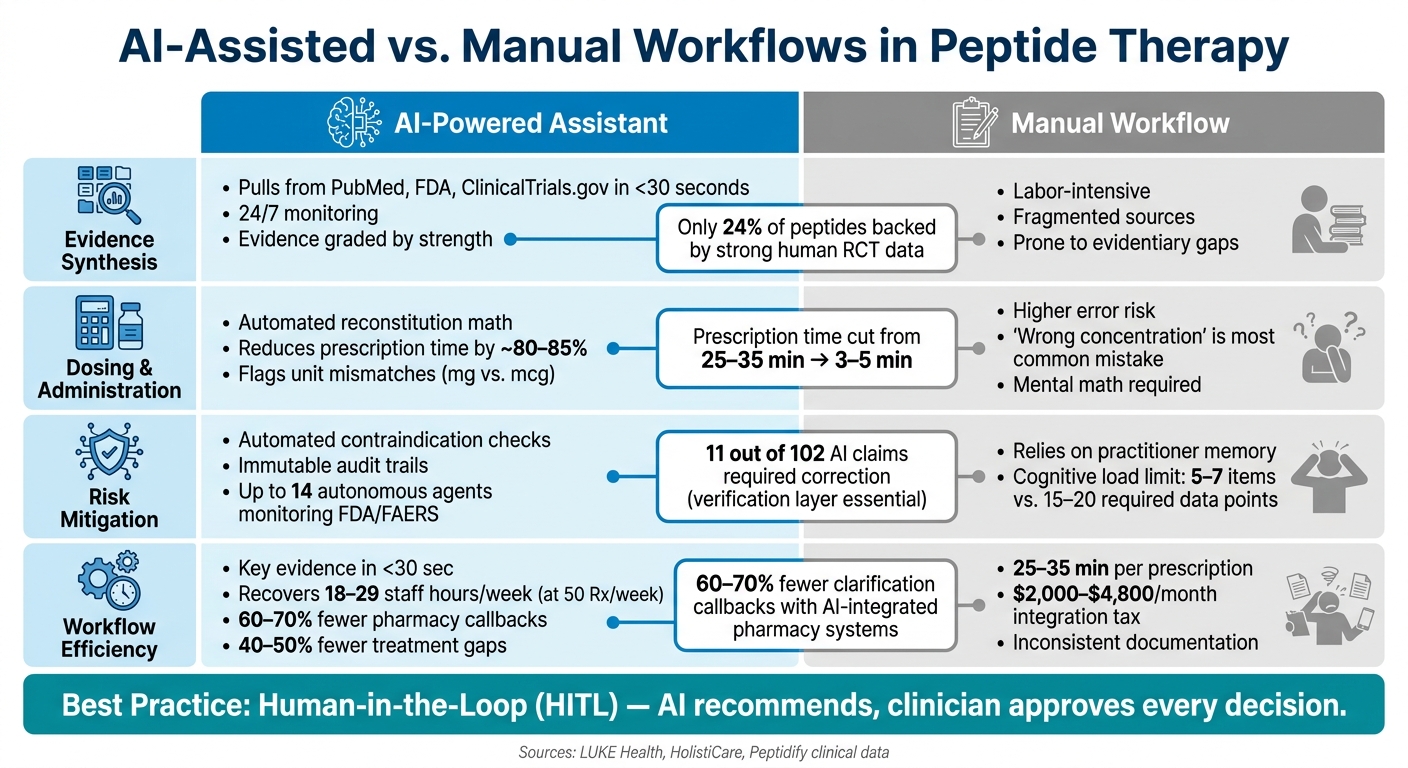
AI vs. Manual Workflows in Peptide Therapy: Key Metrics Compared
This section outlines the strengths and challenges of using AI-assisted workflows compared to manual processes in peptide therapy. By understanding where each method shines and where it might falter, clinicians can make better decisions about integrating these tools into their practice.
AI-powered tools offer a standout advantage: speed combined with detailed analysis. These systems can pull data from sources like PubMed, FDA databases, and ClinicalTrials.gov in under 30 seconds, grading evidence quality along the way. That’s a level of efficiency manual methods simply can’t match. However, there’s a flip side. AI systems trained on incomplete or biased data could produce unreliable recommendations, potentially leading to poor clinical outcomes.
"The risk is equally obvious: an AI system trained on incomplete data, deployed without rigorous guardrails... is not a clinical decision support tool. It is a liability engine." - HolistiCare.io
When it comes to dosing, AI tools like practical reconstitution guides and automated calculators dramatically reduce errors and save time. These calculators can cut prescription preparation time by over 80%, minimizing callbacks caused by manual math mistakes. That said, AI tools might miss patient-specific nuances, such as renal clearance differences or genetic variations that aren’t reflected in standard lab results.
| Clinical Area | AI-Powered Assistant | Manual Workflow |
|---|---|---|
| Evidence Synthesis | Rapid data aggregation from PubMed/FDA; 24/7 monitoring; evidence grading | Labor-intensive; relies on fragmented sources; prone to evidentiary gaps |
| Dosing & Administration | Automated reconstitution math; reduces errors and prescription time by ~80–85% | Higher risk of errors; "wrong concentration" is a frequent mistake |
| Risk Mitigation | Automated contraindication checks; immutable audit trails | Relies on practitioner memory; stronger medicolegal defense via independent judgment |
| Workflow Efficiency | Key evidence in <30 seconds; recovers 18–29 hours of staff time weekly at 50 Rx/week | Time-consuming; inconsistent documentation; weaker audit trails |
While AI excels in efficiency and error reduction, clinical liability remains a crucial consideration. Automation can streamline operations, but documenting independent clinical decisions is key to a strong medicolegal defense. This is especially important in regulatory gray areas. As HolistiCare.io points out, governance isn’t just a feature for AI tools - it’s the foundation that determines whether these systems enhance or compromise clinical practice.
The ideal solution? Combining AI’s speed and pattern recognition with a Human-in-the-Loop (HITL) model. In this setup, AI provides recommendations, but a licensed clinician reviews and approves every decision before implementation. This approach balances the strengths of AI with the critical oversight of human expertise.
Conclusion
While AI-driven tools have introduced efficiency gains and enhanced risk management in peptide therapy, speed and automation alone don’t equate to clinical responsibility. AI-assisted workflows have shown clear advantages in areas like evidence synthesis, precise dosing, and managing regulatory risks. However, these benefits only materialize when paired with vigilant human oversight.
The reality is that the evidence supporting many peptides remains incomplete. An AI system may present recommendations with confidence, but clinicians must always evaluate these suggestions in the context of their patient’s unique needs. Blind reliance on AI can lead to missteps, especially in areas where the research is still evolving.
Regulatory compliance adds another layer of complexity. The FDA has reclassified several commonly used peptides into Category 2, making their compounding prohibited. Enforcement actions have highlighted that AI tools cannot fully shield clinicians from regulatory risks. Instead, careful sourcing, thorough documentation, and adherence to compliance standards are essential safeguards.
"Being bold in integrative medicine means pushing boundaries in clinical thinking - not in regulatory compliance." - Yoon Hang Kim, MD, MPH
These challenges underscore a critical point: AI is a powerful ally but not a substitute for clinical judgment. A Human-in-the-Loop approach, where clinicians verify evidence and maintain detailed audit trails, is key to ensuring responsible use. Tools like PeptidePrescriber make this possible by offering licensed prescribers access to evidence-backed monographs, dosing guidelines, and regulatory updates. Whether AI is involved or not, these resources help keep decisions grounded in sound clinical practice.
FAQs
How do I verify an AI peptide recommendation is real?
To confirm an AI-generated peptide recommendation, think of the tool as a research assistant rather than a decision-maker. Always cross-check its suggestions against primary literature, established clinical guidelines, and the unique needs of the patient. With tools like PeptidePrescriber, you can review recommendations using its evidence-based monographs and dosing protocols, which are backed by published research. Make sure the AI provides clear reasoning, including its consideration of clinical variables and cited sources. Ultimately, your independent clinical judgment should guide the final decision.
What patient factors can AI dosing tools miss?
AI dosing tools sometimes miss the nuances of individual patient care because they rely heavily on standard clinical datasets. Important factors like renal clearance rates, genetic differences in peptide metabolism, and baseline inflammatory conditions may not be fully accounted for. Additionally, these tools often overlook patient-reported details, such as undisclosed supplement use or prior exposure to peptides. By focusing primarily on population-level data, AI tools can fail to capture the variability in individual responses, underscoring the importance of clinician involvement in the process.
How can AI help me stay FDA-compliant with peptides?
AI tools can assist in maintaining FDA compliance by offering clinical suggestions while operating within strict boundaries. Look for systems that incorporate a Human-in-the-Loop approach - where AI provides recommendations, but every action requires your documented approval. Choose platforms that generate an auditable decision trail, including timestamps, rationale, and references to clinical guidelines. This not only supports quality assurance and medicolegal protection but also highlights your independent clinical judgment, ensuring automation is a tool, not a substitute.