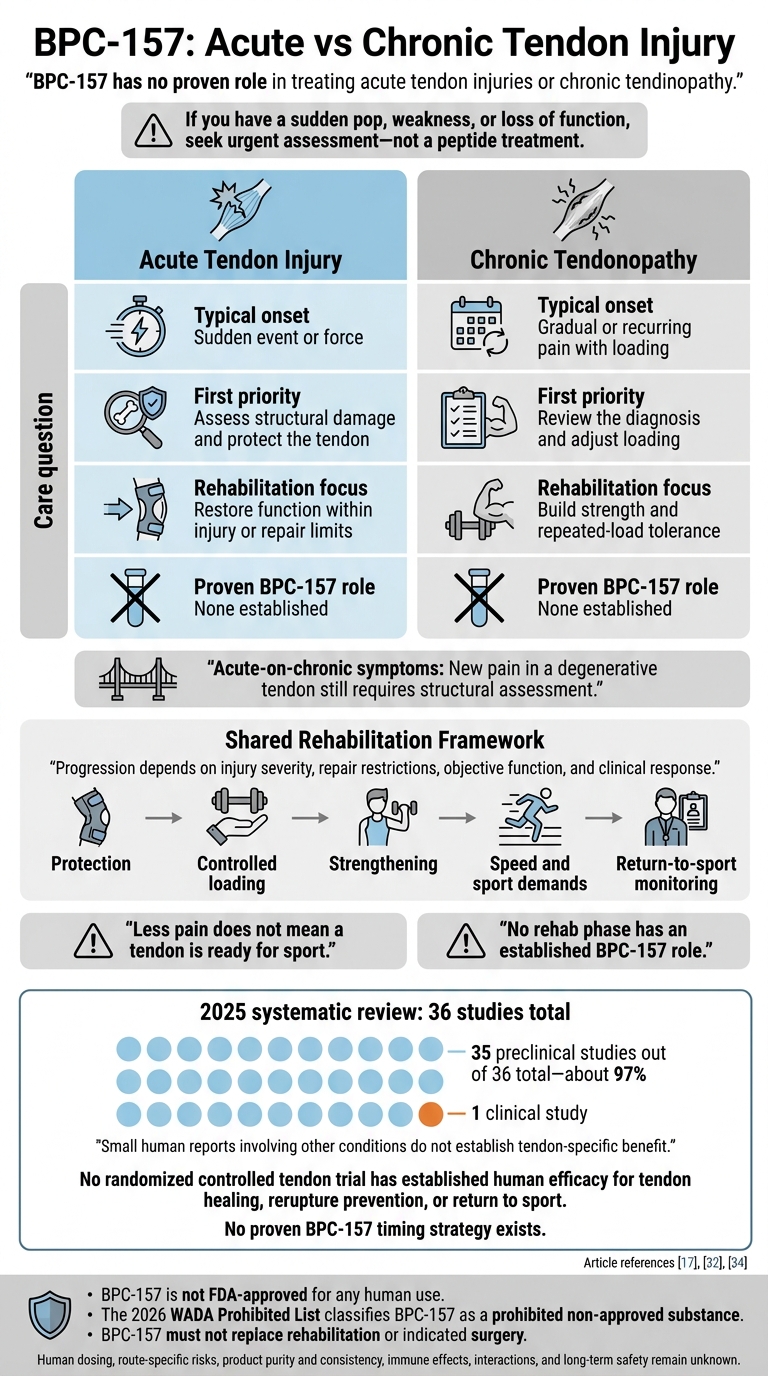
My bottom line: BPC-157 has no proven role in treating acute tendon injuries or chronic tendinopathy. If you have a sudden pop, weakness, or loss of function, seek urgent assessment - not a peptide treatment. For a clinical overview of peptide therapy, practitioners should evaluate the current evidence base.
The evidence is mostly animal and laboratory research: a 2025 review included 35 preclinical studies out of 36 total - about 97%. That does not establish human tendon healing, safe dosing, or the best treatment timing.
I would put the priorities this way:
- Acute injury: Check for a tear or rupture, protect the tendon, and arrange imaging or specialist care when needed.
- Chronic tendinopathy: Review the patient selection criteria and training load, then rebuild strength and loading tolerance.
- Either condition: BPC-157 must not replace rehabilitation or indicated surgery. It is not FDA-approved for human use and is prohibited under the 2026 WADA rules.
Quick Comparison
| Care question | Acute tendon injury | Chronic tendinopathy |
|---|---|---|
| Typical onset | Sudden event or force | Gradual or recurring pain with loading |
| First priority | Assess structural damage and protect the tendon | Review the diagnosis and adjust loading |
| Rehabilitation focus | Restore function within injury or repair limits | Build strength and repeated-load tolerance |
| Proven BPC-157 role | None established | None established |
Less pain does not mean a tendon is ready for sport. My focus is <u>diagnosis first, treatment matched to the injury, and return to activity based on function</u> - not symptom duration alone.
BPC-157: Acute vs Chronic Tendon Injury
What Science ACTUALLY Says About BPC 157 Benefits
sbb-itb-7164bd9
How Acute Injury and Chronic Tendinopathy Differ
Acute tendon injury involves recent structural damage. Chronic tendinopathy involves a mismatch between load and tendon capacity. Acute-on-chronic tears fall between the two. In discussions about BPC-157 timing, this difference helps establish whether protection or progressive loading comes first.
| Feature | Acute tendon injury | Chronic tendinopathy |
|---|---|---|
| Onset | Sudden force, contraction, or trauma | Gradual or recurring symptoms with repeated loading |
| Symptoms | Immediate pain, possible pop, bruising, weakness | Pain with loading, stiffness, reduced performance |
| Tissue findings | Fiber disruption, hematoma, retraction, or avulsion | Possible thickening and disorganized fibers; imaging findings must align with symptoms and the exam |
| Diagnostic urgency | Prompt assessment for suspected rupture, avulsion, or major loss of function | Usually outpatient assessment, unless new findings suggest structural injury |
| Early rehabilitation | Protect tendon continuity and function; establish safe loading suited to the injury | Adjust aggravating loads and rebuild load tolerance and capacity for sport |
Acute Injury: Damage and Urgent Assessment
Partial tears disrupt some tendon fibers. Complete ruptures break tendon continuity, while avulsions detach the tendon from bone. Myotendinous injuries affect the muscle–tendon junction.
Protection and referral should not wait for imaging when the exam suggests a time-sensitive injury. Before discussing BPC-157, establish whether the tendon needs protection or can begin progressive loading.
Chronic Tendinopathy: Pain and Load Intolerance
Persistent pain may stem from a partial tear, bursitis, joint disease, or nerve involvement. Assessment should cover changes in training volume, intensity, recovery, technique, footwear, and work demands. It should also check strength, range of motion, biomechanics, and prior injury.
Loading tests should reproduce the patient’s familiar pain. These findings help determine when rehab can advance and when structural protection must still come first.
For chronic symptoms, reduce loads that provoke pain without defaulting to prolonged complete rest. Start with tolerable resistance work, then move toward heavier and faster loading as function allows.
BPC-157: Evidence and Treatment Timing
No proven BPC-157 timing strategy exists for acute tendon injury or chronic tendinopathy. Care should follow the diagnosis, tissue condition, symptom history, rehab phase, and treatment goal - not the calendar. Acute injuries may need protection, while chronic tendinopathy often calls for progressive loading. Those needs lead to different care decisions.
| Comparison | Acute tendon injury | Chronic tendinopathy |
|---|---|---|
| Proposed biological rationale | Animal models suggest possible effects on inflammation, vascular responses, fibroblast activity, and collagen organization | Preclinical findings suggest possible effects on persistent inflammatory signaling, cellular repair, and tissue remodeling |
| Human evidence and routine use | No adequate controlled evidence shows improved tendon healing; routine use is not supported | No convincing controlled evidence shows improved tendon pain, structure, or function; routine use is not supported |
| Treatment goals | Protect tissue integrity first, then restore safe function | Build load capacity and tolerance over time |
Human dosing, route-specific risks, product purity and consistency, immune effects, interactions, and long-term safety remain unknown.
A plausible biological effect does not show that people heal faster or return to sport sooner.
Laboratory Findings vs. Human Evidence
Small human reports involving other conditions do not establish tendon-specific benefit. A 2025 systematic review found 35 preclinical studies and 1 clinical study. No randomized controlled tendon trial has established human efficacy for tendon healing, rerupture prevention, or return to sport. Nor has one established a timing advantage for acute versus chronic injury.
| Evidence type | What it measures or reports | What it cannot establish |
|---|---|---|
| Laboratory and animal studies | Cell activity, tissue organization, and biomechanical outcomes | Human healing, safe dosing, or whether acute versus chronic timing changes benefit |
| Retrospective reports and small pilots | Symptoms or short-term observations in small, often uncontrolled groups | Benefit beyond rehabilitation, natural recovery, or placebo effects |
| Randomized controlled tendon trials | Would compare treatment groups using defined tendon outcomes | These trials are not available |
Assess the Injury Before Considering BPC-157
Document the diagnosis and baseline function, including range of motion, strength, loading tolerance, symptom onset, and any sudden change in an existing problem. Investigational use cannot replace diagnostic testing, indicated surgery, or rehabilitation.
| Clinical pattern | Assessment priority and tissue state | Treatment goal |
|---|---|---|
| Acute injury | Check structural integrity and identify urgent treatment needs | Protect tissue, preserve function, and avoid delaying definitive care |
| Persistent symptoms | Review the diagnosis, prior rehabilitation exposure, and response to loading | Determine why capacity has not recovered and guide load progression |
| Acute-on-chronic symptoms | New pain in a degenerative tendon still requires structural assessment | Adjust protection and loading to match current findings |
The following claims are unsupported:
“It removes the need for rupture repair”
“It heals the tendon without physical therapy”
“Chronic symptoms make a new tear less urgent”
Once the diagnosis is clear, the rehab phase guides whether to prioritize protection, controlled loading, or progression.
Rehabilitation Phases and Return to Sport
Progression depends on injury severity, repair restrictions, objective function, and clinical response. Track symptoms during activity and over the next 24 hours, along with strength and workload tolerance. Less pain does not prove tendon continuity, collagen maturation, or readiness for competition.
Acute injury and chronic tendinopathy follow different rehab paths, even when symptoms overlap. Match the rehab phase to tissue status, not symptom duration alone. No rehab phase has an established BPC-157 role.
| Phase | Acute injury goal | Chronic tendinopathy goal |
|---|---|---|
| Protection | Respect tear or surgical repair constraints | Reduce aggravating exposure without unnecessary inactivity |
| Controlled loading | Introduce permitted movement and resistance | Establish repeatable, tolerable loading |
| Strengthening | Restore force within tissue limits | Build strength and energy-storage capacity |
| Speed and sport demands | Safely progress high-speed activity and sport demands | Restore repeated-load tolerance |
| Return-to-sport monitoring | Assess strength, power, movement quality, and workload response | Confirm tolerance across repeated training sessions |
Any human efficacy trial would need confirmed diagnoses, matched rehabilitation, and outcomes beyond pain scores. Those outcomes should include function, adverse events, rerupture, and sustained return to sport.
These gaps in evidence also require a closer look at regulatory updates and safety limits.
U.S. Safety and Regulatory Limits
The evidence gap leads to a practical question: what can clinicians legally and safely do in the U.S.? Regulatory status stays the same whether the condition is acute or chronic. BPC-157 is not FDA-approved for any human use. FDA cites insufficient safety data and concerns about immunogenicity, impurities, and aggregation.
FDA approval and lawful compounding are separate issues. Before use, check current FDA notices, federal and state compounding rules, board regulations, and institutional policy.
Discussing a compounding pathway does not settle questions about clinical consent or sport eligibility. Each requires its own review.
Consent, Documentation, and Anti-Doping Rules
The consent discussion should cover uncertain benefits and safety, possible immune and injection-related complications, and established options. These include rehabilitation, specialist referral, or surgery when indicated. Consent cannot override legal restrictions.
Record the diagnosis, baseline function, rehabilitation plan, alternatives, and follow-up arrangements. If a patient receives or pursues BPC-157, also document the formulation, source and dispensing entity, available lot information, route, planned duration, consent discussion, and adverse-event monitoring. Promptly evaluate suspected infection or serious reactions and report them through applicable channels.
For athletes, restrictions go beyond FDA and compounding rules. The 2026 WADA Prohibited List classifies BPC-157 as a prohibited non-approved substance; USADA also identifies it as prohibited. Check the athlete’s federation, league, national anti-doping organization, and event rules separately. Obtain written guidance from the relevant anti-doping authority before exposure. Neither a prescription nor consent protects against a violation, and a therapeutic-use exemption is not automatic.
PeptidePrescriber: Clinical Education Resources
PeptidePrescriber offers peptide monographs, regulatory references, clinical tools, and prescriber education for licensed clinicians. These resources support documentation, regulatory checks, and evidence review. They do not establish BPC-157 efficacy, safety, lawful availability, or a validated tendon-treatment protocol. Clinicians must independently confirm current requirements and apply patient-specific clinical judgment.
Conclusion: Care Priorities and Evidence Limits
Acute tendon injury calls for structural triage and protection. Chronic tendinopathy calls for diagnostic reassessment and progressive loading. Chronic loading programs usually need at least 12 weeks before judging the response. That timeline is not a fixed return-to-sport date. After load increases, symptoms should return to baseline within about 24 hours. If symptoms keep worsening, adjust the load and reassess.
This is the standard of care against which BPC-157 must be judged. BPC-157 remains investigational and must not delay or replace established care. Human evidence does not establish a tendon-specific benefit or a safe, validated regimen. Any discussion requires documented informed consent, an explanation of evidence limits, clear responsibility for follow-up, and checks of current FDA requirements, state rules, and anti-doping rules.
| Injury pattern | Established care | Investigational considerations |
|---|---|---|
| Acute tendon injury | Diagnose first; protect structural integrity; obtain imaging and referrals when indicated before criteria-based rehabilitation. | No validated BPC-157 timing, dose, route, or tendon-specific indication. |
| Chronic tendinopathy | Reassess the diagnosis and loading factors that can be changed; progressively rebuild strength and sport-specific tolerance. | Strong human efficacy data and long-term safety data remain lacking. |
FAQs
What if I’ve already used BPC-157 for tendon pain?
BPC-157 remains investigational. It has no FDA-approved uses, and no large-scale human trials have confirmed its effectiveness or long-term safety. If you’ve already used it, work with your provider on a clear care plan.
Discuss reassessment after defined 4–12-week cycles, documented informed consent, and screening for contraindications, including active malignancy. Set measurable goals for symptoms and daily function.
Competitive athletes should also discuss anti-doping rules: BPC-157 is on the WADA Prohibited List.
When should persistent tendon pain be reassessed?
Clinicians should reassess treatment at the end of each defined cycle, typically every 4–12 weeks. Early in therapy, weekly or every-other-week check-ins help track adverse effects and treatment response. Based on the patient’s progress, clinicians can decide whether to continue, adjust, or stop treatment.
PeptidePrescriber gives licensed healthcare professionals evidence-based resources, including dosing protocols and clinical tools, to support these assessments.
How can I tell if my tendon is ready for sports?
Tendon readiness for sports depends on a clinical assessment of functional recovery - not just symptom relief. BPC-157 remains investigational, with no validated human data on its efficacy or safety. It cannot indicate readiness to return to play.
Clinicians should set measurable functional milestones when treatment begins, then compare progress against baseline at fixed intervals. PeptidePrescriber offers licensed healthcare professionals evidence-based resources to help build structured, objective monitoring plans.