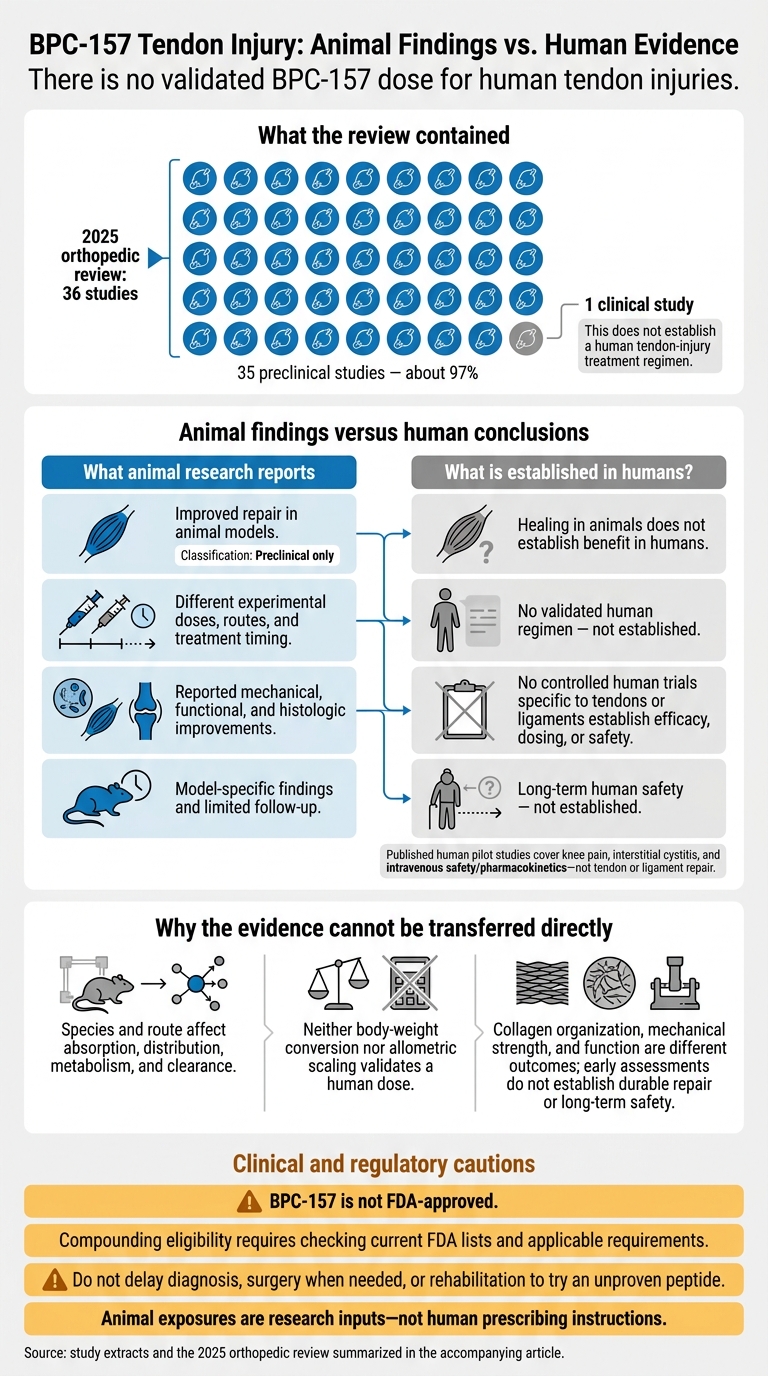
There is no validated BPC-157 dose for human tendon injuries. A 2025 orthopedic review included 36 studies - 35 preclinical and one clinical. That means about 97% were preclinical, not human trials establishing a treatment regimen.
As part of a broader clinical overview of peptide therapy, I review what these studies tested - and what you cannot conclude from them:
- Animal doses: Rat Achilles and ligament studies used different doses and routes. These are research exposures, not human prescribing instructions.
- Human evidence: Controlled tendon and ligament trials have not established healing, dosing, or safety.
- Safety and U.S. rules: BPC-157 is not FDA-approved. Long-term risks remain unknown, and current compounding requirements need to be checked.
- Injury care: <u>Do not delay diagnosis, surgery when needed, or rehabilitation</u> to try an unproven peptide.
My focus is on reading dose units, routes, treatment timing, and measured outcomes without turning animal results into human treatment advice.
BPC-157 Tendon Injury: Animal Findings vs. Human Evidence
Peptide BPC-157 - Does It Work? Breaking Down the Evidence and the Hype
sbb-itb-7164bd9
Animal Dosing Studies for Tendon and Ligament Repair
The table keeps the dose details from the primary-study extracts. “Not reported” refers to the extract - the full paper may include those details.
| Study/year | Species and sample size | Injury model | Route and dose | Schedule and treatment duration | Follow-up | Comparator | Mechanical and functional outcomes | Histologic outcomes and limitations |
|---|---|---|---|---|---|---|---|---|
| Staresinic et al., 2003 | Rats; strain, sex, and sample size not reported | Full Achilles transection approximately 5 mm above the calcaneal attachment | Intraperitoneal: 10 µg/kg, 10 ng/kg, or 10 pg/kg | Daily; started 30 minutes after surgery; last dose 24 hours before tissue collection; total duration not reported | Not reported | Saline | Higher failure load, failure load per cross-sectional area, Young’s modulus, and Achilles functional index reported; exact effect sizes and p-values not reported | More organized fibroblasts and collagen, increased reticulin, and fewer granulocytes; dose-by-endpoint comparisons not reported |
| Achilles tendon detachment, 2006 | Rats; strain, sex, and sample size not reported | Achilles sharply detached from calcaneal bone | Intraperitoneal: 10 µg/kg, 10 ng/kg, or 10 pg/kg | Daily; started 30 minutes after surgery; last dose 24 hours before assessment | Postoperative days 1, 4, 7, 10, 14, and 21 | Saline; additional treatment-control details not reported | Improved failure load, stiffness, Young’s modulus, and Achilles functional index reported; numerical comparisons not reported | Improved collagen organization, vascular appearance, and type-I collagen findings; acute detachment model |
| Cerovecki et al., 2010 | Rats; strain, sex, and sample size not reported | MCL transection | Intraperitoneal: 10 µg/kg or 10 ng/kg | Daily; started 30 minutes after surgery; last dose 24 hours before tissue collection; total duration not reported | Not reported | Injured controls; exact vehicle allocation not reported | Improved function reported; route-specific mechanical results not reported | Improved ligament organization and vascular responses reported; route-specific effect estimates not reported |
| Cerovecki et al., 2010 | Rats; strain, sex, and sample size not reported | MCL transection | Drinking water: 0.16 µg/mL or 0.16 ng/mL; approximately 12 mL/rat/day | Continuous drinking-water exposure; exact onset and duration not reported | Not reported | Exact comparator details not reported | Route-specific mechanical and functional results not reported | Improved ligament healing, organization, vascular responses, and functional outcomes reported; water concentration does not equal absorbed dose |
| Cerovecki et al., 2010 | Rats; strain, sex, and sample size not reported | MCL transection | Topical: approximately 1.0 µg/g in neutral cream base | Started 30 minutes after surgery; last application 24 hours before tissue collection; frequency, quantity applied, and duration not reported | Not reported | Exact cream-vehicle comparator details not reported | Route-specific mechanical and functional results not reported | Improved organization and vascular findings reported; delivered dose cannot be determined without cream quantity |
| Quadriceps muscle detachment and reattachment, 2025 | Rats; strain, sex, and sample size not reported | Quadriceps muscle detachment for muscle-to-bone reattachment | Drinking water: 0.16 µg/mL or 0.16 ng/mL; approximately 12 mL/rat/day | Water exposure until tissue collection; corresponding 10 µg/kg or 10 ng/kg regimens also described, but injected exposure not confirmed | Days 1, 2, 3, 5, 7, 14, 21, 28, 60, and 90 | Drinking water alone | Reattachment evaluated; numerical mechanical and functional results not reported | Detailed histologic results not reported; not a conventional tendon-repair model |
These doses apply to specific animal models. Read them as experimental exposures, not prescribing instructions.
Rat Achilles Tendon Transection and Repair
The extracts do not give exact effect sizes or p-values. The reported improvements therefore should not be described as established treatment effects.
Rat Medial Collateral Ligament Transection
The animal findings depend on the route used. These exposures are not interchangeable, and the results do not carry the same weight as human evidence.
Quadriceps Muscle Detachment and Reattachment
This study tested muscle-to-bone reattachment - not tendon or ligament repair. It provides indirect repair data, not direct evidence of enthesis healing.
The next section explains why these animal doses do not establish a human dosing regimen.
Why Animal Doses Do Not Establish Human Dosing
Research Dose Ranges and Treatment Duration
The same peptide was tested at very different exposures across these rat tendon and ligament models. The 1,000-fold steps between 10 pg/kg, 10 ng/kg, and 10 µg/kg do not establish an optimal dose, therapeutic window, or lowest effective dose.
The table shows why routes and concentrations cannot be treated as interchangeable doses.
| Route | Dose or concentration | Frequency | Exposure duration | Assessment timing |
|---|---|---|---|---|
| Intraperitoneal | Approximately 10 µg/kg, 10 ng/kg, or, in some Achilles studies, 10 pg/kg | Usually once daily | Started about 30 minutes after surgery; stopped 24 hours before sacrifice | Study-specific postoperative endpoints |
| Topical | Approximately 1 µg BPC-157 per gram of neutral cream | Local application; timing varied by study | Started about 30 minutes after surgery; final application 24 hours before sacrifice | Terminal healing assessments |
| Drinking water | Approximately 0.16 µg/mL or 0.16 ng/mL | Continuous access | Continued until sacrifice in some protocols | Some studies assessed animals on postoperative days 7, 14, 28, or 42 |
These are route-specific animal exposures - not human dosing protocols.
The units also matter: µg/kg describes an amount relative to body weight, while µg/mL describes a solution concentration. Neither tells you how much was absorbed. Treatment duration and follow-up are separate, too. An assessment date tells you when researchers measured an outcome - not how long treatment lasted or whether improvement continued after treatment stopped.
Route and Species Differences
Dose is only part of the exposure picture. Intraperitoneal dosing in rodents does not predict absorption from human subcutaneous or intramuscular injections. Drinking-water or topical exposure in animals does not validate oral or topical use in humans, either. Route and species affect absorption, distribution, metabolism, and clearance.
Neither body-weight conversion nor allometric scaling validates a human dose. These calculations cannot replace missing human data on pharmacokinetics, dose-escalation safety, or efficacy.
Controlled surgery and cage activity also do not reflect delayed presentation, rehab loading, or healing risks linked to other health conditions.
Study Quality and Outcome Limits
Assess sample size, attrition, randomization, allocation concealment, blinding, controls, and independent replication. An unreported method is not proof of bias, but it leaves uncertainty about how the study was conducted.
Look at effect sizes, variability, and follow-up - not just statistical significance, which alone does not prove meaningful benefit. Collagen organization does not prove strength, and load-to-failure testing and function measure different outcomes. Early terminal assessments cannot establish durable repair, resistance to reinjury, or long-term safety. Animal dosing therefore remains a basis for research hypotheses, not prescribing.
Human Evidence and U.S. Prescribing Limits
No controlled human trials specific to tendons or ligaments establish BPC-157’s efficacy, dosing, or safety. Published human pilot studies cover only knee pain, interstitial cystitis, and intravenous safety/pharmacokinetics. None studies tendon or ligament repair or establishes a validated regimen.
Symptom relief alone does not prove tissue repair. That requires a defined injury, a comparator, and an objective tissue outcome. With little human repair data available, prescribing questions move from efficacy to safety and compounding limits.
Human Safety Gaps and Compounding Rules
Human safety remains undefined for repeated dosing, injection, nasal use, pregnancy, medication interactions, and long-term outcomes. FDA cites concerns about immunogenicity, aggregation, impurities, and active ingredient characterization, especially for parenteral and nasal products. Reports of short-term tolerability do not establish a safe human dose or rule out uncommon or delayed harm.
BPC-157 is not FDA-approved. Its eligibility for compounding depends on specific statutory criteria. Under section 503A, bulk substances generally must meet an applicable USP/NF monograph, be a component of an FDA-approved drug when no monograph exists, or appear on FDA’s 503A Bulks List. Under section 503B, bulk drug substances are generally limited to those on FDA’s 503B Bulks List or those used under applicable drug-shortage conditions.
FDA materials also describe a proposal to exclude BPC-157 free base and BPC-157 acetate from the 503A Bulks List. Compounding eligibility depends on current FDA lists, facility status, and state pharmacy and medical-board requirements.
Standard Injury Care and Documentation
Before discussing experimental peptides, rule out structural emergencies and document standard injury care. Assess for rupture, fracture or avulsion, infection, compartment syndrome, and neurovascular compromise. Obtain imaging or urgent consultation when indicated. Do not delay surgery, rehabilitation, or load management.
Document the diagnosis, baseline function, conventional care, alternatives, and consent. Consent should explain the unproven benefit, lack of validated dosing, unknown long-term safety, costs, and product-related risks.
Record the exact product formulation, lot information when available, route, exposure dates, adverse events, and follow-up findings. Report suspected adverse events through appropriate FDA, pharmacy, institutional, or state pathways. Checks of identity, sterility, concentration, and storage reduce quality risk; they do not establish efficacy, safety, or legal compliance.
PeptidePrescriber Educational Resources
Clinicians reviewing peptide literature can use structured references to support documentation and evidence checks. PeptidePrescriber provides licensed clinicians with peptide monographs, dosing tools, calculators, practical guides, regulatory references, and a prescriber network. These resources support evidence review and documentation, but they do not validate BPC-157 dosing or establish FDA approval.
Conclusion: What the Evidence Supports
BPC-157 shows signs of repair in animal studies, but it has no validated regimen for human tendon injuries.
Animal exposures are research inputs - not prescriptions that can be transferred to humans. The evidence supports four findings:
| What the evidence supports | Classification | Practical meaning |
|---|---|---|
| Improved repair in animal models | Preclinical only | Findings apply only to the animal model, dose, route, and timing studied. |
| Human benefit remains unproven | Uncertain in humans | Healing in animals does not establish benefit in humans. |
| No validated human regimen | Not established | Animal dose ranges do not define a human regimen. |
| Long-term safety remains unproven | Not established | Human safety remains undefined. |
These findings can guide research, but they do not support prescribing or patient selection.
Before drawing any clinical conclusion, check the original study’s species, dose units, route, timing, duration, comparator, and endpoint.
FAQs
Do acute injury studies apply to chronic tendinopathy?
Most BPC-157 research uses acute injury models in rodents. There’s no direct evidence that these findings apply to chronic tendinopathy. These models may not reflect the degenerative biology of chronic tendinopathy.
Some clinicians use treatment cycles of 8–12 weeks for chronic conditions. But that approach rests on clinical experience - not randomized, controlled human trials.
What would a reliable human BPC-157 trial need to measure?
A reliable human trial of BPC-157 for tendon repair should track function, tendon structure, and pain. That means using standardized functional recovery scores, imaging to assess tendon integrity, and validated pain scales.
The trial should use a randomized, controlled design and be preregistered. These steps help reduce outcome reporting bias and separate the peptide’s effects from those of standard care, such as physical therapy.
Safety monitoring should include baseline and periodic complete blood counts (CBC), comprehensive metabolic panels (CMP), and inflammatory marker tests. Researchers should also carefully document adverse events.
How can I distinguish pain relief from tendon healing?
Less pain and better function don’t necessarily mean a tendon has structurally healed. Animal studies have linked BPC-157 to better collagen organization and biomechanical strength, but those results aren’t guaranteed in humans. Clinicians should track physical therapy progress, imaging findings, and functional test results - not rely on reported pain relief alone.
PeptidePrescriber offers evidence-based monographs and dosing protocols to help licensed professionals understand these differences and set expectations for recovery.