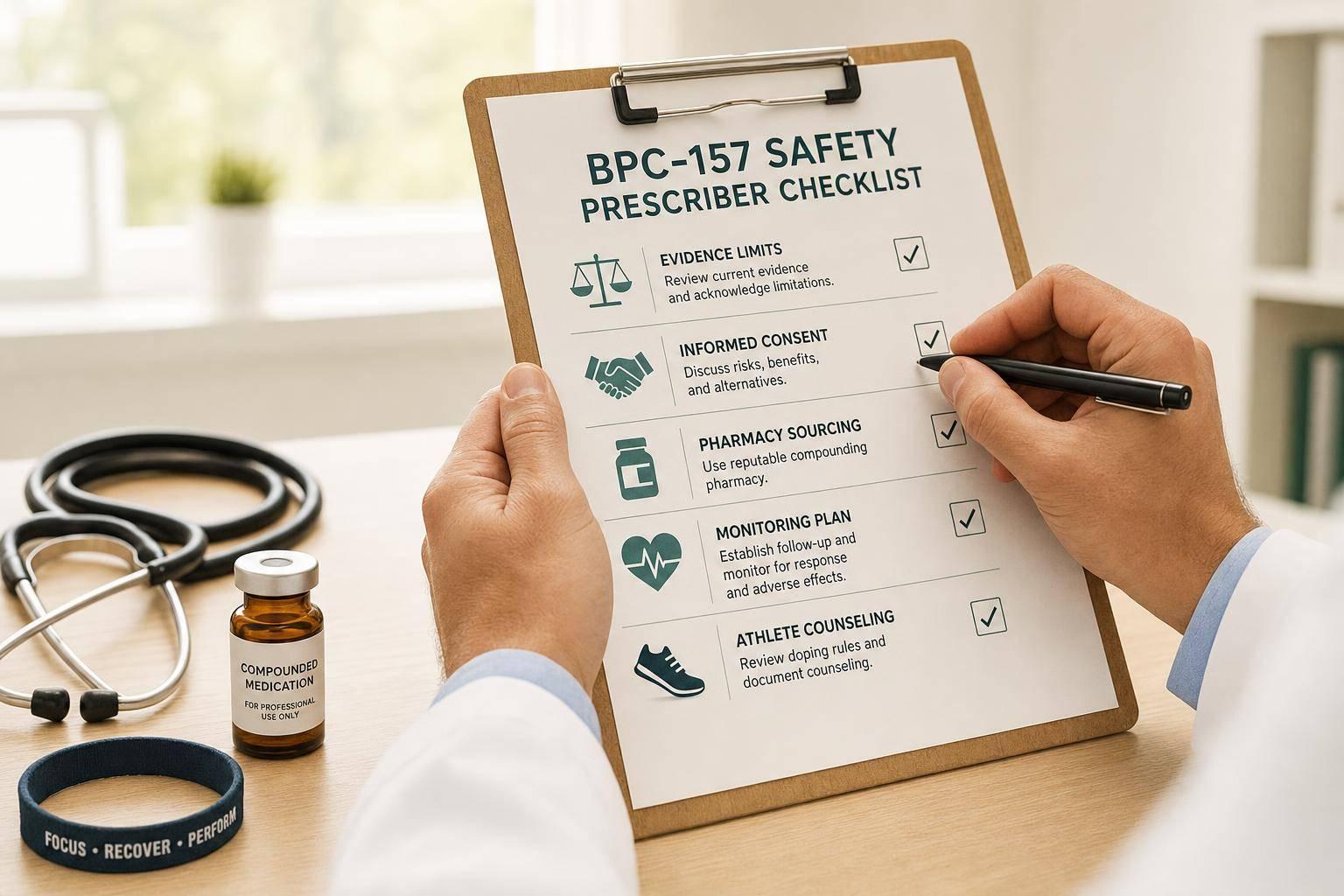
BPC-157 is not FDA-approved, has only about 30 total human subjects in published studies, and has no published randomized controlled trials in humans. So if I discuss it in practice, I should treat it as investigational from the first conversation.
Here’s the short version of what matters most:
- I should lead with evidence limits, not hoped-for results.
- I need plain-language informed consent (available in our Peptide Prescriber Starter Pack) that says what is known and what is not.
- I should verify pharmacy source, licensure, lot number, and COA before any order.
- I need a fixed follow-up plan and a same-day adverse event log process.
- I should apply strict patient selection criteria, including pregnancy, breastfeeding, active cancer, active infection, and many tested athletes.
- I need staff scripts that avoid words like “approved,” “proven,” or “guaranteed.”
This guide is best read as a risk-control checklist for outpatient prescribers. The core point is simple: when human safety data are thin and product quality can vary, my charting, sourcing review, follow-up, and staff communication need to be tight, clear, and consistent.
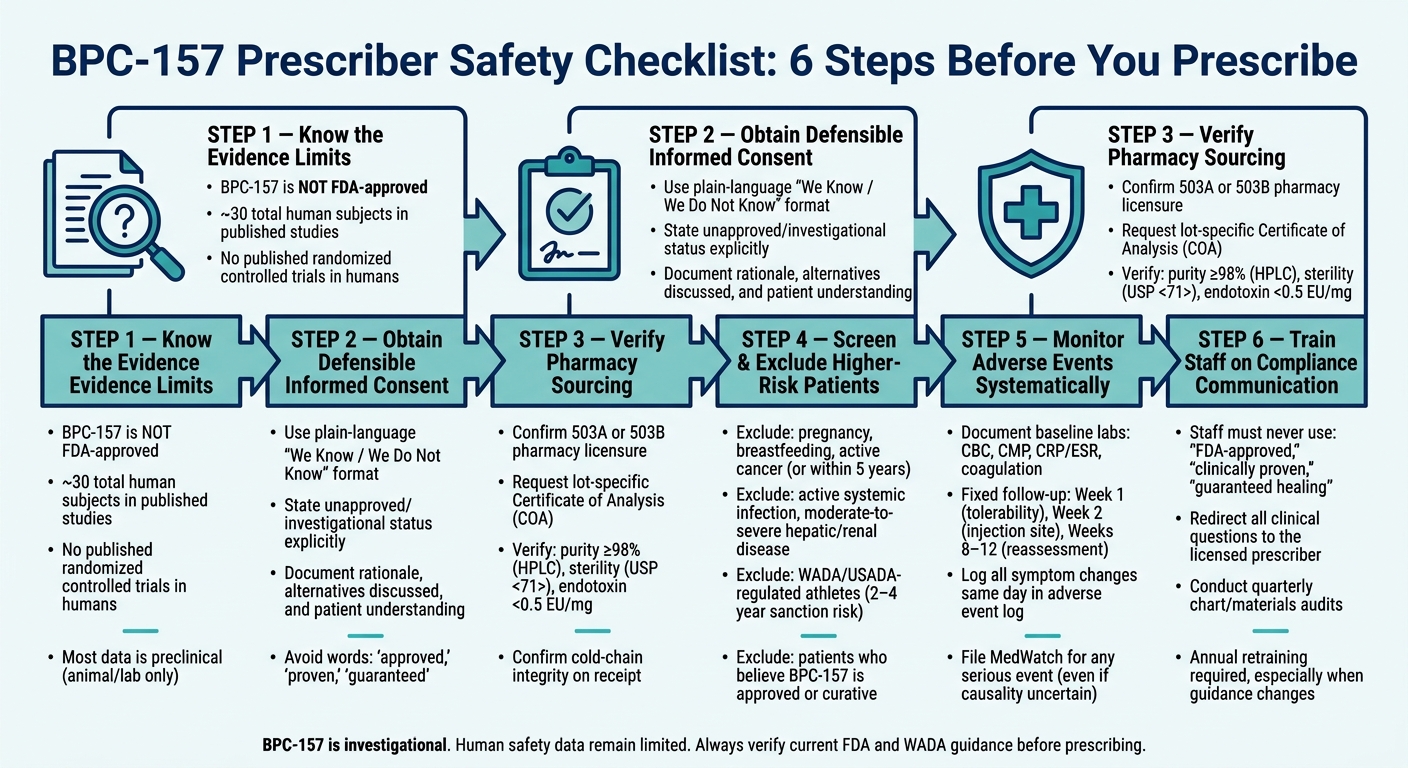
BPC-157 Prescriber Safety Checklist: 6 Steps Before You Prescribe
BPC-157: Everything You Need to Know - Benefits, Risks, Dosing, & Delivery Methods
sbb-itb-7164bd9
1. Know the Evidence Limits and Regulatory Status Before Discussing Use
Before you talk with a patient about BPC-157, treat it as investigational. The human evidence is far too thin to support routine use, standard dosing, or any clear view of long-term risk. Most of the published work is preclinical, with very little human data.
Preclinical Data Does Not Establish Human Safety
There are more than 100 preclinical studies on BPC-157 looking at wound healing, tendon repair, and inflammation. That may sound like a lot, and for early research it is. But animal and lab data can only take you so far. They can point researchers in a direction. They do not prove that a drug is safe or useful in people.
The human evidence is still very small. Only a few pilot studies have been published, there are no published randomized controlled trials, and the total sample size is only about 30 people.
The biggest problem is simple: there are no published randomized controlled trials in humans.
From a clinical standpoint, the missing pieces matter. Human data still do not define:
- pharmacokinetics
- dosing
- treatment duration
- reproductive risk
- drug interactions
Those gaps are exactly why you need to check regulatory status and compounding rules before any order is placed.
FDA Status, Compounding Rules, and Anti-Doping Points to Verify
BPC-157 is not FDA-approved for any clinical use in the United States. FDA has stated that there is not enough human safety information to characterize BPC-157, and it found no studies using BPC-157 through the proposed oral, subcutaneous, nasal, or transdermal routes. FDA compounding materials also point to route-specific evidence gaps, possible immunogenicity concerns, and impurity or characterization issues.
Before ordering, verify the current Federal Register listing and FDA compounding status. This is one of those cases where yesterday's assumption can turn into today's compliance problem.
For patients in regulated sports, anti-doping risk is not a side issue. WADA places BPC-157 in S0, which means it is a non-approved substance. Athletes and military personnel should be told to check the rules of their governing body before use. That counseling should be documented.
Document these limits before moving into informed consent. In practice, focus your note on the points that affect prescribing, sourcing, and athlete counseling.
| Factor | Current Status | What to Document |
|---|---|---|
| Compounding status | Verify current FDA/Federal Register guidance | Current sourcing pathway and pharmacy licensure |
| WADA status | S0, non-approved substance | Athlete counseling on sanction risk |
2. Build a Defensible Informed Consent and Charting Process
Once you've documented the limits of the evidence, the next step is turning that into a signed consent form and a chart note that can stand on their own. A generic waiver won't cut it.
Write Consent Language That States What Is Known and Unknown
Put the evidence limits into plain-language consent. Say clearly that BPC-157 is not FDA-approved and that human safety data are still limited. Keep the wording simple, and separate established facts from what isn't known.
A simple "We know / We do not know" table inside the consent form can make this much easier for patients to follow and easier to defend later. The form should cover:
- Regulatory status: Not FDA-approved; use is investigational
- Unknown risks: Long-term human risks remain undefined, including cancer, reproductive, autoimmune, cardiovascular, and cumulative toxicity concerns
- Dosing: No standardized human dosing regimen has been established
- Product quality: Quality variability in purity and potency is possible
- Efficacy: Human efficacy data for musculoskeletal use are unproven
- Athlete status: If applicable, document that BPC-157 is prohibited under WADA rules and may affect eligibility
The consent form helps protect the patient. The chart note helps protect the decision.
Document Rationale, Alternatives, and Patient-Specific Risk Discussion
Your chart note needs to work on its own. Label it clearly, such as "BPC-157 informed consent discussion".
The note should show why the patient is asking about BPC-157. Document the standard options you discussed and why they were declined, contraindicated, or not enough. Also record patient-specific risk factors - pregnancy or breastfeeding, autoimmune disease, cancer history, and athlete status - and how each one came up in the discussion. Then close the note by confirming understanding: ask the patient to restate the key risks in their own words.
Use the same wording across the consent form and the chart note. If the two tell different stories, that's where problems start.
"Prescribers should ensure thorough informed consent that addresses the investigational nature of this therapy and document accordingly." - PeptidePrescriber Editorial Team
Workflow Support from PeptidePrescriber
Standard templates help clinics use the same consent language across providers. PeptidePrescriber offers editable consent templates, an implementation checklist, and regulatory quick references to help your team standardize the workflow and keep charting consistent.
3. Review Pharmacy Sourcing and Compliance Before Ordering
Once consent is in the chart, check the source before placing any order. With BPC-157, sourcing is the next safety step. That means confirming licensure, quality controls, and lot traceability before anything moves forward.
Questions to Ask About Licensure, Sterile Compounding, and Testing
Start by confirming whether the source is a patient-specific 503A pharmacy or an FDA-registered 503B outsourcing facility. Since BPC-157 is a not FDA-approved substance, any pharmacy compounding it should be able to provide written support for its legal pathway.
If the product is a sterile injectable, ask direct questions about USP <797> compliance. That includes cleanroom classification, environmental monitoring, aseptic technique competency checks, and beyond-use dating backed by sterility and stability data.
You should also request a lot-specific COA that shows:
- Identity by mass spectrometry
- Purity (≥98% by HPLC)
- Potency (90–110% of label claim)
- Sterility (USP <71>)
- Endotoxin results (<0.5 EU/mg)
Temperature control matters too. Ask for documented storage, shipping, and beyond-use dating data, then verify temperature control when the shipment arrives.
What to Record in the Chart About Sourcing Review
Every sourcing decision needs a paper trail in the chart. If you review a vendor and decide not to order because COA data is missing or the compounding pathway is still unclear, document that as well.
The table below shows the minimum items to record for any order that does move forward:
| Documentation Item | Why It Matters | Suggested Chart Wording |
|---|---|---|
| Pharmacy identity & license | Establishes the legal sourcing channel | License verified; license # [Number]. |
| FDA status & compliance review | Shows awareness of current regulatory position and sourcing review | BPC-157 not FDA-approved; sourcing reviewed against current guidance on [date]. |
| Lot/batch number | Enables traceability for adverse event review | Lot # [Number]; COA filed. |
| Purity & identity (COA) | Confirms substance and quality | Identity by MS confirmed; purity ≥98% by HPLC. |
| Sterility & endotoxin | Critical safety check for injectables | USP <71> sterility pass; endotoxin <0.5 EU/mg. |
| Cold-chain receipt | Verifies product integrity on arrival | Cold-chain packaging intact; temp indicator in range. |
Record the lot number, COA, and receipt conditions so any later adverse event can be tied back to the exact source. Those records set the starting point for follow-up and adverse-event review.
PeptidePrescriber's pharmacy-agnostic sourcing guidance and regulatory landscape for compounded peptides can help structure this review process, especially for prescribers working through these compliance questions for the first time.
4. Set Up Adverse Event Monitoring, Incident Logging, and Reporting
Once product source and lot traceability are documented, move to baseline safety steps that help you spot exposure-related events fast. Human safety data are limited, so structured monitoring should start with the first dose.
Baseline and Follow-Up Monitoring to Support Causality Assessment
Document injury details, baseline pain or function, targeted ROS, medication/supplement list, vitals, and a focused exam. Add CBC, CMP, CRP/ESR, and coagulation studies when indicated, given possible vascular effects.
Then use those same baseline measures at follow-up so changes are easy to compare. Stick to a fixed schedule: Week 1 for a tolerability check, Week 2 for an injection-site exam for erythema, induration, or swelling, and Weeks 8–12 for outcome and safety reassessment. At each visit, record dose timing, route, lot number, any symptom changes, and your clinical assessment. Also note whether the timing fits a possible adverse event or points to an unrelated finding.
If you start another agent, stagger initiation by at least one week so attribution stays clearer.
Maintain an Internal Adverse Event Log and Know When to File MedWatch
Any symptom change should move from the chart into a separate event log the same day.
Every clinic prescribing BPC-157 should keep a simple, secure adverse event log, whether that's inside the EHR or in a secure QI database. Each entry should include the date and time of the event, patient identifier using the chart number rather than the full name, BPC-157 dose and route, lot number, source pharmacy, event description, severity grade, action taken, and outcome. Grade severity as mild, moderate, or severe, and flag serious events: death, a life-threatening event, hospitalization, persistent disability, or an intervention to prevent harm.
Review the log at least quarterly to look for lot-specific signals or repeated event types. Any serious event should trigger review within 24 hours and a MedWatch filing decision. Report serious events even when causality is uncertain. In a busy outpatient setting, it helps to assign one staff member as the MedWatch liaison, keep a prefilled MedWatch template on hand, and build a standard operating procedure that triggers MedWatch review anytime an event is logged as serious.
| Log Field | Purpose |
|---|---|
| Date and time (MM/DD/YYYY, local time) | Establishes timeline for causality assessment |
| Patient identifier (chart #) | Enables internal tracing without exposing PHI |
| Dose, route, and dosing schedule | Ties event to specific exposure level |
| Lot number and source pharmacy | Identifies production run for pattern analysis |
| Event description and severity grade | Standardizes documentation for review and reporting |
| Action taken and clinical outcome | Tracks resolution and supports MedWatch narrative |
| Serious event flag (yes/no) | Triggers MedWatch consideration and prescriber review |
5. Set Clinic Policies for Patient Selection and Follow-Up
Once consent, sourcing review, and adverse-event logging are set up, the clinic needs firm rules for eligibility and follow-up. Policy should spell out who can move forward, who should be excluded, and how follow-up will work.
Screen for Higher-Risk Scenarios Before Any Prescribing Decision
Before any prescribing decision, screen for a plausible clinical indication, realistic expectations, and the patient’s ability to stick to the monitoring plan. The default should be not prescribing. A patient should be treated as eligible only when there’s a clear clinical reason and higher-risk factors have been ruled out.
Exclude patients who are pregnant, breastfeeding, have active malignancy or cancer within 5 years, active systemic infection, or moderate-to-severe hepatic or renal disease unless specialist co-management is documented.
For athletes governed by WADA, USADA, NCAA, or similar rules, document anti-doping counseling and decline prescribing. A positive test can lead to a 2- to 4-year sanction.
Decline prescribing if the patient thinks BPC-157 is approved, guaranteed safe, or a substitute for standard care. The same goes for patients whose expectations show they can’t separate investigational therapy from approved care. This distinction is a cornerstone of peptide therapy clinical considerations for any practice.
The table below sums up the main exclusion categories to build into your intake workflow:
| Screening Category | Exclusion/Caution Criteria | Core Concern |
|---|---|---|
| Oncology | Active cancer or history within 5 years | Theoretical risk of VEGF-driven tumor angiogenesis |
| Reproductive | Pregnancy or breastfeeding | No human safety or teratogenicity data |
| Infectious Disease | Active systemic infection | Possible alteration of host immune response |
| Organ Function | Moderate-to-severe hepatic or renal disease | No human dose-adjustment or impairment data |
| Athletics | WADA/USADA-regulated athletes | Anti-doping violation; 2–4 year sanction risk |
| Expectations | Belief that BPC-157 is approved or curative | Informed consent is unlikely |
Patients who pass intake should move into a fixed follow-up pathway, not an improvised one.
Use a Standard Follow-Up Schedule and Escalation Plan
Build follow-up intervals into clinic policy: baseline, early follow-up, 8- to 12-week reassessment, and then quarterly review if therapy continues.
Set clear thresholds for routine, same-day, and emergency contact. Patients should know what can wait, what needs same-day outreach, and what calls for ER evaluation.
Define stop criteria at the start: discontinue for hypersensitivity, injection-site infection with systemic signs, any serious temporally linked event, or no meaningful improvement by Weeks 8–12.
Staff need to apply these rules the same way across calls, patient portals, and charting. If one person screens one way and another documents it differently, the policy starts to fall apart fast.
6. Train Staff on Communication, Records, and Compliance Boundaries
Once consent, sourcing, and monitoring are set up, staff need to use those same limits in every patient interaction. This is where many clinics slip. Staff communication is one of the most missed BPC-157 compliance risks. A prescriber may have clean documentation, but one noncompliant comment from a staff member can still create legal and regulatory exposure. Anyone involved in BPC-157 intake, counseling, dispensing, or follow-up should work from the same playbook.
Use Scripts That Avoid Efficacy Claims and Approval Language
BPC-157 is not FDA-approved for any human indication, and there is no FDA-approved indication or routine clinical-use pathway.
Train staff to say that BPC-157 is unapproved, investigational, and that questions about safety or efficacy need to go to the prescriber. Put banned phrases in writing and give them to the team. Don’t leave this to memory from a training session.
Terms like FDA-approved, clinically proven, or guaranteed healing should not show up in phone calls, portal messages, intake scripts, or after-visit summaries. Non-clinical staff should redirect all clinical questions to the licensed prescriber. Role-play drills can help here. They give staff a chance to practice the right response before they’re talking to live patients. Annual retraining also matters, especially when regulatory guidance shifts.
Audit Charts, Inventory Records, and Patient Materials
Training only works if charts, messages, and handouts use the same language. Written materials should match the approved script. Periodic internal audits, such as quarterly reviews, should cover consent forms, chart notes, pharmacy sourcing files, lot tracking, and all patient-facing materials, including the clinic website and patient education guides.
The table below shows the most common documentation problems and what to do about them:
| Area to Audit | Common Problem | Corrective Action |
|---|---|---|
| Clinical Documentation | No explicit investigational-status statement; vague consent language such as generally safe; missing documentation of risk–benefit discussion or alternatives | Update templates to require investigational-status statement, alternatives discussed, and patient questions documented; revise consent to state unambiguously that BPC-157 is unapproved and use is voluntary |
| Inventory & Lot Tracking | Dispensed vials not linked to patient charts by lot number | Add a lot-number field to EHR medication entries and require staff to record lot at dispensing |
| Pharmacy Sourcing Records | No current COA or pharmacy licensure documentation on file | Require updated documentation from any supplier at least annually; retain in a compliance file |
| Patient Materials & Website | Language implying efficacy or approval such as proven healing peptide or safe and effective regenerative therapy | Remove promotional language, add explicit investigational disclaimers, and align all descriptions with current evidence limits |
Retain compounding and API records based on state law and clinic policy.
Supervisors should also review a sample of portal messages and after-visit summaries during each audit cycle. If a gap shows up, fix it in a specific, documented way. For example, a chart may be missing its investigational-status note, or a handout may still use clinically proven. In those cases, the correction should be logged and then checked again at the next review. It also helps to make compliance part of performance reviews.
Conclusion: Minimum Safety Standards for U.S. Prescribers
BPC-157 does not have an established human safety profile. FDA materials state that there is insufficient human safety data to characterize the risks of BPC-157. Published human data is still limited to small pilot studies. That's the starting point. Every U.S. prescriber needs to begin there.
With that in mind, these are the minimum defensible steps for U.S. prescribers. At a bare minimum, document investigational status, obtain informed consent, verify pharmacy sourcing, monitor adverse events, and counsel tested athletes on anti-doping risk. For tested athletes, document WADA counseling and eligibility risk.
| Safety Area | Minimum Standard |
|---|---|
| Evidence framing | Document as investigational. |
| Informed consent | State unapproved status and unknown safety. |
| Pharmacy sourcing | Verify licensure and lot-specific COA. |
| Athlete counseling | Document WADA prohibition. |
| Adverse event monitoring | Use scheduled follow-up and AE log. |
| Staff communication | Avoid efficacy or approval language. |
The evidence base remains sparse. Regulatory scrutiny is increasing, and product-quality risks may matter just as much as pharmacology risks. Prescribers who document carefully, choose patients conservatively, and stay current with FDA and WADA guidance are in the most defensible position. And for practices that want these steps handled the same way every time, workflow tools can help keep consent, sourcing, and monitoring consistent. PeptidePrescriber provides licensed clinicians with evidence-based monographs, regulatory references, and compliance tools for peptide therapy.
FAQs
Why is BPC-157 considered investigational?
BPC-157 is considered investigational because it has not received FDA approval for any therapeutic use.
While there is a large amount of preclinical research on BPC-157, the efficacy data comes only from animal and in vitro studies. There are no published randomized controlled trials in humans. That means it does not meet the evidence bar required for regulatory approval.
In clinical use, it remains a non-FDA-approved therapy that requires informed consent and documented clinical reasoning.
What should a clinician verify before prescribing BPC-157?
Before prescribing BPC-157, make sure the chart states that it is not FDA-approved. The evidence base is also thin: it is limited to animal and in vitro data, and there are no published human randomized trials.
You should also document informed consent that clearly covers its investigational status. On top of that, confirm the indication and the clinical rationale, set up baseline labs and adverse-event monitoring, and verify that dispensing will comply through a licensed 503A compounding pharmacy.
That pharmacy record should include lot-specific documentation for identity and purity. For injectables, include endotoxin and sterility records where applicable.
Who should generally not receive BPC-157?
BPC-157 generally should not be prescribed to patients with:
- active malignancy or a cancer history within the past five years
- known peptide allergy or hypersensitivity
- pregnancy or lactation
- active infection
- WADA-regulated athlete status
- refusal of informed consent
These exclusions reflect theoretical concerns around angiogenesis, possible effects on host response, and limited safety data.