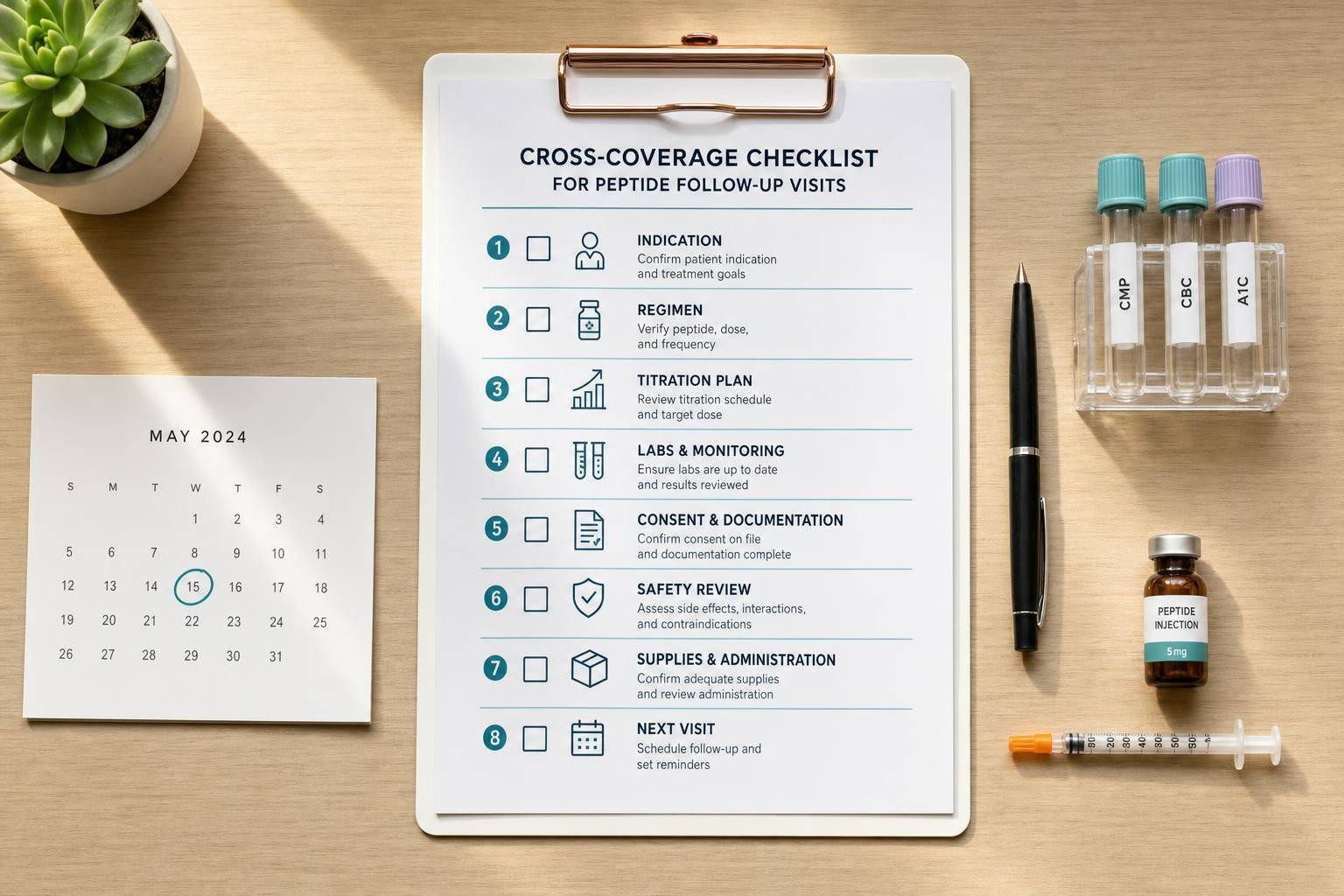
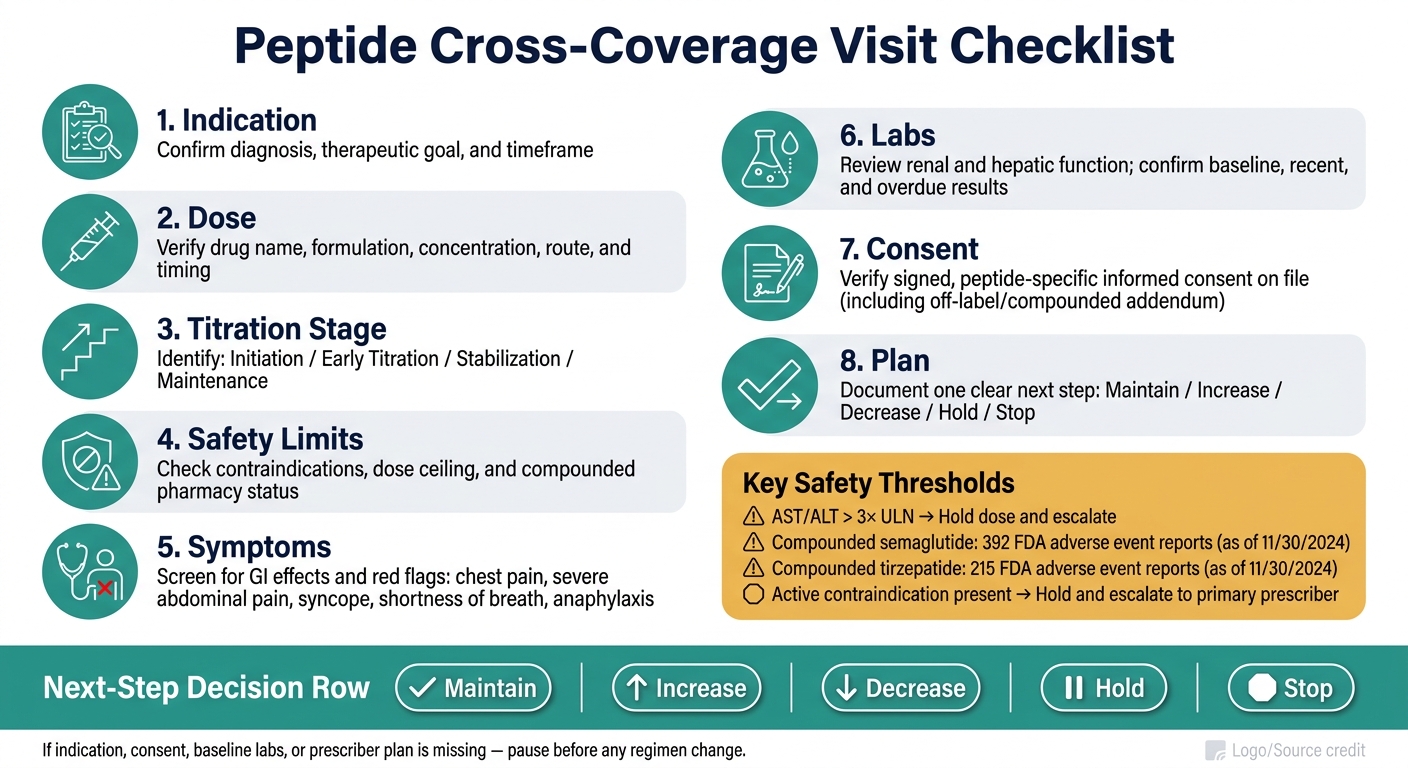
If I’m covering a peptide follow-up, I should not start with the refill. I should start with eight checks: indication, dose, titration stage, safety limits, symptoms, labs, consent, and plan.
That’s the whole point of this article. It lays out a simple visit order that cuts down chart gaps and unsafe dose changes. It also makes clear when I should continue, hold, titrate, or send the case back to the main prescriber.
Here’s the short version:
- I confirm the patient, diagnosis, treatment goal, and why the peptide was prescribed.
- I verify the full regimen: drug name, formulation, concentration, route, dose, timing, and last change.
- I check where the patient is in titration: initiation, early titration, stabilization, or maintenance.
- I screen for side effects, response, and red flags like chest pain, severe abdominal pain, shortness of breath, syncope, or anaphylaxis.
- I review labs before changing the dose, especially if kidney or liver results are drifting.
- I make sure consent is on file, with added review for off-label or compounded products.
- I finish with one clear next step: maintain, increase, decrease, hold, or stop.
A few numbers stand out. The article notes that, as of 11/30/2024, the FDA had received 392 adverse event reports tied to compounded semaglutide and 215 tied to compounded tirzepatide. It also points out one lab threshold that should stop the visit from turning into a dose increase: AST/ALT above 3× ULN.
What I like about this checklist is that it keeps the visit tied to charted facts, not memory. If the indication, baseline labs, consent, or prior prescriber plan is missing, I should pause before making any regimen change.
If I had to boil the full article down to one line, it would be this: verify the plan before I touch the dose.
Peptide Follow-Up Cross-Coverage Checklist: 8-Step Visit Framework
1. Visit Snapshot and Handoff Summary
Use this section to lock in the visit’s clinical facts before you look at dose or symptoms. Center the visit on the treatment goal, not a simple refill request. Once the snapshot checks out, move to the current regimen and safety limits.
Patient Identifiers, Diagnosis, and Peptide Indication
Verify two identifiers: name plus DOB or MRN. Add a third only if it’s already in the chart. Also confirm the encounter type: in person, telehealth video, or telephone.
Then confirm three items in this order: the core diagnosis, the peptide indication, and the measurable treatment goal. This matters. A vague indication creates problems fast when another clinician is covering. Write the indication as diagnosis + therapeutic goal + timeframe. If there’s no measurable endpoint, stop and verify it before you review the regimen.
Document total time on therapy, any dose changes, and any interruptions with the reason for each one. Flag comorbidities that change today’s decisions: cardiovascular disease, chronic kidney disease, history of pancreatitis, active malignancy, or pregnancy plans can all affect how aggressively you manage the visit.
| Verification Item | What to Confirm |
|---|---|
| Patient Identifiers | Full name, DOB, MRN, and a third identifier only when already documented |
| Core Diagnosis | Clinical indication with a measurable endpoint |
| Peptide Indication | Specific reason for therapy, not a generic label like recovery or injury |
| Regulatory Status | Approved on-label, approved off-label, compounded, or investigational |
| Treatment Goal | Documented endpoint and expected timeframe |
| Therapy Duration | Start date, dose changes, and any interruptions with reasons |
| Titration Stage | Loading phase, effect evaluation, or maintenance |
| Safety-Relevant Comorbidities | Conditions that affect dosing, labs, or safety thresholds |
| Primary Prescriber / Comanaging Specialists | Prescriber name, credentials, clinic, and any active comanaging specialists |
If any item in the table is missing, verify it before reviewing the dose.
SBAR-Style Cross-Coverage Note
Turn the snapshot into a short handoff note using SBAR. SBAR - Situation, Background, Assessment, Recommendation - is a brief handoff format used in healthcare to cut communication failures during transitions of care. For peptide cross-coverage, it helps keep the note short, clear, and action-focused.
Use this four-line template:
- Situation: Who you are covering for, the patient's reason for today's visit, and any new symptoms or concerns.
- Background: Age, sex, peptide and indication, current dose and titration stage, prior adverse events, and active comanaging specialists.
- Assessment: Current tolerability, outstanding labs, and any clinical concerns relevant to today's decision.
- Recommendation: Continue, hold, titrate, order labs, or escalate - with any follow-up flagged to the primary prescriber.
Put the primary prescriber’s requested action in the Recommendation line. Tie each decision to any documented protocol.
If the snapshot is missing indication, consent, baseline labs, or prescriber intent, stop and verify those items before making regimen decisions.
sbb-itb-7164bd9
2. Current Peptide Regimen, Titration Stage, and Safety Limits
Once the handoff is clear, confirm the medication details first. Do that before you get into symptoms or labs. Check the start date, the most recent dose change, and the last administration time.
Peptide Name, Dose, Formulation, and Titration Stage
Verify the peptide name, formulation, concentration, route, frequency, dose, and last change as one set of details. If even one piece is off, the patient can end up underdosed or overdosed. This matters even more with compounded products, where reconstitution mistakes and unit-conversion mix-ups can happen.
Document the titration stage clearly: initiation, early titration, stabilization, or maintenance. Then record the planned next step: hold, continue, increase, or decrease, along with the intended next dose. If the chart doesn’t spell out the next move, hold at the current dose and flag it for the primary prescriber.
| Regimen Detail | What to Confirm |
|---|---|
| Peptide name, formulation, concentration, and route | Generic name, product type (prefilled pen, vial, compounded, or other), mg/mL or mcg/mL, and route of administration |
| Current dose, frequency, and timing | Dose in mg or mcg, schedule (daily, weekly, PRN), start date, last dose change, and last administration time |
| Titration stage | Initiation, early titration, stabilization, or maintenance |
| Next planned dose | Specific dose, criteria for advancing, and any reason to defer |
| Primary prescriber's dose ceiling | Maximum allowable dose; any "do not exceed" instruction |
After you’ve confirmed the current dose and titration stage, move to the factors that can change today’s plan: symptoms, co-therapies, and contraindications.
Concomitant Therapies, Prior Adverse Events, and Contraindications
Review all active medications before making any dose decision. Other glucose-lowering drugs - especially insulin or sulfonylureas used with GLP-1 agents - can push hypoglycemia risk higher. Also check for other weight-loss drugs, antiemetics, steroids, anticoagulants, and supplements that may affect monitoring or make symptoms harder to read.
Ask plainly about adverse events since the last visit. If nausea, vomiting, or poor oral intake is still going on, do not advance the dose. Document when the symptom started, how bad it was, how long it lasted, and whether it improved after the dose was held or reduced.
Confirm contraindications as well:
- Pregnancy
- MTC/MEN2 history
- Severe gastroparesis
- Prior pancreatitis
- Major GI motility disorder
For growth hormone–axis peptides, stop for active malignancy or recent cancer treatment. And if the chart lists a maximum dose, treat that as a hard stop.
With compounded formulations, verify the pharmacy’s 503A or 503B status and confirm that the preparation does not contain non-standard additives. Analyses of compounded GLP-1 products have found peptide-related impurities that may trigger anti-drug antibody formation, reduce drug effectiveness, or neutralize native GLP-1. As of November 30, 2024, the FDA had received 392 adverse event reports involving compounded semaglutide and 215 involving compounded tirzepatide.
If any contraindication is present, hold the change and escalate to the primary prescriber.
Reference Tools for Unfamiliar Peptides
If the peptide is unfamiliar, open the monograph, confirm the protocol, and verify the unit conversion before making any dose adjustment.
3. Symptom Review, Response Assessment, and Adverse-Effect Screening
After you confirm the dose and titration stage, the next job is simple: figure out whether the patient is getting better, staying the same, or getting worse. That response category should guide whether you maintain the dose, change it, or hold the peptide.
Changes Since the Last Visit and Indication-Specific Response
Start with a plain question: "What changed since the last visit or dose change?" Then drill into the reason the peptide was prescribed. The follow-up questions should fit the treatment goal.
For weight management, ask about appetite, satiety, portion size, craving frequency, and weekly weight trend. A meaningful response may sound like this: the patient reports less hunger, fewer late-night snacking episodes, and a 6–8 lb loss over 4 weeks. For metabolic health, focus on fasting glucose patterns, postprandial glucose, energy stability, dizziness, shakiness, and any medication changes that may shift glycemic risk. For recovery, pain, or sleep-related goals, ask about function, exercise tolerance, morning soreness, sleep quality, and day-to-day performance.
Write down concrete indicators whenever you can - "walking 30 minutes daily, up from 10 minutes" or "evening snacking down from nightly to twice weekly" - instead of vague notes like "patient feels better." That level of detail makes the handoff note much more useful for the primary prescriber.
Also, document a specific next step rather than leaving the follow-up open-ended.
| Indication | Response Signals to Assess |
|---|---|
| Weight management | Appetite, weight trend, cravings, GI tolerance |
| Metabolic health | Glucose trend, energy, cognitive clarity, stability |
| Growth hormone–axis therapy | Sleep, recovery, body composition |
| Injury recovery | Pain, range of motion, function |
| Sexual function | Onset, duration, benefit |
Use the response category to guide today’s dose decision.
Common Adverse Effects and Red-Flag Events
Once you document response, check tolerability. GI effects are common during titration, but they need attention if they persist, limit dosing, or affect intake, hydration, or daily function.
Ask directly about symptoms since the last visit or dose change, including:
- nausea, vomiting, diarrhea, constipation, abdominal pain, reflux, bloating, fatigue, dizziness, headache, or injection-site reactions
- edema, palpitations, mood changes, sleep problems, and hypoglycemia symptoms such as shakiness, sweating, confusion, or palpitations
For each symptom, ask whether it is improving, stable, or worsening. If the patient is rotating injection sites correctly and still has local reactions, flag that. Repeated reactions may point to a product, storage, mixing, or technique problem instead of routine irritation.
Red-flag events require a different response entirely. Ask whether the patient has had urgent care, ED, or hospitalization since the last appointment. Then screen for severe or persistent abdominal pain, especially pain that radiates to the back; inability to keep fluids down; syncope; chest pain; shortness of breath; marked edema; severe hypoglycemia; confusion; or acute mood or psychiatric worsening. Any of these should prompt holding the peptide and escalating care.
Mild nausea that fades within a day or two after a dose increase is expected. Repeated vomiting with signs of dehydration, or abdominal pain that does not resolve, is not. If the severity is unclear, hold the peptide and escalate.
Document the response category before moving to labs, consent, and the next-step plan.
4. Labs, Consent, Documentation, and Next-Step Plan
After the symptom review, make sure the chart backs up today’s dose decision and the handoff.
Lab Status and Lab-Dependent Decisions
If the symptom check looks acceptable, use the lab data to confirm the dose plan.
Confirm the required labs, the result, units, reference range, collection date, and status: on file, pending, or overdue. Track baseline, recent, and overdue labs, and repeat them at set intervals based on protocol.
Use labs to confirm whether to continue, hold, or titrate. If the patient’s response is improving and renal and hepatic function stay stable, continue titration. If creatinine or transaminases are trending up, hold the current dose and recheck in 4–6 weeks. If AST/ALT go above 3× ULN, hold and escalate.
Check current FDA removal notices before continuing therapy. This matters more than people think. Examples include BPC-157, Semax, Epitalon, Dihexa, LL-37, injectable GHK-Cu, and KPV. If the peptide appears on a current notice, hold therapy and send the decision back to the primary prescriber.
Consent, Note Completeness, and Orders
Once the labs support the plan, verify consent and documentation before signing.
Confirm that a signed, peptide-specific informed consent is on file. The consent should cover the indication, expected benefits, material risks, off-label or compounded status, monitoring needs, and the patient’s responsibilities.
Refresh consent when there’s a trigger, such as:
- A new diagnosis
- A compounded switch
- A major dose escalation
- A higher-risk regimen
If the patient is using a compounded peptide, add the compounded-medication addendum and verify the pharmacy’s licensing and release testing before signing off.
"Informed consent is where peptide education becomes real clinical risk management." - PeptidePrescriber
Before closing the note, reconcile new allergy reactions, active diagnoses, and all orders. Check that every order - labs, referrals, refills - is entered with clear timing, such as "CMP in 4 weeks." Document that written and verbal instructions were given, including dosing changes, injection technique reminders, and when to seek urgent care.
Post-Visit Plan and Communication Back to the Primary Prescriber
With the note complete, state the next step in one line: maintain, titrate, de-escalate, hold, or discontinue. Add the follow-up timing, needed labs, any referrals, and patient education points.
Avoid open-ended follow-up. Fixed intervals - every 3 months for maintenance and monthly during active titration - help prevent the chart from turning into a rolling refill with no clinical decision behind it.
Send a brief SBAR update with the peptide and dose, today’s decision, key labs, and any unresolved items. Flag anything still open - a pending lipase result, a consent that needs updating, or a borderline lab. If you’re unsure about a regulatory or sourcing issue, say that directly instead of leaving it hanging.
Conclusion: A simple checklist that makes peptide cross-coverage safer
Once the labs, consent, and orders are on file, the checklist becomes the handoff record.
Peptide cross-coverage should never be improvised. It needs to follow a fixed sequence: diagnosis and indication, regimen and titration stage, symptoms and contraindications, labs and consent, then the next-step plan.
If you're dealing with a peptide you don't know well, pause and check the source material first. Use clinical resources for peptide-prescribing professionals, including monographs, dosing protocols, and calculators, and injection guides before you lock in the plan. That keeps the visit tied to the charted plan, not anyone's memory.
The aim is simple: a clear, traceable plan that the primary prescriber can review and act on right away.
FAQs
When should I avoid titrating the dose?
Avoid titration if the patient has clear lab changes from baseline. That includes rising liver or kidney markers, hematocrit that stays above 52% to 54%, or IGF-1 above 300 ng/mL.
You should also avoid titration if the patient isn’t tolerating the current dose, can’t complete the required monitoring, or has already met the stop criteria set at initiation.
And one more thing: do not increase the dose because a patient is pushing for it.
What should I do if baseline labs or consent are missing?
If baseline labs or consent are missing, do not prescribe until informed consent for the specific peptide therapy is on file and the right baseline labs are done.
Document both the clinical reason for treatment and the actual consent discussion in the chart. A generic waiver or signature by itself is not enough.
Then:
- Order baseline labs
- Set a follow-up visit to review the results
- Decide whether to continue, adjust, or stop treatment
How should I handle compounded peptide follow-ups?
Prioritize safety monitoring and clear documentation. Make sure the patient is keeping up with the visit schedule, check for adverse events and injection-site issues, review progress against baseline goals, and use lab results to guide decisions, including pausing or stopping therapy when red-flag findings show up.
Document the updated clinical rationale, current symptoms, and a clear next-step plan. Also confirm that informed consent is on file, including the required compounded-medication disclosure.