
Brain insulin helps tell you when to stop eating. But based on current human data, it is not a stand-alone path to lasting weight loss.
If I had to boil this review down fast, I’d say this:
- Insulin works in the brain, not just the blood.
- In the hypothalamus, it helps turn down hunger signals and support fullness after meals.
- It also acts in reward areas like the VTA and nucleus accumbens, where it can lower drive for high-calorie foods.
- In obesity and type 2 diabetes, the brain may become less responsive to insulin, even when blood insulin is high.
- Human intranasal insulin studies show mixed short-term appetite effects and no steady long-term weight-loss result so far.
That matters in practice. It helps explain why some patients feel hungry even with insulin resistance, high insulin levels, or careful diet changes. It also helps frame obesity as brain-and-body biology, not just self-control.
Here’s the short version of what this review supports:
- Mechanism: Brain insulin is part of satiety control.
- Animal data: Direct CNS insulin lowers food intake and body weight.
- Human data: Intranasal insulin can lower intake in some settings, but results vary by sex, age, BMI, and metabolic status.
- Clinical use today: Interesting physiology, but not ready for routine treatment use as a standard peptide therapy.
- Main gap: We still do not know who will respond, how to measure brain insulin sensitivity in clinic, or whether short-term appetite shifts turn into better long-term outcomes.
A few numbers stand out:
- Higher brain insulin sensitivity was linked to 7.2 kg more weight loss and 1.3 L less visceral fat in one lifestyle-intervention line of research.
- In obesity, insulin transport across the blood-brain barrier may fall by about 45%.
- In one randomized crossover trial, intranasal insulin cut calorie intake by 11.7% or about 168.74 ± 54.33 kcal.
Quick Comparison
| Area | What the review says | What it means for you |
|---|---|---|
| Brain satiety signaling | Insulin helps reduce hunger and support fullness | Hunger control is partly neurologic |
| Reward eating | Insulin can blunt reward response to palatable food | Cravings may involve brain insulin signaling |
| Obesity/T2D | Brain insulin resistance may weaken satiety signals | High blood insulin does not always mean good appetite control |
| Intranasal insulin | Short-term effects are mixed; long-term weight effects are weak | Not a standard obesity treatment |
| Peptide care | GLP-1 and amylin act on overlapping appetite circuits | These treatments may work even when insulin signaling is blunted |
So if you’re looking for the plain answer: yes, brain insulin is a satiety signal; no, current evidence does not support using that pathway alone as a routine long-term weight-loss strategy.
Below, I’d read the rest of the article as a clinical map: how the signal works, where it breaks down, what human trials show, and why this topic still matters for obesity care.
sbb-itb-7164bd9
Core Physiology: How Brain Insulin Regulates Satiety and Food Intake
Insulin doesn't just work in the bloodstream. It also acts in the brain as a signal that helps curb appetite. After you eat, insulin crosses the blood-brain barrier and reaches hypothalamic areas such as the ARC, PVH, and VMH. There, it works as a short-term satiety signal and also as a longer-term sign of the body's energy state.
This starts in the brain's hypothalamic satiety circuits, with the ARC, PVH, and VMH doing much of the heavy lifting.
Hypothalamic Circuits: Arcuate, Paraventricular, and Ventromedial Nuclei
The arcuate nucleus (ARC) is one of the main places where insulin helps control eating. It contains two key neuron groups:
- NPY/AgRP neurons, which push hunger
- POMC/CART neurons, which support satiety
Insulin lowers food intake by turning down NPY/AgRP signaling, turning up POMC/CART activity, and increasing α-MSH output to melanocortin receptors in downstream regions like the PVH. In animal models, direct insulin delivery to the brain lowers AgRP/NPY expression in the ARC and increases POMC mRNA, and those shifts line up with lower food intake.
Signals from the ARC then move on to the PVH and VMH. These circuits tie satiety to autonomic output, glucose handling, and energy expenditure.
Extra-Hypothalamic Effects on Reward and Food Motivation
Insulin also affects the brain's reward system. In the VTA and nucleus accumbens (NAc), it softens reward responses to palatable, energy-dense foods when energy is already plentiful. That matters because eating isn't only about fuel. Part of it is pleasure, habit, and cue-driven desire.
Human intranasal insulin studies found weaker reward signaling in the NAc and VTA, lower preference for high-calorie cues, and less connectivity between these regions. In the insula, insulin changes taste and interoceptive responses, which can cut cue-triggered craving and strengthen satiety. If insulin signaling in the VTA-NAc pathway is impaired, hedonic drive can stay high even when circulating insulin is also high.
These brain-level effects work side by side with gut hormones that help bring a meal to a stop.
How Brain Insulin Interacts With Peripheral Signals After Meals
Brain insulin is part of a larger system. During a meal, gut-derived hormones like CCK, GLP-1, and PYY send signals through vagal afferents and direct central pathways to help end the meal. Insulin and leptin boost these short-acting satiation signals in ARC circuits, making the brain more responsive to fullness cues when energy stores are in good shape.
The timing is different across signals, and that timing matters:
- CCK, GLP-1, and PYY help stop the meal within minutes
- Postprandial insulin helps reinforce satiety over hours
- Basal insulin and leptin reflect longer-term energy stores
When central insulin resistance sets in, this layered system starts to fail. Insulin becomes less able to suppress NPY/AgRP activity, support POMC/CART signaling, or tone down reward-related responses to food cues. The result is weaker meal termination, less post-meal fullness, and less reward suppression, all of which can support persistent hunger and weight regain even when circulating hormone levels are high.
Animal models and intranasal insulin trials test these pathways directly. For clinicians, our clinical guides provide practical details on peptide administration and handling.
Evidence Review: Animal Models, Human Intranasal Insulin Trials, and CNS Insulin Resistance
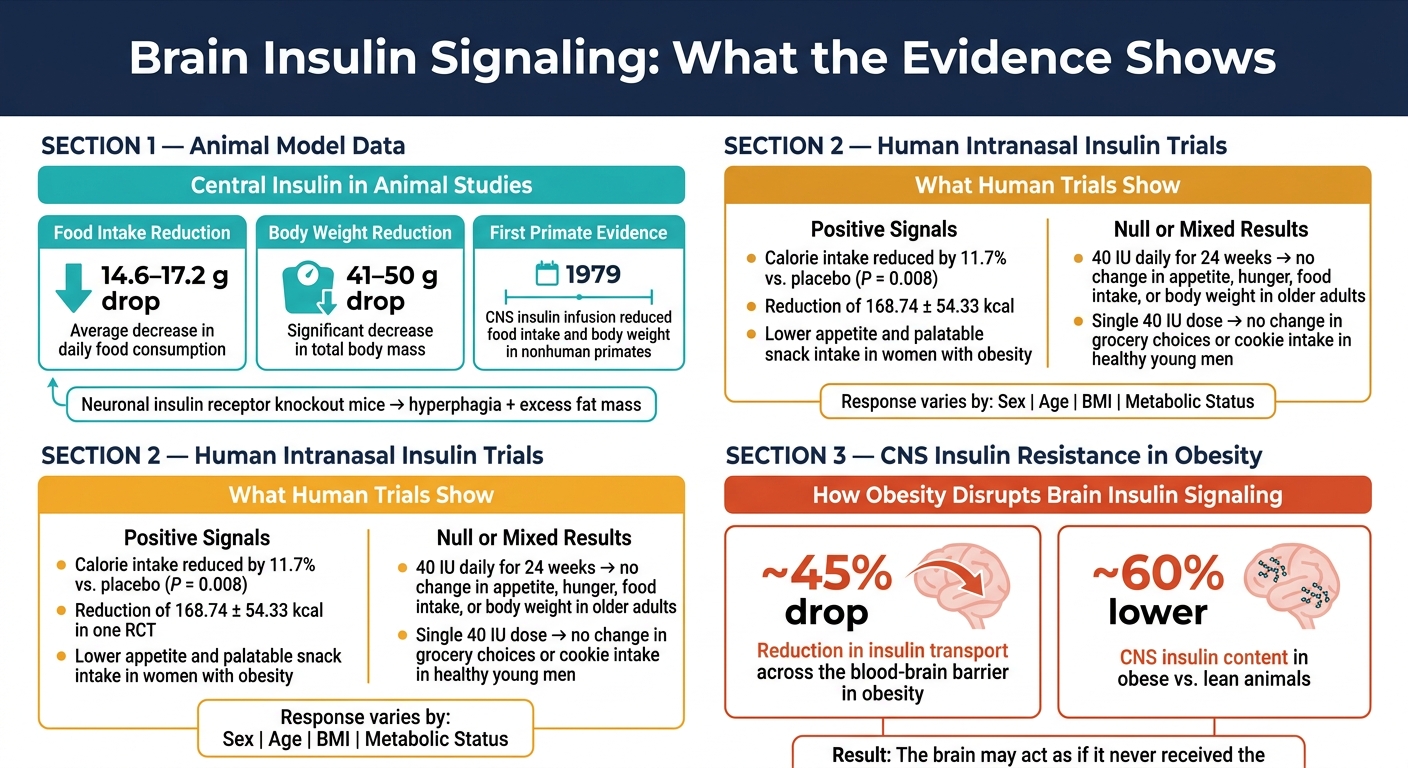
Brain Insulin Signaling vs. CNS Insulin Resistance: Key Clinical Data
Animal Studies of Central Insulin Action
Animal research gives a pretty direct read on what central insulin does. When insulin was delivered straight into the CNS in rats, both food intake and body weight went down. Intake dropped by about 14.6 to 17.2 g, and body weight fell by 41 to 50 g, across both diet conditions.
When that brain insulin signaling system is impaired, the pattern flips. Neuronal insulin receptor knockout mice become hyperphagic, gain more fat mass, and show elevated leptin levels. Put simply, normal central insulin signaling appears to be required for stable energy balance. Early primate data point the same way. Back in 1979, insulin infused into the CNS of nonhuman primates reduced both food intake and body weight.
Human intranasal insulin studies aim to test this same pathway without triggering peripheral hypoglycemia.
Human Intranasal Insulin Studies on Appetite, Satiety, and Intake
Intranasal insulin (INI) is the main tool used to study central insulin action in humans without driving down blood glucose systemically. In acute post-meal studies, the results often show lower intake. In one randomized crossover trial, INI reduced total calorie intake by 11.7% versus placebo. That came out to 168.74 ± 54.33 kcal, with P = 0.008, and it happened without any change in subjective hunger ratings.
Other postprandial studies in women found lower appetite and lower intake of palatable snacks. Those effects were stronger in women with obesity than in lean women.
That said, the picture is not always neat. Some short-term studies and longer trials have shown little or no effect. Daily INI at 40 IU for 24 weeks in older adults, including those with and without type 2 diabetes, did not change appetite, hunger, food intake, or body weight. In healthy young men, a single 40 IU dose also did not change virtual grocery choices or cookie intake compared with placebo.
So the response doesn’t look one-size-fits-all. It seems to shift with sex, age, BMI, and metabolic status.
CNS Insulin Resistance in Obesity and Metabolic Disease
CNS insulin resistance means the brain responds less to insulin even when circulating insulin levels are adequate. The problem appears to involve two main bottlenecks: less insulin gets across the blood-brain barrier (BBB), and insulin receptor function and downstream signaling are reduced.
In obesity, insulin transport across the BBB drops by roughly 45%, and CNS insulin content in obese animals is lower by about 60%. That helps explain a frustrating pattern: after eating, satiety signals can come in weak even when insulin in the bloodstream is high.
CNS insulin resistance also tends to show up alongside leptin resistance, which makes sense because the two systems share transport and signaling problems. Elevated triglycerides may add to both issues by crossing the BBB and impairing receptor function. In plain English, the brain can start acting as if it isn’t getting the “you’ve had enough” message, even when insulin levels are already high.
Clinical Interpretation for Weight Management and Peptide-Based Care
What the Evidence Supports for Current Clinical Practice
In clinical care, the main question isn't whether brain insulin can curb appetite. It's whether that effect leads to lasting weight loss.
Right now, the evidence says brain insulin signaling is a real satiety signal. But it does not support it as a stand-alone treatment target for lasting weight loss. Acute intranasal insulin can lower meal intake. Still, longer trials have not shown lasting shifts in body weight or body composition. That same pattern shows up across study groups: short-term satiety outcomes and long-term outcomes like body weight and eating patterns are not the same thing. In practice, they shouldn't be treated as if they are.
That matters when you compare insulin-pathway biology with GLP-1- and amylin-based therapies.
In day-to-day practice, brain insulin physiology is most helpful as a way to explain what many patients already feel. Some have intense hunger despite high circulating insulin levels. Others find calorie restriction far harder than expected after years of obesity. This model helps make sense of that experience without suggesting there's a simple fix.
How Brain Insulin Pathways Fit Into Peptide-Based Metabolic Models
GLP-1, amylin, and insulin all act on overlapping hypothalamic and brainstem circuits. GLP-1- and amylin-based therapies work through overlapping satiety pathways, which helps explain why they tend to produce stronger weight-loss effects than insulin-pathway manipulation alone. Patients with long-standing obesity and likely CNS insulin resistance may still respond well to GLP-1 receptor agonists because those pathways can remain partly intact even when hypothalamic insulin signaling is blunted.
Brain insulin concepts also help explain why insulin therapy doesn't conflict with insulin's anorexigenic CNS role. Peripheral hyperinsulinemia, hypoglycemia risk, and behavioral adaptation can offset central satiety signaling. The mechanism is there, but the clinical result depends on much more than a single pathway.
Using Structured Clinical Resources to Evaluate Emerging Data
The literature on central insulin signaling moves fast, and not all of it carries over neatly into practice. Intranasal insulin is still investigational, and long-term dosing and safety are not well characterized for routine use. Clinicians need a clear way to separate mechanistic interest from evidence they can actually use.
For clinicians reviewing new peptide data, structured resources can help sort mechanism from practice. PeptidePrescriber provides licensed healthcare professionals with peptide monographs, dosing protocols, clinical calculators, injection guides, regulatory references, and prescriber-network support for evaluating emerging metabolic data.
Conclusion: Key Takeaways and Research Gaps
Taken together, the mechanistic and clinical data point to one clear idea: brain insulin helps signal satiety, reflects long-term energy stores, and influences reward-driven eating. But there’s a catch. Its clinical use seems to depend on whether the CNS still responds to insulin as it should.
CNS insulin resistance makes the picture much messier. In obesity and type 2 diabetes, lower brain insulin transport and weaker signaling may push hunger up and make weight gain more likely. What we still don’t know is the direction of that link. Does CNS insulin resistance help cause obesity? Does obesity lead to CNS insulin resistance? Or do both feed into each other? That unresolved question sits at the center of this research gap. It also helps explain why appetite control can break down in obesity and type 2 diabetes, even when insulin levels in the blood are high.
Human intranasal insulin trials have produced mixed results. Effects seem to vary by sex, baseline adiposity, dose, and duration. And while some short-term findings look promising, durable weight loss has not shown up in a consistent way. The evidence base is still small, short in duration, and drawn mostly from European populations, which limits direct U.S. use. For clinicians, the message is pretty simple: the signal matters, but it’s not ready for routine treatment use.
Priority Questions for Future Research
Four practical questions stand out:
- How can CNS insulin sensitivity be measured in a reliable way in clinical settings? Possible tools include functional imaging, extracellular vesicle markers, and blood-based epigenetic signatures. But none has been validated for routine use yet.
- Which patients are most likely to respond? Sex, baseline adiposity, metabolic status, and reward-signaling differences may help explain why trial results have been so uneven.
- Do any benefits last for months or years? A short-term drop in appetite doesn’t always lead to lasting weight loss or better cardiometabolic outcomes.
- Can brain insulin biology help guide peptide-based obesity care? GLP-1 receptor agonists work on overlapping central appetite pathways, but firm evidence on combined or sequential strategies is still missing.
For now, central insulin signaling looks like a promising mechanism rather than a routine treatment target. The evidence is strong enough to take seriously, but not strong enough for standard clinical use.
FAQs
What is brain insulin resistance?
Brain insulin resistance happens when the brain stops responding the way it should to insulin in the bloodstream. Under normal conditions, insulin crosses the blood-brain barrier and helps control long-term feelings of fullness.
When that signal weakens, as it often does in obesity, the hypothalamus has a harder time dialing down hunger and keeping energy balance in check. That can make weight management a lot harder.
Why doesn’t brain insulin cause lasting weight loss?
Brain insulin helps tell the hypothalamus how much energy the body has stored, but on its own, it doesn’t lead to lasting weight loss. Obesity is tied to long-term biological shifts that push back against weight loss.
When calorie intake goes down, hunger signals such as ghrelin go up, while fullness signals like insulin and leptin go down. At the same time, resting metabolic rate slows. Put those changes together, and weight regain becomes likely unless the underlying metabolic dysregulation is managed over the long term.
Who may respond to intranasal insulin?
The sources provided do not point to any specific patient groups that may respond to intranasal insulin.
Instead, they focus on other parts of the insulin picture:
- endogenous insulin and its role in long-term satiety
- the clinical use of exogenous insulin alongside other peptide medications
- metabolic monitoring in people with insulin resistance
So if you're looking for source-backed guidance on which patients may respond to intranasal insulin, that information isn't identified here.