
Calcitonin and amylin use shared regions of the calcitonin receptor (CTR), not separate binding sites. The key difference is receptor makeup: calcitonin activates CTR alone, while high-affinity amylin binding generally requires CTR paired with one of 3 RAMP proteins.
Both peptides attach their C-terminal end to the receptor’s outer domain and engage its transmembrane core with their N-terminal end. RAMPs change this shared binding surface and can affect receptor availability and signaling.
Quick Comparison
| Feature | Calcitonin | Amylin |
|---|---|---|
| Receptor | CTR; also acts at CTR–RAMP complexes | Mainly CTR–RAMP complexes |
| RAMP role | Not required for CTR activation | RAMP1, RAMP2, and RAMP3 form AMY1, AMY2, and AMY3 |
| Binding pattern | C-terminal docking; N-terminal activation | Same general pattern, shaped by the RAMP partner |
| Cross-receptor activity | Salmon calcitonin can activate CTR and AMY receptors | AMY1 can also respond strongly to CGRP |
Compare the exact peptide, receptor species, CTR splice variant, RAMP subtype, and assay - not just the reported number. Binding strength, the concentration needed for a response, and maximum response are different measurements. None alone establishes clinical interchangeability.
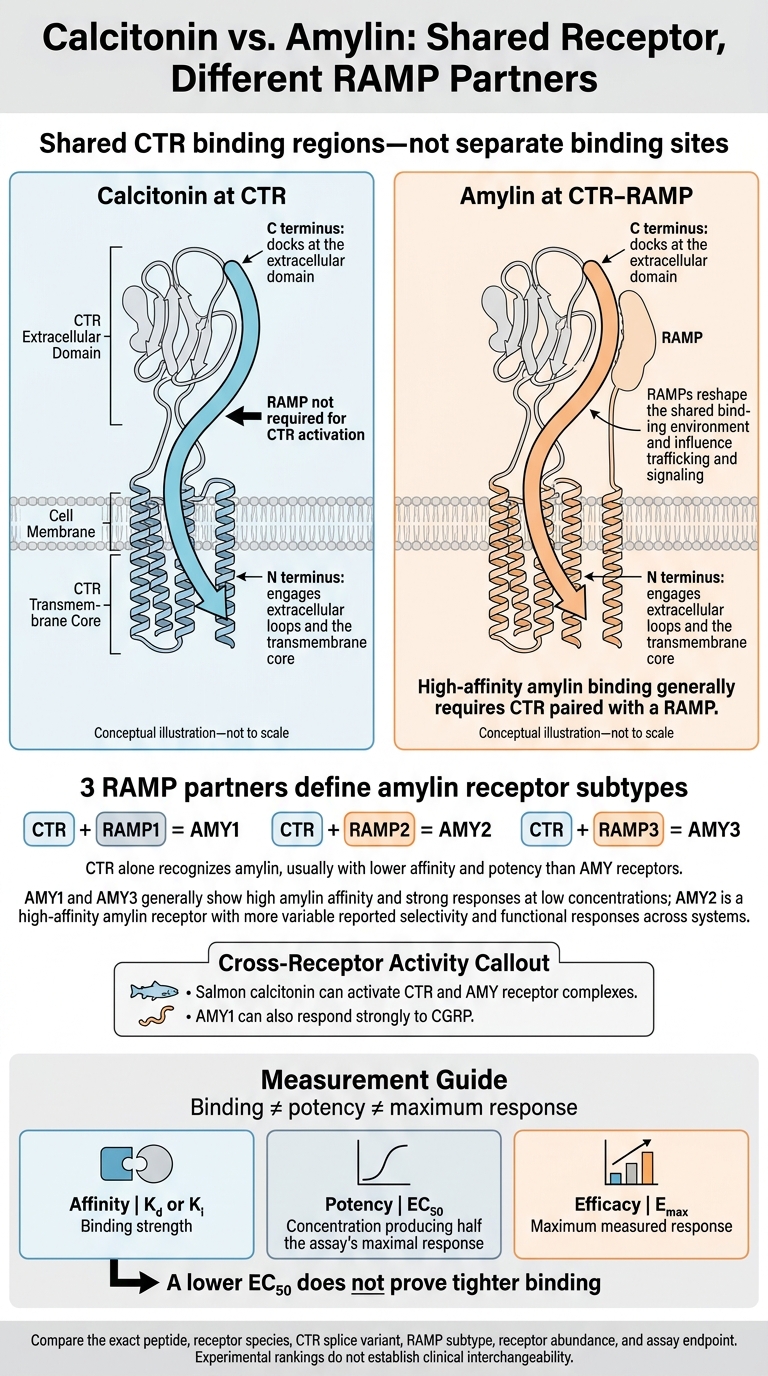
Calcitonin vs. Amylin: Shared Receptor, Different RAMP Partners
Structural basis for amylin receptor phenotype - How do peptides activate AMYRs? (animated + music)
sbb-itb-7164bd9
How Calcitonin Binds to CTR
CTR alone provides a baseline for understanding peptide therapy and where calcitonin binds before RAMPs change the receptor surface. CTR couples mainly to G_s, so cAMP is the standard functional readout. Experiments without RAMPs help separate CTR’s own behavior from the effects of RAMP association.
Extracellular Recognition and Transmembrane Activation
Calcitonin contacts the extracellular domain and transmembrane core in a single binding event. Its C-terminal region anchors to the extracellular domain, while its N-terminal region engages extracellular loops and the upper transmembrane region to favor activation.
Structural studies map these contacts; functional assays test whether they drive activation. The structures show an extended hydrophobic binding pocket and outward movement near the extracellular ends of transmembrane helices 6 and 7. The receptor rearranges during binding - the pocket isn’t fixed. Cryo-EM shows the contacts, while cAMP assays measure signaling.
Human vs. Salmon Calcitonin Selectivity
Similar sequences don’t guarantee the same receptor behavior. Human and salmon calcitonin share approximately 50% amino acid sequence identity, but their residence times and receptor preferences can differ. The table shows reported patterns, not a universal ranking.
| Peptide | CTR without RAMP | CTR–RAMP amylin receptors | Interpretation limits |
|---|---|---|---|
| Human calcitonin | Activates CTR alone. | Activity changes after RAMP association; specify the receptor complex and assay. | CTR-only data do not establish amylin-receptor selectivity. |
| Salmon calcitonin | Activates CTR and can produce longer signaling in human systems. | Can activate amylin receptor complexes in vitro, with limited selectivity across receptor contexts. | Results depend on RAMP subtype, receptor construct, species, expression level, and endpoint. Avoid universal affinity claims. |
Before comparing values, check the receptor species, splice variant, RAMP subtype, and assay endpoint. Also, keep binding constants (K_d or K_i) separate from functional EC_50 values. Signal amplification can lower EC_50 without tighter binding, and longer signaling does not establish higher equilibrium affinity.
How RAMPs Form Amylin Receptors
Amylin receptors form when CTR pairs with a RAMP. CTR supplies the binding scaffold, while the RAMP adjusts recognition, trafficking, and signaling. Calcitonin binds directly to CTR, but amylin’s receptor behavior depends on which RAMP is present. The same peptide can therefore act differently at CTR alone and at CTR–RAMP complexes.
AMY1, AMY2, and AMY3 Composition
The RAMP partner determines the receptor subtype. The table separates binding affinity from downstream response - two measurements that don’t always tell the same story.
| Composition | Receptor identity | Typical amylin pharmacology | Evidence limits |
|---|---|---|---|
| CTR without a RAMP | Calcitonin receptor | Recognizes amylin, usually with lower affinity and potency than AMY receptors. | Results depend on CTR splice variant, species, expression level, receptor density, and assay conditions. Ligand binding alone does not prove strong signaling. |
| CTR–RAMP1 | AMY1 | Generally high amylin affinity and strong responses at low concentrations. | Results depend on receptor composition and assay conditions. |
| CTR–RAMP2 | AMY2 | High-affinity amylin receptor, though reported selectivity and functional responses vary more across systems. | Binding and functional findings do not always agree. |
| CTR–RAMP3 | AMY3 | Generally high amylin affinity and strong responses at low concentrations. | RAMP3-dependent trafficking and assay-specific coupling can affect apparent potency and receptor abundance. |
High affinity, activity at low concentrations, and maximum response are separate findings. Report which was measured rather than treating them as interchangeable.
Where Amylin Contacts the Receptor
Amylin follows the same two-domain binding pattern as calcitonin. Its C terminus binds the extracellular domain, while its N terminus engages extracellular loops and the transmembrane core. Structural studies support a shared CTR–RAMP binding environment, not a separate RAMP-only pocket.
How RAMPs Shape Peptide Selectivity
RAMPs act as allosteric partners. Their extracellular domains sit beside CTR and reshape its binding surface. Their transmembrane helices also contact CTR, and the RAMP subtype affects surface delivery, recycling, and signaling.
To interpret tissue responses, check whether CTR and the relevant RAMP are present together at the cell surface. Detecting CTR mRNA alone does not establish an AMY subtype. A stronger response may also reflect more available receptors - not tighter binding.
These subtype differences provide context for the side-by-side binding comparison below.
Calcitonin vs. Amylin Binding: Side-by-Side Comparison
Calcitonin and amylin bind the same class B1 scaffold, but RAMP association changes the binding interface. The table shows what RAMPs change within that shared scaffold.
| Feature | Calcitonin at CTR | Amylin at CTR–RAMP complexes |
|---|---|---|
| RAMP requirement | Not required for activation | Generally needed for high-affinity amylin recognition |
| C-terminal recognition | Amidated C terminus (Pro) contributes to recognition and activity | Amidated C terminus (Tyr) is important; RAMPs may help position it |
| N-terminal activation contacts | Contacts near the transmembrane core promote activation | N-terminal and mid-peptide contacts stabilize activation |
| Receptor shape | CTR scaffold | Same scaffold, different ECD/RAMP geometry |
| Ligand selectivity | Salmon calcitonin can remain highly active at CTR–RAMP complexes | AMY1 can also respond strongly to CGRP |
These patterns reflect experimental pharmacology - not fixed rankings that apply across all receptor preparations. Binding differences also don't always translate into signaling differences.
Binding Affinity vs. Functional Response
Affinity (K_d or K_i) measures binding strength. Potency (EC₅₀) is the concentration that produces half the assay’s maximal response. Efficacy (E_max) is the maximum measured response.
A lower EC₅₀ does not prove tighter binding. Receptor density, signal amplification, ligand degradation, and assay conditions can all change apparent potency. How you interpret the results depends on how they were measured.
What Receptor Studies Can and Cannot Show
Structural studies map contacts in selected states. Binding assays measure association, while functional assays measure signaling. None alone proves clinical relevance.
Before comparing subtypes, check RAMP identity, CTR splice variant, ligand species, receptor abundance, and assay endpoint. Also check whether the study used engineered cells, native tissue, or an animal model. Assay rankings do not prove receptor equivalence, and experimental rankings do not establish clinical interchangeability among AMY1, AMY2, and AMY3.
Conclusion: CTR and RAMPs Shape Peptide Recognition
Within the shared two-domain binding model, CTR serves as the shared signaling core. RAMPs determine amylin receptor subtype and selectivity, so peptide recognition depends on the full CTR–RAMP complex.
Check Receptor and Assay Details
Binding depends on both the ligand and receptor context. Specify the exact peptide tested, since ligands can differ in affinity and activity. Record its sequence, peptide and receptor species, CTR splice variant, RAMP partner, and assay endpoint. Keep direct binding measurements separate from cAMP signaling or β-arrestin recruitment.
Binding affinity alone does not establish a functional response or clinical equivalence. Therapeutic claims need product-specific clinical evidence and label support. Assess recognition in the context of the full receptor complex.
PeptidePrescriber provides evidence-based peptide monographs and clinical references for licensed healthcare professionals.
FAQs
Can calcitonin and amylin compete for the same receptor?
Yes. Receptor selectivity is relative, not absolute. Calcitonin and amylin can compete for the same receptor, especially at higher concentrations. That competition may affect how cells respond.
But binding affinity doesn’t necessarily predict functional effects. Tissue type, receptor density, and local physiological conditions also help determine which signaling pathways are activated.
Can changing RAMP levels alter a cell’s amylin response?
Yes. Amylin receptors form when the calcitonin receptor pairs with a receptor activity-modifying protein (RAMP). The amount and type of RAMP available help determine which receptor complexes form and which peptides they respond to.
Changing RAMP levels can therefore change how a cell detects and responds to amylin compared with calcitonin.
How can researchers separate RAMP effects from receptor density effects?
Draw on evidence from several methods rather than relying on one assay: receptor density and receptor reserve can both amplify responses. Pair validated agonists and antagonists with functional recordings and genetic methods, such as knockdown or rescue experiments.
Compare systems using the same species, endpoint, concentration, and exposure duration. Document tissue access, too, to assess whether receptor-RAMP complex formation drives the response.