
If I understand the core peptide terms, I can predict three things fast: what a peptide does, how long it lasts, and where problems may show up.
That’s the whole article in plain English. Receptor terms explain the signal. PK/PD terms explain dose timing and drug exposure. Stability terms explain why one peptide lasts minutes while another lasts about 7 days.
Before I read any peptide protocol, I’d look for these points:
- Receptor + ligand: what the drug binds to
- Agonist type: full agonist, partial agonist, antagonist, or inverse agonist
- Affinity + selectivity: how tightly and how narrowly it binds
- Signaling path: GPCR, cAMP, calcium, PI3K/Akt, or MAPK/ERK
- PK terms: absorption, bioavailability, clearance, volume of distribution, and half-life
- PD terms: efficacy, dose-response, and therapeutic window
- Stability: enzyme breakdown, chemical breakdown, and half-life extension methods
A few facts make this easier to picture:
- Native GLP-1 lasts about 2 minutes
- Sermorelin has a half-life of about 10 to 20 minutes
- Semaglutide lasts about 152 to 185 hours and is dosed once weekly
- Oral peptide absorption is often less than 1% to 2%
- Intranasal peptide absorption may range from about 1% to 20%
Quick take: if receptor action looks strong, half-life looks short, and degradation looks fast, I’d expect tighter timing and more frequent dosing. If albumin binding or other half-life extension is built in, I’d expect fewer doses but a slower washout.
| Term group | What it tells me |
|---|---|
| Receptor biology | What effect starts |
| Signaling pathway | How that effect spreads in the cell |
| PK/PD | How much drug gets in and how long it acts |
| Stability | Why the effect is short or long |
So instead of reading a peptide protocol like a recipe, I’d read it like a cause-and-effect chain: binding → signaling → exposure → breakdown.
Receptor and ligand terms that define peptide mechanism
Receptor, ligand, and binding site
A receptor is a protein - most often on the cell surface - that receives a chemical signal and turns it into a cell response. It’s not just a place where something sticks. It acts more like a switch. For a protein to count as a receptor, binding has to trigger a downstream effect. If a molecule binds to a site and nothing happens after that, that site is not a receptor in the signaling sense.
A ligand is any molecule that binds to a receptor. That ligand can be endogenous, like native GLP-1, or synthetic, like semaglutide, which maintains 94% structural homology to native human GLP-1. The binding site is the exact part of the receptor where the ligand docks. Shape, charge, and local chemistry all help decide which ligands fit and how tightly they bind.
This gets much more useful once you look at where receptors are found in the body. GLP-1 receptors are expressed in the pancreas, GI tract, CNS, and heart. That distribution helps explain why GLP-1 agonists improve insulin secretion and reduce appetite. It also explains why nausea and delayed gastric emptying are predictable on-target effects. Sermorelin targets GHRH receptors in the anterior pituitary’s somatotroph cells, which is why its effects are self-limiting through somatostatin feedback.
| Peptide | Target Receptor | Key Tissue Locations | What This Predicts |
|---|---|---|---|
| Semaglutide | GLP-1 receptor | Pancreas, CNS, GI tract, heart | Glycemic control, satiety, GI side effects |
| Tirzepatide | GIP + GLP-1 receptors | Pancreas, adipose, CNS, GI | Broader metabolic effects, synergistic weight-loss and metabolic effects |
| Sermorelin | GHRH receptor | Anterior pituitary | Pulsatile GH release, IGF-1 production |
Agonist, partial agonist, antagonist, and inverse agonist compared
These four terms describe what happens after a ligand binds.
A full agonist activates a receptor to its maximum capacity, producing the strongest response that receptor can give. Tesamorelin is one example. It acts as a full agonist at the GHRH receptor, driving strong GH and IGF-1 production - enough to produce clinically significant visceral fat reduction in HIV-associated lipodystrophy.
A partial agonist binds the same receptor but does not push it to the maximum, even if every receptor is occupied. That ceiling can be useful, especially in more sensitive patients. But there’s a catch: if a partial agonist and a full agonist are both present, the partial agonist can compete for receptor occupancy and lower the total response.
An antagonist binds without activating the receptor. It blocks the endogenous ligand but does not send its own signal. An inverse agonist goes a step further. It stabilizes the receptor in an inactive state and can suppress even the baseline activity that some receptors produce on their own.
| Ligand Class | Receptor Effect | Clinical Effect Ceiling | Prescribing Implication |
|---|---|---|---|
| Full agonist | Maximum activation | High - strongest response | Titrate slowly; full adverse-effect potential |
| Partial agonist | Submaximal activation | Moderate - built-in cap | Useful in sensitive patients; can blunt full agonist if combined |
| Antagonist | No activation; blocks ligand | None (blocks signal) | Monitor for under-activity of the targeted system |
| Inverse agonist | Suppresses below baseline | Negative - reduces constitutive activity | Reserved for constitutively active receptor pathways |
Affinity, selectivity, desensitization, and downregulation
Affinity describes how tightly a ligand binds to its receptor. It’s often measured by the dissociation constant (K_d), where a lower K_d means tighter binding. Semaglutide binds the GLP-1 receptor with a K_i of about 0.38 nM, close to native GLP-1 at about 0.45 nM. In plain terms, that means strong binding at low doses. It also means receptor occupancy can last longer, which matters when a patient has an adverse reaction and the effect doesn’t fade right away.
Selectivity refers to how much a ligand prefers one receptor over related ones. Ipamorelin, for example, is highly selective for the GHS-R1a receptor while sparing other receptors, which helps explain its limited off-target endocrine effects. Tirzepatide shows the other side of the coin. Its dual GIP/GLP-1 agonism broadens the treatment effect, but it also broadens the side-effect surface and calls for closer follow-up.
Desensitization and downregulation are two common reasons a peptide may lose effect over time, even when dosing stays the same. They sound similar, but they’re not the same thing.
Desensitization is fast and reversible. Repeated receptor stimulation can trigger phosphorylation, β-arrestin recruitment, and G-protein uncoupling. The receptor is still there, and the ligand may still be bound, but signaling drops off.
Downregulation is slower and tends to last longer. With chronic agonist exposure, receptors can be internalized and degraded, which cuts down the total number of working receptors on hand.
From a prescribing angle, both point in the same direction: don’t jump straight to dose escalation. Cycling protocols, drug holidays, and structured reassessment at set intervals usually make more sense.
sbb-itb-7164bd9
Signaling pathways and what they predict clinically
GPCR signaling and second-messenger effects
Once a peptide binds, the next question is simple: which pathway turns on, and how fast does that show up in the patient?
A lot of therapeutic peptides work through G protein-coupled receptors (GPCRs). When a peptide binds a GPCR, it often turns on a Gs → adenylyl cyclase → cAMP → PKA cascade. In plain terms, that usually means a fast cAMP/PKA response first, followed by a slower transcription phase that plays out over hours to days.
That timing matters in practice. With sermorelin, GH can rise fast, but IGF-1 is usually rechecked after 4 to 8 weeks. Test too soon, and the result can point you in the wrong direction.
Not all GPCRs use the same G protein, and that difference helps predict both effect and side effects.
- Gs-coupled receptors increase cAMP and tend to drive secretory and metabolic effects. Think insulin release with GLP-1 receptor agonists or GH release with GHRH analogs.
- Gq-coupled receptors increase intracellular calcium and activate PKC. That pattern is more often tied to contractile and vascular effects.
That’s why Gq-linked peptides can come with blood pressure changes, cramping, or headache. If you know which G protein a peptide leans on, you’re already a step ahead on monitoring.
Tirzepatide is a good example. It shows biased signaling that favors Gαs over β-arrestin recruitment, which helps explain its strong metabolic effect profile.
By contrast, RTK signaling tends to move more slowly and fits better with growth-related and metabolic remodeling effects.
RTK signaling and growth or metabolic effects
Receptor tyrosine kinases (RTKs) operate in a different way. When a peptide ligand activates one, the receptor autophosphorylates and pulls in adaptor proteins that feed into PI3K/Akt and MAPK/ERK pathways.
PI3K/Akt does much of the metabolic heavy lifting: glucose uptake, glycogen synthesis, lipid metabolism, and cell survival. MAPK/ERK is more tied to structural change: cell proliferation, differentiation, and gene expression.
These effects are slower than cAMP-driven secretion. But over time, they can reshape tissue-level outcomes.
That’s the tradeoff. RTK-linked signaling can support lasting shifts in body composition and metabolic markers, yet chronic overactivation brings proliferative concern into the picture. Chronic or excessive activation of PI3K/Akt is linked to proliferative signaling, including tumor cell survival and angiogenesis. Because of that, age-appropriate cancer screening before starting any peptide that modulates the GH/IGF-1 axis is a smart safety step.
| Pathway | Primary Downstream Effects | Clinical Onset | Key Risk with Overactivation |
|---|---|---|---|
| Gs → cAMP → PKA | Hormone secretion, metabolic shifts | Minutes to days | GI dysmotility, tachycardia, CNS effects |
| Gq → IP3/DAG → PKC | Smooth muscle contraction, Ca²⁺ release | Minutes | Hypertension, cramping, arrhythmia risk |
| RTK → PI3K/Akt | Glucose uptake, cell survival, lipid metabolism | Days to weeks | Insulin resistance, neoplastic promotion |
| RTK → MAPK/ERK | Cell proliferation, differentiation, hypertrophy | Weeks to months | Cardiac hypertrophy, proliferative changes |
Pathway cross-talk and the limits of simple receptor labels
In biology, pathways almost never stay in their own lane. A receptor label gives you a starting point, not the whole story.
GLP-1 receptor activation increases cAMP, but it also feeds into PI3K/Akt and MAPK/ERK, which support β-cell survival and proliferation. So one peptide can drive both functional effects and structural effects, even when the receptor label seems to suggest just one path.
This gets more important with combination regimens. If a patient is taking a GLP-1 analog along with a growth-related peptide, overlapping PI3K/Akt and ERK signaling can stack on top of each other. Sometimes that means more metabolic upside than expected. It can also mean broader growth signaling, which calls for closer follow-up.
Don't attribute every response to a single receptor.
If a patient on a combination plan shows an unexpected change in blood pressure, cardiac function, or a proliferative marker, pathway overlap may explain more than any one drug on its own. In that setting, it helps to stagger new peptides and document overlapping pathways in the care plan.
Understanding the biology of peptides: what they are and how they signal.
Pharmacokinetics and pharmacodynamics terms that shape dosing
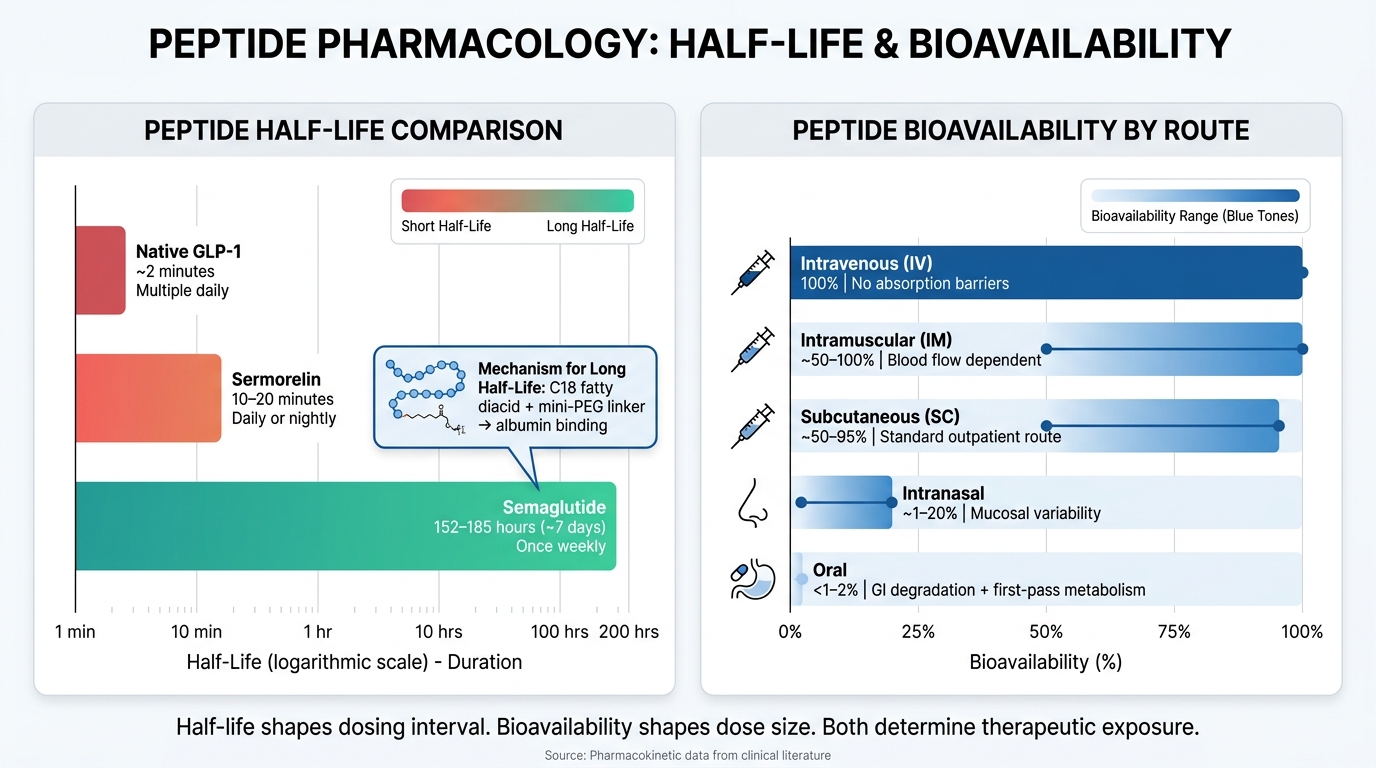
Peptide Half-Life & Bioavailability by Route: Key PK/PD Reference
After receptor signaling, PK and PD help answer the dosing questions that matter most in day-to-day care: Will this dose reach the target? How long will it stay active? And when does help start to turn into harm?
Absorption, bioavailability, and route of administration
Absorption describes how much peptide leaves the dosing site and enters circulation. Bioavailability is the share of the dose that gets there intact and active. For outpatient injections, subcutaneous (SC) and intramuscular (IM) routes are the main options. Clinicians must ensure patients use proper injection technique to maintain these levels. They usually deliver fairly high bioavailability, often around 60–90% for many therapeutic peptides.
Oral peptides are much tougher. Most have very low bioavailability because gastric acid, proteolytic enzymes, and first-pass metabolism cut down how much active peptide reaches circulation. Oral semaglutide gets around part of this problem with an absorption enhancer, but oral peptides still need much higher doses than injectables. Intranasal delivery falls somewhere in the middle. Bioavailability is often around 1–20%, but it can vary a lot based on technique, mucosal health, and nasal anatomy.
| Route | Typical Bioavailability | Key Limitation | Prescribing Implication |
|---|---|---|---|
| Intravenous (IV) | 100% | Requires infusion setting | Best reserved for acute or monitored settings |
| Subcutaneous (SC) | ~50–95% | Injection-site reactions, technique | Standard outpatient route; rotate sites |
| Intramuscular (IM) | ~50–100% | Procedural burden | Injectable alternative when SC is not ideal |
| Intranasal | ~1–20% | High variability, mucosal factors | Monitor symptoms and administration technique |
| Oral | <1–2% | GI degradation, first-pass metabolism | Often needs absorption enhancers; don't assume dose equivalence |
Food timing can matter too. Growth hormone secretagogues like sermorelin should be given at least 2 hours after the last meal because carbohydrates and fats can blunt the intended GH pulse.
Bioavailability tells you how much exposure you get. Half-life tells you how long that exposure sticks around.
Clearance, volume of distribution, and half-life
These terms connect through one equation: t½ = 0.693 × Vd / CL. Half-life increases when a drug spreads more into tissues or when the body removes it more slowly. Most peptides have a small volume of distribution and are cleared fast through renal filtration and proteolysis.
Sermorelin has a plasma half-life of about 10–20 minutes. That short half-life helps preserve pulsatile exposure. Semaglutide works very differently. Its fatty acid chain binds albumin and stretches the half-life to about 7 days, which is why once-weekly dosing works.
The practical point is simple: half-life strongly shapes dosing interval. A short half-life usually means shorter exposure and faster washout. A long half-life allows less frequent dosing, but it also means slower washout if something goes wrong.
Potency, efficacy, dose-response, and therapeutic window
Once exposure is understood, the next issue is effect: how much response do you get from that exposure?
Potency is how much drug is needed to produce an effect, often described with EC50. Efficacy is the largest effect a peptide can produce. A partial agonist may be very potent and still have a lower ceiling than a full agonist.
In practice, this affects starting doses and titration. Sermorelin keeps GHRH receptor activity even though it is a truncated fragment, so its dose-response curve still follows the self-limited pituitary feedback loop. Push the dose high enough, and the curve starts to flatten.
The therapeutic window is the range where the drug works without causing unacceptable harm. PK and PD both shape that window. Bioavailability affects how much gets in. Half-life and clearance affect how long exposure lasts. If the window is narrow, even small dose changes can move a patient from too little effect to adverse effects. And when the curve reaches a plateau, each extra dose increase tends to add more risk than gain.
Degradation, stability, and putting it all together
If PK tells you how long a peptide sticks around, stability tells you why it lasts that long to begin with.
Proteolytic degradation, chemical instability, and short duration
Peptides tend to break down in three main ways.
First, enzymes can chop them up. Proteases such as DPP-4, pepsin, trypsin, and chymotrypsin cleave peptide bonds and shut peptides down. That helps explain why native GLP-1 lasts only about 2 minutes.
Second, there’s chemical breakdown. Oxidation and deamidation are part of the problem, and heat, light, and higher pH can speed that process up.
Third, there’s physical instability. Aggregation, precipitation, and adsorption can lower the amount of drug that actually gets delivered, even when you don’t see an obvious chemical change. That’s a big reason long-acting peptide design matters so much.
Basic storage steps help limit chemical and heat-related breakdown. Refrigeration, usually 36–46 °F, protection from light, and following beyond-use dates all matter. And if a solution looks cloudy or has particles in it, don’t use it.
Half-life extension strategies and clinical implications
Because native peptides break down so fast, manufacturers modify them to protect against enzymes and clearance.
Amino acid substitution can help block enzymatic cleavage. Fatty-acid acylation can increase albumin binding, which slows renal clearance and extends half-life. Semaglutide uses a C18 fatty diacid plus a mini-PEG linker, giving it a plasma half-life of about 152–185 hours and making once-weekly dosing possible.
PEGylation increases hydrodynamic size, which lowers renal filtration and proteolysis. The tradeoff is that it can change tissue distribution and bring rare hypersensitivity concerns. Fc fusion extends dosing intervals through neonatal Fc receptor recycling, but it also adds immunogenicity and hypersensitivity issues.
For prescribers, these design choices affect more than convenience. They change:
- how often the drug is dosed
- how long washout takes
- how long adverse effects may last after stopping
That matters in day-to-day care. A long-acting acylated peptide like semaglutide may need a 2-month washout before a planned pregnancy. A short-acting peptide like sermorelin puts more weight on handling, since degradation or adsorption can cut the delivered dose in a meaningful way.
Conclusion: Using peptide terms to interpret expected effects and limits
The terms covered across this guide - receptor agonism, affinity, signaling pathway, bioavailability, half-life, therapeutic window, proteolysis, and half-life extension strategy - work together as one framework. Mechanism explains what a peptide is trying to do. Pharmacokinetics explains whether it gets there. Stability explains whether it survives long enough to matter.
When you review a protocol, it helps to move through three layers: receptor pharmacology and signaling pathway first, then the PK profile, then degradation and stability. Each layer closes the gap between what a peptide is designed to do and what it ends up doing in practice.
FAQs
How do I tell if a peptide is likely to act fast or last long?
Check the peptide’s half-life, structural stability, and delivery route. Peptides with short half-lives - often because they’re cleared by the kidneys fast or broken down by proteases - tend to act fast, but they may need more frequent dosing.
Small structural changes can help. For example, cyclization or the addition of D-amino acids can extend circulation time by making the peptide harder for enzymes to break down.
The delivery route matters too. It can shape how fast the peptide starts working. In some cases, inhaled delivery reaches peak systemic signals faster than intravenous injection.
Why do some peptides need weekly dosing while others need frequent dosing?
Some peptides can be dosed weekly because their half-life and stability are built to last longer in the body. That can happen through albumin binding or other half-life extension methods.
Others clear much faster. When a peptide has a short half-life, it usually needs more frequent dosing to keep exposure steady and maintain signaling. In plain terms, dosing comes down to how long the peptide stays intact in circulation, plus the delivery route and how quickly it breaks down.
Which peptide terms matter most when judging safety and side effects?
The most important terms here are receptor specificity, half-life, and metabolic pathways.
If receptor specificity is poor, a drug may bind to healthy tissues, not just the target area. That can lead to systemic side effects. Half-life matters too, because it shapes how often a patient needs dosing and how much risk there is of the drug building up over time.
Clinicians should also look at immunogenicity, off-target biodistribution, and patient-specific factors, such as a history of malignancy or the use of co-medications. This matters even more when growth-promoting or metabolic pathways are in play.