
Here’s the short answer: I’d add a peptide only after standard care has been confirmed, used long enough, and still misses a clear target. If the diagnosis is shaky, adherence is poor, or follow-up is not possible, I’d wait. If there’s a contraindication, weak product quality, or no human data worth leaning on, I’d skip it.
In plain English, understanding peptide therapy comes down to three choices:
- Add a peptide when standard care is already in place, the goal is clear, and there’s a way to track results safely
- Delay when the workup is incomplete, basics like sleep/nutrition/rehab/adherence are not settled, or treatment has not had enough time
- Avoid when risk is too high, the source cannot be verified, or monitoring and consent cannot be done well
A few numbers make the point fast:
- HbA1c often needs about 3 months after a dose change before I can judge response
- Semaglutide cut major adverse cardiovascular events by 20% in the SELECT trial for people with obesity and no diabetes
- Testing of unverified peptide products found purity as low as 5%–75%
- A 2025 review found 35 of 36 BPC-157 studies were in animals, with no completed Phase 1 human safety data and no controlled human efficacy trials
What matters most is not whether a peptide sounds promising. It’s whether standard care has already had a fair try, the evidence fits the goal, and the patient can be followed safely.
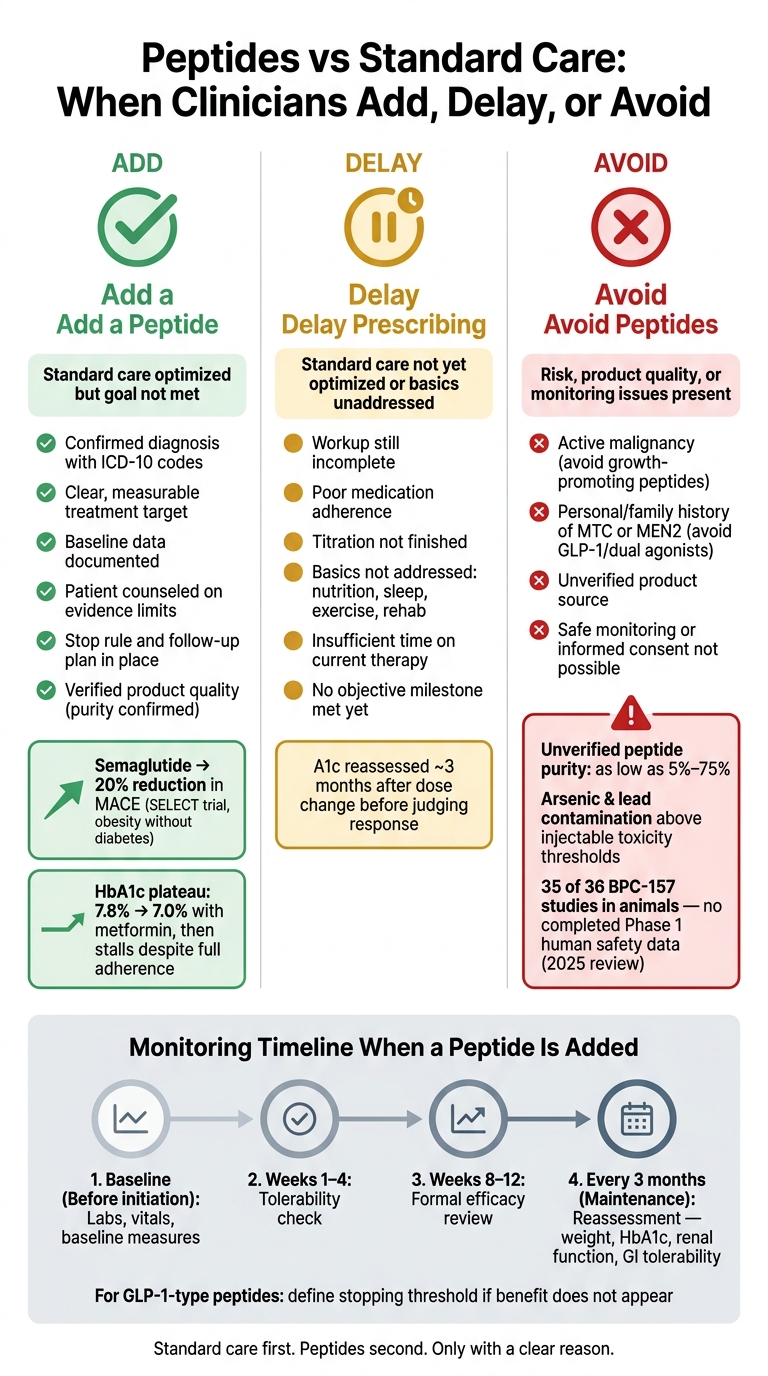
Peptides vs Standard Care: Add, Delay, or Avoid Decision Guide
The Truth About Peptides, Injections & What Actually Helps You Heal Faster | Dr. Svetlana Dani
sbb-itb-7164bd9
Quick Comparison
| Decision | When I’d choose it | What needs to be in place |
|---|---|---|
| Add | Standard care falls short after a fair trial | Confirmed diagnosis, clear target, baseline data, counseling, stop rule, follow-up plan |
| Delay | Treatment is still early or basics are not addressed | More time, better adherence, more workup, finished titration |
| Avoid | Risk, product quality, or monitoring problems make use unsafe | Contraindications, weak sourcing, poor follow-up, weak evidence |
That’s the frame for the full article: standard care first, peptides second, and only with a clear reason.
Standard Care First
Before you add a peptide, make sure standard care is already in place and dialed in. That’s the starting point for a reason. It’s the guideline-backed first step for a diagnosis or clinical goal, and it has the strongest support for clinical outcomes. In plain terms: standard care is the benchmark.
Peptides, when used, should come after the basics are clear. That means the diagnosis is confirmed, baseline therapy is set, and the treatment goal is defined. The first move is simple: verify the diagnosis, current treatment, and target.
Confirm the Diagnosis, Baseline Therapy, and Treatment Target
Before prescribing, confirm the diagnosis, current therapy, and a measurable target. That includes history, physical exam, condition-specific labs, and risk stratification. Use imaging only when guidelines call for it to confirm the diagnosis. Without that groundwork, it’s hard to judge whether standard therapy has had a fair shot.
A weak response doesn’t always mean the treatment failed. Sometimes the issue is nonadherence, underdosing, or not enough time on therapy. In diabetes care, for example, A1c is often rechecked about 3 months after a dose change to judge response. If the diagnosis isn’t locked down and standard care hasn’t been given an adequate trial, there’s no clear way to judge peptide benefit. Clinicians should also consult practical guides for administration and handling protocols before starting therapy. Add a peptide too soon, and you blur the picture.
Document specific treatment targets. That may mean glycemic control, LDL reduction, blood-pressure control, or pain relief and functional improvement in musculoskeletal cases. If those targets are already being met, adding a peptide may increase risk and complexity without enough upside. If the targets are still not being met after a real, optimized trial of standard therapy, then the adjunctive question starts to make sense.
That difference is easier to see side by side.
Comparison Table: Standard Care vs. Peptide Therapy
| Dimension | Standard Care | Peptide Therapy |
|---|---|---|
| Primary role | First-line, guideline-directed foundation | Adjunctive, after optimization |
| Strength of evidence | Large trials, meta-analyses, guideline support | Variable; weaker for off-label or compounded use |
| Expected time to benefit | Weeks to months for symptoms; months to years for event reduction | Depends on the molecule; timelines are often less well established |
| Monitoring burden | Routine, disease-specific | Individualized; may require extra labs and closer follow-up |
| Safety concerns | Well-characterized risks and contraindications | More uncertainty around long-term safety, immunogenicity, and formulation quality |
| Best candidates | Most patients at the start of a care pathway | Confirmed diagnosis, documented failure of optimized standard care, or clear intolerance, with ability to complete monitoring |
| Reasons to defer | Not applicable; this is the starting point | Incomplete workup, poor adherence, unfinished titration, unstable disease, or an unfavorable risk-benefit profile |
With the baseline set, the next question is when peptides add enough to justify their use.
When Clinicians Add Peptides
Clinicians usually add a peptide only after standard care has been dialed in and still falls short of a clear goal. If that goal isn't being met, the next step is simple: consult peptide dosing protocols to decide whether the peptide offers enough upside to make the tradeoffs worth it.
Common Triggers for Adjunctive Peptide Use
A therapeutic plateau is one of the most common reasons. In plain terms, the patient improves, then progress stalls. Sometimes the issue is a plateau. Other times, standard treatment works in theory but the patient can't tolerate it.
In metabolic care, that can look like an HbA1c that drops from 7.8% to 7.0% with metformin and lifestyle changes, then refuses to budge even with full adherence and enough time on treatment.
Poor tolerance of standard options is another fair reason to look at a peptide. Say a patient can't safely take NSAIDs because of renal disease or a history of GI bleeding. In that case, a peptide may make sense if its mechanism fits the clinical problem, the evidence backs it up, and follow-up is realistic. The key point is to match the mechanism to the unmet need, not to some vague hope of “feeling better.”
Some peptides also have clear, evidence-backed uses. Semaglutide is a good example. In the SELECT trial, it showed a 20% reduction in major adverse cardiovascular events (MACE) in patients with obesity but without diabetes. That gives clinicians a concrete reason to add it when cardiometabolic risk stays high despite standard care. Still, the reason for use has to fit the treatment goal, not just the diagnosis.
What to Document Before Adding a Peptide
Good documentation does two jobs at once: it shows why the peptide was added, and it makes the result easier to judge later. Before prescribing any peptide, the chart should include:
- Diagnosis: a confirmed diagnosis with the relevant ICD-10 codes
- Prior therapy: what was tried, along with doses, duration, and results
- Baseline measures: objective markers tied to the goal, such as HbA1c, weight and BMI, pain scores, function scores, inflammatory markers, or hormone levels
- Counseling: a note that the patient was counseled on the evidence and its limits
- Stop rule: the follow-up schedule and the stop rule, including the exact objective threshold and time point that would lead to discontinuation
If those pieces can't be documented in a clear way, it's usually better to wait than to prescribe.
When Clinicians Delay or Avoid Peptides
Once baseline documentation is done, the next call is fairly direct: delay use when the plan is still being worked out, or avoid use when risk, product quality, or monitoring make treatment unsafe.
Delay: Incomplete Workup, Early Treatment Stage, or Unaddressed Basics
A delay makes sense when the current plan hasn't had a fair shot yet. If a patient still hasn't addressed the basics - nutrition, sleep, exercise, rehabilitation, and medication adherence - adding a peptide usually muddies the picture. It doesn't make the next step clearer. It makes it harder to tell what's helping and what's not. The key is to use objective milestones, not just the number of visits.
Poor adherence is another common reason to pause. If a patient isn't following the current plan with any consistency, there's no clean way to tell whether the plan is failing. Moving to a peptide in that setting doesn't fix the issue. It just adds another moving part.
Avoid: Unfavorable Risk-Benefit Profile or Inability to Monitor Safely
Once standard care has been optimized, the next step is to ask a blunt question: does the peptide itself create a hard stop?
The clearest examples are absolute contraindications. Avoid growth-promoting peptides in active malignancy. GLP-1 and dual agonists should also be avoided in patients with a personal or family history of medullary thyroid carcinoma (MTC) or multiple endocrine neoplasia syndrome type 2 (MEN2). These are contraindications, not judgment calls.
Product quality and regulatory status are just as firm a reason to avoid use. If the source can't be verified, do not prescribe. Analytical testing of unverified peptide products has found purity as low as 5%–75%, with arsenic and lead contamination above established toxicity thresholds for injectables. For BPC-157, a 2025 systematic review found that 35 of 36 published studies were done in animals, with no completed Phase 1 human safety data and no controlled human efficacy trials. When standard options by therapeutic category already exist, that evidence gap makes avoidance the defensible choice.
Avoid use when safe monitoring, reliable follow-up, or informed consent cannot be completed.
Risk, Evidence, and Monitoring Before Prescribing
Once a peptide is on the table, the next question is simple: is there enough proof, quality control, and follow-up to justify prescribing it? Before writing the prescription, clinicians need three things in place:
- A clear evidence bar
- A defined monitoring plan
- Verified product quality
Those are the decision points.
Measured clinical outcomes matter more than theoretical mechanisms. Randomized trial data with measurable clinical endpoints support adjunctive use far more than a mechanistic rationale on its own.
Product quality is a hard stop. For compounded products, lot-specific quality documentation and pharmacy verification need to happen before the order is written, not after.
If those quality checks pass, monitoring starts before treatment begins. A practical cadence looks like this: baseline labs and vitals before initiation, a tolerability check during weeks 1–4, a formal efficacy review at weeks 8–12, and reassessment every 3 months during maintenance. For GLP-1-type peptides, that means tracking weight, HbA1c, renal function, and GI tolerability, with a defined stopping threshold if benefit doesn't show up.
A Simple Decision Framework for Practice
That leads to the day-to-day question: when does this framework support prescribing?
Use standard care first. Add a peptide only when the goal is specific, the evidence supports that use, and the monitoring plan is already set. Delay prescribing when baseline therapy has not been optimized or the workup is still incomplete. Avoid prescribing when contraindications are present, product quality cannot be confirmed, or safe follow-up is not realistic.
Conclusion: The Safest Answer Is Not Always the Peptide
The best answer is the one that fits the evidence, the risk, and the monitoring plan.
FAQs
How long is a fair trial of standard care?
There’s no one-size-fits-all timeline here. It depends on the condition being treated and the type of treatment being used.
For investigational peptides, clinicians usually set 4–8 week courses and reassess at the end of each cycle. Growth hormone secretagogues often run for 3–6 months, then pause for a 1–2 month break.
No matter the approach, follow-up should be planned from the start, with a formal review at 8–12 weeks to decide whether to continue, adjust, or stop treatment.
What counts as enough evidence to add a peptide?
Enough evidence usually means results from multiple randomized controlled trials in humans that point in the same direction, or from meta-analyses. If the data includes a small number of human trials plus animal research, that points to moderate evidence. If the support comes mostly from animal studies with very little human research, the evidence is preliminary. And if studies don’t use control groups, or there are no human trials at all, the evidence is generally insufficient.
You should also confirm a specific clinical indication and a measurable endpoint. On top of that, make sure standard therapies were tried, declined, or weren’t appropriate for the case. Then document medical necessity, informed consent, and follow-up.
What should be monitored after starting a peptide?
Use a set follow-up schedule from the start. Check tolerability early on, including injection-site reactions when relevant, and document any adverse events and the steps taken in response.
Track both effectiveness and safety over time. Follow:
- HbA1c and fasting glucose
- Weight and BMI
- Renal and liver function
- Lipids
- Heart rate
At each visit, check for signs of pancreatitis, gallbladder disease, and retinopathy symptoms. Keep up mental health screening as well.