Yes - GLP-1 drugs can trim muscle along with fat. In many studies, about 25% to 40% of total weight loss came from lean mass. The key point, though, is simple: GH peptides may help on paper, but human proof in GLP-1 users is still missing.
If I had to boil this down for you, it would be this:
- GLP-1s like semaglutide and tirzepatide can lead to large weight loss
- Some of that loss is lean mass, not just fat
- That matters more in older adults, frail patients, and people with sarcopenic obesity
- GH secretagogues may support nitrogen balance and lean tissue
- But no randomized trial has tested them as a GLP-1 add-on for muscle protection
- Protein intake and resistance training still come first
A few numbers help frame the issue. In one semaglutide substudy, people lost about 6.9 kg (15 lb) of lean mass over 68 weeks. In tirzepatide data, lean mass dropped too, but most weight lost was still fat. So this is not proof that GLP-1s damage muscle in some special way. It means weight loss often includes both fat and lean tissue.
Here’s how I’d look at it in practice:
| Topic | What matters most |
|---|---|
| Main risk | Lean mass loss during GLP-1 weight loss |
| Who needs closer follow-up | Adults over 60–65, sarcopenic obesity, post-hospital or post-surgery patients, fast weight loss |
| What GH peptides may do | Increase GH/IGF-1 signaling, improve nitrogen balance, help hold lean tissue |
| Main problem with the idea | No GLP-1 combination RCTs showing better muscle or function |
| What to do first | 1.2–1.6 g/kg/day protein + 2–3 resistance sessions per week |
| What to track | Weight, body composition, grip strength, chair stands, recovery |
The short version: DXA changes alone do not tell the whole story. I’d care more if lean mass loss comes with lower grip strength, slower chair stands, fatigue, or poor recovery. That’s where the discussion shifts from “scan result” to “day-to-day function.”
So the bottom line is clear: GH peptides are still an off-label, limited-data option for a small subset of higher-risk patients - not a routine fix for everyone on GLP-1 therapy.
This Peptide IMPROVED My Patients' GLP1 Results (Helps Build Muscle)
sbb-itb-7164bd9
How GH Peptides May Help Protect Lean Mass
Growth hormone secretagogues (GHS) include peptides such as ipamorelin, sermorelin, CJC-1295, and tesamorelin. They work by prompting the pituitary to release growth hormone in pulses. That pulse then signals the liver to make IGF-1, which plays a central role in muscle protein synthesis and lean tissue maintenance. Unlike taking exogenous GH, secretagogues keep the body’s own feedback loop in place, so normal feedback still limits excess GH release.
Protein Turnover, Anabolic Signaling, and Recovery
One problem with GLP-1 therapy is simple: people often eat less protein. When that happens, negative nitrogen balance can follow. GH may help on this front because it shifts the body toward fat oxidation. In plain terms, it increases lipolysis and mobilizes free fatty acids, which can help spare amino acids from being burned for fuel. In one controlled study, GH cut plasma urea nitrogen by about 40%, which points to better nitrogen retention. From there, baseline muscle reserve and training status become the next things to look at.
IGF-1, which sits downstream of GH, activates the PI3K–Akt–mTOR pathway in muscle cells. That pathway helps drive protein synthesis and amino acid uptake. In a 12-week randomized controlled trial of adults with obesity on a hypocaloric diet, the placebo group lost 2.62 ± 1.51 kg of lean body mass and had a nitrogen balance of −4.52 ± 3.51 g/day. The GH group, by contrast, gained 1.13 ± 1.04 kg of lean body mass and kept a positive nitrogen balance of +1.81 ± 2.06 g/day despite the same calorie restriction. That’s a sharp split in how protein metabolism moved under the same diet conditions, and it maps closely to the kind of calorie deficit many patients face on GLP-1 drugs.
GH/IGF-1 signaling also supports collagen synthesis and tissue repair. That may help training tolerance, which matters because resistance training is one of the main ways to hold on to muscle during weight loss. MK-677 (ibutamoren), an oral GHS, showed a similar pattern in a double-blind crossover study during a low-calorie diet. Mean daily nitrogen balance moved from −1.48 g/day on placebo to +0.31 g/day with MK-677, and integrated nitrogen balance over days 8–14 reached +2.69 g·day vs. −8.97 g·day for placebo (P < 0.001).
Where the Theory Runs Ahead of the Evidence
Here’s the catch: more lean mass on paper does not always mean better function. A scan can look better while strength, power, or physical performance barely move. Most of the data here are mechanistic, not GLP-1-specific. No published randomized controlled trial has tested a GHS with semaglutide, tirzepatide, or any other GLP-1 receptor agonist to see whether it lowers the share of lean mass lost. That gap is a big reason risk stratification matters before adding a secretagogue.
Patient selection also matters because functional gains have been small and inconsistent. Research in young, exercising adults shows that GH-driven nitrogen retention does not automatically lead to more contractile protein or greater force output. So while the mechanism makes sense, direct proof in GLP-1 users is still missing. For now, GH secretagogues in this setting remain an off-label adjunct with limited human data.
Which Patients Deserve Closer Attention
The evidence for GH secretagogues is still thin, so patient selection matters a lot more than routine use. Most people taking a GLP-1 drug do not need a separate talk about GH support. But some patients are in a different spot. For them, lean-mass loss isn't just a DXA finding. It can change mobility, day-to-day function, independence, and recovery.
Higher-Risk Patients: Age, Sarcopenic Obesity, and Fast Weight Loss
The best place to start is with patients who are least able to absorb any muscle loss. The clearest warning signs are age over 60–65, sarcopenic obesity, and weight loss that is moving faster than expected.
Sarcopenic obesity means a patient has excess body fat along with low skeletal muscle mass. That's already a shaky starting point before GLP-1 therapy even begins. If weight loss then strips away more of that limited muscle reserve, the effect on function can be much bigger than the scale suggests.
The pace of weight loss matters too. If someone keeps losing more than 1–2 lbs per week, and that comes with fatigue, visible thinning in the arms and legs, or trouble meeting protein goals because of nausea or early satiety, muscle loss may start to cancel out the upside of fat loss. In that situation, it makes more sense to slow GLP-1 titration, shore up protein intake, and check function sooner rather than jump to a peptide add-on.
Recent surgery or hospitalization also changes the picture. These patients may already be in a catabolic state, and appetite suppression can make recovery-related catabolism worse. That can deepen negative protein balance at the exact time the body is trying to heal.
How Training Status Affects the Calculus
Training and nutrition do a lot of the heavy lifting here. They often decide whether a patient even needs drug support in the first place.
A patient who is already doing resistance training, eating enough protein, and recovering well has less reason to add GH support. In that group, start with the basics: training quality, protein timing, and sleep.
For sedentary patients, the first move should still be a structured entry into resistance exercise, scaled to what they can handle. That part matters. If they haven't had a fair shot at training and nutrition, it's hard to make the case for peptide therapy. The discussion gets more relevant only when those basics fall short, or when comorbidities plainly limit exercise adherence.
When Poor Recovery Signals Concern
When recovery stays poor even after the basics are dialed in, the case for adjunctive support gets stronger. Older adults often need about 0.40 g/kg per meal to maximize muscle protein synthesis, compared with about 0.24 g/kg in younger adults. On a GLP-1, where appetite suppression is part of the mechanism, those intake targets can be tough to hit.
A few day-to-day signs can hint that recovery is lagging:
- Prolonged soreness after light activity
- No progress in training loads over several weeks
- Fatigue that lasts after routine tasks
- Falling grip strength
- Slower sit-to-stand times
These are practical signs, not just lab or scan findings. If they show up despite enough protein, decent sleep, and a sound training plan - especially in an older patient or someone with sarcopenic obesity - the idea of a GH secretagogue as a targeted adjunct starts to rest on firmer clinical ground.
The highest-risk group includes older adults, patients with sarcopenic obesity, those losing weight fast, people recovering from recent surgery or hospitalization, and deconditioned patients who cannot train enough to protect lean mass.
What the Human Data Actually Show Right Now
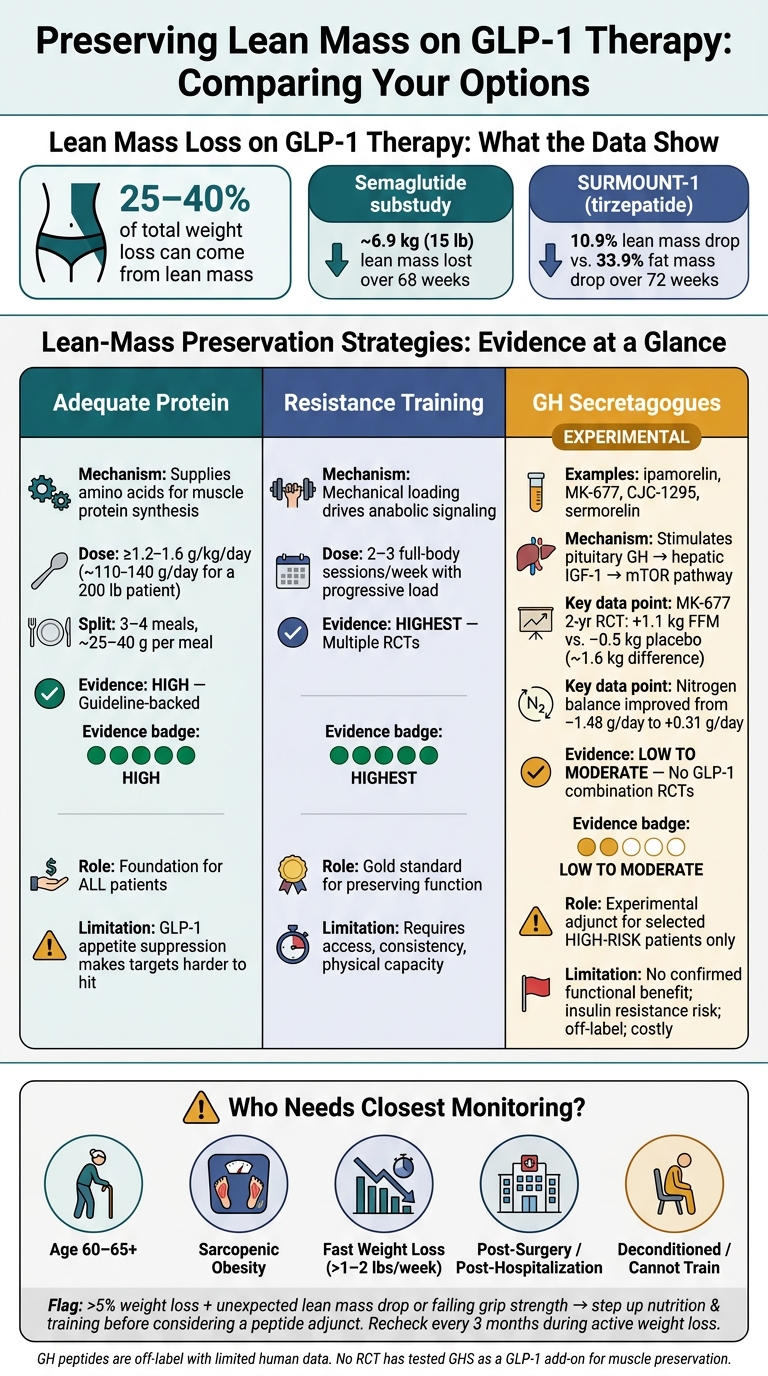
GLP-1 Muscle Loss: GH Peptides vs. Protein & Training - Evidence Compared
Human data are still limited. GLP-1 trials and GH secretagogue trials do report body-composition outcomes, but no study shows that adding a GH peptide to GLP-1 therapy helps preserve muscle or strength. That gap comes through pretty clearly once you look at the human trial data.
What Studies Show About GLP-1 and Lean Mass
At the population level, the data are fairly reassuring. In the SURMOUNT-1 DXA substudy, tirzepatide led to a mean body-weight reduction of 21.3% over 72 weeks. Fat mass dropped 33.9%, while lean mass dropped 10.9%. Put simply, about 75% of the weight lost was fat and 25% was lean mass, which was similar to placebo.
So GLP-1 therapy does not seem to strip muscle in some special way beyond what you'd expect from an effective weight-loss treatment.
Just as important, those DXA shifts did not lead to a steady pattern of strength or performance loss across the full group. But averages can hide a lot. One systematic review of semaglutide trials found that lean mass made up anywhere from nearly 0% to 40% of total weight loss across six studies. That's a big spread, and it helps explain why individual risk assessment matters more than population averages in high-risk patients.
What Studies Show About GH Secretagogues
The picture changes when the drug is a GH secretagogue. The strongest human evidence comes from a 2-year randomized, placebo-controlled trial of oral ibutamoren (MK-677) in older adults. In that study, MK-677 increased fat-free mass by about 1.1 kg, while placebo showed a 0.5 kg decrease. That works out to a between-group difference of about 1.6 kg. GH and IGF-1 levels moved toward young-adult ranges, and that effect did not fade from tachyphylaxis.
But here's the catch: strength and physical function did not improve. Side effects included insulin resistance, edema, and increased appetite. For GLP-1 users, that glucose-tolerance signal matters, because many already start with metabolic risk.
The case for injectable secretagogues like ipamorelin is even thinner. No published randomized efficacy trials show better lean mass, strength, or functional outcomes in obesity or aging groups.
There's also a basic measurement issue here. Fat-free mass is not the same thing as skeletal muscle. Changes in FFM can reflect fluid retention, organ mass, or connective tissue. None of those automatically mean better strength or recovery.
Comparing Practical Options for Lean-Mass Preservation
For prescribers, the pecking order is still simple: protein first, resistance training next, then selected adjuncts.
| Strategy | Mechanism | Evidence Strength | Likely Clinical Role | Major Limitations |
|---|---|---|---|---|
| Adequate Protein Intake (≥1.2–1.6 g/kg/day) | Supplies amino acid substrates for muscle protein synthesis | High; guideline-backed | Foundation for all patients | Appetite suppression from GLP-1s can make targets harder to hit |
| Progressive Resistance Training | Mechanical loading drives anabolic signaling and helps preserve muscle | Highest; multiple RCTs | Gold standard for preserving function | Requires access, consistency, and enough physical capacity |
| GH Secretagogues (e.g., CJC-1295/ipamorelin, MK-677) | Stimulates pituitary GH release and hepatic IGF-1 production | Low to moderate; no GLP-1 combination RCTs | Experimental adjunct for selected high-risk patients | Cost, insulin resistance risk, no confirmed functional benefit, off-label use |
Protein and resistance training have high-certainty, guideline-backed support. GH peptides are still experimental, so they make sense only when the clinical case goes beyond mechanism alone.
Clinical Takeaway: What to Prioritize First
Human data is still thin, so the clinical resources for peptide-prescribing professionals suggest the playbook should stay simple: start with protein, resistance training, and routine follow-up. GH peptides come later, and only for a narrow group of patients whose lean-mass issues continue after those basics are in place.
First Steps Before Adding a Peptide Adjunct
Start this plan when the GLP-1 starts. Set a protein target of at least 1.2–1.6 g/kg/day. For a 200 lb patient, that works out to about 110–140 g/day, split across 3–4 meals, or roughly 25–40 g per meal. In adults age 65 and up, and in patients losing weight fast, it makes sense to aim for the high end of that range.
Pair that with a documented resistance-training plan: 2 to 3 full-body sessions per week with progressive load. Put it in the visit note the same way you'd record any other co-therapy. If it isn't written down, it often gets treated like an afterthought.
Monitoring should begin on day one, not after problems show up. A practical baseline includes:
- weight
- body composition
- grip strength
- at least one function measure, such as a 30-second chair stand
Recheck every 3 months during active weight loss. Flag more than 5% weight loss when it comes with a larger-than-expected drop in lean mass or grip strength. That's the signal to step up nutrition and training support before moving to a peptide.
If lean mass or strength keeps dropping even after those steps, then a GH adjunct can enter the conversation.
Prescriber Takeaways
Keep decisions tied to three core ideas:
- GLP-1s lower fat mass and lean mass, so track function - not just the number on the scale.
- GH peptides make sense on paper, but no randomized trial has tested them as a GLP-1 add-on for muscle preservation.
- The main candidates for a peptide adjunct are older adults, patients with sarcopenic obesity, and patients with fast losses despite enough protein and resistance training - only after those lifestyle steps are fully in place.
FAQs
Do GLP-1 drugs cause real muscle loss?
Yes. Lean soft tissue can account for 25% to 40% of total weight lost during GLP-1 therapy. That happens as part of the body’s metabolic response to major weight loss.
To help limit that loss, clinicians often suggest:
- Resistance training 2 to 3 times per week
- Protein intake of 1.2 to 1.6 g/kg per day
- DEXA scans every 12 weeks to track body composition
Who is most at risk for lean-mass loss on GLP-1s?
Patients face the most risk during GLP-1 therapy when rapid weight loss happens without steps to offset the body’s metabolic strain. Lean soft tissue can make up 25%–40% of total weight lost.
That risk goes up when people skip resistance training, eat too little protein - about 1.2–1.6 g/kg/day is the target - or are older. Age matters here because growth hormone secretion drops by about 14% per decade after age 30.
When should GH peptides be considered?
GH secretagogues may come into play during GLP-1 therapy when a patient shows signs of age-related GH decline or sarcopenic obesity. That often looks like more visceral fat, slow recovery after exercise, poor sleep, or low-to-normal IGF-1.
Here’s the basic idea: GLP-1 agonists can lower lean mass along with body fat. So some clinicians use GH secretagogues to help support protein synthesis and preserve lean tissue.
Before starting treatment, providers should rule out active malignancy and review any glycemic concerns.