
In a code, the safest pattern is simple: one person gives a clear order, one named person repeats it back, the leader confirms it, and the task is reported out loud when done. That short loop helps stop missed orders, wrong doses, and silent gaps. In one study, teams using directed closed-loop communication reached 100% task completion, compared with 81% when the loop was missing or incomplete.
If I had to boil the whole article down, I’d put it this way:
- Name the person you want to act
- State one clear task
- Get a repeat-back
- Confirm or correct it
- Have the person report completion with the time
- Set roles at the start so no task floats in the room
- Use the same pattern in the ICU, ED, OR, clinic, and rapid response calls
- Practice it in mock codes so it shows up under stress
The article also makes one point plain: communication problems are common in arrests. One cited study found barriers in 42.5% of in-hospital cardiac arrests, and those barriers were linked with lower odds of guideline-level chest compression fraction. That means this is not just about sounding organized. It is about helping the team do the right thing at the right time.
I’d read the rest of the piece as a bedside playbook for nurses, APPs, and physicians on how to use call-outs, check-backs, role assignment, and completion reports when seconds matter.
Closed Loop Communication in Emergency Medicine: An Essential Skill for Patient Safety
sbb-itb-7164bd9
The Core Elements of Closed-Loop Communication
Five behaviors make the loop work: call-outs, check-backs, task confirmation, completion reports, and role clarity. Together, they keep the team lined up on what’s happening, what’s finished, and what needs to happen next. The best place to start is with the clearest actions in the room: call-outs and check-backs.
Call-Outs and Check-Backs
A call-out is a clear spoken update to the team or to one person by name. It might be a rhythm change, a defibrillator setting, or a medication order. For example: "Pulseless VT, charging to 200 J biphasic - clear."
A check-back is the receiver repeating the message before acting. If the leader orders amiodarone 300 mg IV bolus, the medication nurse repeats the dose and route, then says it again when giving it. That may sound simple, but in a code, simple is what keeps people on the same page. In a 2025 study of operating room emergencies, directed closed-loop communication produced 100% action completion versus 81% when the loop was incomplete or absent.
Once the message is confirmed, the next step is just as important: someone has to own the task.
Task Confirmation and Completion Reports
These are not the same thing. Task confirmation means a person says they are taking the task. A completion report means they say the task is done and include the key detail. For example, the team member states that epinephrine 1 mg IV was given at 10:02 AM. The recorder repeats it back and logs the time.
The same pattern applies to shocks and compression switches. After defibrillation, the team reports that the shock was delivered at 200 J at 10:04 AM and that everyone was clear. After a compressor change, the team reports the switch at 10:06 AM and that compressions restarted without pause. The pattern is easy to remember:
- assign
- repeat
- complete
- report
That system falls apart fast if roles are fuzzy at the start.
Role Clarity at Code Onset
Before closed-loop communication can work, everyone needs to know their job. Saying roles out loud at code onset removes guesswork. A clear setup might sound like: "I'm the team leader. Sarah, you're on compressions. Alex, airway. Jamie, you're our medication nurse. Chris, you're recording. Taylor, you're the runner." Each person should say yes to the role out loud.
The six core roles are team leader, compressor, airway manager, medication nurse, recorder, and runner. Naming roles out loud helps stop duplicate work and missed tasks when the room gets hectic.
With roles in place, the leader can direct tasks by name and ask for repeat-back at every step.
How to Use Closed-Loop Communication During a Code
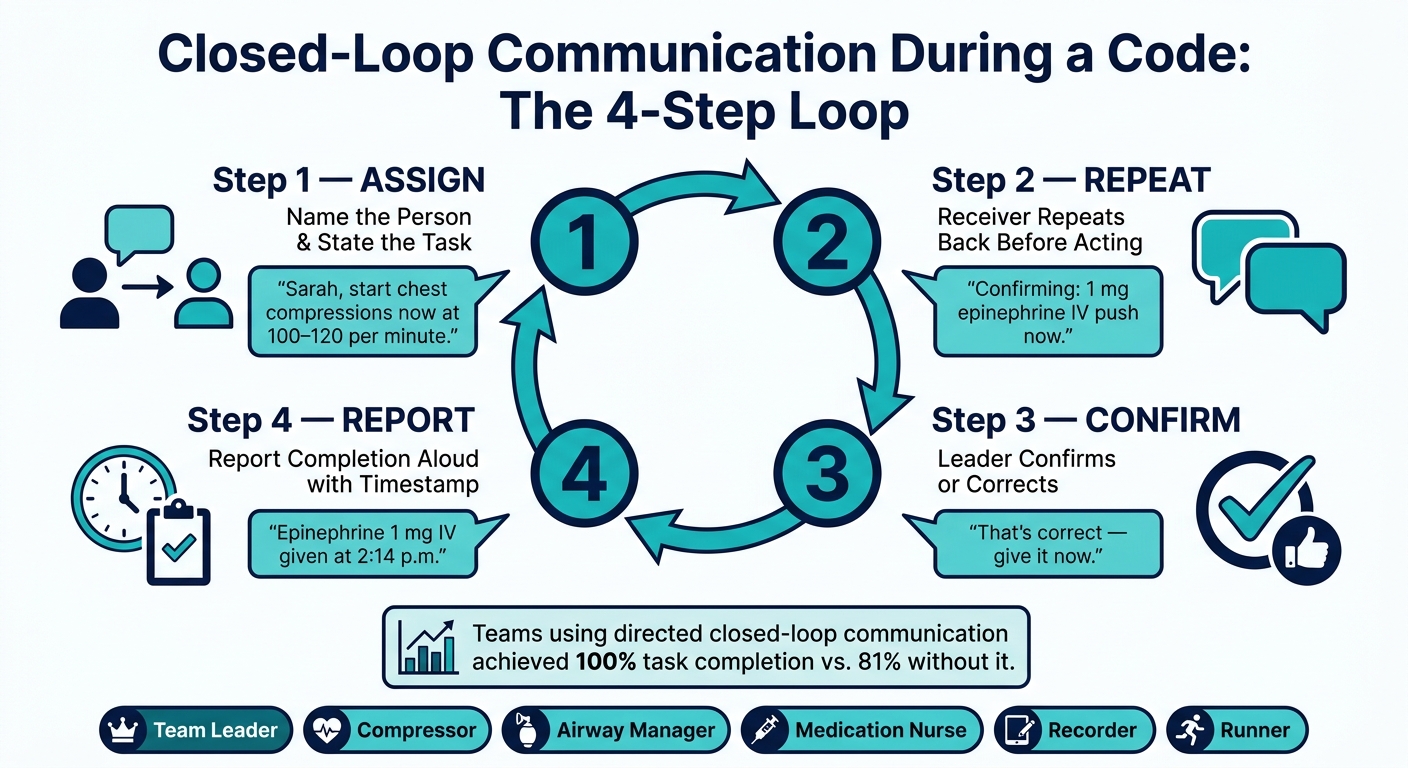
Closed-Loop Communication in Code Events: The 4-Step Loop
Use the same loop from code activation through stabilization: assign, repeat, confirm, report. Once roles are set, that loop should carry every order from start to finish.
Step 1: Assign a Leader and Direct Tasks by Name and Role
The leader should assign roles out loud and direct each task to a specific person. Vague orders like "start compressions, give epinephrine, prepare to intubate" can spread responsibility too thin. If no one is named, it’s easy for each person to assume someone else has it.
A better approach is simple and direct. The leader makes eye contact, speaks calmly, and gives one instruction at a time:
Sarah, start chest compressions now at 100 to 120 per minute.
Medication nurse, prepare 1 mg epinephrine IV.
Dr. Lee, prepare for endotracheal intubation.
Naming the person and the task cuts down on missed steps and team confusion.
Step 2: Require Repeat-Back and Explicit Confirmation
After the leader gives an order, the receiver repeats it back before acting. Then the leader confirms it. That short exchange matters more than people think.
For a medication order:
Leader: Medication nurse, give 1 mg epinephrine IV push now. Nurse: Confirming: 1 mg epinephrine IV push now. Leader: That's correct - give it now.
For defibrillation:
Leader: Charge to 200 joules and prepare to shock. Tech: Charging to 200 joules, preparing to shock. Leader: Correct - announce clear, then shock.
The repeat-back needs to include the details that can’t be missed, such as:
- Drug name and dose
- Energy level
- Tube size
- Procedure type
Those are the details that can cause harm if they’re wrong. AHA guidance points to this step as a way to cut wrong-drug and wrong-dose errors, stop shocks from happening before safety checks, and improve charting of interventions and timing.
Step 3: Report Completion and Critical Updates Out Loud
The loop is not done until the task is reported as complete. Each finished action should be called out loud with the key detail and a time stamp.
Examples that work in practice:
Epinephrine 1 mg IV given at 2:14 p.m.
Shock delivered at 2:16 p.m.
Pulse check complete - no pulse.
Tube placed at 22 cm at the teeth, bilateral breath sounds, ETCO₂ waveform confirmed.
Pulse present, blood pressure 92 over 58.
These updates help the recorder stay accurate, let the leader track medication intervals, and give the whole team a live picture of where the resuscitation stands.
Open-loop communication stops at the order. Closed-loop communication goes all the way through: name the person, get the repeat-back, confirm the order, and hear the completion report.
These steps show up a bit differently for nurses, APPs, and physicians.
Role-Specific Examples for Nurses, APPs, and Physicians
Closed-loop communication works the same way in every code. But in practice, each role uses it a bit differently. The main difference is simple: who starts the exchange, what gets repeated back, and what must be reported out loud.
Nurses: Medication, Monitoring, and Status Call-Outs
Nurses usually own the medication and monitoring updates. That means repeating every verbal medication order with the full details: drug, dose, route, and timing. Then, once the medication is in, they say so out loud. They should also report rhythm changes, IV access status, oxygen saturation, and blood pressure without waiting for someone to ask.
That matters because missing details are common. In trauma resuscitations, the medication route appeared in only 17.8% of verbal orders. A full repeat-back helps fix that problem. Live monitoring updates also give the code leader what they need to change course fast.
Example:
- Order received: Amiodarone 300 mg IV bolus.
- Repeat-back: Confirming amiodarone 300 mg IV bolus; drawing it now.
- Completion call-out: Amiodarone 300 mg IV bolus given at 2:12 p.m.
- Monitoring call-out: SpO₂ is 88% on bag-mask ventilation with 15 liters per minute of oxygen; chest rise is present but limited.
APPs use the same loop, but they often apply it across procedures and multiple tasks happening at once.
APPs: Procedure Coordination and Dual Leadership Roles
APPs often sit in a shared procedure-and-coordination spot during a code. Because of that, parallel tasks need to go to a named person, and each one needs a repeat-back before the team moves on. As steps are finished, those milestones should be said out loud.
Examples:
- RSI medications: etomidate 20 mg IV and succinylcholine 100 mg IV.
- Airway: tube visualized through the cords, secured at 22 cm at the teeth, waveform capnography confirmed.
- Line placement: right IJ central line in place, blood return from all three ports, ready for vasopressors.
Physicians: Directing the Code and Enforcing the Loop
Physicians run the code by giving clear orders, insisting on repeat-back, and pulling together the updates coming in from the team. Orders should come one at a time, with confirmation before the next task starts. That pacing cuts confusion, especially when the room gets loud.
It also helps when the physician says outright that anyone can speak up if they notice a safety issue or hear an order that doesn't sound right. That kind of permission can catch mistakes early and keep everyone on the same page.
In one interprofessional emergency team study, closed-loop communication was used in only 45% of 1,626 call-outs. Repeat-backs and named task assignments help close that gap. Teams are more likely to use those habits under pressure when they've practiced them in mock codes and debriefs.
Implementation, Training, and Key Takeaways
Build the Habit Through Mock Codes and Debriefs
Once the bedside loop is clear, the next step is simple: practice it until it becomes second nature. Short, frequent simulations - about 10 to 15 minutes on the unit - help teams build that habit without pulling too much time away from patient care.
The drill should stay focused on the loop itself: assign, repeat, confirm, report.
Each simulation needs a clear code leader from the start, often a physician, charge nurse, or APP, who assigns roles by name. During the scenario, facilitators should stop vague commands in the moment and restate them using closed-loop language. That helps the team hear the difference and use it under pressure.
The debrief is where the learning sticks. Instead of centering the discussion on whether every clinical step was perfect, focus on how the team communicated. A neutral structure works well:
- What happened
- What went well
- What to improve next time
From there, look at the basics. Was every order directed to a named person? Was it repeated back before action? Was completion announced out loud with a time stamp?
A one-page checklist can make that feedback more objective. In one assessment of 44 mock codes, 50% of evaluations showed participants did not clearly identify responsibilities or engage in closed-loop communication.
Use calm, blame-free language in the debrief. People learn more when they don't feel put on trial. Over time, checklist trends can feed into quality dashboards and ACLS/BLS recertification programs.
Apply the Same Standard in Outpatient Emergency Workflows
This same standard matters just as much in low-resource outpatient emergencies. Clinics that provide peptide therapy, injections, infusions, or wellness services face the same communication risks during adverse events, and often with smaller teams and fewer onsite resources.
If a patient develops syncope, hypotension, or suspected anaphylaxis, the lead clinician should take charge at once and assign roles by name. One person should be told to call 911 and then report back with any instructions received. Every next step - stopping the infusion, elevating the legs, starting oxygen, giving epinephrine, or activating EMS - should include repeat-back and a spoken completion report with the time.
This works best when the workflow is set before anything goes wrong. Predefined roles and standing orders make closed-loop communication easier when stress hits. Outpatient clinics should write emergency policies that plainly include:
- Role assignment
- Repeat-back
- Completion reporting
Conclusion: The Key Behaviors to Remember
Define roles, direct tasks by name, require repeat-back, confirm or correct, and report completion aloud. Those actions match ACLS/BLS team dynamics, which stress effective leadership, clear communication, mutual support, and situation monitoring. When teams practice these behaviors and track them on a regular basis, they cut preventable errors and close the gaps that silence and assumption leave behind.
FAQs
What is closed-loop communication in a code?
Closed-loop communication is a standard verbal process used during high-stakes events, like a code, to make sure information is shared clearly and correctly.
Here’s how it works: one person gives a clear instruction, the receiver repeats it back, and the sender confirms that it’s correct. That simple back-and-forth helps prevent mix-ups and supports safe, accurate task completion.
Who should repeat back orders during a code?
The materials provided don’t cover closed-loop communication or explain who should repeat back orders during a medical code.
Instead, they focus on peptide therapy topics, including:
- clinical guidance
- regulatory compliance
- informed consent
How can teams practice closed-loop communication?
Teams can use closed-loop communication during time-sensitive code events by following a simple process: the sender gives a clear request, the receiver repeats it back, and the sender confirms that the message was understood correctly.
It also helps to assign roles clearly, use specific call-outs, and confirm tasks out loud. That way, critical actions are acknowledged and completed as intended.