If a peptide safety issue is not logged on day one, your practice can miss the FDA clock. For many cases, the rule is simple: log the report, sort the case, send it to the right party, and track the deadline. For serious and unexpected adverse events, that clock is 15 calendar days from first receipt. For follow-up data, the next clock is often another 15 calendar days.
Here’s the short version of what I’d want any U.S. peptide practice to know:
- Every report starts with intake. You need an identifiable patient, reporter, suspected product, and event or complaint.
- Not every case goes down the same path. The route depends on whether the peptide is an FDA-approved drug, a 503A compounded product, or a 503B outsourced product.
- Most reports fall into 5 groups: serious adverse event, non-serious adverse event, medication error, lack of effect, or product quality complaint.
- Some cases are both clinical and product-related. If a patient reaction and a product defect show up together, log both.
- Ownership matters. One case should have one ID, one timeline, and one owner.
- Recordkeeping is the control. If staff talked about a case but never wrote it down, that is a compliance gap.
- Files should stay on hand for at least 10 years.
In other words: this is less about peptide science and more about process, timing, and written proof. I’d treat the article as a plain guide to building a reporting system that can hold up if FDA or a state board asks questions.
Regulatory scope for peptide postmarketing reporting
Clinics usually don’t file straight to the FDA. But they do own the first step: classifying the case, deciding how fast it needs attention, and making sure the record is complete.
The main FDA reporting duty usually sits with the NDA or BLA holder, not the prescribing clinic. Where the peptide sits in the supply chain matters a lot here. That’s why intake has to start cleanly on first contact. If the first notes are thin or sloppy, everything after that gets harder.
Which report types apply in daily practice
In day-to-day work, most cases land in five buckets: SAE, non-serious AE, medication error, therapeutic failure, and PQC.
- Serious adverse events (SAEs) - such as death, hospitalization, life-threatening reactions, or major disability - need the fastest escalation.
- Non-serious adverse events: Document all non-serious events. Submit unexpected ones to MedWatch when clinically relevant.
- Medication errors: This includes the wrong drug, dose, route, patient, or reconstitution volume.
- Therapeutic failure counts as an adverse experience and should be documented and escalated for review.
- PQCs include particles, contamination, potency concerns, labeling mismatches, and temperature excursions.
Direct reporting vs escalation
Serious or unexpected events may go straight to MedWatch when the source pharmacy or manufacturer is unclear or not responding. For FDA-approved peptide products, the manufacturer should also receive the report, since it carries the main postmarketing reporting duty.
For compounded peptides, route issues through the pharmacy’s quality system and, when needed, the state board. 503B outsourcing facilities must report adverse events under federal rules.
If a case includes both a reaction and a defect, log it as both an AE and a PQC. Send the clinical details to the safety lead for MedWatch review, and send the product details to the pharmacy or quality contact for lot investigation and quarantine if needed. MedWatch Form 3500 has a dedicated product problem field for this exact use.
| Event Type | Primary Practice Action | MedWatch? |
|---|---|---|
| Serious adverse event (SAE) | Document, notify sponsor/pharmacy, and escalate immediately | Yes |
| Non-serious adverse event | Log, monitor, and notify sponsor/pharmacy as appropriate | Consider if unexpected or novel |
| Medication error | Document and review internally | Yes, if significant or potentially harmful |
| Lack of effect | Document and escalate for dose/product review | Consider if unexpected or product-related |
| Product quality complaint | Notify pharmacy/manufacturer quality unit and quarantine product if needed | Yes, if serious harm potential |
These case types shape the minimum intake fields, the triage path, and the follow-up timing used in the next section.
sbb-itb-7164bd9
Intake systems for adverse events and product complaints
Once the case type is identified, intake has to collect enough detail to send the report to the right team. If intake is incomplete, delays show up later.
Every adverse event or product quality report should be recorded in a standard format at first contact, no matter how it comes in:
- Phone
- Portal
- Secure message
- In-person visit
- Staff observation
Pharmacy and manufacturer reports should go into the same system too. Mark them as external, and keep the original source document on file.
Minimum information required at intake
A case is only triage-ready when it has four core elements: an identifiable patient, an identifiable reporter, a suspected product, and a description of the event or complaint.
Use this same intake standard for SAEs, non-serious AEs, medication errors, therapeutic failures, and PQCs. The intake form should also record the treatment date or date window, lot number or dispensing details, and reporter contact information. Use the MM/DD/YYYY format so timing stays consistent across the record.
A tiered form usually works best. Start with required fields needed to open the case, then leave room for optional details that can be gathered during follow-up, such as lab values, concomitant medications, storage conditions, photos, or pharmacy communications.
Triage rules for adverse events versus product quality complaints
After a report is logged, the next step is classification.
An adverse event is a change in a patient's health, such as nausea, hypotension, or an injection-site reaction. A product quality complaint is a defect in the product, such as particles, a leaking vial, or a temperature excursion.
Sometimes one report includes both. In that situation, open linked AE and PQC records, cross-reference them, and make sure both the clinical team and the quality lead or pharmacy contact get the details they need.
Use the same intake logic across all sources. Route patient and prescriber reports to the clinical safety workflow. Route pharmacy and staff reports tied to product handling, lot history, labeling, or storage to the quality workflow. If the source or event type isn't clear, document that uncertainty and route the case under your escalation policy.
That routing decision shapes case creation, status tracking, and follow-up timing.
Case creation, tracking, follow-up, and FDA reporting timelines
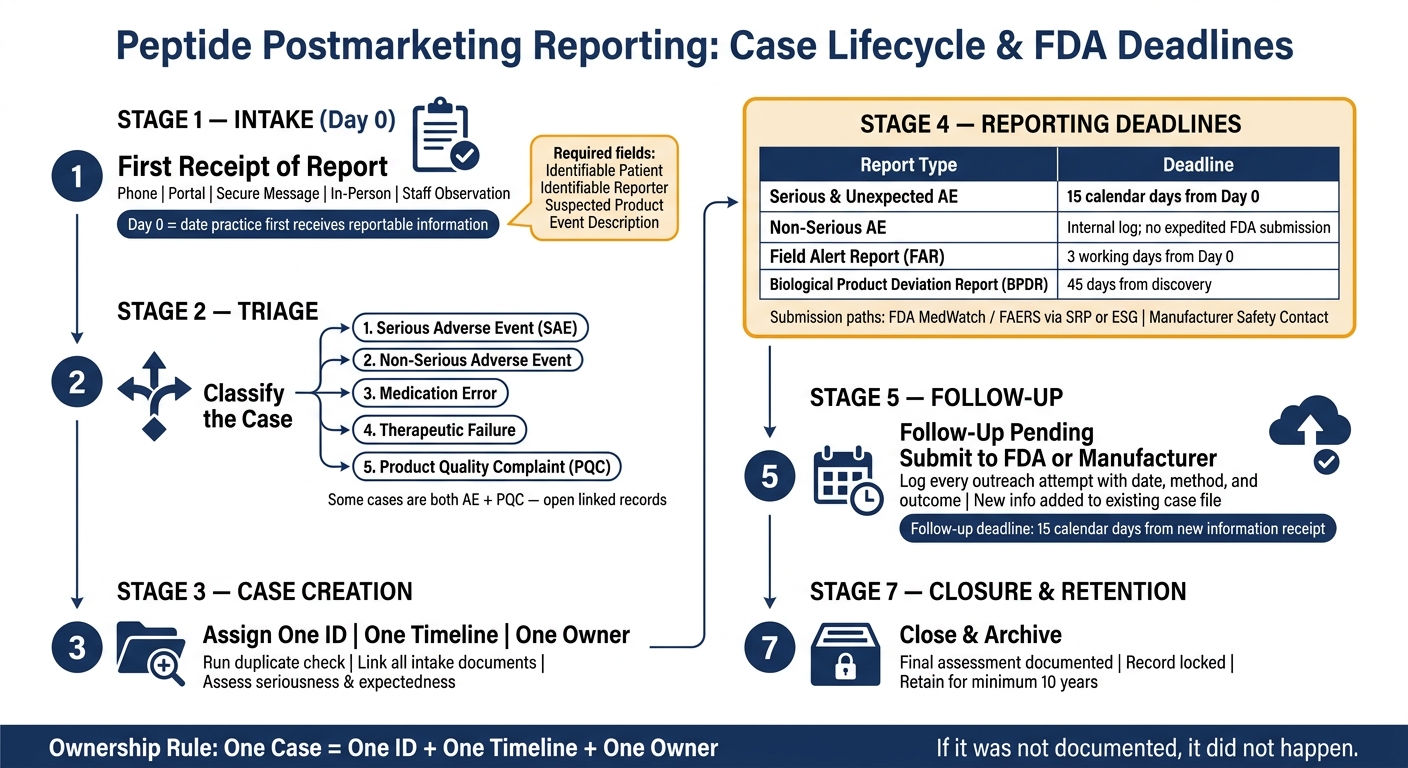
Peptide Adverse Event Reporting Workflow: From Intake to Submission
Once triage is done, the case should move into a controlled record with one ID, one timeline, and one owner. Assign a unique case ID, then link the intake form, event description, product details, lot or batch number, and reporter information to that record. After that, run a duplicate check against existing logs using identifiers like patient initials, event date, product name, and lot number. That step helps prevent double filing.
Next, assess seriousness and expectedness to decide if the case needs expedited reporting or routine review. Day 0 is the date the practice first receives reportable information.
Case status controls and follow-up expectations
Defined case statuses make the workflow easier to see and manage. Just as important, status changes should match the reporting clock. Each status needs a clear owner and a short list of actions that must be finished before the case moves forward.
| Case Status | Primary Owner | Required Actions |
|---|---|---|
| Open | Intake Coordinator | Assign unique case ID; run duplicate check; confirm minimum data fields are complete |
| Triaged | Clinical Lead / Medical Director | Assess seriousness and expectedness; classify as AE or product complaint; determine reporting path |
| Follow-up Pending | Case Manager | Document outreach attempts with date, method, and outcome; set next contact date |
| Submitted | Regulatory/Safety Staff | Verify data integrity; submit to FDA or manufacturer; log confirmation number |
| Closed | Medical Director | Document final assessment and closure rationale; archive record and ensure it is audit-ready |
Log every follow-up attempt and add new information to the existing case file. If outreach fails, document that too. A case should move to Closed only after all reporting duties are finished and no more information is expected. At that point, lock the record at closure. Adverse event records for peptide practices should be kept for at least 10 years.
Reporting deadlines and submission paths
Case status affects both the reporting clock and where the report goes. The table below shows the main report types for U.S. peptide practices, along with their triggers, deadlines, and who owns the task.
| Report Type | Trigger | Deadline | Submission Path | Responsible Party |
|---|---|---|---|---|
| Serious & Unexpected AE | Death, hospitalization, or life-threatening event not consistent with known safety information for that peptide | 15 calendar days from Day 0 | FDA MedWatch / FAERS via the Safety Reporting Portal (SRP) or Electronic Submissions Gateway (ESG); manufacturer safety contact | Medical Director / Compliance Officer |
| Non-Serious AE | Minor or expected events | No routine FDA expedited submission; document internally and escalate if unexpected or clinically significant | Internal safety log | Case Manager under clinician oversight |
| Field Alert Report (FAR) | FDA-approved NDA/ANDA product quality issue (e.g., contamination, sterility failure, mislabeling) | 3 working days from Day 0 | FDA electronic submission; working days are Monday–Friday, excluding federal holidays | Compliance Officer / Quality Lead |
| Biological Product Deviation Report (BPDR) | Biologic peptide product deviation affecting safety, purity, or potency | 45 days from discovery | FDA electronic submission | Medical Director / Quality Lead |
These deadlines only work when ownership is clear and the record is complete. For compounded peptides, send product problems to the dispensing pharmacy and document whether the issue is product-related or compounding-related.
Staff roles, oversight, and audit-ready records
Once a case is open and triaged, clear ownership and tight record control keep things moving. Without written role assignments, cases drift into informal handling, decisions never make it into the file, and reports get stuck. FDA warning letters have pointed to missing written procedures and weak oversight in postmarketing adverse drug experience reporting.
Role definitions and escalation authority
Each role needs defined authority and a clear handoff point. A job title alone isn't enough.
- Front-desk staff: log and route the report. They should never handle a report only by word of mouth without creating a record.
- Clinical staff: assess whether the symptoms point to an adverse event and document what they find.
- Prescribers: decide medical significance.
- Pharmacy liaisons: contact the dispensing pharmacy or manufacturer about product quality issues and place the response in the case record.
- Compliance personnel: track timelines and check for completeness.
- The designated safety reviewer: owns final classification and closure.
The file should make the trail easy to follow: who reviewed the case, when they reviewed it, what decision they made, and what evidence backed that decision.
Escalation authority also needs to be written down, not left to guesswork. Front-line staff should escalate at once for any report involving hospitalization, a life-threatening symptom, death, pregnancy exposure, medication error, contamination, loss of potency, or repeated complaints tied to the same lot. The safety reviewer should have written authority to trigger prescriber and compliance review that same day when a serious event is suspected. That matters because a serious case can otherwise sit in someone's inbox while the 15-calendar-day clock keeps ticking.
Those assignments should also appear in the case file itself, not live only in staff instructions.
Documentation standards that hold up in an audit
Every entry in a case file should be date-stamped, such as 08/27/2026, and written clearly enough that a reviewer can piece together the event without needing someone to explain it out loud. The file should include the product name, lot number, dose, route, administration date, onset date, symptoms or defect description, all follow-up attempts, and the final outcome. Inspectors look for proof of a controlled process, not someone's memory of what happened.
Corrections need extra care. Never overwrite an original entry. Keep the original text, note who made the change, record the date and time, and explain why the correction was needed. This matters most for seriousness determinations and lot numbers, where even a small change can affect reporting duties. If your practice uses electronic records, make sure the system keeps a visible audit trail that shows both the original entry and the revised one.
Every part of the file should connect to the same case ID: intake, chart note, product record, triage note, correspondence, and submission confirmation. Keep records readable, searchable, and complete for the full retention period. Compliance personnel should run periodic file audits to catch gaps such as missing lot numbers, unsigned final reviews, or cases discussed verbally that never made it into the official log.
Conclusion: Core controls every peptide practice should have in place
A compliant postmarketing reporting program doesn't need a lot of moving parts. It needs a few clear controls that work together: intake, case triage, tracking, timelines, ownership, and recordkeeping.
If a case is discussed but never logged, that's a compliance failure. Documentation is the control. This begins with rigorous patient selection criteria to minimize adverse events before they occur. That's the standard every peptide practice should meet.
When each reportable event is logged, assigned, and closed with a complete record, the program is audit-ready.
FAQs
Who is responsible for filing a peptide safety report?
For FDA-approved peptides, the clinician reports serious adverse events through FDA MedWatch.
For compounded peptides, the reporting path depends on the facility type. 503B outsourcing facilities must report adverse events. Individual clinics, on the other hand, should keep detailed internal records of patient responses and any adverse events.
Clinicians should also have internal protocols in place to log, classify, and escalate events. That way, records stay audit-ready and reporting timelines are met.
What starts the 15-day reporting clock?
The 15-day reporting clock for FDA postmarketing adverse event reporting starts when information about a reportable adverse event is formally received.
For healthcare professionals and peptide clinics, that means you need clear intake and classification systems from the start. If a qualifying event comes in, your team should spot it right away so the reporting deadline doesn’t slip.
How should we handle a case with both a reaction and a product defect?
Prioritize patient safety and complete documentation. Assess the patient right away for serious adverse events, such as an injection-site infection, and follow your established discontinuation criteria if needed. Record the reaction in the patient chart, along with any clinical action taken, such as pausing therapy or adjusting the dose.
Keep detailed internal records of the suspected defect too. That should include the source pharmacy, lot numbers, and any relevant testing documents, such as the Certificate of Analysis. For FDA-approved peptides, report serious adverse events through FDA MedWatch.