
If standing orders are vague, every care model breaks down. In this review, I see the same bottom line across all four setups: solo prescriber, NP-led, physician-PA, and RN-supported work best when tasks, stop rules, refill checks, and escalation points are written in plain language.
Here’s the short version:
- Solo prescriber gives the most direct control, but one missed lab or consent step can stall care.
- NP-led spreads routine work to staff, while the NP keeps diagnosis, consent, and treatment changes.
- Physician-PA can handle more patient volume, but it depends on clear physician oversight rules.
- RN-supported helps with teaching, symptom checks, and follow-up, but the RN cannot diagnose, prescribe, or change treatment.
- Across all models, the same failure points show up: missed baseline labs, refill drift, weak consent documentation, and unclear handoffs.
- Fixed review points like Week 1, Week 2, Weeks 8–12, and every 3 months help stop autopilot prescribing.
- The safest standing orders usually spell out six things: who qualifies, who does not, when to stop, when to escalate, what to chart, and when to follow up.
A few facts stand out to me:
- First peptide prescribing should have a hard stop until baseline labs and screening are done.
- The article flags 7 consent domains that should match both the consent form and chart note.
- Reassessment often centers on the 8–12 week mark, when clinics should check effect, safety labs, and whether to continue.
Standing Orders: How to Guide
sbb-itb-7164bd9
Quick Comparison
| Model | Main strength | Main risk | Best fit |
|---|---|---|---|
| Solo Prescriber | One clinician controls the full process | Single point of failure | Small, low-volume clinics |
| NP-Led | Routine work shifts to staff under protocol | State NP rules may limit authority | Growing clinics |
| Physician-PA | PA handles routine follow-up with physician backup | More supervision and charting rules | Moderate- to high-volume practices |
| RN-Supported | RN can cover repeat monitoring and teaching | Scope creep if standing orders are loose | Clinics with frequent lab and symptom follow-up |
If I had to reduce the whole article to one rule, it would be this: delegate tasks, not judgment. That idea drives lab review, refill rules, dose changes, symptom triage, and documentation in every model.
1. Solo Prescriber Workflow
In a solo prescriber model, one clinician handles patient selection, protocol design, safety review, documentation, and follow-up. If one lab gets missed or one consent step slips through, it falls back on that prescriber. That's why the solo model works as the clearest baseline when you're comparing it with shared-care workflows.
Safety Checks
A solid solo safety process starts with a hard stop before the first prescription. Use class-specific baseline labs such as IGF-1, fasting glucose/HbA1c, renal function, and lipids. These shouldn't be treated as nice-to-have items. They need to be complete before first prescribing. At the same time, run contraindication screening in parallel: active malignancy is an automatic decline for growth-promoting peptides, while severe renal or hepatic impairment should trigger a hold for certain agents.
Red-flag criteria also need to live inside the protocol itself, not in someone's memory. If a patient reports new symptoms between visits, such as major GI distress, unexpected edema, or mood changes, the standing order should spell out exactly when that means a prescriber call and when it means an ER referral.
Task Handoffs
Admin staff can take a lot off the prescriber's plate without stepping into clinical judgment. They can send intake forms, confirm that lab orders were placed, and verify that results are back before a peptide-start visit gets scheduled. An EHR task list helps here. No order should move forward until the prescriber reviews the labs and signs off.
It's also smart to avoid refill loops that run on autopilot. Reassessment should happen at fixed points:
- Week 1 tolerability
- Week 2 injection-site review
- Weeks 8-12 effect check
- Every 3 months after that
Visit Flow
A well-run solo visit usually moves through five steps: pre-visit data collection, structured assessment, shared decision-making, protocol-based ordering, and patient education plus documentation. Pre-visit intake through online forms can save time during the actual visit because labs and history are already in place before the encounter starts. For more involved peptide consults, that often keeps visits in the 20-40 minute range.
Documentation templates help a lot, especially when they mirror the informed consent packet. If the chart note uses the same language as the consent form, there's less room for mismatches during an audit. The note template should include the seven consent domains: clinical rationale, evidence, risks, alternatives, product status, business interests, and follow-up plan .
Regulatory Guardrails
Each peptide fits into one of four buckets: approved on-label, approved off-label, compounded, or investigational. That label drives which consent addenda are needed and which sourcing rules apply. Before prescribing restricted compounds, verify current 503A bulks-list status.
For compounded products, standing orders should reflect pharmacy-agnostic sourcing policies and document the clinical rationale for using a non-FDA-approved formulation. Missing even one of the seven required consent domains is a common audit finding in peptide practices. In a solo model, that risk is higher because there isn't a second clinician checking the chart. PeptidePrescriber's regulatory references and peptide monographs can be built into standing-order templates to help keep documentation current.
That baseline shows what the NP-led workflow can spread across more than one licensed clinician.
2. NP-Led Workflow
In an NP-led workflow, standing orders shift routine work to staff while the NP keeps clinical control. Compared with solo prescribing, this takes intake and routine monitoring off the NP's calendar. The basic split is simple: routine work moves outward, while diagnosis, consent, and treatment changes stay with the NP.
Safety Checks
Use protocol-based baseline labs and hard-stop contraindication checks. For example, GH-axis peptides should include IGF-1 before initiation. Build these required fields into the EMR so an order can't move ahead until every check is done.
Staff should only move the protocol forward when labs, vitals, and screening questions are confirmed in the checklist. When those checks are built into the system, each role can do its part without guesswork.
Task Handoffs
The cleanest NP-led handoff model breaks the workflow into four stages, with a clear trigger at each step:
| Workflow Stage | Primary Lead | Key Tasks | Handoff Trigger |
|---|---|---|---|
| Pre-Initiation | Admin | Baseline labs, pharmacy logistics | Chart ready for NP review |
| Clinical Decision | NP | Candidate selection, evidence summary, informed consent | Signed consent filed in chart |
| Loading Phase | RN | Week 1 tolerability check, Week 2 injection-site assessment | 4-week check-in complete |
| Effect Evaluation | NP | Repeat safety labs, repeat outcome measure, continue/adjust/stop decision | Updated treatment plan |
The standing order should spell out the escalation rule. If labs and symptom screens fall within set parameters, the RN can move ahead with education and scheduling. If they don't, the chart should go to the NP for review before anything else happens.
Visit Flow
Order baseline labs before the NP visit. Use standard intake forms for history and medications. Then the NP confirms the indication, reviews the results, and gets consent. After that, RN or MA staff can handle teaching and onboarding.
For established patients, refill decisions should stay tied to documented reassessment. Standing orders can let RN staff process a refill only when labs and symptom screens meet set criteria. If not, the chart goes back to the NP. Scheduled reassessment points help route routine refills to staff and exceptions to the NP.
That setup only works if the standing order matches state scope rules and clinic policy.
Regulatory Guardrails
Practice authority rules shape what an NP-led standing order can allow. In full-practice states, NPs may independently evaluate, diagnose, order tests, and sign standing orders. In reduced or restricted practice states, standing orders may need direct physician sign-off or a written collaborative practice agreement, especially for complex therapies. So before the template goes live, it should match state-specific scope rules.
Standing orders should be written, dated, easy to find in the EMR, and reviewed at least once a year so the protocol stays aligned with current evidence and scope rules. For compounded peptides, the standing order should document the product's sourcing and regulatory status, including whether it is 503A or 503B. If that product status changes, the protocol should be reviewed. PeptidePrescriber's regulatory references and pharmacy-agnostic sourcing guidance can help NPs turn current compliance requirements into standing-order language.
The physician-PA model follows the same delegation logic, but supervising physician rules change who can authorize each handoff.
3. Physician-PA Workflow
This model follows the same standing-order logic used in NP-led care, but the physician agreement sets the PA's delegation limits. In a physician-PA setup, the physician owns diagnosis, treatment approval, and escalation. The PA manages routine follow-up, dose changes that stay within protocol limits, patient education, and documentation. When those boundaries are spelled out in the standing order itself, the workflow moves faster and accountability stays clear.
Safety Checks
Before taking action, the PA checks the chart against a defined safety checklist. The PA should verify response before reordering by reviewing adverse effects and comparing current findings with protocol thresholds. That includes flagging abnormal glucose, blood pressure, renal or hepatic function, and any new symptoms before PA sign-off. Active malignancy should trigger an automatic decline for growth-promoting peptides. If any checkpoint fails, the chart goes to the physician before the PA moves forward.
Task Handoffs
After the chart clears safety checks, routine follow-up stays with the PA, while exceptions go to the physician. The PA should send red-flag symptoms, off-protocol responses, unclear diagnoses, or medication conflicts back to the physician.
| Workflow Stage | Primary Lead | Key Action | Escalation Trigger |
|---|---|---|---|
| Candidate Selection | PA | Screen for measurable endpoints; exclude requests without a measurable indication | Unclear indication → physician |
| Regulatory Classification | Physician | Classify as approved (on-label or off-label), compounded, or investigational | Investigational status → physician hold |
| Informed Consent | PA | Execute base consent + applicable addenda (compounded, off-label) | Complex polypharmacy → physician review |
| Baseline Monitoring | PA | Order/review IGF-1, A1c, lipid panel, CBC, CMP | Abnormal results → physician |
| Tolerability Check (Wks 1–4) | PA | Document adverse events and injection-site reactions | Red-flag symptoms → same-day physician review |
| Effect Evaluation (Wks 8–12) | Physician/PA | Compare results to baseline; continue, adjust, or stop | Off-protocol response → physician |
Visit Flow
A typical visit starts with intake and chart review, then moves into a PA-led history and protocol check. The PA reviews labs and symptom screens against standing-order criteria, handles counseling, and processes routine refill decisions. The physician steps in only when the case falls outside protocol. Standardized handoffs cut delays because each reassessment point is clearly defined. Use fixed reassessment points for every refill decision.
Regulatory Guardrails
Most states require a supervisory or collaborative agreement that defines the scope of the PA's delegated authority. The physician remains responsible for delegated acts.
It helps to document why the PA was allowed to act and which findings would have triggered physician review. For compounded peptides, the standing order should also note pharmacy sourcing, licensing, and compliance status. If FDA status changes, review the standing order before delegated prescribing continues. PeptidePrescriber's regulatory references and pharmacy-agnostic sourcing guidance can help physician-PA teams turn current compliance requirements into standing-order language.
4. RN-Supported Workflow
The RN-supported workflow covers the narrowest part of care, but it works well for routine patient touchpoints. In plain terms, the RN handles execution and flags issues, while the prescriber owns the plan and the medical calls. The prescriber sets the treatment plan and signs the standing orders. The RN then carries out those orders within clear limits.
The upside is simple: better throughput. The prescriber can stay focused on new consults and harder clinical calls, while the RN handles monitoring, patient teaching, and follow-up.
Safety Checks
Before taking any action, the RN checks the required contraindication list and confirms baseline labs are in place. If anything looks off, the prescriber reviews and interprets it. Active malignancy and other red-flag findings must go to the prescriber before the protocol continues. Before processing refills, the RN also confirms compounding eligibility and pharmacy compliance.
That setup keeps the RN in a screening lane, not a treatment-decision lane.
Task Handoffs
This model works best with fixed-interval check-ins instead of loose, open-ended follow-up. If there is any adverse event or any out-of-range finding, the RN should escalate it to the prescriber.
When that handoff happens, SBAR can make the message cleaner and easier to act on. The RN should include:
- Vitals
- Recent labs
- Peptide and dose
- Symptom timeline
With those details in the chart or handoff, the prescriber can often act right away without extra back-and-forth calls.
Visit Flow
Once the prescriber signs the order, the RN turns the protocol into day-to-day care. That includes leading patient education on injection technique, dosing schedule, storage, missed-dose instructions, and side effects to watch for. Scripted materials and teach-back help confirm the patient understands the plan .
| Phase | RN Task |
|---|---|
| Initiation | File signed consent, verify baseline labs, confirm pharmacy compliance |
| Loading Phase | Tolerability check-in; injection-site assessment; document adverse events |
| Effect Evaluation | Re-measure therapeutic endpoints; coordinate repeat safety labs |
| Maintenance | Reassess indication; document rationale for continuation |
Regulatory Guardrails
State nurse practice acts set the boundaries for what RNs can do under standing orders. That means the prescriber has to write standing orders with enough detail to spell out state-permitted delegated tasks. Those orders should list indications, contraindications, required assessments, escalation criteria, and documentation standards.
Charting should show protocol adherence, not independent medical judgment. Only the prescriber may start therapy or change it.
The RN also has a compliance role: verify pharmacy credentials and 503A or 503B status before refill processing . PeptidePrescriber's regulatory references and pharmacy-agnostic sourcing guidance can help teams turn these rules into standing-order language that is easier to audit. That helps the team keep patient flow moving without pushing RN scope beyond its limits.
Strengths, Tradeoffs, and Best Fit by Model
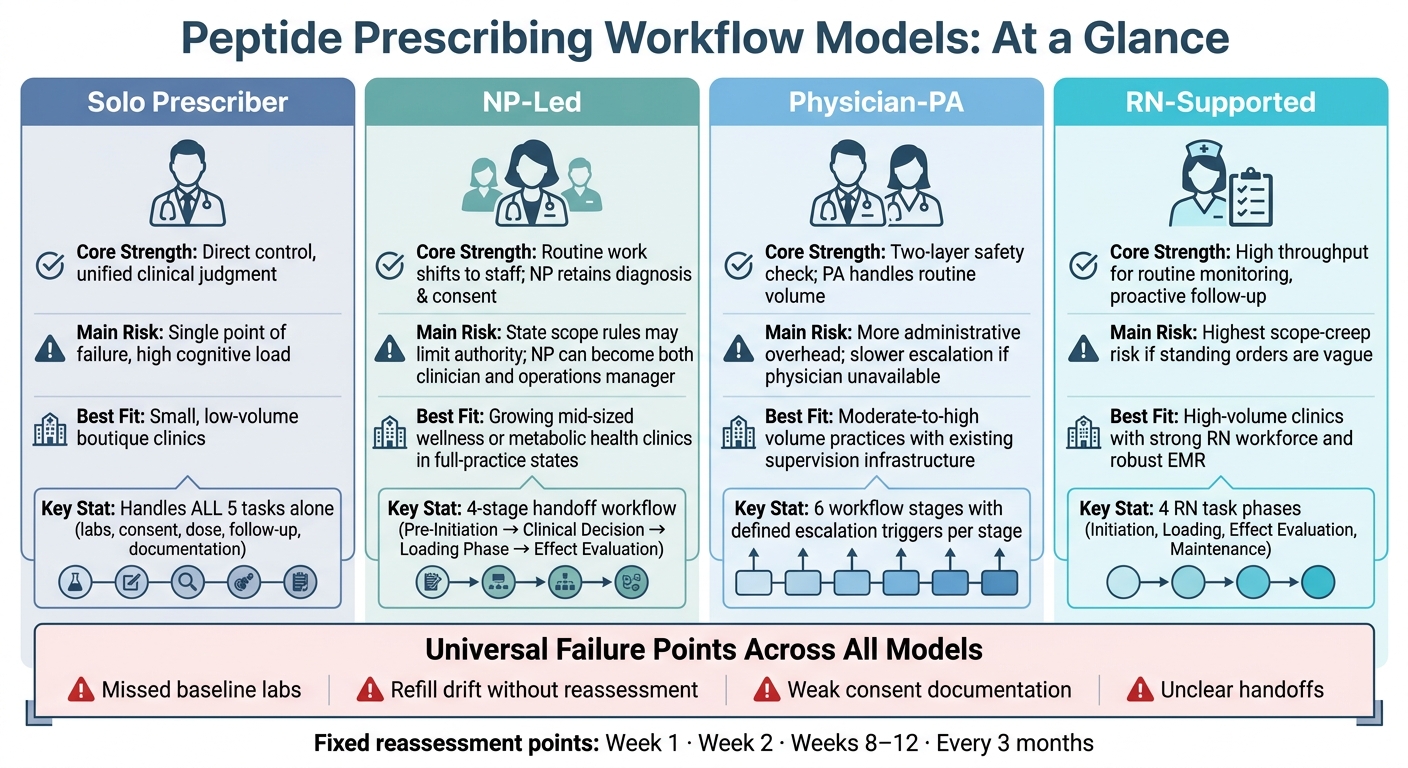
Care Team Workflow Models for Peptide Prescribing: Strengths, Risks & Best Fit
Each model leans into a different strength. The solo prescriber setup puts direct control first. The NP-led model puts autonomy first. The physician-PA model is built for throughput. And the RN-supported model is strongest when the clinic relies on protocol-based monitoring.
That’s why standing orders matter so much. They mark the line between routine work that can be delegated and the point where prescriber review has to step in. No model is best at everything. The right choice depends on where the practice is in its growth and how deep the staffing bench is.
The core tradeoff is simple: control vs. scale. Solo models keep decisions in one place. Shared-care models spread out routine work, which can help a clinic handle more volume, but they also bring more coordination and state scope limits. You can see that tradeoff most clearly in everyday standing-order decisions.
The clearest differences show up at common decision points:
| Task | Solo Prescriber | NP-Led | Physician-PA | RN-Supported |
|---|---|---|---|---|
| Abnormal labs | Prescriber only | NP owns; RN/MA flags | PA first-pass; physician escalation | RN flags; prescriber decides |
| Refill requests | Prescriber approves directly | RN/MA pre-screens; NP approves | PA manages routine; physician reviews complex | RN confirms safety criteria; prescriber approves |
| Dose changes | Prescriber-scheduled visits | NP adjusts within protocol; RN collects data | PA conducts follow-up; physician sets ceilings | RN gathers structured data; prescriber titrates asynchronously |
| Missed labs | Prescriber follow-up | RN/MA tracks; NP sets hold policy | PA manages compliance; physician sets parameters | RN runs adherence program; prescriber holds or discontinues |
| Injection training | Prescriber-led or delegated under a limited protocol | RN/MA handles under protocol | RN/MA handles under protocol | RN-led with scripted materials and teach-back |
| Symptom checks | Prescriber-managed | RN collects; NP reviews | RN collects; PA reviews | RN-led with defined escalation triggers |
Those ownership patterns shape which clinic sizes and staffing setups can handle the workflow without running into bottlenecks.
Matching the model to the practice stage matters more than trying to pick the “best” model in the abstract. Small clinics usually do best with the solo prescriber structure, where simplicity and direct control matter more than scale limits. Growing practices that are adding patients faster than one prescriber can manage should usually look at the NP-led model first, especially in states where collaborative agreement overhead is low.
The physician-PA model can slow smaller practices for one main reason: regulatory overhead. It tends to work best when supervision rules and documentation are already baked into the protocol. High-monitoring clinics - practices that need frequent lab checks, weekly symptom tracking, or hands-on injection support - are often a strong match for the RN-supported model, as long as the standing orders spell out every escalation threshold. Physician-PA workflows make sense when a practice wants high throughput and already has supervision infrastructure in place.
PeptidePrescriber’s regulatory references and clinical tools can help teams turn those thresholds into standing-order language.
Pros and Cons by Workflow Model
Each workflow model has clear upsides and clear limits when standing orders sit at the center of a peptide practice. The table below shows the main tradeoffs fast, and the notes after it get into what tends to matter day to day.
| Workflow Model | Major Advantages | Major Disadvantages | Ideal Use Case |
|---|---|---|---|
| Solo Prescriber | Unified clinical judgment; no handoff errors; rapid protocol updates | Single point of failure; high cognitive load; capacity ceiling | Boutique, low-volume specialty practices |
| NP-Led | Strong autonomy in full-practice states; cost-effective prescriber role; protocol-driven care fits peptide programs well | Collaboration requirements vary by state; NP can become both clinician and operations manager | Mid-sized wellness or metabolic health clinics in full-practice states |
| Physician-PA | Built-in two-layer safety check; PA handles routine volume; physician focuses on complex cases | More administrative overhead; slower escalation if physician availability is limited; higher staffing costs | Moderate-to-high volume practices with existing supervision infrastructure |
| RN-Supported | High throughput for routine monitoring; proactive follow-up; cost-effective staffing model | Highest scope-creep risk; standing orders must be precise to avoid quasi-prescribing decisions | High-volume clinics with a strong RN workforce and robust EMR documentation |
The solo prescriber model is the simplest setup, but it hits a wall fast. One person handles every safety step: lab review, contraindication checks, dose changes, and follow-up decisions. That can work in a small practice. Once patient volume grows, though, missed follow-ups and thin documentation become much more likely. There’s also no second reviewer to catch small mistakes before they turn into bigger ones.
The NP-led and physician-PA models both add backup, but they’re built in different ways. In an NP-led setup, one clinician usually owns the protocol, makes the tougher calls, and directs support staff working under standing orders. In a physician-PA setup, the work is split more clearly. The PA handles routine patient flow, while the physician steps in for exceptions and more complex cases. That split can help, but it also means more charting rules and more written guardrails around where the PA’s role stops and the physician’s role starts.
The RN-supported model can move routine work very well. It’s often a strong fit for scheduled labs, symptom check-ins, and injection teaching. But it also brings the most legal risk if the standing orders are loose. If dose-adjustment rules or escalation triggers are vague, RNs can get pushed into decisions that look too much like prescribing. That’s where exact wording matters. Standing orders should spell out clear triggers, not broad suggestions. For example, if ALT exceeds 3× the upper limit of normal, hold therapy and notify the prescriber the same day - not general guidance that leaves room for guesswork.
Across all four models, the same breakdowns show up again and again: skipped candidate selection, consent language that doesn’t match the chart note, and refills that keep going without a documented effect check at the 8–12 week mark. In practice, the workflow model matters less than how tightly the standing orders are written and followed.
Conclusion
Across all four models, the same pattern shows up: delegation works best when it’s narrow and explicit. The safest and most efficient setup is the one that fits patient acuity, staff skill, and state scope rules - while staying as simple as those limits allow.
Strong standing orders spell out the basics in plain terms:
- eligibility
- contraindications
- stop rules
- escalation thresholds
- documentation
- follow-up timing
When those pieces are vague or missing, the workflow model matters a lot less, because mistakes can happen in any setup. That’s the core design rule for standing orders in peptide practice.
PeptidePrescriber offers monographs, dosing protocols, clinical tools, and regulatory references to support standing-order design.
More complexity does not mean more safety.
FAQs
Which care model fits my clinic best?
The right fit comes down to one thing: can your clinic run peptide-specific safety steps the same way every time?
That means having a steady process for safety checks, informed consent, sourcing and category classification, and set monitoring intervals.
A prescriber-led model tends to work best when your clinic can reliably:
- choose the right candidates
- document product status
- schedule re-evaluation with baseline and class-appropriate labs
If your process depends on staff support, that can still work. But the team needs to document consent correctly and stick to the lab and follow-up schedule without gaps.
What should a standing order include?
A standing order should include a peptide-specific consent packet that covers:
- the indication
- the measurable endpoint
- the response and reassessment timeline
- the evidence summary
- adverse effects
- injection risks
- drug interactions
- alternatives considered
- the risks of no treatment
It should also spell out:
- FDA approval status
- whether the product is off-label or compounded
- whether it comes from 503A or 503B
- any prescriber-pharmacy financial interest
- the patient’s pharmacy choice
- the follow-up plan, including reevaluations, adverse-event reporting, discontinuation criteria, and the date
When should care be escalated to the prescriber?
Escalate care if monitoring shows major changes from baseline or if safety limits are crossed. That includes ALT or AST above 5 times the upper limit of normal or eGFR below 30.
You should also escalate for:
- Serious adverse events
- Unmet therapeutic endpoints
- Major injection-site reactions
- Systemic symptoms
- Cases where regulatory or pharmacy documentation is not enough to verify safety