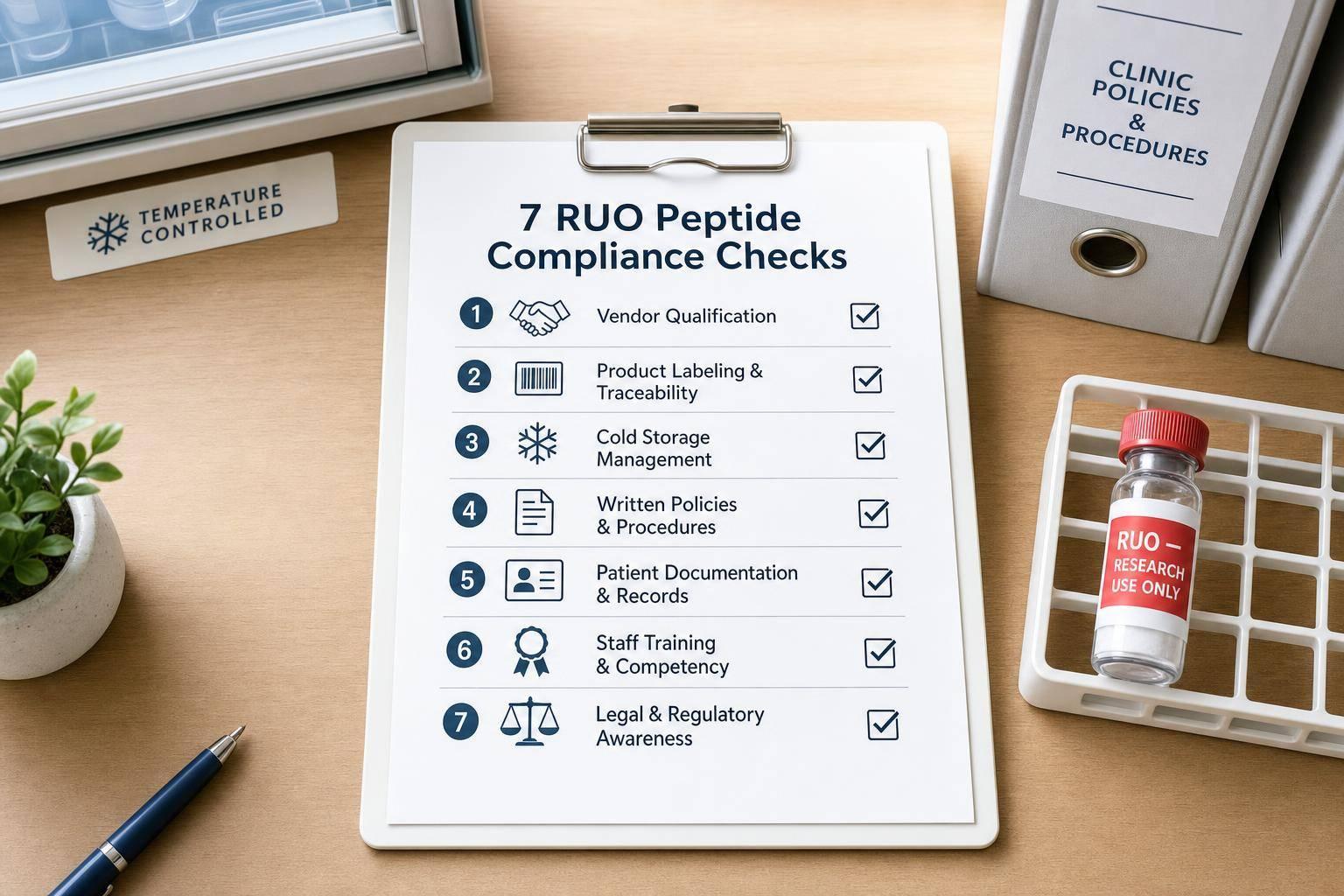
An RUO label does not make clinic use okay. FDA can look past “For Research Use Only” if a clinic’s website, records, storage, staff language, or workflow points to human use of peptide therapy.
If I had to boil this article down to one point, it’s this: a clinic should treat RUO peptides as non-patient items at every step. That means I need to check 7 things before anything touches a live workflow:
- Vendor review: confirm identity, source, and lot-specific COA
- Label check: make sure all materials use RUO wording and avoid treatment claims
- Storage split: keep RUO stock physically and digitally apart from patient injection supplies
- Written policy: set rules for ordering, handling, transfer, and disposal
- Chart limits: keep RUO out of treatment notes, med lists, and dosing records
- Staff training: teach banned terms and when to stop and escalate
- Legal/compliance sign-off: get written approval before launch
The article’s core warning is simple: one weak link can turn a research item into a human-use issue. A vial marked RUO may still draw FDA attention if staff talk about “therapy,” if the EMR shows “administered,” or if inventory sits next to patient injectables. That’s why the piece centers on three rules: separation, documentation, and escalation.
7 RUO Peptide Compliance Checks for Clinics
Can Med Spas Legally Offer Peptides? FDA Rules & MSO-PC Structure Explained.
sbb-itb-7164bd9
Quick Comparison
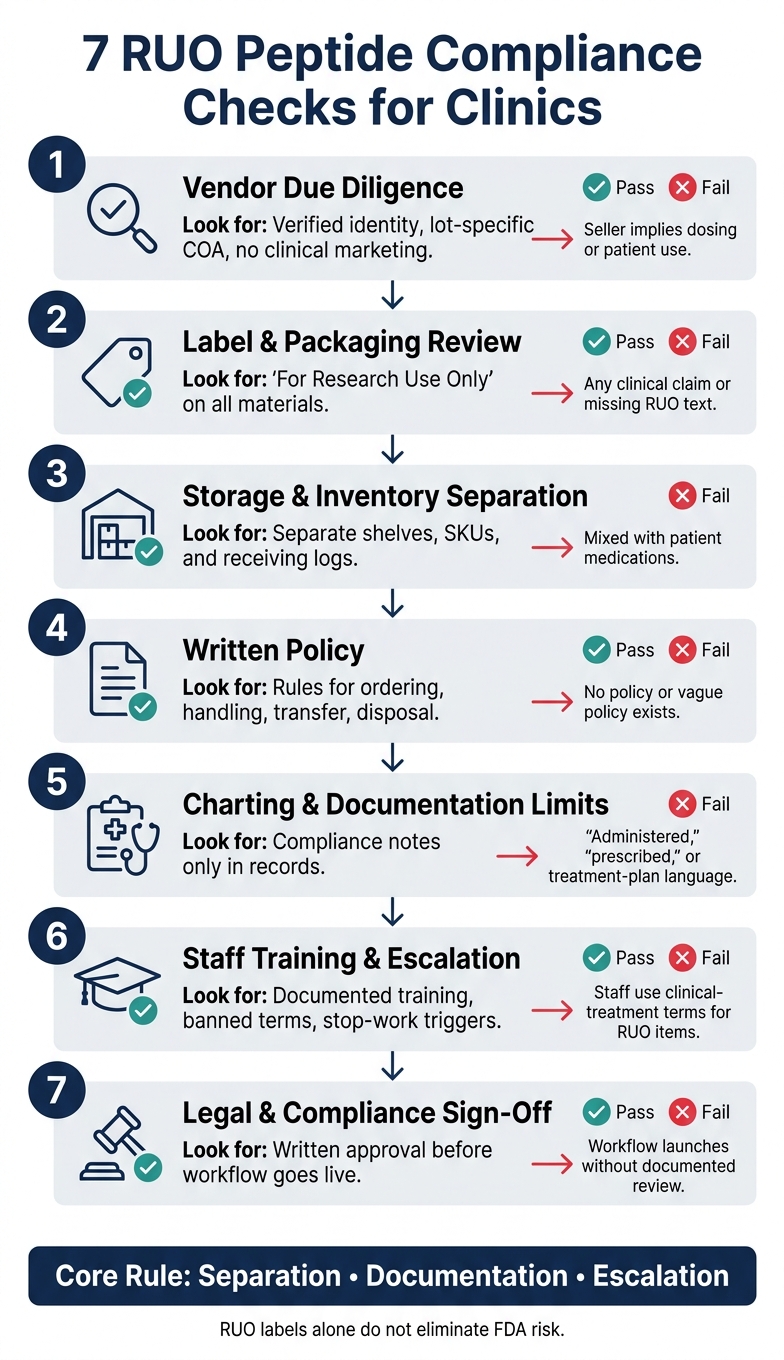
| Check | What I’m looking for | Main fail signal |
|---|---|---|
| Vendor due diligence | Verified seller, source records, lot-specific COA | Seller pushes dosing, treatment, or patient use |
| Label and packaging | RUO wording on vial, insert, invoice, and listing | Missing RUO text or any clinical claim |
| Storage and inventory | Separate shelves, bins, SKUs, and logs | Mixed with patient meds or same inventory trail |
| Written policy | Clear rules for order, receipt, storage, transfer, disposal | No policy or vague policy |
| Charting and docs | Compliance notes only | “Prescribed,” “administered,” or treatment-plan language |
| Staff training | Documented training and stop-work triggers | Staff use clinic-treatment terms for RUO items |
| Legal/compliance review | Written approval before go-live | Workflow starts without review |
A strong RUO process is not about labels alone. It’s about making sure every record, every shelf, and every staff action matches the same nonclinical line.
The 7 RUO Peptide Compliance Checks
Use these checks in a clinic audit, in the order shown. Each one shuts down a different route that could move an RUO peptide from inventory into patient use. The goal is simple: decide whether to proceed, quarantine, or escalate at each step.
1. Vendor Due Diligence: Confirm Identity, Origin, and RUO Status
Before an RUO peptide enters your workflow, verify the supplier's legal identity, business status, product origin, and document trail. A legitimate vendor should have traceable contact details, a clear chain of custody, and lot-specific Certificates of Analysis (COAs).
The COA needs to match the lot you received and include identity and purity data. If the COA is missing a lot number or shows an old retest date, don't use it.
Review the vendor's website and sales materials too. Red flags include phrases like "doctor-recommended", "patient protocol included", or dosing calculators. Those point to clinical intent, not research-only use.
Pass: Vendor identity, origin, lot-specific COA, and marketing review are on file, with no implied dosing or treatment use. Fail: Seller materials suggest clinical use, the COA is generic or incomplete, or vendor identity cannot be verified.
Once the vendor is cleared, move to the product-facing materials.
2. Label and Packaging Review: Verify RUO Wording and Remove Human-Use Signals
Check every surface tied to the product: the vial, carton, insert, invoice, and web listing. Each one should state "For Research Use Only" or "Not For Human Consumption." If even one of those materials leaves out that language, the product fails this check.
Also look for contradictions. RUO wording on a vial does not fix an insert that says "clinically tested", a website that mentions "weight loss protocols", or an invoice that labels the product as "injectable therapy."
Flag high-risk wording right away, including "treats", "prescribes", "for injection in patients", "used for weight loss", or any disease-specific claim anywhere in the materials.
Pass: All product-facing materials use RUO language with no dosing directions or treatment claims. Fail: Any material uses clinical language, suggests patient benefit, or leaves out the RUO statement.
3. Storage and Inventory Separation: Keep RUO Products Separate in Storage and Inventory Systems
You need separation in both the physical space and the digital system. Physically, RUO products should sit on separate shelves, in distinct bins, or in a locked area that is clearly apart from patient medications, sample kits, and any injectables meant for clinical use.
Digitally, RUO items need their own SKU naming convention, inventory category, and receiving log, separate from the pharmacy or clinical medication system.
This is where clinics often get sloppy. A product can look "separate enough" on the shelf, but if it shares the same inventory trail as patient-use drugs, you've got a problem.
Pass: RUO products have a dedicated storage area, separate SKUs, and a standalone receiving log. Fail: RUO items share shelving, inventory categories, or receiving records with patient-use medications.
After storage controls are in place, put the rules into writing.
4. Written Policy Language: Define Ordering, Handling, and Disposal Limits
Your written policy should spell out exactly who may order RUO products, who may receive them, where they are stored, whether they may be transferred between clinic locations, and who approves disposal. If the policy stays vague, staff may treat RUO items like normal clinical stock.
The policy should also ban clinical-use language in internal communication and include a stop-work rule for any shipment, document, or message that blurs the line between research use and human use.
Pass: A current written policy defines ordering authority, receiving steps, storage location, transfer limits, and disposal procedures, and it clearly bans clinical-use language for RUO items. Fail: No written policy exists, the policy is old, or it does not address ordering, handling, and disposal limits for RUO products.
5. Charting and Documentation Limits: Chart Compliance Only, Not Treatment
RUO products should never appear in the medical record as treatment. If an RUO product touches your workflow, the chart may include source verification, regulatory review, and chain-of-custody notes - and nothing beyond that.
Terms like "administered", "dose increased", or "prescribed" turn the record into a clinical-use record. Vendor review notes, legal review files, and inventory reconciliation should stay outside the medical chart unless your counsel approves a different setup.
This part matters more than many teams think. One careless phrase in a chart can undo a lot of careful process work.
Pass: Chart entries refer only to compliance review or chain-of-custody, with no administration or treatment language. Fail: Any chart entry uses medication-style language or records an RUO product as part of a treatment plan.
Charting limits only hold up if staff know how to follow them.
6. Staff Training and Escalation: Teach RUO Terminology and Escalation Triggers
Anyone who handles RUO products needs role-based training. That training should cover what RUO means, what staff must not say to patients, and the exact moments when they need to stop and escalate.
Staff should avoid patient-care language when talking about RUO materials. Escalation triggers include a vendor giving dosing instructions with an RUO product, a provider asking to chart a nonclinical product as a medication, or a COA that lacks lot-specific identity confirmation.
Staff should also know what not to do. If a patient asks about an RUO product, the answer should go to the medical director - not get handled on the spot at the point of care.
Pass: All relevant staff completed documented RUO training that covers terminology, banned language, patient-question boundaries, and escalation triggers. Fail: Training has not happened, is not documented, or misses roles that interact with RUO products.
Before any workflow goes live, get formal approval.
7. Legal and Compliance Review: Require Sign-Off Before Any Workflow Involving RUO Products Goes Live
No workflow involving RUO products should launch without written sign-off from counsel, compliance leadership, or a designated medical director. The review should cover sourcing, storage, SOPs, forms, scripts, and marketing.
You also need written confirmation that the workflow stays separate from patient care. If that cannot be documented, the workflow is not ready.
Pass: Counsel or compliance leadership reviewed and signed off on all relevant materials and confirmed in writing that the workflow keeps a defensible separation from patient care. Fail: Any workflow element goes live without documented legal or compliance review, or the review did not cover all outward-facing and internal materials.
Practical Verification Tools Clinics Can Use
Simple, repeatable tools help clinics turn the seven checks into a fast audit they can defend if anyone asks. The goal is straightforward: put these tools in place before any RUO workflow goes live.
Pass/Fail Audit Lines for Each Checkpoint
Use a one-page yes/no audit sheet for each checkpoint. Run it before any RUO-related workflow goes live, then run it again every month or quarter. If even one item fails, stop the workflow until the problem is fixed and documented.
| Checkpoint | Pass | Fail |
|---|---|---|
| Vendor file | Vendor file confirms identity, address, ownership, lot-specific COA, SDS, RUO declaration, and origin/manufacturing documents. | Missing documentation or marketing materials describing clinical claims. |
| RUO label | Primary container and inserts show "For Research Use Only / Not for Human Use", with no dosing or route language; the inventory system classifies the product as RUO/non-clinical. | Any label references a condition, dosing schedule, patient language, or administration route. |
| Storage separation | Dedicated, labeled, access-restricted area separate from patient-use medications; inventory system shows a separate RUO category with restricted access. | RUO stock shares shelving, refrigerator bins, or inventory categories with patient-use medications. |
| Policy status | Approved policy on file with approver signatures, defining ordering, handling, and disposal limits. | Draft-only document, missing signatures, or no review date on file. |
| Charting limits | EMR templates allow RUO references only in compliance or internal audit fields; chart audits show no RUO product in medication lists or treatment plans. | Any RUO product appears in a medication list, treatment plan, or billing entry. |
| Staff training | Documented training log covering RUO terminology, banned language, and stop-work triggers for all staff who handle RUO products. | No training log, or staff cannot explain what RUO means. |
| Legal sign-off | Written approval from counsel or compliance officer is on file before the workflow launches. | Verbal-only approval, no documentation, or workflow launched before legal review. |
Assign one owner to the process. Keep completed audits in a compliance folder, not in the patient record system.
Table: Acceptable vs. High-Risk Workflow Signals
Use these signals during vendor review and site audits. They make it easier to spot when a workflow is staying in bounds and when it’s drifting into danger.
| Domain | Acceptable Signal | High-Risk Signal |
|---|---|---|
| Vendor | Website describes peptides as laboratory reagents for in vitro research; vendor asks for institutional or professional credentials. | Website promotes patient transformation programs or clinical peptide stacks; testimonials describe individual dosing regimens. |
| Label | Primary container marked "For Research Use Only / Not for Human Use"; inserts cover stability and storage only. | Label references a condition or includes dosing language, route language, or frequency instructions. |
| Storage | Locked, labeled cabinet or freezer away from patient-care areas; inventory software lists RUO items in a research/reagent category with restricted access. | RUO vials mixed into the same refrigerator or medication carts used for vaccines or other clinical drugs. |
| Charting | RUO products never appear in medication lists or treatment plans; any mention is limited to compliance or internal audit notes. | Provider documents an RUO peptide as part of a patient's current regimen. |
| COA | Lot-specific COA includes identity and lot number; supporting verification is documented. | Generic COA reused across multiple shipments; no lot number or no clear identity confirmation. |
If a site audit or audit sheet finds a fail, record the date, the auditor’s name, the exact finding, and the corrective action taken. That paper trail helps show good-faith compliance. For RUO workflows, the big three are separation, documentation, and escalation.
Resources for Clinic Policy Development and Clinician Education
Once the audit checks are done, clinics need written tools that turn those rules into day-to-day work. A defensible RUO policy doesn't start when a regulator or payer asks for it. It starts earlier, with written policies, staff training, and reference tools that people can use in practice.
In most clinics, four resource types do the heavy lifting:
- Governance documents
- Training assets
- Operational tools for intake, review, and escalation
- Regulatory references
Policy language should turn those resources into a clear intended-use standard. Internal RUO policy language should track FDA intended-use standards. RUO labeling by itself does not remove regulatory risk if labeling, promotion, or other materials point to clinical use. For example: "RUO-labeled materials may not be represented to staff or patients as treatment products, and no dosing or administration instructions may appear in patient-facing materials."
Using PeptidePrescriber for Regulatory References and Policy Templates
For clinics putting those documents together, PeptidePrescriber can help with policy work by providing regulatory references, monographs, and editable documentation tools. Its regulatory references and peptide monographs group product references and regulatory notes in one place, which gives internal policies a fact-based starting point. Its editable consent templates, chart-note frameworks, and staff onboarding resources also help clinics standardize documentation across providers and locations. That's often where compliance gaps show up first.
Its Starter Pack can give clinics a starting point for consent templates, implementation checklists, and a regulatory quick reference.
Conclusion: A Defensible RUO Workflow Depends on Separation, Documentation, and Escalation
Taken together, these seven checks set a clear RUO boundary. Risk builds over time across sourcing, labeling, storage, policy, charting, training, and review.
The practical rule is simple: treat RUO materials as nonclinical at every step. Keep them separate from anything tied to patient care.
Staff also need to know when to stop work. If a trigger appears, they should escalate it right away. And before any RUO-adjacent workflow goes live - or changes in a material way - legal and compliance sign-off is required.
Recent FDA enforcement makes the stakes plain. FDA warning letters show that "research use only" and "not for human consumption" disclaimers do not overcome evidence of human use.
A defensible RUO workflow depends on separation, documentation, and escalation.
FAQs
Can a clinic ever use RUO peptides for patient care?
No. Research Use Only (RUO) peptides should never be used for patient care.
They are meant only for in vitro research and are not authorized for human administration.
That line matters. RUO products are not made to the pharmaceutical-grade standards required for clinical use. In plain terms, they are not prepared for use in patients.
They may also contain hazardous residual solvents, including trifluoroacetic acid (TFA). And the risk doesn’t stop at use. Simply possessing RUO-labeled vials in a clinic can create serious legal and professional risk.
What should trigger an immediate RUO compliance escalation?
Escalate immediately if you find unlabeled, research-chemical-grade products in clinic inventory, can’t verify a pharmacy’s current state license, Category 2 compliance, or release-testing records, or a peptide’s regulatory status is unclear.
If there’s an active FDA removal notice or a pending Pharmacy Compounding Advisory Committee consultation without a defined posture, stop prescribing until the current FDA posture is confirmed through the Federal Register.
How often should a clinic audit its RUO peptide process?
Audit the RUO peptide workflow at least quarterly. Review suppliers, documentation practices, and any formulary steps touched by regulatory changes.
Move the audit up when a major change happens, such as the peptide, indication, source pharmacy, or patient risk level. Update charting and consent so they match those changes.