
If I want to expand a peptide clinic the right way, I start by mapping competitors before I add anything new. That means I look at public data on intake, labs, pricing, telehealth reach, follow-up timing, consent, sourcing, and patient support. The goal is simple: see where the market is crowded, where care falls short, and where my clinic can add a service that fits clinical scope and compliance rules.
Here’s the full picture in plain English:
- I sort clinics into direct, indirect, and substitute rivals.
- I build one comparison grid using the same fields for every clinic.
- I convert costs to a monthly U.S. dollar view so $150/month + meds and $400 all-in can be compared fairly.
- I score service depth across consult quality, protocol range, lab monitoring, patient education, and support access.
- I map the patient journey across discovery, intake, consult, treatment start, monitoring, and longer-term care.
- I look for weak spots like auto-refills without reassessment, no baseline labs, thin consent, or no adverse-event process.
- I rank new service ideas by clinic fit, staffing, compliance burden, workflow load, and revenue potential.
A few facts stand out. Many clinics list follow-up poorly or not at all. Some rely on basic waivers instead of a structured informed consent process. And as of April 2026, FDA removal notices for peptides like BPC-157, Semax, Epitalon, and MOTS-c make those areas much harder to build around. By contrast, options like Tesamorelin and PT-141 have a clearer prescribing path.
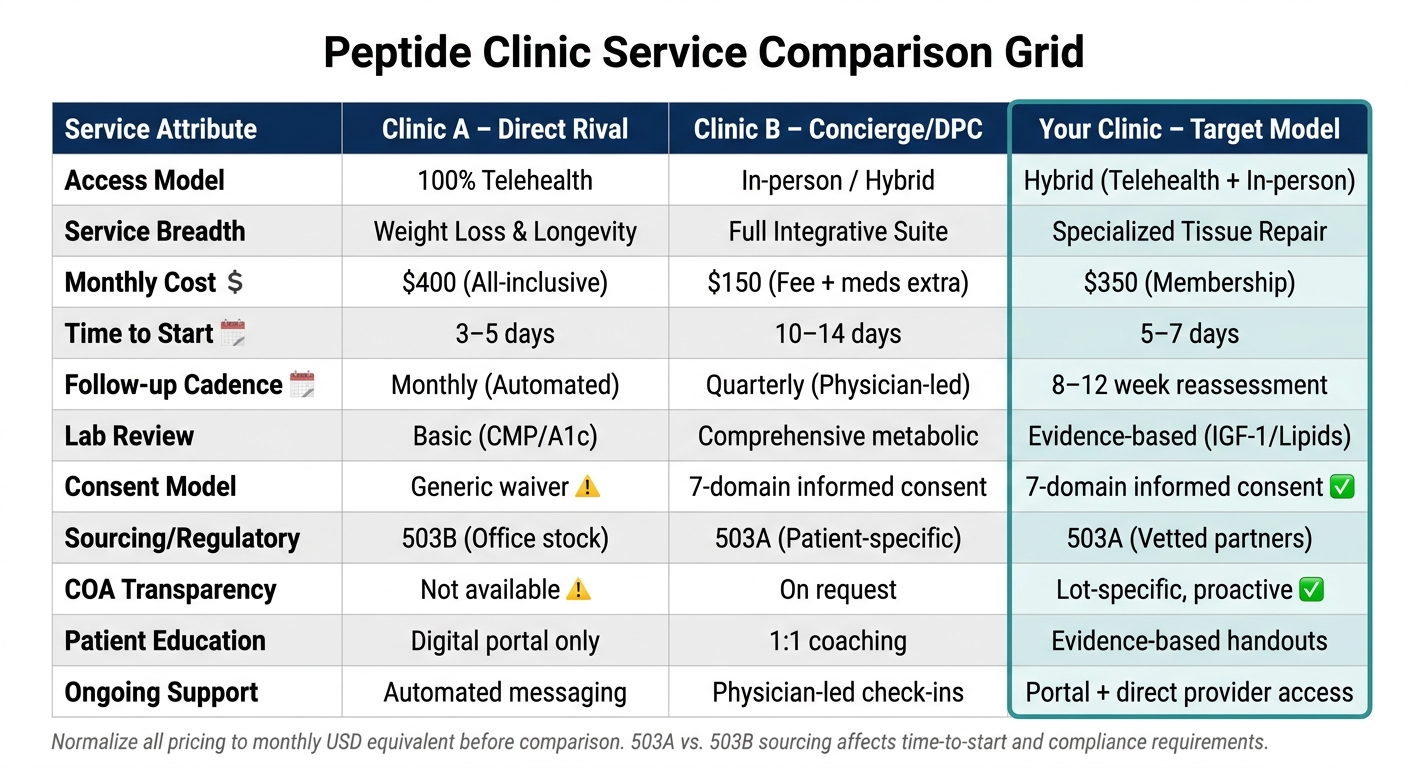
Peptide Clinic Competitor Service Comparison Grid
Quick Comparison
| Area | What I check | What often goes wrong |
|---|---|---|
| Competitor type | Direct, indirect, substitute | Clinics get grouped too broadly |
| Intake | Screening, contraindications, consent | Fast intake with weak screening |
| Labs | Baseline and follow-up labs | No labs or no set reassessment |
| Pricing | Monthly normalized cost in USD | Hidden add-on fees |
| Sourcing | 503A, 503B, or RUO | Vague product sourcing |
| Support | Portal, phone, provider access | Little contact after treatment starts |
| Monitoring | Week 1, week 2, and 8–12 week reviews | Refills without clinical review |
| Compliance fit | Product status and prescribing path | High-risk services prioritized too early |
My takeaway is straightforward: I should not copy the busiest clinic or the loudest offer. I should build around care gaps I can support well - like tighter follow-up, clearer sourcing, better patient education, and a cleaner refill process.
That’s what this article walks through step by step.
sbb-itb-7164bd9
1. Define the competitive set
Define a tight competitive set before you build the grid.
Group direct, indirect, and substitute rivals
Split competitors into three tiers based on how closely they match your service model.
- Direct: Same patient segment, similar provider-led peptide model.
- Indirect: Same patient goal, different service model.
- Substitute: Same patient budget and attention, minimal clinical oversight - gray-market vendors selling research-use-only products, DIY biohacking communities.
This tiering makes it easier to see where your clinic is in a head-to-head fight and where the market is only nearby.
Use a simple tiering rule to keep the list focused
A simple rule keeps the list from getting out of hand. Use this filter:
| Tier | Patient Need | Service Model | Level of Oversight |
|---|---|---|---|
| Direct | Same (e.g., weight loss, recovery) | Similar (concierge, telehealth, DPC) | High - prescriber-led |
| Indirect | Same | Different (medspa, functional med, BHRT) | Moderate |
| Substitute | Same | Low-touch (DIY, gray market) | Minimal to none |
The point here is to isolate the rivals that matter for service comparison, not every clinic that happens to mention peptides.
As you map each competitor, note their sourcing route - whether they use 503A compounding, 503B outsourcing facilities, or gray-market channels. That line matters. It shapes consent requirements and sourcing liability, so it belongs in your grid.
Keep the list limited to the same indication and footprint. Use that set to build the service comparison grid in the next step.
2. Build a service comparison grid
Once you’ve set your competitive tiers, turn them into a side-by-side view. A service comparison grid lists clinics in rows, service traits in columns, and formats each cell the same way.
Choose the columns that matter in peptide care
Your columns make or break the grid. In peptide care, generic business labels don’t tell you much. The useful stuff is how a clinic handles access, clinical rigor, sourcing, and patient support.
Track the same attributes for every competitor:
- access model
- service breadth
- eligibility process
- baseline lab requirements
- follow-up cadence
- refill process
- pricing structure
- consent model
- patient education
- ongoing support
- sourcing/regulatory posture (503A, 503B, or RUO)
Two columns often get missed: consent depth and Certificates of Analysis (COA) transparency.
A clinic using a generic waiver is working in a very different way from one using a structured, 7-domain informed consent packet that covers clinical rationale, evidence basis, risks, alternatives, product status, business interests, and follow-up. The same goes for COA access. If a clinic can provide a lot-specific COA covering identity, purity, and endotoxin testing, that’s a strong quality signal.
Set up your own data sheet first, then compare clinics using that same format.
Build the matrix and normalize the inputs
The hard part is normalization. You need monthly cost, lab fees, and follow-up timing on the same basis.
A clinic charging $150 a month with labs billed separately is not directly comparable to one charging $400 a month all-inclusive until you normalize the numbers.
Convert every pricing model into a monthly USD equivalent. Do the same with follow-up timing by using fixed checkpoints, such as a week 1 tolerability check and an 8- to 12-week effect evaluation.
| Service Attribute | Clinic A (Direct Rival) | Clinic B (Concierge/DPC) | Your Clinic (Target Model) |
|---|---|---|---|
| Access Model | 100% Telehealth | In-person / Hybrid | Hybrid (Telehealth + In-person) |
| Service Breadth | Weight Loss & Longevity | Full Integrative Suite | Specialized Tissue Repair |
| Monthly Cost | $400 (All-inclusive) | $150 (Fee + meds extra) | $350 (Membership) |
| Time to Start | 3–5 days | 10–14 days | 5–7 days |
| Follow-up Cadence | Monthly (Automated) | Quarterly (Physician-led) | 8–12 week reassessment |
| Lab Review | Basic (CMP/A1c) | Comprehensive metabolic | Evidence-based (IGF-1/Lipids) |
| Consent Model | Generic waiver | 7-domain informed consent | 7-domain informed consent |
| Sourcing/Regulatory Posture | 503B (Office stock) | 503A (Patient-specific) | 503A (Vetted partners) |
| COA Transparency | Not available | On request | Lot-specific, proactive |
| Patient Education | Digital portal only | 1:1 coaching | Evidence-based handouts |
| Ongoing Support | Automated messaging | Physician-led check-ins | Portal + direct provider access |
For the time-to-start column, the 503A vs. 503B distinction matters. 503B office stock can move faster than 503A patient-specific compounding, so your grid should show that clearly.
Use the finished grid to score service depth and map the patient journey next.
3. Score service depth and map the patient journey
Turn the grid into a ranking by scoring each clinic with the same rubric. A comparison grid only helps if every clinic is judged the same way. Before you score anything, define what each number on your 1–5 scale means. That keeps scoring steady from one reviewer to the next.
Use a consistent service-depth scoring model
Score each competitor across five core factors: consultation quality, protocol range, lab monitoring, patient education, and support access. The table below shows the difference between a low score and a high score for each factor.
| Service Factor | Low Score (1–2) | Mid Score (3) | High Score (4–5) |
|---|---|---|---|
| Consultation Quality | Generic waiver; no discussion of alternatives or evidence basis | Basic consent; mentions off-label status but lacks evidence summary | Structured informed consent with risks, alternatives, and follow-up |
| Protocol Range | Narrow product set; no sourcing transparency | 503A/B options; basic dosing protocols | Clear scope by product type and regulatory status |
| Lab Monitoring | No baseline or follow-up labs required | Baseline labs performed; inconsistent follow-up | Baseline plus scheduled reassessments |
| Patient Education | Verbal instructions only | Basic handouts on administration and side effects | Written education on storage, risks, and product status |
| Support Access | No portal; difficult to report adverse events | Email support; standard response times | Scheduled check-ins at week 1 and week 2; clear adverse-event reporting structure |
One scoring rule is worth locking in early: give extra weight to clear exclusion criteria. If a clinic spells out when it will decline a patient - such as for contraindications or refusal of informed consent - that clinic should score higher than one that seems willing to accept everyone.
Compare each stage of the patient journey
Scores show depth. The journey map shows where that depth falls apart in day-to-day care.
Use the journey map to test whether a high score reflects a strong workflow or just polished marketing. Map each competitor across six stages - discovery, intake, consultation, treatment start, monitoring, and ongoing care. For each stage, note what the clinic provides, what the patient has to do, and where friction shows up.
| Journey Stage | What to Evaluate | Common Friction Points |
|---|---|---|
| Discovery | Quality of education; evidence-graded references; provider credential transparency | Vague claims; lack of evidence-based education |
| Intake | Triage rigor; contraindication screening; baseline lab requirements | Accepting patients with soft indications without measurable endpoints |
| Consultation | Disclosure of off-label and compounded status; financial interest disclosure | No mention of alternatives; failure to disclose pharmacy relationships |
| Treatment Start | Lot-specific COA availability; injection training; storage education | Confusion over "Research Use Only" labels; no written storage instructions |
| Monitoring | Fixed reassessment dates; week 1 tolerability check | Automatic refills with no clinical decision-making or endpoint tracking |
| Ongoing Care | Discontinuation criteria; adverse-event logging; 3-month maintenance reassessments | No structured process for reporting or escalating adverse events |
The biggest gaps usually show up at treatment start and monitoring. That’s where lean clinics often skip review, reassessment, or refill controls. Those friction points give you the clearest input for the next step.
4. Find open market space and prioritize next moves
Identify white space from clusters and gaps
The journey map shows where competitors start to fall apart. This step is where you turn those weak spots into clear priorities.
Start by looking for repeat gaps in the patient journey. Then translate those gaps into open market space. A lot of clinics still depend on ad hoc follow-up. A better move is to set fixed check-in points, like week 1 for tolerability, week 2 for site assessment, and weeks 8 to 12 for effect review, so patients aren’t left to figure out the early phase on their own.
Once follow-up gaps are easy to see, positioning gaps often appear right after. Many clinics build their identity around one peptide. A stronger move is to position around a measurable patient goal instead of a single peptide. That gives the clinic more clinical depth than a generic "peptide clinic."
A common pattern shows up in remote care too. Some clinics make intake easy, then fade into the background once treatment begins. If your map shows that competitors offer little or no support during the loading phase - no help with injection technique, no early side-effect management, and no structured two-way communication between visits - that quiet stretch is where your opening sits.
Still, not every gap is worth building around. Some look good on paper but don’t fit your clinic.
Prioritize opportunities by feasibility and fit
Rank each option based on your clinical scope, staffing, and how much regulatory risk your clinic is willing to take on. Score each one across:
- strategic fit
- provider expertise
- staffing capacity
- compliance requirements
- operational complexity
- expected revenue potential
Give extra weight to regulatory risk. As of April 2026, the FDA issued removal notices for several high-interest peptides, including BPC-157, Semax, Epitalon, and MOTS-c, from Category 2. Any opening tied to those substances should sit low on the list until there’s more clarity. By contrast, FDA-approved options like Tesamorelin and PT-141 should move higher because the compliance path is clearer.
You can also save time by leaning on tools you already have access to. Dosing libraries, reconstitution calculators, and consent templates from PeptidePrescriber can help you test staffing needs and workflow before launch.
Conclusion: Turn the map into a clinic action plan
The map matters only if it changes what the clinic builds next.
The full process comes down to five steps: define the right competitor set, build a comparison grid, score service depth, review the patient journey stage by stage, and use what you find to spot defensible gaps. Each step sets up the next one.
The strongest openings usually don’t come from copying every service in the market. They come from better care design and smoother delivery: structured follow-up where rivals go silent, transparent sourcing where others stay vague, and clinical focus where competitors stay generic.
Pick one gap, confirm that it fits, then build the workflow before you market it.
FAQs
How many clinics should I map first?
Start with three to five direct rivals. That gives you a manageable place to begin and helps you get a clear read on your local market without feeling buried in too much data.
A smaller first group also makes it easier to compare patient journeys, service depth, and market positioning before you branch out to indirect competitors or add more clinics.
What data should I collect if pricing is unclear?
When competitor pricing is hard to pin down, spend less time chasing a per-unit number and more time looking at wholesale unit economics. A simple gut check helps here: compare your wholesale costs against public retail prices and see if the math still works. If the spread is too tight, the model may not hold up.
It also helps to look beyond price and study service depth and the full patient journey. Pay attention to how offers are bundled. For example, some clinics pair peptide therapy with hormone optimization or weight management instead of selling one compound on its own. That gives you a clearer picture of what patients are paying for.
From there, position your offer around a guided care plan, not just individual compounds. That shift matters. Patients usually aren’t looking to buy a vial or prescription in isolation. They’re looking for structure, follow-up, and a plan that makes sense from start to finish.
How do I choose safe service gaps to expand into?
Choose service gaps you can fill safely by tying a clear, evidence-based clinical indication to a measurable endpoint you can track. Then expand only where patients can give informed consent and complete follow-up.
That means steering clear of gaps driven by vague “recovery” or “anti-aging” demand, early requests for specific peptides, or any setup that makes reassessment hard.
Start small. In most cases, that looks like:
- Offering 2–3 well-researched peptides
- Confirming compliant pharmacy sourcing
- Setting fixed re-evaluation intervals
- Writing down clear discontinuation criteria before you scale
The goal is simple: match each peptide to a defined use case, monitor a specific outcome, and make sure you can stop treatment just as clearly as you start it.