
If I had to boil this down to one point, it’s this: most regenerative medicine clinics should start by branding around one patient problem, not one peptide and not every service at once.
Here’s why:
- Condition-focused branding is usually the clearest for patients
- It lines up better with how people search for care
- It tends to create less ad-policy risk than naming compounds (using a Peptide Prescriber Starter Pack can help with regulatory compliance)
- It often supports repeat care plans worth $4,000 to $6,000 per year per peptide patient
- Broad regenerative branding can drive bigger single-case revenue, often $3,000 to $15,000+ per treatment, but it can also make the message less sharp
There’s also a trust issue in this market. Studies cited in the article say about 96% of regenerative medicine clinic websites include unsupported or incorrect claims. So the branding choice is not just about lead flow. It also affects ad approval, patient trust, and how easy your offer is to explain.
If I compare the three paths in plain terms:
- Condition-focused: best for clinics that want to own one problem first
- Modality-focused: works better for people who already know peptide terms and are shopping by treatment type
- Broad regenerative: fits larger clinics with more services, more systems, and more staff
Quick Comparison
| Model | Best use | Main upside | Main downside |
|---|---|---|---|
| Condition-focused peptide branding | New or focused clinics | Clear message, better fit with symptom searches, lower ad risk | Heavier reliance on one patient segment (requiring precise patient selection criteria) |
| Modality-focused peptide branding | Clinics serving peptide-aware buyers | Pulls in people already researching compounds | More price shopping and more ad restrictions and regulatory hurdles |
| Broad regenerative branding | Established multi-service clinics | More cross-sell paths and higher case values | Less clear message and more complex claim control |
So if you want the short answer: lead with the outcome, package the care, and keep claims tight. That is the core lesson from the full article.
sbb-itb-7164bd9
1. Condition-Focused Peptide Niche Branding
This model builds the clinic’s identity around one patient problem, not a compound or a broad service bucket. So instead of marketing yourself as a peptide clinic, you lead with the outcome people care about: chronic knee pain, hormone imbalance, hair restoration, or post-surgical tissue repair. The message starts with the patient’s problem, not the treatment.
Positioning Clarity
Condition-focused branding leads with the who and the result. Most patients don’t think in molecule names. They think, “my knee still hurts after that injury,” not “I need a specific peptide.”
As Mark Sanna, CEO of Breakthrough Coaching, puts it:
"Trying to be everything to everyone often results in becoming memorable to no one."
When your clinic becomes known for helping with one clear issue, that identity gets stronger over time. Local search signals and patient word-of-mouth start pointing in the same direction. You’re not just another clinic on the list. You become the answer people connect to a specific problem.
Patient Acquisition Fit
This branding model reaches patients earlier in their search by using symptom-led language like “chronic joint pain,” “metabolic fatigue,” or “hair thinning,” instead of treatment names. That matters because people usually search by what they feel, not by the clinical tool used to treat it.
It also helps screen for fit. Patients who respond to this type of message are often already looking for a focused clinical option and may be more open to a physician-guided plan.
Compliance and Trust
Condition-based messaging also lowers a major operating risk. Platforms like Google and Meta apply their own health ad rules apart from the FDA, and using specific compounded molecule names in headlines can trigger flags or account suspensions, even when the clinical claim itself is accurate.
By framing campaigns around outcomes and symptoms, clinics are more likely to keep ads live and avoid the drug-promotion issues that often catch regenerative clinics by surprise. Plain symptom-based messaging can also feel easier for patients to understand, which helps build trust.
Operational and Revenue Model
This model can support better revenue retention. When peptide therapy sits inside a physician-guided program with labs, monitoring, and follow-up, care becomes more continuous and more structured.
A single peptide patient can represent between $4,000 and $6,000 in annual revenue through recurring protocols and monitoring. A program name like “The Performance Recovery Program” can also cut down on price shopping because the offer feels like a guided care plan, not just a product comparison.
That setup supports recurring care, stronger lifetime value, and less direct price pressure.
This approach tends to work best when a clinic wants to own one problem first, then branch into a broader mix later.
2. Modality-Focused Peptide Clinic Branding
If condition-focused branding sells the outcome, modality-focused branding sells the tool.
Here, the clinic is built around peptide therapy itself. In some cases, it leans on a specific compound like BPC-157, CJC-1295, or Sermorelin. The message focuses on what the clinic offers, not who it's for or the problem it addresses.
Positioning Clarity
This model makes the tool clear, but the patient story can get blurry.
A prospect may understand that the clinic offers peptide therapy. What they may not see right away is why that matters for their own situation. That gap matters. For buyers who already know the space, the message is easy to follow. For first-time prospects, it's often too abstract.
There's another issue too: price comparison. When a clinic builds its identity around a compound name, patients can compare it with the next clinic selling that same compound. At that point, the choice can shift from clinical skill to price per vial.
Patient Acquisition Fit
This model tends to pull in a very specific kind of patient: people who have already done the homework and know which compounds they want.
As Tamerlan Musayev, Founder of PeptideLeads, puts it:
"Peptide therapy patients are not like typical healthcare consumers. They tend to be highly educated, research-driven individuals who have often spent weeks or months learning about specific peptides."
That audience is real, and it's getting bigger. Peptide-related search queries increased by 300% between 2021 and 2026.
Still, it's a narrow group. Many prospects don't speak peptide jargon. They need context before they book, which means the clinic has to teach before it can sell. So this model can work well for high-intent traffic, but it tends to struggle when the goal is broader awareness.
Compliance and Trust
This is where modality-focused branding can get tricky fast.
Naming compounded peptides in ads or landing pages can lead to account suspensions on Google and Meta. That's not a small headache. It can shut down traffic sources a clinic depends on.
Trust is also harder to earn in a space where skepticism is already high. About 96% of regenerative medicine clinic websites have been found to include at least one clinical misstatement. When a clinic leads with molecule names, it's easier for prospects to lump it in with weaker players unless the message is grounded in education and transparency.
Operational and Revenue Model
The main revenue problem with this model is perception.
Patients can start to see the therapy as a product: a vial with a dollar amount attached. Once that happens, price shopping kicks in. And when people shop like they're buying a commodity, the clinic loses room to stand on care quality alone.
A better move is to package peptides inside a broader care offer. That can include:
- Lab monitoring
- Lifestyle guidance
- Complementary therapies
When those pieces sit under a proprietary program name, the relationship starts to feel less like a one-time purchase and more like an ongoing care plan. This setup works best when the clinic can first bring in informed buyers who already understand what peptide therapy is.
3. Broad Regenerative Medicine Clinic Branding
Broad branding frames a clinic as a one-stop shop for regenerative care, with offers like stem cells, PRP, exosomes, and peptides. On paper, that can look strong. In practice, it often makes the brand less distinct. For peptide clinics, this approach tends to work best when peptides are part of a larger regenerative menu. That kind of range can support growth, but it also makes it harder to own one clear position in a patient's mind.
Positioning Clarity
The main problem is sameness. Once a clinic tries to speak to everyone, the message usually gets fuzzy. Generic service pages don't give patients a clear reason to pick one clinic over another. And when the offers seem interchangeable, price starts to drive the decision.
Patient Acquisition Fit
Broad branding can bring in a larger audience, but the quality of those conversions is often lower. Many regenerative patients are still in research mode, so they need more education before they're ready to book. That usually means a longer funnel, backed by a solid CRM, automated follow-up, and steady educational content. This includes providing clinical guides on handling and administration to build patient confidence. Without that setup, clinics can burn time and ad spend on leads that never turn into patients.
Compliance and Trust
A broad practice also has to manage compliance across several treatment types at the same time. Each modality comes with its own limits, which adds more chances for mistakes. A peer-reviewed study found that 96% of stem cell clinic websites display at least one misstatement. That's a clear sign of how easy it is to get claims wrong when the service list gets too broad.
Operational and Revenue Model
Broad branding can push average ticket size higher. Regenerative procedures often cost $3,000 to $15,000+ per treatment, and full protocols can reach $15,000 to $50,000. Bundling can also help. Pairing peptide therapy with hormone optimization or medical weight loss, for example, may increase lifetime patient value.
The catch is operations. Broad clinics often pull in a mixed group of patients, and some won't fit the clinic's model well. That leads to more consults that don't close. So even when top-line revenue looks good, margins can get squeezed.
These trade-offs show up most clearly in the comparison below.
Side-by-Side Comparison Across Four Business Dimensions
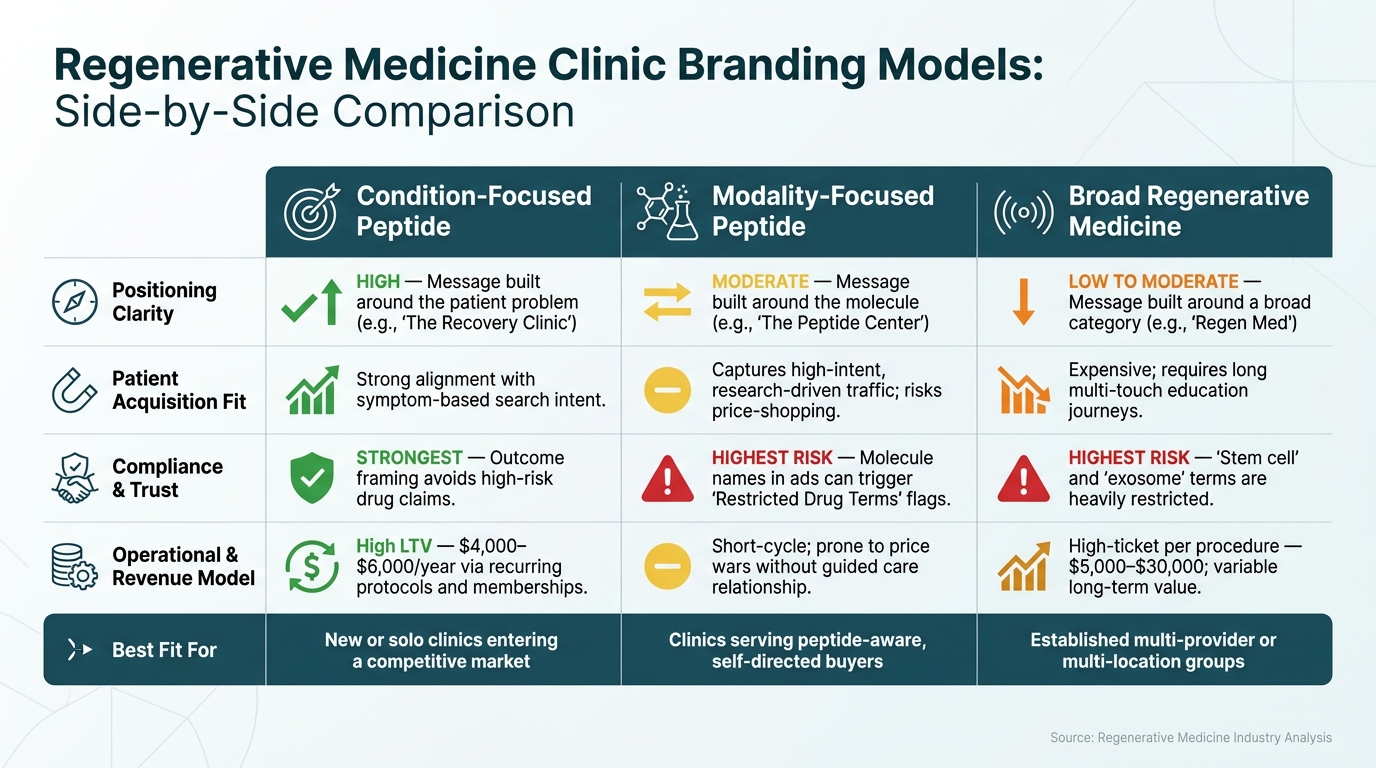
Regenerative Medicine Clinic Branding Models: Side-by-Side Comparison
The table below boils the trade-offs down to the four growth variables that matter most. It shows which model comes out ahead on clarity, acquisition, compliance, and revenue.
| Dimension | Condition-Focused Peptide | Modality-Focused Peptide | Broad Regenerative Medicine |
|---|---|---|---|
| Positioning Clarity | High - defined by the problem solved (e.g., "The Recovery Clinic") | Moderate - defined by the molecule used (e.g., "The Peptide Center") | Low to moderate - defined by a broad category (e.g., "Regen Med") |
| Patient Acquisition Fit | Strong alignment with symptom-based search intent | Captures high-intent, research-driven traffic; risks price-shopping | Expensive; requires long, multi-touch education journeys |
| Compliance & Trust | Strongest - outcome framing helps avoid high-risk drug claims | Highest risk - molecule names in ads can trigger "Restricted Drug Terms" flags | Highest risk - "stem cell" and "exosome" terminology is heavily restricted |
| Operational & Revenue Model | High LTV ($4,000–$6,000/year) via recurring protocols and memberships | Short-cycle; prone to price wars without a guided care relationship | High-ticket per procedure ($5,000–$30,000); variable long-term value |
Compliance is where this branding choice stops being a messaging issue and starts affecting day-to-day operations. The split is pretty clear: outcome-led branding is easier to defend, while compound names and terms like stem cell or exosome tend to draw the most ad scrutiny.
The care model shifts too. Peptide clinics need standardized workflows for dosing, consent, and documentation. Reviewing clinical insights can help providers stay current on these evolving best practices. Broad regenerative clinics, on the other hand, need more procedural capacity.
Revenue follows the same logic. Broad practices tend to monetize visits. Niche peptide clinics tend to monetize continuity. So while broad regenerative clinics can win on per-visit revenue, peptide-focused models usually win on predictability and recurring value.
Pros and Cons of Niche Versus Broad Branding
Niche branding wins on clarity. Broad branding wins on room to grow. That trade-off shows up fast in patient acquisition, offer design, and day-to-day marketing.
| Condition-Focused (Niche) | Modality-Focused (Peptide-Forward) | Broad Regenerative Medicine | |
|---|---|---|---|
| Primary Advantage | Clearer differentiation and higher conversion of patients already searching for a specific problem | Attracts patients already researching a specific treatment | More service lines and cross-sell opportunities |
| Main Disadvantage | Overreliance on one patient segment; concentration risk | High risk of ad suspension and price commoditization | Weaker messaging clarity; attracts low-intent leads |
| Best-Fit Clinic Type | First-time prescribers; solo practitioners in competitive markets | Peptide-focused clinics serving informed self-directed patients | Established multi-provider or multi-location groups |
The sections below show where each model works best and what each one gives up.
Main Advantages of Niche Branding
Condition-focused positioning makes a clinic feel like the obvious choice for one clear problem. That matters because patients searching for terms like "non-surgical knee recovery" or "post-surgical repair" usually aren't browsing out of curiosity. They're motivated and looking for a provider they can trust.
A niche brand meets that intent head-on. The message is tighter, the offer is easier to grasp, and the path from search to booked consult gets shorter. Instead of making patients sort through a long menu of services, the clinic speaks directly to the issue already on their mind.
Main Advantages of Broad Branding
Broad branding gives a clinic more room to sell across service lines. A patient may come in for PRP, then find out the clinic also offers peptide dosing protocols or HRT. That's a natural cross-sell, and it's much easier when the brand isn't boxed into one treatment lane.
For multi-provider groups with an existing loyal patient base, that flexibility can be a strong edge. They can add offers, test new programs, and move patients into other cash-pay services without having to rebuild the brand each time.
Main Risks and Trade-Offs
The main risk with niche branding is concentration. If a clinic builds its identity around one condition or one patient need, it takes a hit if demand softens or that segment slows down. And if the clinic wants to pivot later, rebranding can get expensive and disruptive fast.
Broad branding has the opposite problem: diluted messaging. When a clinic tries to talk to everyone, the message often lands weakly. Generic booking ads can pull in patients who aren't ready to commit, which means the team has to do more intake, more filtering, and more follow-up just to find the right fits. That adds real operational overhead, not just extra clicks.
Best-Fit Clinic Types
Clinic stage matters more than brand style by itself.
For first-time peptide prescribers, niche branding is usually the safer place to start. It helps build authority faster in one defined category, keeps compliance exposure lower, and makes it easier to build repeatable clinical workflows before scaling.
For established cash-pay practices already offering HRT, medical weight loss, or longevity programs, a broader regenerative brand tends to fit better. The patient base already exists, the cross-sell systems are in place, and the brand can take on new service lines without a full repositioning.
Multi-provider or multi-location groups are the clearest match for broad branding, but only if they put money and effort into CRM segmentation. If follow-up isn't segmented, a broad brand can turn into a lead-gen mess instead of a growth asset.
Conclusion
The right model comes down to where the clinic is today and where it wants to go next. Clinic maturity should shape the choice.
For clinics that need local authority fast, niche branding is the cleanest place to start. Peptide-first niche brands work well for new entrants and focused specialists who need to build trust fast. The move here is simple: lead with one outcome - recovery, performance, or longevity. That tighter message makes it easier to draw in high-intent patients.
Established practices have a different path. A peptide sub-brand makes sense for clinics that want to add peptides to HRT, weight loss, or longevity programs. Instead of treating peptides as a separate offer, they can be folded into programs patients already know. That supports recurring care and can improve patient lifetime value.
For larger clinics already selling several regenerative services, the trade-off changes again. Full-spectrum regenerative positioning fits established clinics that offer higher-ticket orthopedic and pain services. But it also asks more from the clinic. There’s more patient education, more trust-building, and more sales friction, especially when treatment courses run from $5,000 to $30,000.
Whatever model you choose, lead with the outcome, not the molecule. Patients look for answers to problems they know they have, not compounds they’ve never heard of. For prescribers building that base, PeptidePrescriber offers clinical, compliance, and business resources for peptide therapy.
FAQs
How do I choose the right branding model for my clinic stage?
Choose your branding model based on where your clinic is now and where you want it to go.
If you’re just getting started, don’t try to be everything to everyone. Pick a clear niche or focus on a specific patient group instead of using broad branding. That makes it easier to stand out and shape your message around the outcomes patients care about.
As your clinic grows, keep your brand consistent and tied to what sets you apart. Skip generic messaging. Build signature programs. Then use your niche to sharpen your website, content, and patient experience.
Why is condition-focused branding safer for ads?
Condition-focused branding is often the safer play because it helps clinics sidestep automated compliance flags that can pop up when ads push a treatment head-on.
Platforms like Google and Meta often treat regenerative medicine and peptide therapies as high-risk or experimental. That means direct promotion can get flagged fast.
A simpler path is to center your message on the problem people want help with, not the therapy itself. Think chronic knee pain or athletic recovery. That kind of ad can slip past policy filters more easily while still reaching people who are out there looking for answers.
Can a niche clinic expand into broader regenerative services later?
Yes. A niche regenerative medicine clinic can grow into broader services over time.
Starting with a specialty helps the clinic build local authority and patient trust. That matters. People are more likely to try added services from a provider they already know and feel good about.
As that trust builds, patients often move into related services. This can lift lifetime value without adding much to patient acquisition costs. Over time, the clinic can grow from a focused specialty practice into a more complete health destination.