
If I had to sum up this topic in one line: a pain clinic should sell clarity, not peptides.
For a U.S. pain clinic, the brand works best when I keep the message centered on one patient problem, functional goals, and clear limits. That means I frame peptide therapy as one part of care, not the whole offer, and I make product status, evidence limits, consent, and follow-up plain from the start.
Here’s the short version:
- I define the audience by pain condition, care goal, and decision stage
- I speak to patients who want help with sleep, mobility, work capacity, and activity
- I avoid cure claims and keep the promise tied to function
- I present peptides as adjunctive and, where needed, investigational
- I match the same language across website copy, consults, consent forms, chart notes, and referrals
- I use a simple care path: Assess, Plan, Monitor
- I explain compounding status, such as 503A vs. 503B, in plain English
- I use fixed follow-up points, like Week 1 and Week 8–12, instead of loose refill-style messaging
A large share of pain patients do not arrive as first-time care seekers. Many come in after failed treatment, delayed care, or mixed results. So the brand has to answer a simple question fast: Why should this clinic feel safer, clearer, and easier to understand than the last one?
That answer should show up in every touchpoint, from patient handouts to referral letters.
Define Your Chronic Pain Audience Before Writing Any Brand Message
Before you write a single line of brand copy, get clear on who you serve. Many chronic pain patients don’t show up at a clinic on day one. They often arrive after other treatments failed, were denied, or just didn’t fit their case. That history shapes what they think, what they worry about, and what they need to hear from you. It should also shape what your clinic says - and what it does not say.
Map Patient Segments That Fit Peptide-Based Pain Care
Not every chronic pain patient is a fit for peptide-based care. Your messaging should make that clear. Segment patients based on clinical fit, not broad market reach.
Look at three things:
- the pain problem
- the care goal
- the decision stage
The most relevant groups often include patients with chronic musculoskeletal conditions, post-surgical recovery needs, and cash-pay patients looking for functional or regenerative pain care. These patients tend to respond to niche positioning built around solving a specific pain problem, not broad wellness claims.
Define the clinic by the pain issue and the care goal, not by the product class. A clinic built around chronic pain conditions and functional outcomes comes across as clearer and more believable than one that simply promotes “peptide therapy.”
Identify Core Beliefs, Fears, and Decision Drivers
Patients with messy care histories often carry two feelings at once: they feel dismissed, and they still hope something might help. Your messaging needs to speak to both.
In this group, decisions are usually driven by functional goals - sleep, work capacity, mobility, and activity tolerance - not fuzzy claims like “feeling younger.” Move every message toward specific endpoints, such as range of motion, sleep, work capacity, or return-to-activity milestones.
Concerns about product legitimacy also matter. Patients may question legitimacy when they see “Research Use Only” or “Not for Human Consumption” labels on peptide vials. Address that head-on by explaining the 503A or 503B compounding requirements that apply and by offering lot-specific Certificates of Analysis.
Use Patient Feedback to Refine Language and Tone
Your intake notes and follow-up conversations can tell you a lot about how patients think and talk. Pay attention to the exact words they use to describe pain, past care, and goals.
Use a realistic, respectful, and specific tone. If you overpromise, people tune out. If you downplay what they’ve been through, trust slips fast. Keep the language tied to the clinic’s core commitments: trust, function, and transparency. Let patient phrases, concerns, and patterns shape the clinic’s positioning statement and its service boundaries.
sbb-itb-7164bd9
Build an Ethical Positioning Framework for Chronic Pain Services
Use the patient segments above to shape a position that patients and referring providers can grasp fast. The goal is simple: turn audience insight into a clear clinic position that explains who you help, which care gap you fill, and what you can honestly promise.
Write a Positioning Statement Grounded in Unmet Need and Scope of Care
A strong positioning statement answers three questions: Who do you serve? What problem do you address? How do you deliver care? Keep it tight. If a clinic tries to talk to everyone, it usually connects with no one.
A workable model looks like this: "We serve adults with chronic musculoskeletal pain who have not found lasting relief through standard care. We offer structured, multimodal pain management that may include peptide therapy as one adjunctive tool, aimed at supporting tissue healing and function."
This framing does a few things well. It names a specific patient problem. It places peptides inside a broader care plan instead of making them the whole story. And it centers the promise on function, not cure.
That statement also needs to line up with current regulatory realities.
Frame Peptides as Adjunctive, Biologically Plausible, and Investigational Where Applicable
Because the regulatory status of pain-related peptides remains under review, avoid FDA-approval language or outcome guarantees. Instead, describe therapy as adjunctive, biologically plausible, and investigational where applicable. Your informed consent materials and clinical documentation should match what your marketing says.
If your website sounds cautious, but your consult call sounds like a sales pitch, people notice. So do regulators.
Weak vs. Strong Positioning Models for Pain Clinics
The gap between weak and strong positioning comes down to expectation risk. Say too much, and you create problems. Say too little, and your clinic sounds fuzzy.
| Feature | Cure-Oriented (Weak) | Symptom-Management Only (Weak) | Function & Partnership (Strong) |
|---|---|---|---|
| Evidence Fit | Overstates investigational data | Ignores underlying pathology | Grounded in biological plausibility |
| Compliance Risk | High; unapproved drug claims | Moderate; over-reliance on meds | Low; focus on informed consent |
| Regulatory Tone | Defensive or dismissive | Vague | Transparent about compounding status |
This position should guide your service names, patient education, and everyday communication.
Turn Your Positioning Into Service Framing, Patient Education, and Brand Voice
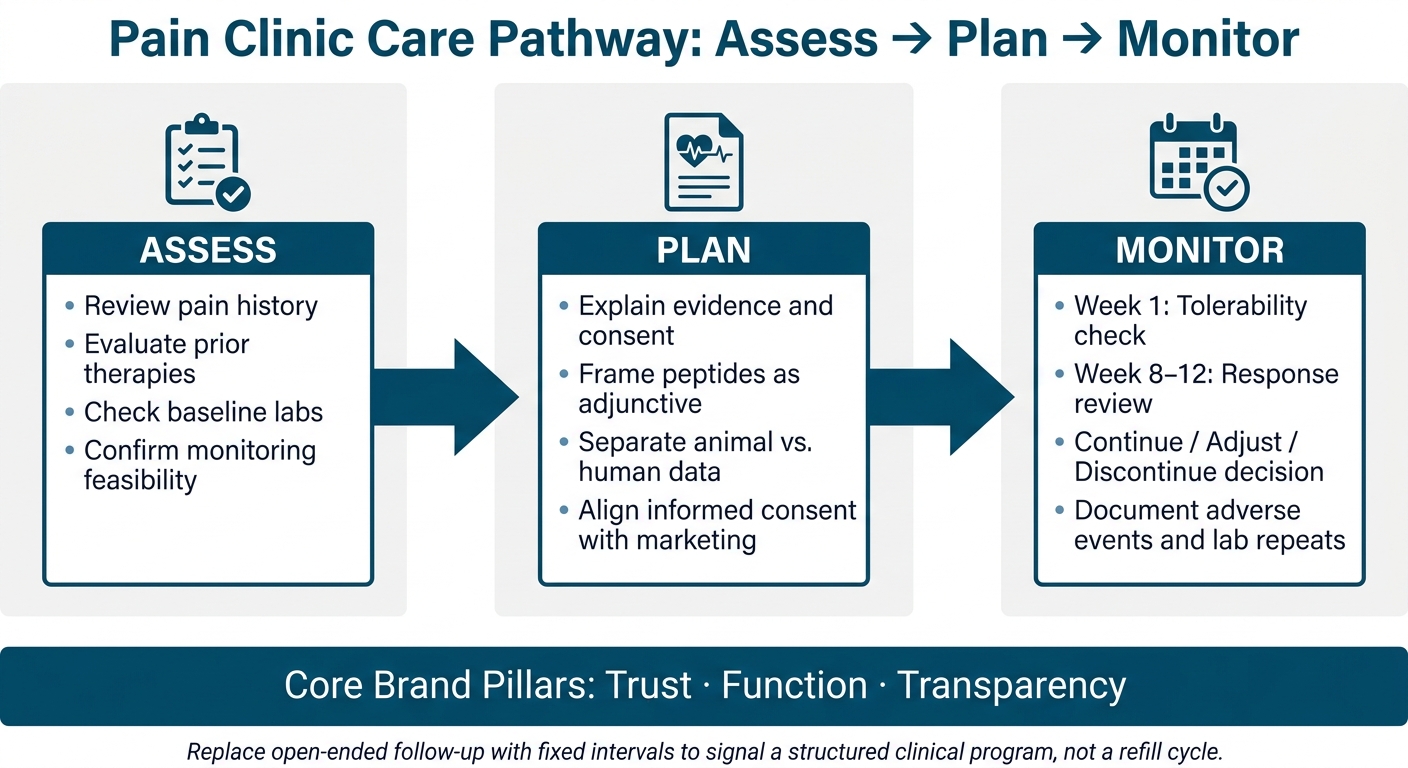
Pain Clinic Brand Positioning: Assess, Plan, Monitor Care Framework
A positioning statement only matters when patients can see it and hear it at every step. That means your clinic's message should show up across care pathways, education materials, referral communication, and brand voice. Trust, function, and transparency should shape how you talk about care from the first visit to follow-up.
Structure Care Pathway Messaging Around Assess, Plan, and Monitor
Chronic pain doesn't move in a straight line, and your messaging shouldn't feel rushed. A simple three-stage framework - Assess, Plan, and Monitor - gives patients a clear picture of what care with your clinic looks like.
In the Assess stage, review the patient's pain history, prior therapies, baseline labs, and patient selection criteria for a monitoring plan. In Plan, explain the evidence, consent, and how peptides fit into the broader care plan. This is where informed consent becomes patient education, not just paperwork. It's also the right place to separate animal data from human evidence. Then Monitor on a set schedule and decide whether to continue, adjust, or stop.
That same structure should carry through your handouts, follow-up messages, and referral communication.
Develop Patient Education Themes That Improve Understanding and Recall
Patient education should help people make sense of their pain, their progress, what they can do at home, and where peptide evidence has limits. Teach pain mechanisms, variable symptoms, realistic progress, self-care steps, and the evidence limits of peptide therapy.
Use simple handouts, injection guides, and plain label explanations to cut confusion. Each handout should connect to clear follow-up measures so patients know what to watch, what to track, and what happens next.
Set a Brand Voice That Is Respectful, Evidence-Aware, and Plain-Spoken
A clinically empathetic voice should be precise, plain-spoken, and open about uncertainty. Write to the patient-indication question, not the peptide-first question.
Use transparent, clinically empathetic language instead of jargon or sales-heavy copy. Keep that same tone in referral notes, internal templates, and team communication. When the voice stays steady across all of those touchpoints, patients get a clearer sense of how your clinic thinks and how it cares.
Standardize Referral Language and Clinical Communication Across the Care Team
Once your clinic voice is clear, the next step is to use it the same way in referrals, charting, and follow-up. A positioning statement on its own doesn’t do much if the team speaks in different ways from one touchpoint to the next.
That gap shows up fast. Patients hear one thing at the front desk, another during the visit, and then read something else in the chart or consent packet. Referring providers notice it too. Mixed wording creates confusion for patients and chips away at trust with other clinicians. Using the same language in chart notes, consent forms, and patient conversations keeps charting, consent, and patient messages aligned. Put simply: patients shouldn’t hear one message and receive another.
Use Referral Language That Supports Coordination, Not Competition
When you reach out to a patient’s primary care physician, orthopedist, or physical therapist, frame peptide therapy as part of the current care plan, not a rival to it. Each referral or consult summary should spell out the clinical rationale, prior therapies tried or declined and why, measurable therapeutic endpoints, and expected follow-up intervals.
A dedicated "Integration with Existing Care" section in consult letters sends a clear signal to the receiving provider: you reviewed what has already been done, and you’re adding to that work rather than starting from scratch. Support that section with literature-backed references to strengthen clinical credibility.
Be explicit about the why. If a patient declined a prior intervention, say so. If they didn’t respond, note that too. That kind of detail helps the next clinician understand the decision path instead of guessing.
Templates help make that coordination repeatable across the team.
Build Repeatable Documentation and Communication Templates
Templates keep communication consistent. At a minimum, a peptide clinic should have these core documents:
| Template Type | Essential Elements to Include |
|---|---|
| Chart Note | HPI framed by therapeutic rationale, evidence summary, alternatives considered, product status classification, and material risks disclosed |
| Referral Note | Clinical rationale, measurable therapeutic endpoints, prior therapies tried, and expected follow-up intervals |
| Progress Note | Therapeutic endpoint measurement vs. baseline, safety lab repeats, adverse event documentation, and continue/adjust/discontinue decision |
| Consent Addendum | Specific disclosures for off-label use and compounded medication status (503A vs. 503B) |
Give staff a routing checklist, chart-note skeletons, and editable consent templates so each clinician follows the same protocol. It saves time, but more than that, it keeps the care model steady across the whole team.
It also helps to replace open-ended follow-up wording with fixed follow-up intervals, such as a Week 1 tolerability check and a Week 8–12 response review. That kind of scheduling shows a structured clinical program, not a refill cycle.
Conclusion: Position the Clinic as a Reliable Chronic Pain Care Partner
Strong brand positioning comes from doing the same things the same way, over and over. That only works when the clinic uses consistent language across patient education, referrals, and documentation. When audience research, service framing, patient education, and referral language all move in the same direction, the clinic’s identity becomes clear without needing to say it out loud.
That’s what patients and referring clinicians tend to notice most. Clinics that build long-term trust don’t overpromise. They present peptides as adjunctive tools within multimodal care, with the focus on trust, function, and transparency.
Key Takeaways for Long-Term Brand Consistency
Every part of this guide ties back to one core idea: the clinic’s reputation is only as strong as its least consistent touchpoint. The table below sums up the positioning rules that should stay aligned across the clinic.
| Area | What to Do |
|---|---|
| Audience insight | Center messaging on the pain problem and care goal before writing copy |
| Positioning language | Build messaging around functional outcomes, not product names |
| Evidence framing | Separate preclinical, human, and investigational evidence; disclose limitations clearly |
| Patient education | Plain-language handouts, fixed monitoring intervals, and consent materials that match the clinical rationale |
| Referral communication | Standardize consult letters, chart notes, and progress notes |
| Regulatory transparency | Classify each product as approved, off-label, compounded, or investigational before marketing or prescribing |
Consistency here doesn’t mean perfection. It means the clinic’s message and the clinic’s actions match - every visit, every note, every referral.
FAQs
Who is the best-fit patient for this brand position?
The best-fit patient has a documented clinical reason for treatment, such as chronic pain or a musculoskeletal injury, when standard options haven’t worked well enough or aren’t a good fit. They should also have measurable goals, realistic expectations, and be willing to complete monitoring and lab work.
The strongest candidates come in ready for informed consent, not asking for specific peptides by name. They should also be able to complete baseline evaluation and follow-up care. Avoid patients with absolute contraindications, such as active malignancies or polypharmacy issues that aren’t yet clear.
How should a pain clinic describe peptide therapy compliantly?
A pain clinic should describe peptide therapy in a clinical, disciplined way. That means focusing on patient safety, careful records, and a clear reason for treatment, not broad marketing claims.
Start with a specific, measurable indication. In plain terms, there should be a defined clinical reason to use the peptide, and that reason should be tracked. The clinic should also confirm candidacy through a structured evaluation rather than a casual screening.
Before treatment begins, the patient should receive peptide-specific informed consent. That consent should match the product being used and the goals of care.
The clinic also needs to clearly state the product’s regulatory status. Patients should be told whether the peptide is FDA-approved or compounded. If it is compounded, the clinic should explain what that means, where the product comes from, and how it is sourced.
Follow-up shouldn’t be vague. There should be a defined plan tied to the peptide class and the patient’s clinical goals, with monitoring and documentation built into that plan.
What should every patient touchpoint say consistently?
Every patient touchpoint should use the same clinical evidence and terminology found in your informed consent and treatment documentation.
That means patient education, staff scripts, and clinical counseling should all describe peptide products, dosing protocols, and care pathways the same way. When the language stays consistent, there's less ambiguity, and patients can follow their treatment more clearly from the first consultation through ongoing care.