
DSIP is not a proven brain recovery treatment. If I had to sum up the article in one line, it would be this: DSIP is still investigational, has weak human data, and should stay behind standard sleep and rehab care.
If you’re looking at DSIP for concussion, TBI, or stroke recovery, here’s the short answer:
- There are no controlled trials in brain injury rehab populations
- Human research is small, old, and mixed
- Reported sleep effects are mostly about sleep length and stage 2 NREM, not clear brain repair
- 30%–70% of people after TBI deal with major sleep problems, so treating sleep still matters
- First-line care stays the same: CBT-I, sleep routine fixes, rehab-based sleep support, melatonin, and selected approved sleep meds
- In the U.S., DSIP is not FDA-approved for any use
- Any use should be treated as experimental, with informed consent, close follow-up, and careful sourcing
That’s the core point. The article makes a simple case: DSIP has a plausible theory around sleep and stress signaling, but that theory has not turned into clear clinical proof for brain recovery. So if sleep, fatigue, mood, pain, or stress are slowing rehab, it makes more sense to fix those with standard care first.
Quick comparison
| Option | Main use | Evidence for post-brain-injury care | U.S. status | Role |
|---|---|---|---|---|
| CBT-I / sleep hygiene | Insomnia and poor sleep habits | High | Standard care | First step |
| Melatonin | Sleep timing and sleep onset | Moderate | OTC | Early med option |
| Trazodone / low-dose doxepin | Sleep support | Moderate | FDA-approved drugs, often off-label for sleep | Common next step |
| Z-drugs | Short-term insomnia treatment | Moderate | FDA-approved | Short-term use only |
| Benzodiazepines | Sedative sleep aid | Limited fit in TBI | FDA-approved | Usually avoided or last-line |
| DSIP | Proposed sleep/HPA-axis effect | Low to very low | Not FDA-approved | Experimental only |
So when I read this review, the takeaway is clear: DSIP may be discussed in rare, hard-to-treat cases, but it should not replace proven sleep and rehab care. The rest of this clinical review explains why the theory is stronger than the human proof.
sbb-itb-7164bd9
Mechanistic Rationale: DSIP, Slow-Wave Sleep, and Stress Signaling
DSIP comes up in brain recovery for a simple reason: it may affect sleep architecture and stress signaling, and both shape recovery physiology. The draw here is indirect. Better sleep and less stress may help rehab go more smoothly, but that is not the same as repairing tissue. Its receptor biology is still unresolved, so most mechanistic claims still lean on animal work and small human studies.
Proposed Effects on Sleep Architecture and Recovery Physiology
DSIP is not thought to act like a standard sleep drug. Instead of broadly damping the central nervous system, it seems to help normalize disrupted sleep architecture, with a focus on more restorative NREM sleep. Proposed mechanisms include increased GABAergic tone in sleep-promoting circuits and lower drive in wake-promoting centers, which may help the body move into physiologic sleep onset.
One small infusion study gives a sense of why people pay attention to it. DSIP increased total sleep time by a median 59% within 130 minutes versus placebo, shortened sleep onset, and improved next-night sleep efficiency. It did this without sedative-like EEG changes or next-day psychomotor slowing.
Why does that matter in brain recovery? Because sleep continuity affects cognition, fatigue, and how well someone can tolerate rehab. Consolidated slow-wave sleep is linked to glymphatic clearance, synaptic homeostasis, and memory transfer, so DSIP has been hypothesized to support recovery indirectly. That said, the human sleep data are more consistent for total sleep time and stage 2 NREM than for slow-wave sleep, and the clinical effect looks modest.
HPA-Axis Modulation, Fatigue, and Cognitive Recovery Hypotheses
Animal and in vitro data suggest DSIP may inhibit CRF-stimulated ACTH release and reduce cAMP signaling in pituitary cells, but human studies have not shown consistent effects on ACTH or cortisol. That matters because HPA-axis overactivation may add to fatigue and make rehab harder to stick with. It does not prove a recovery benefit.
So the idea is plausible, but still thin: if DSIP lowers stress signaling, it might help with fatigue or alertness. For now, those benefits remain speculative.
Preclinical Neuroprotection and Cognitive Signals
In rodent hypobaric hypoxia models, p-DSIP improved NREM and REM sleep, Morris water maze performance, and hippocampal p-CREB expression. That points to a memory-related plasticity signal and possible cytoprotection under ischemic stress.
But there’s a big gap between a rodent signal and a treatment decision. No parallel human data exist in concussion, stroke, or neurorehabilitation. So these findings are best viewed as early signals, not a basis for clinical use.
For practitioners, clinical resources for peptide-prescribing professionals can help contextualize these findings within a broader evidence-based framework. The next section tests whether these signals translate into human outcomes.
Clinical Evidence Review: What Human Studies Show
Sleep and Daytime Function Outcomes in Small Human Trials
The biology behind DSIP may sound promising, but that promise hasn't shown up clearly in human research. The available DSIP studies in people are small, dated, and mostly based on intravenous use in adults with primary insomnia. Most enrolled just 6 to 16 participants, and the studies used uneven dosing and different outcome measures. For concussion, stroke, and TBI recovery, that leaves the evidence indirect at best.
The findings are mixed. One double-blind trial found better sleep efficiency and improved next-day daytime performance. But later controlled studies showed only modest gains, or no clear clinical value at all.
A polysomnographic study adds an important detail: increases in total sleep time came mostly from stage 2 NREM sleep, while slow-wave sleep and REM changed very little. In plain terms, people may have slept longer, but not in a way that points to much practical payoff.
Daytime effects were also small and measured unevenly. No study used standardized executive-function testing or real-world functional outcomes, which matters if the goal is brain recovery rather than just sleep tracking.
What Is Missing for Concussion, Stroke, and Neurorehabilitation Populations
There are no modern U.S. trials testing DSIP in concussion, stroke, post-TBI symptoms, or structured neurorehabilitation. The studies that do exist were done in patients without brain injury, so applying those results to neurorecovery is a stretch.
There is also no settled framework for dose, treatment length, or patient selection in this setting. That leaves clinicians guessing on the parts that matter most.
The route used in research creates another problem. Intravenous dosing is hard to carry over into outpatient care, and subcutaneous use has not been tested in controlled human trials; clinicians should consult practical clinical guides for standard administration protocols. So if DSIP is being used in brain recovery settings right now, it should be viewed as unvalidated extrapolation, with clear chart documentation and informed consent. At this point, DSIP is, at most, an investigational adjunct. The next section compares it with standard brain recovery care.
Evidence Quality Summary
By GRADE criteria, the human DSIP evidence base rates low to very low across the clinical domains that matter most. In short, it sits far below first-line care.
| GRADE Domain | Assessment |
|---|---|
| Risk of bias | Small, often single-center studies; open-label designs; baseline imbalances in some controlled trials; blinding procedures under-reported |
| Inconsistency | Mixed results across trials; sleep-stage effects especially variable |
| Indirectness | Data come from insomnia or non-neurologic populations; no neurological injury cohorts; older diagnostic criteria |
| Imprecision | Sample sizes are usually 16 or fewer participants; effect estimates are unstable; subgroup analyses are underpowered |
| Publication bias | Positive findings are concentrated in a few research groups; the literature is era-limited and may underrepresent null results |
DSIP Compared With Standard Brain Recovery Care
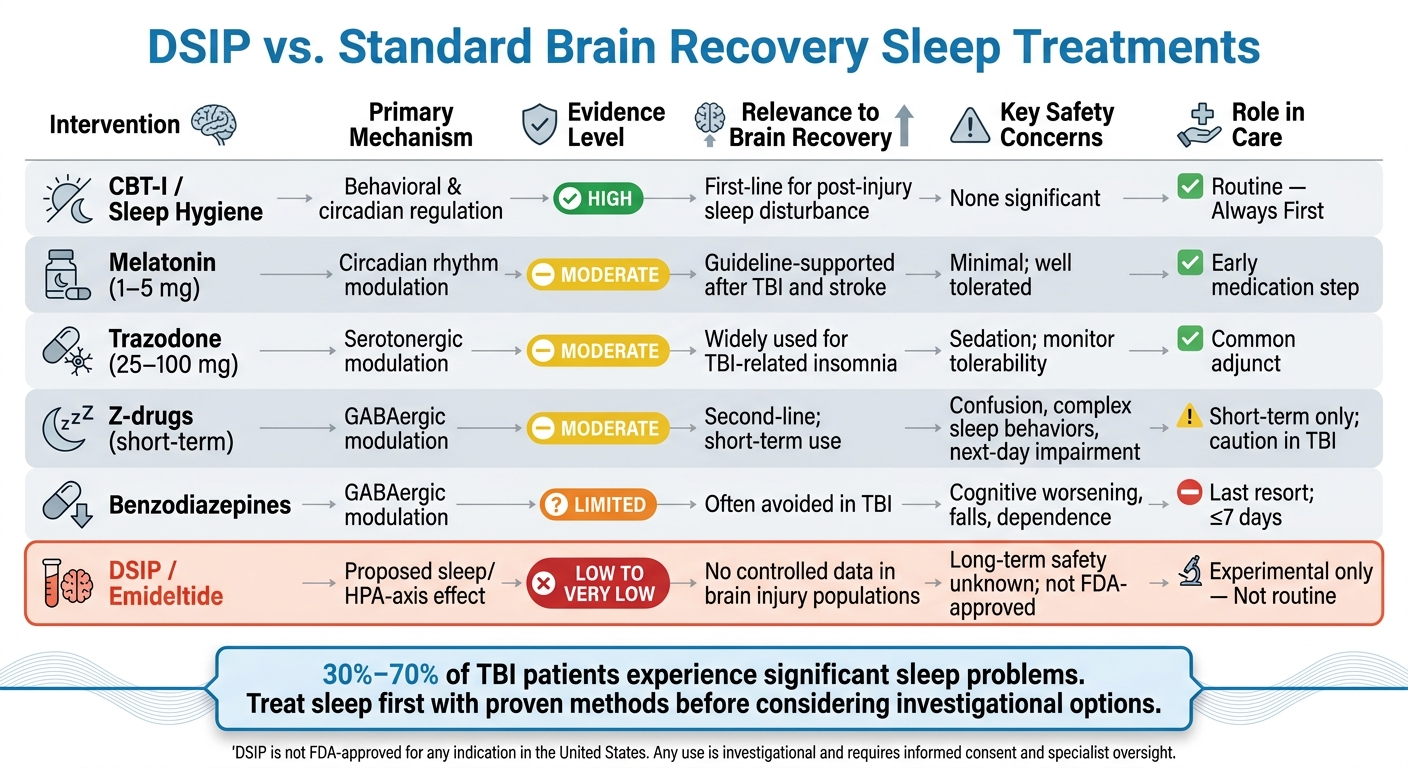
DSIP vs. Standard Brain Recovery Sleep Treatments: Evidence Comparison
Because the human evidence is thin, DSIP has to be weighed against standard care. And right now, DSIP is not part of standard brain recovery care. In practice, clinicians start by tightening up guideline-based sleep treatment first. That’s the practical issue here: how DSIP stacks up against the options already used after concussion, TBI, or stroke.
First-Line Care: CBT-I, Rehabilitation Sleep Strategies, and Approved Medications
Cognitive Behavioral Therapy for Insomnia (CBT-I) is the main treatment for sleep problems after post-concussion, post-TBI, or post-stroke care in U.S. practice. It targets the core drivers of insomnia through CBT-I methods. In TBI and stroke care, clinicians often shorten sessions, repeat key points, and use written supports because attention and memory can be limited. One 6- to 8-session CBT-based program improved sleep quality in adults with mild to severe TBI and stroke, even 25 to 48 months after injury.
Rehab teams also lean on basic sleep-stabilizing steps: fixed wake times, sleep hygiene, and steady daily routines to help regulate circadian rhythms. Morning bright-light exposure and graded physical activity can also help with fatigue and sleep quality.
If behavior-based treatment doesn’t do enough, medication usually comes next. In that setting, melatonin is often the first choice, followed by trazodone or low-dose doxepin for sleep-maintenance insomnia. Z-drugs may be used for short periods when other options don’t work well enough. Benzodiazepines sit at the back of the line because they can worsen thinking problems, increase falls, and lead to dependence.
DSIP enters the picture only after those steps have failed, and even then, only as an experiment.
Where DSIP May Be Considered Investigational Rather Than Routine
In a small group of refractory cases - for example, someone with stubborn, non-restorative sleep after concussion or TBI who completed CBT-I with good adherence and also tried fitting medications - DSIP gets attention because of its proposed effects on sleep, fatigue, and stress signaling. That’s the main theory behind it.
But in the United States, this is still fully investigational. DSIP does not appear in major TBI, stroke, or rehab care pathways. Providers can access regulatory quick reference tools to navigate these requirements. Any use would call for clear disclosure that the benefit is uncertain, dosing is unsettled, safety is not well defined, and the drug is not approved. Clinicians often utilize clinical tools to manage protocols for more established therapies.
Comparison Table: DSIP Versus Standard Care Options
The table below shows where DSIP sits next to routine options.
| Intervention | Primary Mechanism | Evidence Level | Relevance to Brain Recovery | Common Safety Concerns | U.S. Regulatory Status | Role |
|---|---|---|---|---|---|---|
| CBT-I / Sleep Hygiene | Behavioral & circadian regulation | High | First-line for post-injury sleep disturbance | None significant | Guideline-supported | Routine; always first |
| Melatonin (1–5 mg) | Circadian rhythm modulation | Moderate | Guideline-supported after TBI and stroke | Minimal; generally well tolerated | OTC / guideline-supported | Early medication step |
| Trazodone (25–100 mg) | Serotonergic modulation | Moderate | Widely used for TBI-related insomnia | Sedation; monitor tolerability | FDA-approved (off-label for sleep) | Common adjunct |
| Z-drugs (short-term) | GABAergic modulation | Moderate | Second-line; short-term use | Confusion, complex sleep behaviors, next-day impairment | FDA-approved | Short-term only; caution in TBI |
| Benzodiazepines | GABAergic modulation | Moderate (general insomnia) | Often avoided in TBI | Cognitive worsening, falls, dependence | FDA-approved | Last resort; ≤7 days |
| DSIP (emideltide) | Proposed sleep/HPA effect | Low to very low | No controlled data in brain injury populations | Long-term safety unknown | Not FDA-approved; investigational | Experimental only; not routine |
Safety, U.S. Regulatory Limits, and Clinical Bottom Line
When the benefit data are thin, safety and legal status end up doing most of the work in the decision.
Adverse Effects, Unknowns, and Patients Who May Need Extra Caution
Published human DSIP trials point to a fairly mild short-term tolerability profile. Across about 70 subjects in early trials, researchers reported no major systemic toxicity. Reported events include headache, nausea, vomiting, dizziness, hypotension, drowsiness, and injection-site irritation.
That said, the short-term safety picture should be treated as provisional. There are no large safety trials, no chronic-use data, and no systematic neurologic safety assessment.
Some patient groups call for extra caution, and in some cases, avoidance:
- Post-injury patients with severe depression, PTSD, psychosis, or bipolar disorder - DSIP’s effect on sleep architecture and stress signaling has not been well defined in these groups.
- Unstable endocrine conditions such as poorly controlled thyroid disease, adrenal insufficiency, or Cushing syndrome - DSIP is thought to interact with the HPA axis, but modern trials have not tested this.
- Polypharmacy - Interaction risk with SSRIs, antiepileptics, stimulants, sedative-hypnotics, and antihypertensives is unknown.
- Pregnancy and breastfeeding - No reproductive toxicology data exist, which leaves a major evidence gap.
- Unstable or fluctuating post-acute neurologic status - Active seizures, delirium, or ongoing intracranial pathology are settings where any untested neuromodulatory agent may carry added risk.
This is the part that gives many clinicians pause. A drug can look mild on paper, but if the dataset is small and the follow-up is short, there’s still a lot we don’t know.
FDA Status, Compounding Considerations, and Documentation Needs
Safety limits matter even more because DSIP’s U.S. regulatory status is still unsettled. DSIP - also called Emideltide in compounding settings - is not FDA-approved for any indication in the United States. It has no FDA approval, approved labeling, or approved dosing for insomnia, brain recovery, or any other condition.
In plain terms, this means any clinical use should be treated as investigational. Ideally, it should stay inside an IRB-approved research protocol or, at minimum, a tightly structured off-label setting that fits federal and state law. Prescribers should work only with state-licensed 503A pharmacies that can document sourcing, sterility testing, and regulatory compliance. Products sold as “research chemicals” or direct-to-consumer products are not appropriate for clinical use.
Documentation matters here. The chart should clearly state that DSIP is not FDA-approved, that the human evidence base is limited in both size and quality, and that long-term safety is unknown. Notes should also record:
- the clinical rationale
- alternatives offered, such as CBT-I and approved sleep medications
- the compounding pharmacy and lot number
- a monitoring plan for sleep quality, cognition, mood, and adverse events
For higher-risk patients, the record should also explain why DSIP was considered despite the uncertainty and what safeguards were put in place.
Conclusion: Key Takeaways for Clinicians
DSIP is still biologically plausible. Proposed effects on slow-wave sleep and HPA-axis modulation make mechanistic sense. But the human literature is small, dated, and inconsistent, and no controlled trial has shown benefit in concussion, stroke, or TBI populations.
For concussion, TBI, and stroke recovery, keep DSIP in the investigational bucket and use standard sleep treatment first. If DSIP is considered at all, limit it to highly selected cases with specialist input, explicit informed consent, careful monitoring, and verified compounding compliance.
FAQs
Can DSIP help sleep without improving brain recovery?
Yes. A therapy can improve sleep without leading to full brain recovery.
Better sleep quality or longer sleep doesn’t always fix the deeper neurological or metabolic stress behind the problem. Put simply, sleeping better can be a good sign, but it’s not the whole picture.
Full brain recovery may also depend on dealing with issues like chronic inflammation, mitochondrial impairment, or oxidative stress. That’s why tools like the PSQI and MoCA matter. They can help separate a person’s perceived sleep gains from their broader recovery progress.
When, if ever, is DSIP considered after TBI or stroke?
There is no direct clinical evidence or formal guidance supporting DSIP (Delta Sleep-Inducing Peptide) for brain recovery after TBI or stroke.
In practice, clinicians should stick with FDA-approved treatments first. If a non-FDA-approved peptide is being considered, it should be handled as investigational, with informed consent clearly discussed and documented.
What should patients ask before trying investigational DSIP?
Ask if there’s a clear clinical reason for using DSIP, what goals will be used to track progress, and whether it’s being used as a time-limited trial instead of left open-ended.
Patients should also ask for plain disclosure that DSIP is unapproved, that the evidence base is limited, and for a certificate of analysis that confirms purity and sterility.