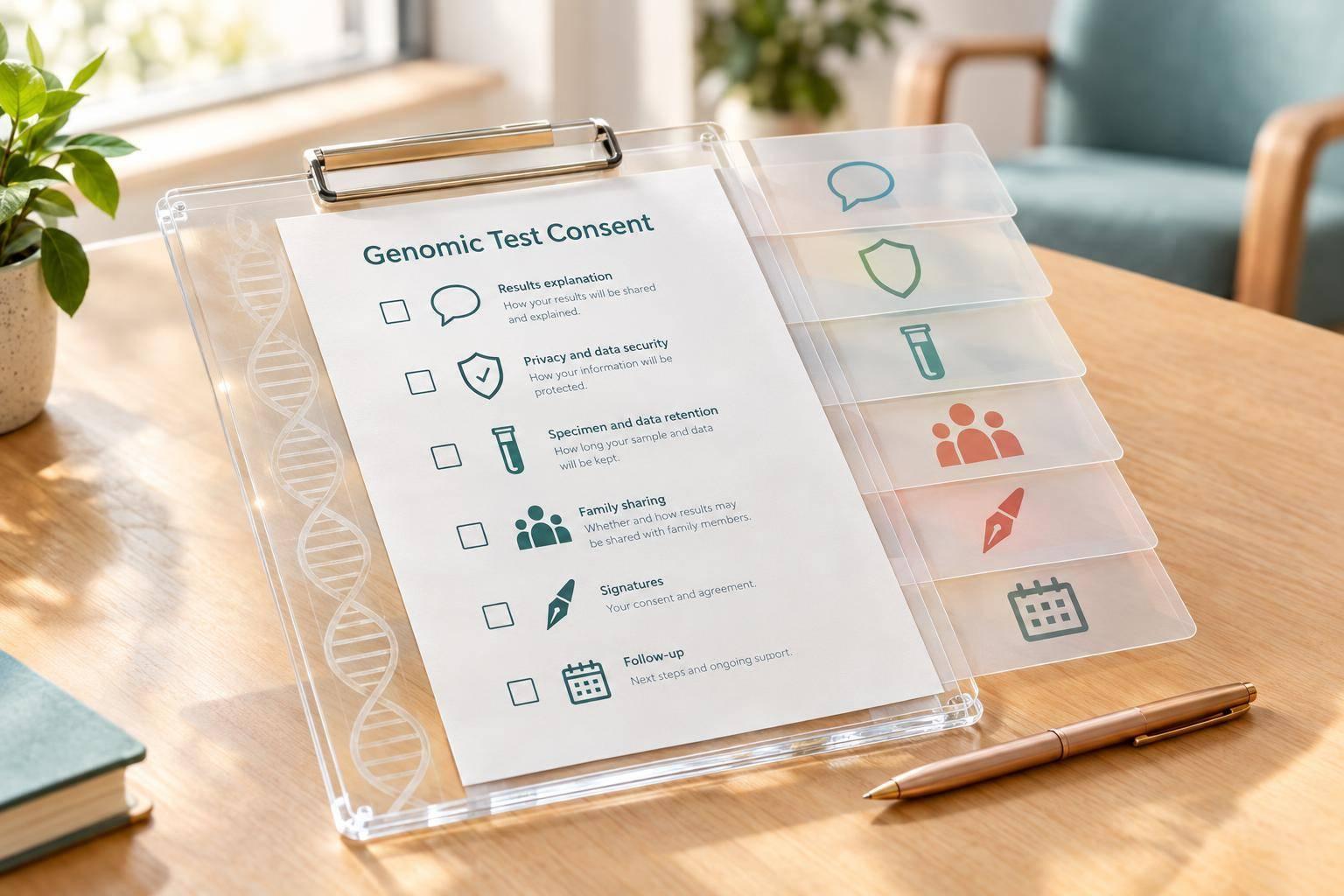
I recommend building consent around the exact genetic test - not using one form for every test. Before collection, check the laboratory’s rules, explain what results can and cannot tell you, and record the patient’s choices.
I use this checklist to keep the packet focused, which is also included in our Peptide Prescriber Starter Pack:
- Test and results: Identify the patient, test, specimen, and purpose. Explain risks, limits, uncertain results, and choices for secondary findings.
- Privacy and storage: State who receives results, what material and data are kept, and for how long. Keep family-sharing and research permissions separate.
- Patient decisions: Record questions, understanding, signatures, interpreter needs, and whether testing will proceed, wait, or stop.
- Clinic follow-through: Assign staff to review consent, deliver results, arrange follow-up, and track the form’s version.
Two points deserve plain language: testing does not guarantee a diagnosis or treatment benefit, and <u>a signature does not replace a discussion</u>. HIPAA access requests generally have a 30-calendar-day deadline; GINA generally covers health insurance and employment - not life, disability, or long-term-care insurance.
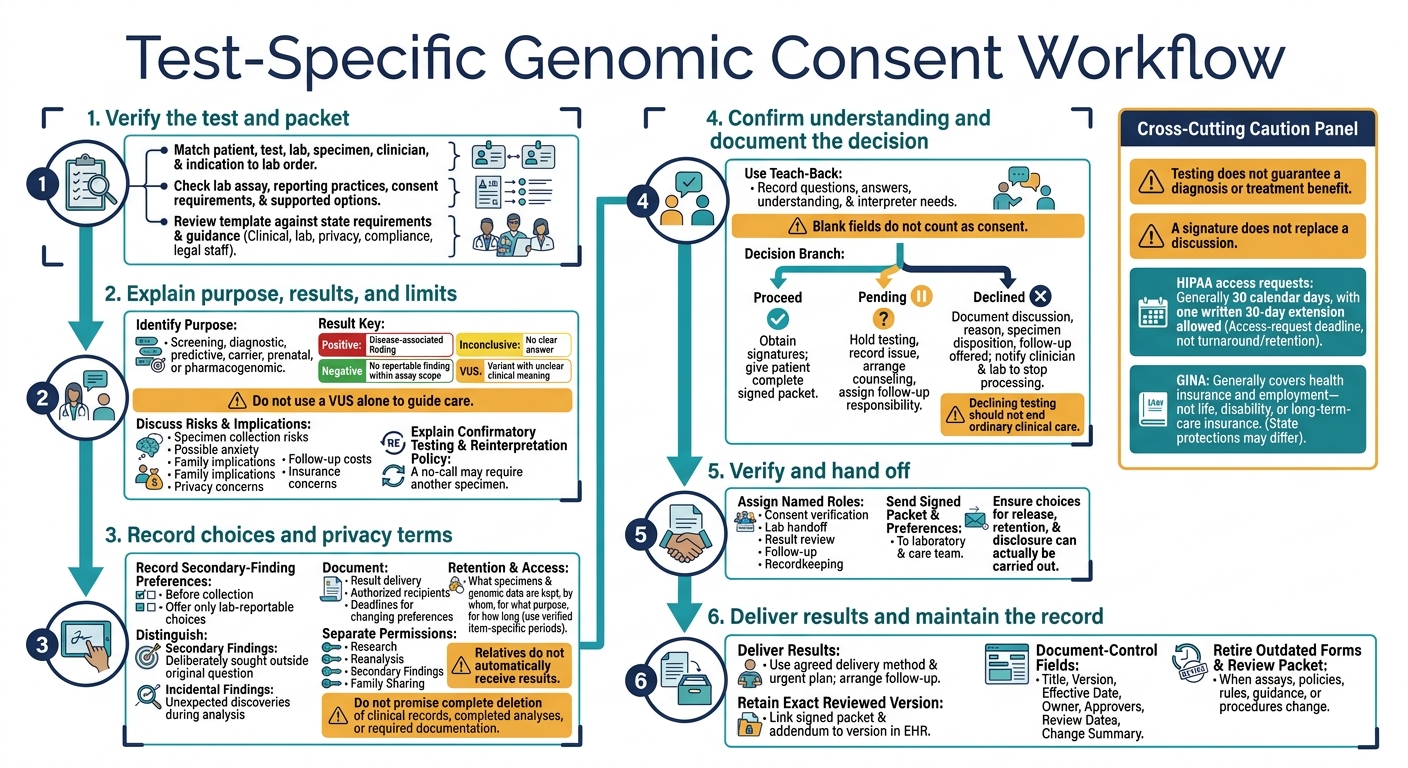
Test-Specific Genomic Consent Workflow
Patient Intake, Test Purpose, and Results
Patient Details and Test Purpose
Record the patient’s legal name, date of birth (MM/DD/YYYY), medical record number, contact details, preferred communication method, preferred language, and interpreter needs. Include the ordering clinician, practice and laboratory contact information, test name, specimen type, collection date, and order or accession number. These fields link the consent form to the exact assay, specimen, and reporting terms.
Document the clinical question, relevant symptoms, family history, and prior testing. For pharmacogenomic testing, also record current medications. Identify the test purpose as screening, diagnostic, predictive, carrier, prenatal, or pharmacogenomic. Screening estimates likelihood; diagnostic testing evaluates a suspected condition; predictive testing estimates future risk; carrier testing informs reproductive risk; and pharmacogenomic testing informs medication decisions.
For example, the form can say:
This test analyzes genetic material from your blood or saliva to look for changes that may help explain your symptoms, estimate the chance of developing certain conditions, identify carrier status, or guide medication selection.
Explain that results may also reveal inherited risk in relatives or unexpected family relationships, and that interpretation depends on medical and family history. For medication testing, document the drug-related question. Make clear that results are one factor in treatment decisions, alongside other medications, organ function, and clinical response - not a promise that treatment will work.
Benefits, Risks, and Test Limits
Once the test’s purpose is clear, explain what results can and cannot tell the patient. Describe possible benefits - a clearer diagnosis, surveillance options, reproductive guidance, or medication guidance - without promising a change in care.
- Positive: a disease-associated finding.
- Negative: no reportable finding within the assay’s scope.
- Inconclusive: no clear answer.
- VUS: a variant with unclear clinical meaning.
Do not use a VUS alone to guide care. A no-call (failed) test may require another specimen. Explain that new evidence may change the interpretation, and include the laboratory’s reinterpretation policy.
Describe collection risks for the specimen being used. Blood draws can cause pain, bruising, bleeding, dizziness, or infection. Inadequate or contaminated saliva may require recollection. Also explain possible anxiety, effects on family members, privacy concerns, follow-up costs, and insurance concerns. Do not suggest that legal protections cover every insurance type. Document whether confirmatory testing is required before making diagnosis or treatment decisions.
Choices for Secondary Findings
If the assay can return extra results, record the patient’s preference before collection. Secondary findings are results deliberately sought outside the original clinical question. Incidental findings are unexpected discoveries during analysis.
Use a separate preference page and offer only choices the laboratory can report: receive clinically actionable secondary findings, decline where opting out is permitted, or discuss the categories before choosing. Explain that this choice does not change how primary findings are reported and does not override laboratory policy or professional guidance.
Record the available categories, laboratory policy and professional-guidance version, deadline for changing preferences, and how to submit a change. Check current ACMG guidance rather than hard-coding a permanent list. Keep research and information-sharing permissions separate from result preferences.
sbb-itb-7164bd9
Result Sharing, Storage, and Privacy
Result Delivery and Authorized Recipients
Once the patient chooses what can be reported, document how results will be delivered and who may receive them.
Name the reporting clinician, performing laboratory, genetic counselor, and clinic privacy contact. Specify the delivery method: an office visit, telehealth, telephone, secure portal, or paper notice. Include scheduling instructions, contacts for questions, and a plan for urgent findings.
Set a deadline for changing delivery preferences, such as before laboratory analysis starts or the report is finalized. Make clear that these preferences do not override legal access or disclosure duties.
Patients may request laboratory reports and underlying genomic data in the designated record set. HIPAA access requests generally must be fulfilled within 30 calendar days, with one written 30-day extension allowed.
| Pathway | Recipient | Authorization requirements | Clinical-record inclusion |
|---|---|---|---|
| Routine clinical disclosure | Patient, ordering clinician, and treating providers | Treatment, payment, health care operations, patient access rights, or another legally permitted basis; authorization when required | Usually included in the patient’s clinical record when generated or received for clinical care |
| Patient-authorized third-party disclosure | A named relative, outside clinician, attorney, insurer, or other person selected by the patient | Written or electronic authorization naming the information, recipient, purpose, and expiration or revocation terms, unless another legal basis applies | Include the disclosure or authorization according to clinic and laboratory records policies |
Specimen and Genomic-Data Retention
Keep short-term clinical retention separate from optional future use. Patients should be able to see what the lab keeps, why it keeps it, and for how long.
Specimen retention: Name the laboratory or biobank responsible for retained material. For each item, document the retention period, permitted uses, and what happens after withdrawal: destruction, anonymization, return, or continued retention. Check these periods against laboratory policy and applicable federal or state requirements.
A current ACMG laboratory standard recommends keeping the original sample until testing is complete and the report is issued. Processed material should be retained in line with applicable law and professional standards. HIPAA itself does not set a universal genomic-data retention period.
| Retention category | Material and purpose | Period to document | Access and control | Withdrawal limits |
|---|---|---|---|---|
| Short-term clinical retention | Specimen and information needed for testing and reporting | Verified testing and reporting period | Authorized laboratory and clinical personnel; performing laboratory and ordering clinic | Completed testing and required records may remain |
| Extended laboratory retention | Extracted DNA, residual specimen, slides, libraries, variant data, or quality-control records for repeat analysis, quality assurance, validation, proficiency testing, or regulatory documentation | Verified period for each retained item | Performing laboratory; authorized personnel, auditors, or regulators | Completed analyses and required records may remain |
| Optional future use | Coded or de-identified specimens or genomic data for test development, education, quality improvement, or approved research | Consent-specified period or endpoint | Named clinic, laboratory, biobank, sponsor, or research institution; approved users or controlled-access repositories | Future use stops after valid withdrawal where feasible; prior analyses, publications, and de-identified data may remain |
Genomic-data storage: Identify each party separately: the clinic responsible for the EHR, the laboratory responsible for sequencing files and reports, and any storage provider, biobank, or research repository. Describe the stored files, access controls, verified security measures, backup practices, and deletion limits.
Do not promise complete deletion from clinical records, completed analyses, or required documentation. Keep permission for optional future use separate. NIH guidance says secondary research use should align with the consent originally obtained. De-identification lowers - but does not eliminate - the risk of genomic re-identification.
Privacy and Permission to Share With Family
Use a separate authorization for family disclosure. Relatives do not automatically receive results.
List recipient categories separately instead of using an open-ended phrase. Provide the privacy contact’s name, telephone number, mailing address, and secure contact method. Explain that HIPAA protects identifiable genetic information held by covered entities, while permitting or requiring some disclosures without patient authorization. State privacy laws may add requirements.
The family-sharing authorization should name the recipient, permitted findings, communication method, purpose, expiration, and process for revoking permission for future disclosures. It does not authorize research-database sharing.
GINA generally protects against genetic discrimination in health insurance and employment, but not life, disability, or long-term-care insurance. State protections may differ. Direct insurance questions to the privacy contact or qualified legal or genetic-counseling resources.
Lunch and Learn Webinar: Taking Consent for Genomic Testing
Patient Acknowledgment and Clinic Workflow
Once result-release and privacy terms are set, the packet must record who signed, who reviewed, and who is responsible for follow-up.
Acknowledgment and Signatures
Make the acknowledgment specific to the test. Record the patient’s legal name, DOB, test name and scope, specimen type, collection date, laboratory, ordering clinician, and consent-review date. Include the signature of the patient or legally authorized representative, the representative’s name and legal authority, and the staff member obtaining consent.
When an interpreter is involved, record their name or ID, language, modality, and date. Use MM/DD/YYYY and a consistent time format with AM/PM and a time zone. Follow state rules for minors, assent, and representative authority. These fields help staff use the consent at the point of care - not just meet legal requirements.
Add a discussion checklist and space to record questions asked and answered. Document both the topics reviewed and the patient’s understanding, rather than relying on a signature alone. Give each optional authorization its own checkbox.
Use three decision statuses: proceed, pending, or declined.
- Pending: Hold testing, record the unresolved issue, arrange counseling, and assign responsibility for follow-up.
- Declined: Document the discussion, any reason the patient voluntarily offers, specimen disposition, and follow-up offered. Notify the ordering clinician and laboratory to stop processing.
Declining testing should not end ordinary clinical care. If counseling is needed, the referring provider remains responsible for ensuring it is available.
After the patient signs, route the form through a defined review and version-control process.
Laboratory Review and Template Version Control
Before putting the packet into use, have clinical, laboratory, privacy, compliance, and legal staff review it. Check that it matches the actual test, laboratory policies, state requirements, and current professional guidance. Verify what any outside template covers: a general treatment form cannot replace genomic consent or counseling.
Assign named roles to consent verification, lab handoff, result review, follow-up, and recordkeeping. Use workflow fields to carry out the patient’s choices for release, retention, and disclosure. State consent responsibilities explicitly; do not assume the laboratory handles them.
Add a document-control panel with the title, version, effective date, owner, approvers, review dates, and change summary. Link every signed packet and addendum to its version in the EHR, give the patient a copy, and retire outdated forms.
Review the packet whenever assays, reporting policies, state rules, professional guidance, or clinic procedures change. Check it against current ACMG secondary-findings guidance.
Conclusion: Assemble a Test-Specific Consent Packet
Combine the completed sections above into one test-specific consent packet. Check every provision against the laboratory’s assay, reporting practices, consent requirements, and patient-selected options.
Keep optional permissions for research, reanalysis, secondary findings, and family sharing separate. Include only choices the laboratory supports.
Use this final completion checklist:
- Complete the fields: Patient, date of birth (DOB), test, laboratory, specimen, clinician, indication, and clinic contact information. Make sure the packet matches the laboratory order.
- Check state requirements: Have compliance or legal staff verify state-specific language for privacy, representatives, and disclosure.
- Confirm understanding: Use teach-back. Check that each selected option can be carried out and that blank fields do not count as consent.
- Get signatures: Obtain all required signatures and give the patient a complete copy of the signed packet.
- Keep and share the record: Retain the exact reviewed version in the clinical record. Record the consent date and template version, then send the signed packet and preferences to the laboratory and care team.
FAQs
When does a test change require new consent?
Review and update informed consent whenever the patient’s treatment plan changes substantially. Obtain new consent when:
- The clinical indication changes.
- The prescribed peptide changes.
- The medication source changes.
- The patient moves to a higher-risk regimen.
Can patients withdraw consent after testing starts?
The provided sources don’t explicitly address withdrawing consent after testing begins. Still, informed consent is a continuing process. Standard clinical practice allows patients to stop participating or withdraw consent at any time during their care.
Clinicians should renew consent when the treatment or its indication changes, or when the patient moves to a higher-risk regimen.
How should clinics document consent during telehealth visits?
Clinics should use a consistent, peptide-specific consent packet with language that matches the patient’s chart note. The packet must cover seven areas: the clinical rationale, a summary of the evidence, risks, alternatives, product status, the prescriber’s financial interests, and the follow-up plan.
Give patients time to ask questions, and document their understanding.