If a patient can’t tell what you offer, who it’s for, and how to book in about 10 seconds, your site copy needs work.
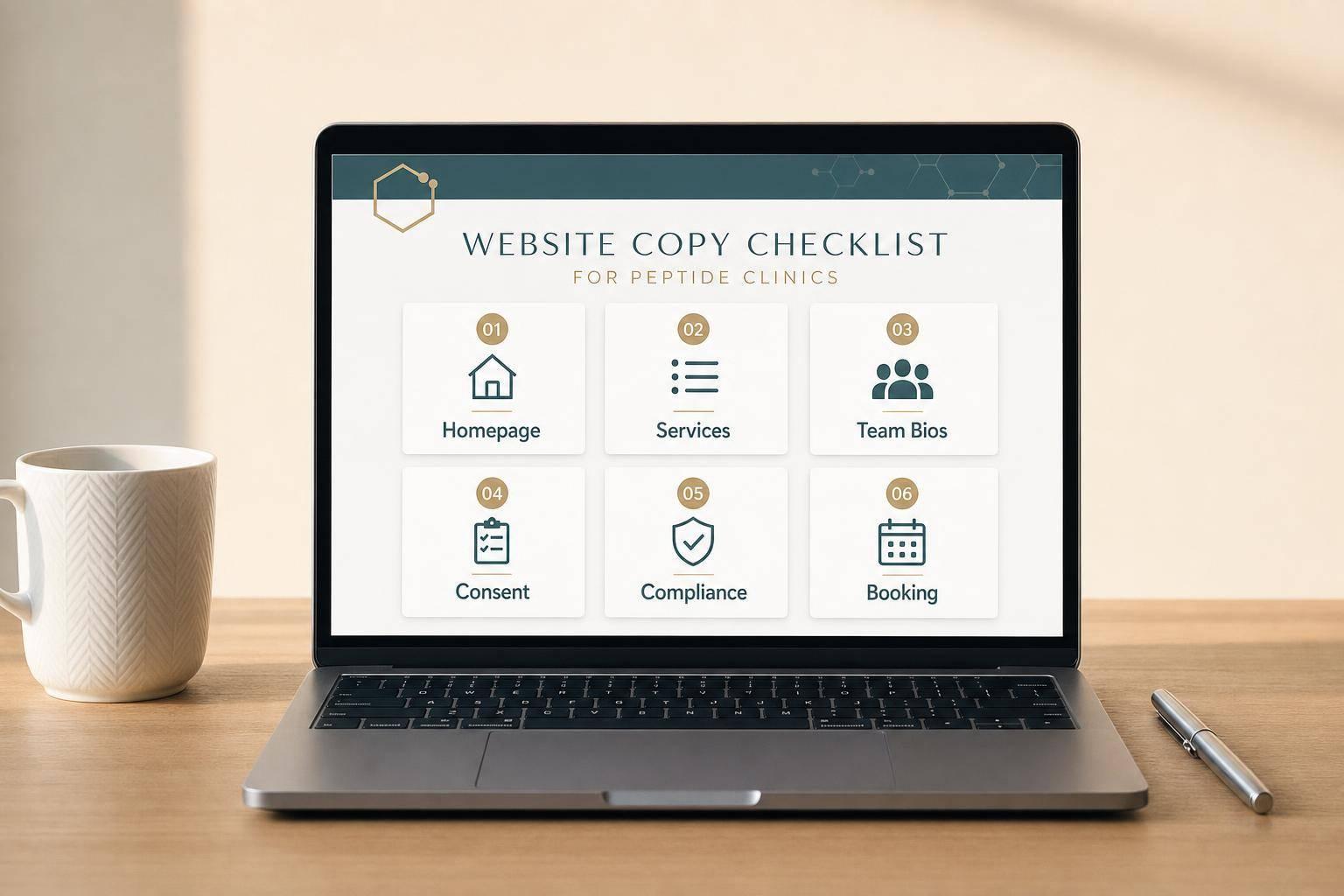
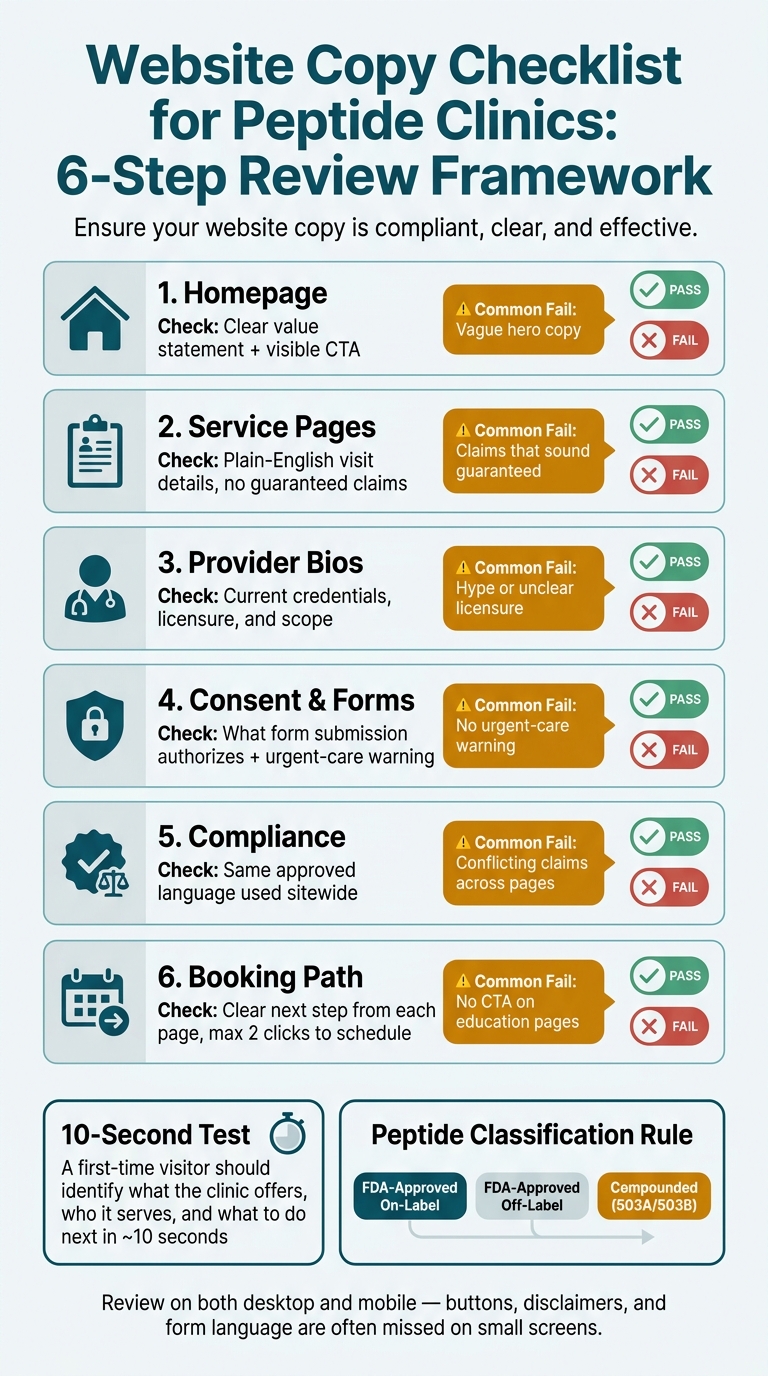
I’d review the site with 6 checks: homepage message, service pages, clinician bios, consent wording, compliance language, and booking flow. The goal is simple: make sure every page is accurate, stays within clinical scope, and gives a clear next step. That matters because unclear or risky medical copy can hurt trust, lead to poor-fit bookings, and create legal trouble.
Here’s the short version of what I’d look for:
- Homepage: say what the clinic does, who it serves, and show a clear booking button
- Service pages: explain the visit process, patient selection criteria, labs, follow-up, and avoid promises
- Provider bios: list licenses, degrees, board certifications, and focus areas without hype
- Forms and consent wording: explain what form submission means and add a non-urgent use warning
- Compliance: remove cure claims, absolutes, and mixed messages across pages
- Booking path: keep the path to scheduling at 2 clicks or less from main pages
A simple pass/fail review works best. If copy is vague, overstated, inconsistent, or missing key details, I’d mark it fail and fix it before launch. I’d also test on desktop and mobile, since buttons, disclaimers, and form language often get missed on small screens.
| Review area | What I’d check first | Common fail |
|---|---|---|
| Homepage | Clear value statement + visible CTA | Vague hero copy |
| Services | Plain-English visit details | Claims that sound guaranteed |
| Bios | Current credentials and scope | Hype or unclear licensure |
| Consent/forms | What submission allows | No urgent-care warning |
| Compliance | Same approved language sitewide | Conflicting claims |
| Booking | Clear next step from each page | No CTA on education pages |
One more point: if the site mentions peptides, I’d confirm each one is described in the right category, such as FDA-approved on-label, FDA-approved off-label, or compounded under 503A/503B. That final check helps keep the copy aligned with current U.S. rules and with how the clinic actually practices.
Website Copy Checklist for Peptide Clinics: 6-Step Review Framework
Page-by-Page Copy Checklist
Use these checks on each page. Start with the homepage. Then make sure the service pages and provider bios back up the same core message.
Homepage Value Statement
Your homepage has one job: tell a visitor what you do, who you help, and what to do next in the first screen.
A strong hero statement answers three questions at once: What need do you address? What kind of care do you provide? What’s the next step? For example: "Personalized peptide therapy consultations for adults seeking medically guided treatment options, with virtual and in-person appointments available." It’s specific, patient-safe, and easy to act on.
Now compare that with a weak line like "Transform your health with cutting-edge peptides," which is vague, salesy, and doesn’t explain the service.
Check the primary call-to-action button too. A button like "Schedule a Peptide Consultation" should be visible without scrolling on both desktop and mobile. The top navigation should stay simple, with clear links to core pages such as:
- Home
- Services
- Providers
- Book Appointment
If the homepage promise is fuzzy, the service pages usually won’t convert cleanly either.
Service Page Clarity
Each major service needs its own page. That page should open with a short, plain-English explanation of what the service is and why a patient might look for it. After that, spell out what happens at the first visit: intake, labs, visit length, and follow-up. (See our practical clinical guides for help with patient education and intake protocols.)
The biggest risks on service pages are promising too much and making it sound like almost anyone qualifies. Swap phrases like "works for everyone" or "guaranteed results" for language that reflects clinical reality: "results vary," "may improve," or "only after medical evaluation."
A page should also say when a service may not be a fit. Certain contraindications, medications, or medical histories can affect candidacy. Saying that up front cuts down on confusion and helps protect the practice.
Also check that the page explains what happens at the first appointment. A lot of clinic sites skip this, and that leaves potential patients unsure how to begin.
Clinician Bio Language
Bios should be current, easy to read, and easy to verify. List each clinician’s name, degree(s), active licensure, current board certifications, and clinical focus in a consistent format. Describe years of experience and specialty areas in plain language. Skip vague claims like "world-class expert" or "leading authority" unless there’s an objective, independent basis for them.
| Bio Element | What to Check |
|---|---|
| Credentials | Are degrees, licenses, and any peptide-relevant CME current and listed? |
| Clinical Focus | Does it name specific areas of practice rather than vague categories like "anti-aging"? |
| Outcome Language | Are there any guarantees? If yes, remove them. |
| Regulatory Awareness | Does the bio avoid promoting substances with unresolved FDA status as routine offerings? |
| Tone | Is the language professional and human - not promotional or med-spa-style? |
Once the bio copy is clean, move to consent and compliance language.
sbb-itb-7164bd9
Consent, Privacy, and Compliance Copy Checks
Consent-Related Wording
Forms, booking requests, and contact submissions carry the most copy risk. Each form needs to say exactly what submitting it means.
- State what submission authorizes. Include language such as: "By submitting this form, you agree that our team may contact you about scheduling and care coordination."
- If the form collects health information, state what is collected, how it is used, who may access it, and how the clinic may respond.
- Add a "not for urgent concerns" warning. Include a line such as: "Do not use this form for urgent medical concerns."
That point matters because administrative consent is not clinical consent. Website copy can help patients understand what comes next, but it should not stand in for clinical consent.
For testimonials and other patient content, be careful. A glowing patient story may feel harmless, but from a compliance angle, it can function like a claim.
- Treat testimonials as claims. Use language such as: "Patient experiences vary and are not a promise of similar results."
- Use written authorization for photos and patient statements. HIPAA requires authorization specifically for marketing use, separate from treatment consent.
After the consent language is in place, review the rest of the site and make sure every page uses the same approved claim language. One page can't say one thing while another page says the opposite.
Compliance Review Across All Pages
Review every page against a single approved language set. One disclaimer will not fix conflicting claims somewhere else on the site.
Cut promotional wording, absolute statements, and disease-cure language. For example, replace "peptide therapy reverses aging" with "results vary by patient and depend on clinical evaluation."
Also update any page that presents restricted or investigational peptides as routine treatment. If the site makes that kind of care sound standard when it isn't, that's a problem waiting to happen.
Final check:
- Telehealth consent, state availability, privacy notices, and emergency instructions match actual operations.
Once the claims and consent language are clean, check that the booking path matches them.
Booking Path and Conversion Clarity
Scheduling Language and Next-Step Instructions
Once the compliance copy is approved, review the booking path right away. When a prospective patient is ready to take action, they shouldn't have to stop and figure out what comes next.
The language on each page should line up with where that patient is in the decision process. Match the CTA to readiness. Use lighter language on educational pages, and use direct scheduling language on service pages.
After the patient clicks, the site should instantly explain what happens next. One short line can do a lot of work: confirm that they'll receive a confirmation email within a few minutes with appointment details and pre-visit instructions. Also spell out the documents they should bring: a current medication list and relevant lab results, if available. Patients should still be able to book even if their records aren't complete.
Skip vague phrases like "Get started" or "Start your consultation." Those phrases don't tell the patient what the click will actually do.
Clear Path From Page to Appointment
The path from any major page to the scheduler should take no more than two clicks. Put the main scheduling CTA in the header, repeat it near the top and bottom of every service page, and place it on clinician bio pages too. Use one label across the site. If "Schedule Consultation" is the main action, don't swap it with "Book Now" or "Consult Today" on other pages.
Once desktop placement is set, check that same CTA behavior on mobile. Buttons should be easy to tap and visible without horizontal scrolling. A sticky header with a persistent scheduling link is a practical fix on longer pages, where the CTA can otherwise disappear as the user scrolls.
During the audit, flag these failure points:
- Educational pages with no next step
- Multiple booking methods with no sign of which one to use
- Forms that ask for full medical history before scheduling
Audit each educational page to confirm there's a visible CTA and a linked booking path.
Use the final approval pass to verify these booking cues on live pages.
Final Approval Before Website Copy Goes Live
This last review is your safety net. Give the homepage, service pages, provider bios, consent copy, compliance language, and booking flow one more careful pass before anything goes live. If a claim, term, or instruction hasn't been checked, don't publish it.
Use the 10-second test. A first-time visitor should be able to tell what the clinic offers, who it serves, and what to do next in about 10 seconds. After that, check peptide terms and claims against current regulatory language.
Go page by page on peptide-related content and confirm the current regulatory language is correct. Every peptide listed on the site should fall into one of these groups:
- FDA-approved on-label
- FDA-approved off-label
- Compounded (503A/503B)
Readability matters just as much as accuracy. Run consent copy, service descriptions, and FAQ pages through a readability check before sign-off. If a patient can't understand what they're agreeing to, the copy needs work. Use approved references to keep patient-facing language clear and compliant.
PeptidePrescriber offers evidence-based monographs, regulatory references, and practice-growth resources for licensed healthcare professionals. Use those materials as support, not as a stand-in for legal or regulatory review. Before launch, document final approval from the medical director, compliance reviewer, or legal advisor.
FAQs
How often should a clinic review website copy?
Clinic website copy needs regular review so it stays accurate, compliant, and in step with current clinical standards.
When clinical protocols or informed consent documents change, the website should change too. That keeps messaging consistent across the practice and helps avoid gaps between what patients read online and what they receive during care.
PeptidePrescriber can help with compliant, evidence-based copy updates.
What should a peptide clinic avoid saying on its website?
Avoid website copy that can weaken compliance or trust. That includes:
- specific compounded molecule names in headlines or ads
- broad, generic messaging aimed at everyone
- vague, misleading, or overstated clinical claims
- presenting peptides as cosmetic or anti-aging solutions without a measurable clinical endpoint
Instead, use clear, transparent language centered on education, clinical rationale, and specific patient goals.
Who should approve website copy before it goes live?
Before website copy goes live, your clinical and legal staff should review it to make sure it matches your prescribing patterns, practice protocols, and state regulations.
That review helps confirm your clinical claims, informed consent language, and required disclosures are accurate, compliant, and right for your patient population. It should also line up with your clinical documentation and help lower legal or regulatory risk.