
If a patient stops a GLP-1 (such as semaglutide or tirzepatide) for more than a short missed-dose window, I should not assume they can jump back to the old dose. Studies show many people stop these drugs and many start again later, but the gap often comes with weight regain, appetite return, and worse glucose control.
Here’s the short version:
- Stopping is common. In U.S. cohorts, first-year discontinuation reached 64.8% in people without T2D and 46.5% in those with T2D.
- Restarting is also common. About 47.3% of people with T2D and 36.3% without diabetes restarted within 1 year in one large cohort. Another claims study found 53.6% restarted within 1 year and 65.9% within 2 years.
- The gap matters. After stopping semaglutide, about two-thirds of lost weight was regained within 52 weeks in STEP 4. After liraglutide, patients regained 9.6 kg (21 lbs) in a year in one follow-up study.
- Labels mostly cover one missed dose, not long gaps. Wegovy is one of the few that says if 2 or more weekly doses are missed, restarting the dose-escalation schedule may help limit GI side effects.
- GI tolerance can fade during time off. That means nausea, vomiting, and diarrhea may return if someone restarts too high.
- Common restart approach: after 2 to 4 weeks off, many clinicians step down or re-titrate; after more than 4 weeks, full re-titration from the starting dose is often used.
Bottom line: when I look at the data, re-initiation is a dosing and safety issue, not just a refill issue. The safest pattern is usually: check the length of the gap, review why treatment stopped, restart lower when needed, and titrate slowly.
| Topic | What the article shows |
|---|---|
| How often people stop | High first-year discontinuation rates |
| How often people restart | Many restart within 1 to 2 years |
| What happens during the gap | Weight regain, appetite return, HbA1c rebound |
| What labels say | Mostly short missed-dose rules; little on long gaps |
| What clinicians often do | Lower-dose restart or full re-titration |
| Main risk at restart | GI side effects after tolerance fades |
If you need a simple takeaway, it’s this: the longer the GLP-1 gap, the more I should think like I’m starting over.
What the evidence shows on restart patterns after GLP-1 gaps
Same-agent restart versus switching agents in published cohorts
After a gap, the big issue is simple: do patients go back to the same GLP-1 drug, or do they move to a different one?
That sounds like a basic question, but most cohort studies don't cleanly separate those two paths. In many cases, researchers count any GLP-1 RA refill after a qualifying gap. So if a patient stops one agent and later starts another, that still lands in the "restarted" bucket.
In a U.S. claims analysis of 14,196 patients with T2D who stopped GLP-1 therapy based on a gap of 60 days or more, 53.6% reinitiated within 1 year and 65.9% within 2 years. Those numbers show that restarting is common. But they also leave a practical problem for clinicians: what dose should patients restart at, and how well will they tolerate it?
Weight regain, appetite recurrence, and glycemic relapse during gaps
Once treatment stops long enough to count as a real gap, the upside starts to slip. Appetite comes back. Weight tends to climb. Blood sugar control can worsen.
That's why a long interruption isn't the same as an ordinary refill delay. The body doesn't just pause and wait.
STEP 4 showed that about two-thirds of weight lost on semaglutide 2.4 mg was regained within 52 weeks after stopping. In a post-treatment follow-up of liraglutide, participants regained 9.6 kg - about 21 lbs - in the year after stopping. A meta-analysis found mean regain of 2.2 kg with liraglutide and 9.7 kg with semaglutide or tirzepatide.
The glycemic side matters just as much. Trials of semaglutide and tirzepatide show HbA1c reductions of about 1.5% to 1.8% and 1.87% to 2.46%, respectively. So when therapy is interrupted, patients can lose a meaningful chunk of that benefit.
Published re-initiation findings by study type: comparison table
The published data point in the same direction: many patients restart after a gap, but gaps still come with clear clinical costs.
| Study / Source | Design | Population | Gap Definition | Key Finding |
|---|---|---|---|---|
| Large U.S. health system cohort (n=125,474) | Observational cohort | Adults with T2D and without T2D on GLP-1 RAs | ≥60 days | Re-initiation within 1 year: 47.3% with T2D and 36.3% without T2D; within 2 years: 57.3% and 46.4% |
| U.S. T2D claims analysis (n=14,196) | Observational claims | Adults with T2D who discontinued GLP-1 RAs | ≥60 days | 53.6% reinitiated within 1 year; 65.9% within 2 years |
| STEP 4 (semaglutide) | Randomized withdrawal | Adults with overweight/obesity | Planned discontinuation | About two-thirds of lost weight was regained within 52 weeks of stopping |
| Liraglutide post-treatment follow-up | Randomized post-treatment follow-up | Adults with obesity | Planned discontinuation | 9.6 kg regained in the year after stopping |
| Meta-analysis (liraglutide, semaglutide, tirzepatide) | Pooled analysis | Mixed obesity/T2D | Varies | Mean regain was 2.2 kg with liraglutide and 9.7 kg with semaglutide or tirzepatide |
There is one big catch in almost all of this evidence. Most real-world studies use claims data or other admin records. That means they can miss cash-pay fills, stockpiling, or undocumented switching between agents. In plain English, restart rates in day-to-day care may be higher than pharmacy claims make them look.
These studies also rarely report the exact dose used at restart. And that's a major gap in the evidence, especially when restart dosing is often where tolerability problems show up first.
sbb-itb-7164bd9
What U.S. labels and expert guidance say about dose restart
Label language for semaglutide, tirzepatide, dulaglutide, and liraglutide
U.S. FDA labels usually tell patients what to do after one missed dose. What they usually don’t spell out is how to restart after a longer break. That matters, because published cohort studies show that restart happens often, yet most of those studies don’t report the restart dose. So in practice, clinicians often lean on the label language plus expert algorithms to decide the next step. Since cohort data rarely spell out restart dosing, labels and expert algorithms end up doing most of the work here.
For Ozempic (semaglutide for T2D), the label says the missed dose can be taken as soon as possible if the next scheduled dose is more than 5 days away. If not, the patient should skip it and go back to the usual weekly schedule. Mounjaro (tirzepatide) follows a similar setup, with a 4-day (96-hour) window. Dulaglutide says to take the missed dose if at least 72 hours remain before the next scheduled dose. If less time remains, skip it and resume the normal schedule.
Wegovy (semaglutide for obesity) is one of the few labels that goes further. If 2 or more consecutive weekly doses are missed, Wegovy may be restarted with the usual dose-escalation schedule to limit GI adverse reactions.
For liraglutide, the label gives guidance for a single missed dose only.
Full re-titration versus step-down restart: when each applies
The day-to-day issue isn’t whether treatment should restart. It’s how to restart it without making the patient miserable.
Most expert guidance leans toward full re-titration after 2 or more missed weekly doses, especially for patients who previously had GI side effects or who are at risk for dehydration. Some protocols use ≥3 missed weekly doses as a more practical cutoff for restarting at a lower dose.
That split makes sense. After time off therapy, GI tolerance may not be the same as it was before. A patient who handled a higher dose a month ago may not slide back into it so easily now.
Label instructions versus expert restart algorithms: comparison table
| Agent | Missed-Dose Label Instruction | Long-Gap Restart Approach | Evidence Level |
|---|---|---|---|
| Semaglutide (Ozempic) | Take within 5 days; otherwise skip and resume the weekly schedule | Restart at 0.25 mg and re-titrate using the usual escalation schedule | Label + expert consensus |
| Semaglutide (Wegovy) | If 2 or more consecutive doses are missed, may restart with the usual dose-escalation schedule to limit GI adverse reactions | Full re-titration from 0.25 mg is common; lower-dose restart used case by case | Label + expert consensus |
| Tirzepatide (Mounjaro) | Take within 4 days (96 hours); otherwise skip and resume the next scheduled dose | Restart at 2.5 mg and re-titrate more slowly if needed | Label + expert consensus |
| Dulaglutide | Take if at least 72 hours remain before the next dose; otherwise skip and resume the usual schedule | Restart at the lowest initiation dose; longer gaps may warrant re-titration | Label + class extrapolation |
| Liraglutide | Single missed-dose guidance only | For longer gaps, restart at the lowest approved dose and re-titrate based on tolerance | Label + expert consensus |
These restart approaches come mostly from expert consensus and pharmacology rather than randomized trials. That gap in trial data is worth keeping in mind, since these restart rules are mainly about one thing: GI tolerance can shift after time off treatment.
Tolerance and symptom recurrence after restarting GLP-1 therapy
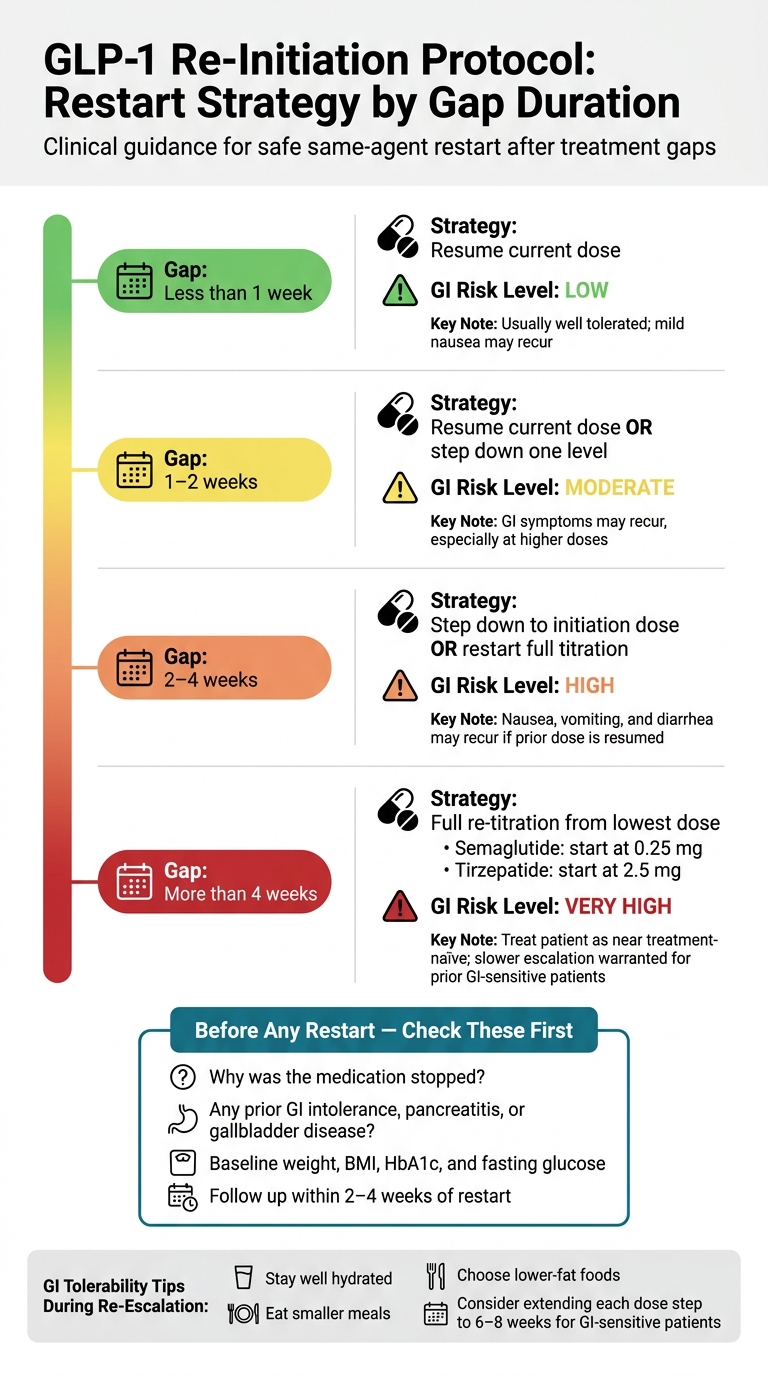
GLP-1 Re-Initiation Protocol: Restart Strategy by Gap Duration
Why GI tolerance may reset after time off therapy
Once you decide to restart, GI tolerance usually becomes the main issue. GLP-1 receptor agonists slow gastric emptying and make people feel full sooner. Over time, the gut gets used to that effect, so symptoms like nausea and vomiting often ease after about 4–8 weeks at a steady dose.
After a break, that tolerance can fade. So when someone restarts after a longer gap, the same early treatment side effects can show up again, including nausea, vomiting, and delayed gastric emptying.
What studies and case-based evidence show about symptom recurrence
Trial data and case-based reports show a pretty clear pattern: GI side effects are still dose-dependent, and they can come back - or hit harder - when a person jumps back to a prior maintenance dose after time off.
Case reports have described severe GI intolerance and related problems after restarting the same high-dose semaglutide following a multi-week gap. Reported issues include gastric stasis, esophagitis, and electrolyte imbalance. The pattern is consistent: if a patient stops for a while and then goes straight back to a dose they once handled well, they may not handle it well the second time.
Because of that, many experts treat patients who miss 3–4 weekly doses, or who have been off therapy for 1–2 months, as if they are new to GLP-1 therapy from a GI tolerance standpoint.
Restart dose pattern and expected tolerability: comparison table
That body response leads to a fairly predictable restart pattern based on how long the gap has been.
| Gap Duration | Typical Restart Strategy | Key GI Tolerability Considerations |
|---|---|---|
| <1 week | Resume current dose | Usually well tolerated; mild nausea may recur |
| 1–2 weeks | Resume current dose or step down one level | Moderate risk; GI symptoms may recur, especially at higher doses |
| 2–4 weeks | Step down to initiation dose or restart full titration | High risk if the prior dose is resumed; nausea, vomiting, and diarrhea may recur |
| >4 weeks | Full re-titration from the lowest dose (semaglutide 0.25 mg; tirzepatide 2.5 mg) | Patients may respond as treatment-naïve; slower escalation is warranted for prior GI-sensitive patients |
For patients who have had GI side effects before, it often makes sense to stretch each dose step to 6–8 weeks. It also helps to give plain, practical advice during restart:
- Stay well hydrated
- Eat smaller meals
- Choose lower-fat foods
Those tolerance patterns shape how restart should be monitored and documented.
Clinical takeaways for safe same-agent re-initiation
Patient selection, monitoring, and documentation at restart
If there’s been a break in treatment, it’s smart to treat the restart like a new safety check. GI tolerance can reset after a gap, so don’t assume the patient will handle the old dose the same way.
Start by confirming why the medication was stopped. Prior GI intolerance, a serious adverse event, or a peri-procedural pause should all push you toward a slower restart.
Review prior tolerability, any history of pancreatitis or gallbladder disease, and baseline weight, BMI, HbA1c, and fasting glucose. During re-escalation, keep a close eye on GI symptoms, hydration, and renal function. If vomiting or diarrhea shows up, check BUN and creatinine promptly, since those symptoms can point to the same tolerance reset covered in the prior section. Follow up within 2–4 weeks of restart, and reassess at each dose increase.
Documentation matters here. Record:
- The length of the treatment gap
- The agent and dose used last
- The reason therapy stopped
- The selected same-agent restart dose and your clinical rationale
That paper trail helps with continuity of care and makes the plan much easier to review if symptoms come back.
Using standardized clinical resources to support restart protocols
PeptidePrescriber gives licensed clinicians access to peptide monographs, dosing protocols, calculators, injection guides, and regulatory references that can help standardize restart decisions.
Key points summary
In day-to-day care, GLP-1 treatment gaps happen a lot, and restarting without reassessment can create avoidable risk. Wegovy allows reinitiation of the dose-escalation schedule after 2 or more missed weekly doses to reduce GI adverse reactions.
For longer gaps, many patients need a step-down restart or even full re-titration based on the agent, prior dose, and earlier GI tolerance. Weight regain, appetite return, and worsening glycemic control during gaps are well documented, so the aim is to restore metabolic control safely, not fast. Start low, titrate slowly, watch symptoms, and document the reasoning.
FAQs
How long is too long to restart my old GLP-1 dose?
If your GLP-1 therapy has been interrupted for more than 2 weeks, restart at the lowest starting dose. For semaglutide, that usually means 0.25 mg once a week. This helps lower the risk of rebound gastrointestinal side effects or pancreatitis.
Even if you were taking a higher maintenance dose before the break, the safer move is to go back to the starting dose and increase it again little by little so your body can tolerate it.
What should I do if my appetite or blood sugar worsens during a gap?
If appetite control or blood sugar gets worse during a treatment gap, don’t try to catch up by jumping your dose too fast. That can backfire and make side effects harder to handle.
Instead, look at clinical markers to decide when to restart. For example, a fasting glucose increase of more than 25 mg/dL or a clear increase in HbA1c can help guide re-initiation.
If the gap is longer than 2 weeks, restart at the lowest initial dose. For semaglutide, that means 0.25 mg once weekly. Then follow the standard 4-week titration schedule to put tolerance first.
Does restarting after a break cause side effects again?
Yes. Restarting GLP-1 therapy after a break can bring back gastrointestinal side effects, especially during re-titration.
If treatment has been paused for more than two weeks, guidance recommends starting again at the lowest dose, such as 0.25 mg once weekly for semaglutide, to help lower the chance of nausea, vomiting, diarrhea, constipation, and other tolerance-related side effects.