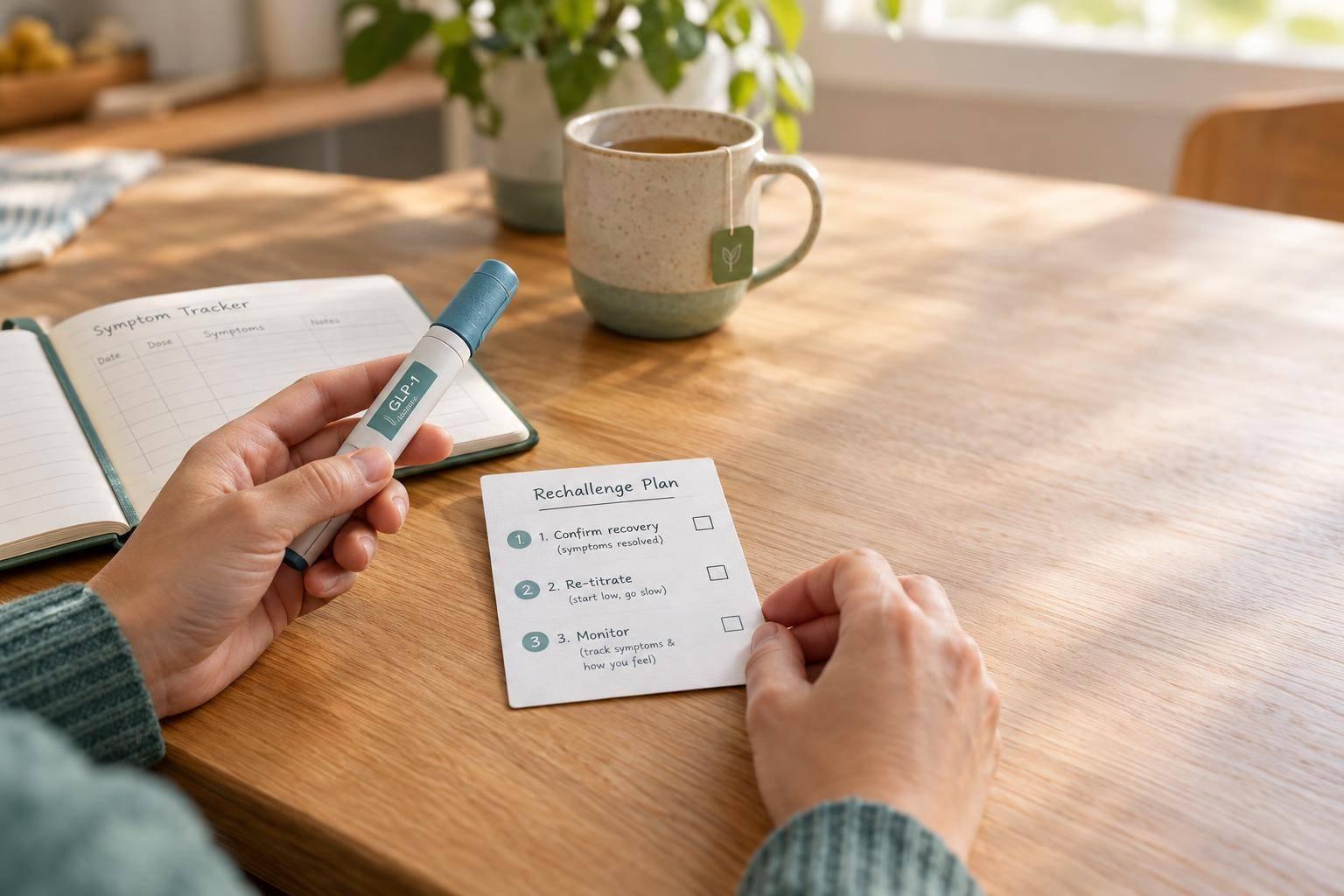
Restarting a GLP-1 after side effects may be an option - but only after recovery and a review with your prescriber. I explain how to check the prior reaction, choose a restart dose, and set clear rules for when to stop.
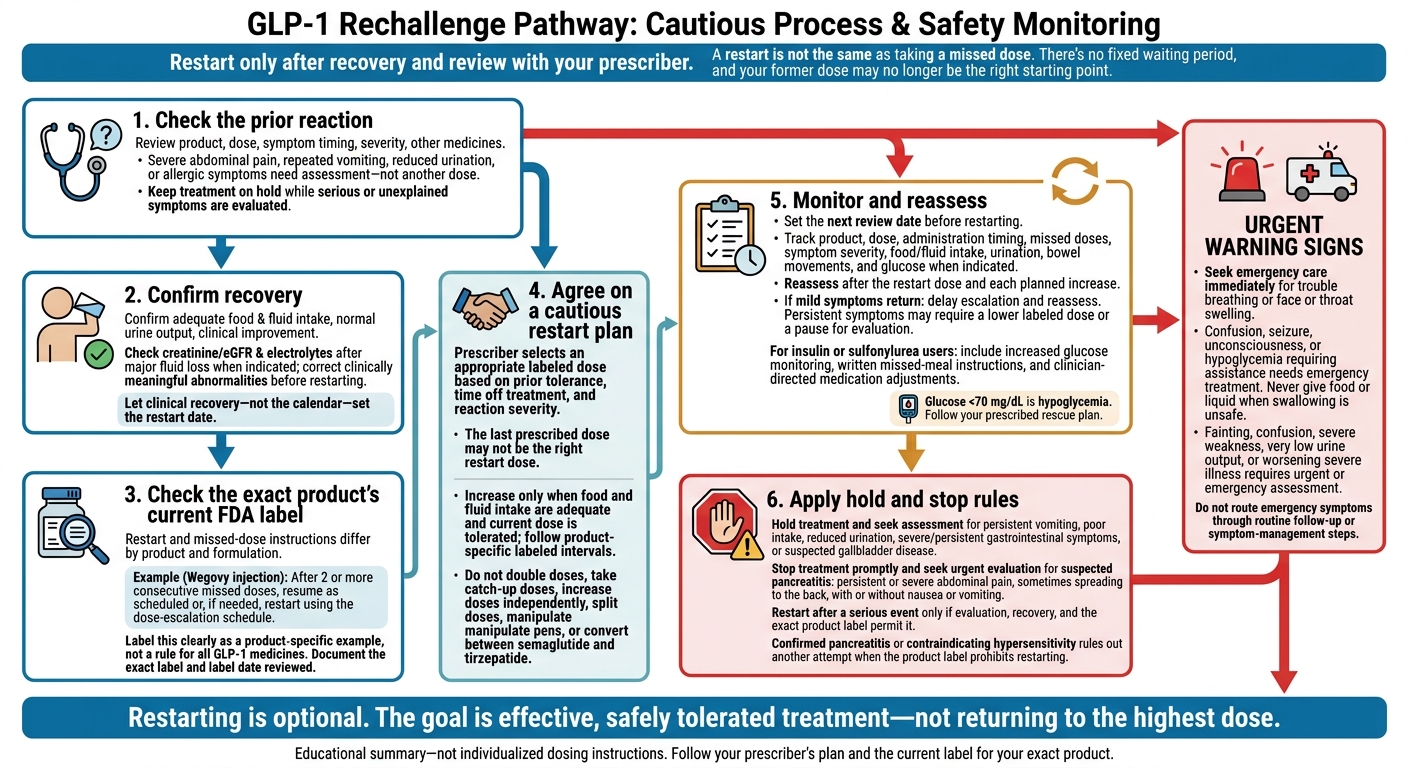
A restart is not the same as taking a missed dose. There’s no fixed waiting period, and your former dose may no longer be the right starting point.
Here’s the plan I outline:
- Check what caused the symptoms. Severe abdominal pain, repeated vomiting, reduced urination, or allergic symptoms need assessment - not another dose.
- Confirm recovery. Make sure you can eat and drink, with kidney testing when needed.
- Check your exact product’s FDA label. Restart instructions differ. For example, Wegovy may need re-escalation after 2 or more missed weekly doses.
- Restart cautiously with your prescriber. Use an appropriate labeled dose, and delay increases if symptoms return.
- Track symptoms and arrange follow-up. Include intake, urination, bowel habits, and glucose when relevant.
- Know when to hold or stop. Some diagnoses or reactions rule out another attempt; trouble breathing or face or throat swelling requires emergency care.
<u>The goal is safely tolerated treatment - not getting back to your highest dose.</u> Restarting is optional, and your preferences belong in the decision.
GLP-1 Restart After Side Effects: Safety Checklist
Why are patients stopping and restarting GLP-1 meds?
sbb-itb-7164bd9
Decide When to Restart
Once urgent causes have been addressed, assess whether the patient is ready to restart. Let clinical recovery - not the calendar - set the restart date. Consider the product’s half-life, dosing interval, time off treatment, and risk of recurrence.
Confirm Recovery Before Restarting
Keep treatment on hold while the patient has marked vomiting or diarrhea, dehydration, uncontrolled abdominal pain, severe constipation, or an inability to maintain oral intake. Before restarting, confirm adequate food and fluid intake, normal urine output, and clinical improvement.
After major fluid loss, check creatinine/eGFR and electrolytes when indicated. Pay particular attention to patients with chronic kidney disease (CKD), older adults, patients taking diuretics, those with reduced urination, and those recently hospitalized. Correct clinically meaningful abnormalities before rechallenge.
Check Product-Specific Restart Instructions
Once the patient has recovered enough to restart, follow the product-specific labeling for timing and re-titration. Check the exact product and formulation in the current FDA prescribing information, and document the label date reviewed.
Weekly injectables have different missed-dose rules. Do not use one restart rule for every product.
| U.S. product/formulation | Dosing interval | Missed-dose or restart instruction | Restart dose |
|---|---|---|---|
| Wegovy injection (semaglutide) | Weekly | After 2 or more consecutive missed doses, resume as scheduled or, if needed, restart using the dose-escalation schedule. | Re-escalation may reduce gastrointestinal adverse reactions. Choose the restart dose based on recovery and prior tolerability. |
| Ozempic injection (semaglutide) | Weekly | Take a missed dose within 5 days; otherwise, skip it and resume on the regular day. | Missed-dose guidance does not address rechallenge after a prolonged interruption. |
| Zepbound injection (tirzepatide) | Weekly | Take within 4 days (96 hours); otherwise, skip and resume on the regular day. Keep doses at least 72 hours apart. | Missed-dose guidance does not address rechallenge after a prolonged interruption. |
| Mounjaro injection (tirzepatide) | Weekly | Take within 4 days (96 hours); otherwise, skip and resume on the regular day. Keep doses at least 72 hours apart. | Missed-dose guidance does not address rechallenge after a prolonged interruption. |
| Saxenda injection (liraglutide) | Daily | Use the current FDA label for daily reinitiation after an interruption. | A prolonged interruption or a stop due to intolerance may require an earlier labeled titration dose. |
| Rybelsus tablets (oral semaglutide) | Daily | Follow the current FDA label for missed-dose and administration instructions. | Review prior tolerability, interruption length, and labeled titration before resuming a higher dose. |
Document whether the plan is to resume treatment, repeat an earlier dose, restart escalation, or keep treatment on hold. Provide written instructions stating the dose, administration date, follow-up date, and symptoms that require holding treatment.
Choose the Restart Dose and Titration Pace
Choose a Restart Dose
After recovery and a review of the product label, choose the lowest labeled dose the patient can tolerate.
The last prescribed dose may not be the right restart dose. Consider the exact product, indication, time off treatment, last tolerated dose, and severity of the prior reaction. After several weeks off or repeated intolerance, restart at a lower labeled step or begin initial titration again. If the label gives no restart dose, document the individualized clinical judgment behind the choice.
| Rechallenge scenario | Dose choice |
|---|---|
| Brief interruption after mild intolerance | Use the last tolerated labeled dose or step down one labeled level, based on time off and prior intolerance. |
| Longer interruption after intolerance | Use the last tolerated labeled dose or step down one labeled level, based on time off and prior intolerance. After a long hold or repeated intolerance, restart at a lower labeled step or begin initial titration again. |
| Mild, dose-related intolerance | Use the last tolerated labeled dose or step down one labeled level. Reassess before increasing. |
| Recurrent moderate symptoms | After assessment, pause treatment or return to a lower labeled step. Repeated vomiting or poor intake requires more than a dose adjustment. |
| Serious or unexplained event | Keep treatment on hold pending evaluation. The diagnosis may make restarting inappropriate. |
Once the restart dose is set, let symptom response guide titration - not the calendar alone. Wait to increase until the patient is eating, drinking, and tolerating the current dose.
Do not split doses, manipulate pens, or convert between semaglutide and tirzepatide. Do not use a lower titration dose as maintenance unless the product’s labeling supports it.
Define When to Increase the Dose
The labeled interval is the minimum time between increases. Wegovy allows a 4-week delay during escalation when a dose is not tolerated. Zepbound starts at 2.5 mg once weekly for 4 weeks. Later increases are 2.5 mg, only after at least 4 weeks at the current dose. The 2.5-mg dose is for initiation, not maintenance; choose maintenance dosing based on indication and tolerability. Longer holds require clinician assessment. Never speed up escalation to make up for time off.
Increase only when symptoms are mild or resolved. Confirm adequate food and fluid intake, no nutritional compromise, and no unresolved concern about a complication. Review glucose readings and concurrent insulin or sulfonylurea use before increasing. Aim for the lowest effective, tolerated maintenance dose - not the former highest dose.
If mild symptoms return, delay escalation and reassess. Persistent symptoms call for a lower labeled dose or a pause to assess other causes. If intolerance recurs despite slower titration, reconsider whether to continue therapy rather than repeatedly attempting escalation.
Treat Symptoms Without Masking Complications
When mild symptoms return during rechallenge, rule out complications before adding supportive care. Supportive care during rechallenge is appropriate only for mild intolerance after red flags are excluded. First, document when symptoms occur, their severity, oral intake, urine output, glucose readings, and exam findings.
Address Gastrointestinal Symptoms and Intake
Recommend smaller, more frequent, lower-fat meals. Eat slowly and stop when comfortably full. Offer fluids in small, frequent amounts within any heart- or kidney-related limits; do not set a fixed fluid target. If vomiting or diarrhea continues, assess blood pressure, orthostatic symptoms, hydration, renal function, and electrolytes. Pay particular attention to older adults, patients with kidney disease, and those taking diuretics.
The table below outlines outpatient care for mild, stable symptoms. These steps support rechallenge but do not replace reassessment if symptoms worsen.
| Symptom | Conservative care | Medication review | Reassessment timing | Hold treatment or seek urgent evaluation |
|---|---|---|---|---|
| Mild nausea or early fullness | Eat small, lower-fat meals; eat slowly; stop when full | Review other medicines that may cause nausea; avoid routine preventive antiemetics | Reassess before the next dose increase, or sooner if intake declines | Hold treatment and contact the prescriber if symptoms worsen or prevent adequate intake |
| Vomiting or diarrhea | Take small sips; use individualized oral rehydration if tolerated | Review metformin, laxatives, antibiotics, diuretics, and dehydration risk | Contact the care team the same day for persistent vomiting, dizziness, or poor fluid intake | Hold treatment; seek urgent assessment for inability to drink, fainting, confusion, or markedly reduced urination |
| Constipation | Check bowel habits, intake, activity, and fiber tolerance | Review opioids, iron, calcium, anticholinergics, and antiemetics that cause constipation | Review symptoms if they persist despite initial measures | Seek urgent evaluation for severe pain, progressive distension, vomiting, or inability to pass stool or gas |
| Persistent reflux or postmeal fullness | Eat smaller meals; avoid large meals near bedtime and known triggers | Review medicines that affect reflux or gut motility before adding acid suppression | Arrange prompt review for recurrent symptoms or poor nutrition | Hold treatment and assess recurrent vomiting or worsening intake; seek urgent evaluation for severe pain or jaundice |
Persistent early satiety, reflux, recurrent vomiting, or poor intake calls for evaluation for delayed gastric emptying or another GI disorder - not simply more symptom medication. Several GLP-1 products are not recommended for patients with severe gastroparesis.
Before adding treatment for symptom control, review all drugs that can worsen gastrointestinal symptoms or hypoglycemia.
Review Symptom Medications and Hypoglycemia Risk
Tailor antiemetics, bowel regimens, and acid suppression to each patient. Review allergies, drug interactions, renal and hepatic function, pregnancy status, QT prolongation risk, sedation, and obstruction risk. Use the lowest effective treatment for the shortest appropriate period. Some antiemetics can worsen constipation.
Do not mask severe pain, repeated vomiting, reduced urination, jaundice, or allergic symptoms. Breathing difficulty or swelling of the face or throat requires emergency care.
For patients taking insulin or sulfonylureas, the restart plan should include written instructions for missed meals, increased glucose monitoring, and clinician-directed medication adjustments - not a blanket dose reduction. Glucose <70 mg/dL is hypoglycemia. Explain its symptoms and the prescribed rescue plan. Recurrent lows need prompt medication review. Confusion, fainting, or hypoglycemia that does not respond to rescue treatment requires urgent help.
Monitor and Document Rechallenge
Plan Follow-Up and Track Symptoms
Set the next review date before restarting, then begin structured follow-up as soon as treatment resumes. Reassess after the restart dose and each planned increase. Arrange earlier contact for patients with prior severe reactions, urgent care, dehydration, kidney risk, chronic kidney disease, gastrointestinal disease, or insulin or sulfonylurea use. Identify the responsible clinician, preferred contact method, and after-hours pathway. Delay dose increases until symptoms resolve.
Use a daily log or chart checklist to record the product, dose, administration timing, and missed doses. Track symptom severity and trends, including symptoms that recur sooner after each dose. Also record food and fluid intake, urination, bowel movements, glucose when indicated, and any interventions. Use these details to guide whether to continue, delay, or increase the dose.
Order tests for a clinical reason - not automatically with every dose increase. Check renal function and electrolytes only when symptoms suggest volume depletion, especially in patients with chronic kidney disease. Review other medicines that affect glucose, hydration, or bowel function. Choose other tests based on the suspected condition; do not order routine amylase or lipase tests without a symptom-driven reason.
Record Decisions and Patient Instructions
Use the follow-up record to support the rechallenge decision. Document the original adverse event, the reason for rechallenge, the restart dose, the escalation plan, and clear hold or stop criteria. Include the event’s suspected cause, timing, severity, duration, treatment, emergency evaluation, objective findings, recovery status, and whether it was confirmed or only suspected.
Record the alternatives considered and why they were rejected, along with symptom-management measures, follow-up timing, indicated testing, expected benefit, and patient preferences. Written instructions should explain when to delay the next dose and call the clinic - and when to seek emergency care rather than wait for a reply.
Record the exact missed-dose rule for the prescribed product and formulation, plus the exact label reviewed. Make clear that patients must not double doses, take extra “catch-up” doses, increase doses on their own, or return to a previously higher dose after a prolonged interruption.
Define When to Hold or Stop Treatment
Use these stop rules when symptoms go beyond mild intolerance that resolves on its own. Hold treatment before increasing the dose.
| Event | Immediate action | Required evaluation | Rechallenge? |
|---|---|---|---|
| Suspected pancreatitis: persistent or severe abdominal pain, sometimes spreading to the back, with or without nausea or vomiting | Stop treatment promptly and seek urgent evaluation. Seek emergency care if the illness worsens. | Examination, vital signs, hydration assessment, serum lipase, and other tests or imaging as needed | Do not restart until pancreatitis is ruled out or resolved. Wegovy labeling says not to restart after confirmed pancreatitis; check the exact current label for the prescribed product. |
| Dehydration or suspected acute kidney injury: persistent fluid loss, dizziness, dark urine, or reduced urination | Hold treatment and get a prompt assessment. Seek emergency care for fainting, confusion, severe weakness, or very low urine output. | Fluid status, blood pressure, pulse, electrolytes, creatinine/eGFR, and review of medicines that increase kidney risk | Consider restarting after hydration and kidney recovery. Repeated acute kidney injury (AKI) favors stopping treatment. |
| Severe or persistent gastrointestinal symptoms, including poor intake or abdominal swelling | Hold the next dose and contact the prescriber the same day. Severe pain or inability to keep fluids down requires urgent care. | Assess nutrition and hydration. Check for obstruction, gastroparesis, pancreatitis, or other causes when indicated. | After recovery, consider a lower dose or slower dose increases if appropriate. |
| Suspected gallbladder disease: right-upper-abdominal pain, fever, jaundice, or repeated pain after meals | Hold treatment and get a prompt assessment. Severe pain, jaundice, or worsening illness warrants urgent or emergency evaluation. | Examination, liver tests, bilirubin, and ultrasound or other imaging as needed | Consider restarting only after diagnosis, treatment, and symptom resolution. |
| Serious hypersensitivity, including anaphylaxis or angioedema: trouble breathing, wheezing, swelling of the face, lips, tongue, or throat, fainting, or hives that worsen quickly | Discontinue treatment and seek emergency care immediately. | Emergency treatment and identification of the ingredient or excipient responsible | Do not retry the culprit product after a hypersensitivity reaction that makes its use contraindicated. Zepbound is contraindicated after a previous serious hypersensitivity reaction to tirzepatide or its excipients. |
| Severe hypoglycemia: confusion, seizure, unconsciousness, or need for assistance | Seek emergency treatment and hold further GLP-1 doses until reviewed. Use prescribed glucagon if available. Never give food or liquid when swallowing is unsafe. | Review glucose readings, insulin or sulfonylurea doses, other contributing medicines, and kidney function when indicated | Consider restarting after insulin or sulfonylurea adjustment and with a clear monitoring plan. |
These thresholds take priority over routine dose increases and efforts to suppress symptoms. Check the exact product label. Confirmed pancreatitis or contraindicating hypersensitivity rules out another attempt when the label prohibits restarting that product.
Even when the label does not prohibit restarting, another attempt may be inappropriate if symptoms return at lower doses, dehydration or kidney injury repeats, adequate nutrition cannot be maintained, or symptom-suppressing medication is continually needed just to tolerate treatment. Unresolved abdominal symptoms and repeated severe hypoglycemia despite insulin or sulfonylurea adjustments also weigh against another attempt.
Summary: Steps for Safer Rechallenge
Restart only after symptoms resolve, stop criteria are ruled out, and the expected benefit still outweighs the risk. Review the prior drug, dose, timing, symptoms, and other medicines that may have contributed. Confirm that the patient can tolerate food and fluids, urine output is adequate, and kidney function has recovered when relevant.
Check the current product label for restart instructions. Base the restart dose on prior tolerance, time off treatment, and reaction severity - not simply the previous dose. A lower dose may be appropriate.
If symptoms return, slow dose escalation. Increase the dose only when tolerability supports it. For GI intolerance, stay at the current dose step for another 2–4 weeks when the product permits. Nutrition and hydration take priority over dose increases.
Document the restart dose, criteria for dose increases, follow-up date, and stop rules. Track intake, symptoms, urine output, and glucose. Use warning signs defined in advance to prompt evaluation rather than another dose adjustment.
Rechallenge is optional and requires patient agreement. Success means effective, safely tolerated treatment that respects patient preference and does not compromise nutrition or hydration - not reaching the highest dose.
FAQs
How can I tell if my symptoms were caused by my GLP-1?
Your clinician can compare your symptoms with your usual health and known GLP-1 side effects. A link may be more likely if symptoms start or worsen after a dose increase, ease after stopping the medication, or return after restarting it.
If symptoms are severe, getting worse, or lasting more than two weeks at a stable dose, clinicians should check for other causes, including pancreatitis or dehydration, and consider pausing the medication.
Does tolerating a lower restart dose mean I can increase it safely?
Yes - but only if side effects are mild and controlled, meaning they aren’t getting worse or interfering with daily life. The dose must also be correct, and you need enough time at that dose to see how well you tolerate it - typically about 4 weeks or longer.
If gastrointestinal (GI) symptoms last more than about 2–3 weeks after a dose increase, hold at the current dose or lower it rather than increasing it again. Any increase must stay within the protocol’s dose steps and limits.
How do I decide whether restarting is worth the risk?
Start by reviewing why GLP-1 therapy was stopped and the patient’s current health. Acute pancreatitis, bowel obstruction, or persistent vomiting that causes dehydration often require stopping treatment permanently.
If gastrointestinal symptoms can be controlled, assess whether the patient can tolerate slower titration, smaller dose increases, or care to prevent symptoms. When restarting is appropriate, use the lowest initial dose, such as 0.25 mg for semaglutide, to reduce the risk of symptoms returning. The prescribing clinician should confirm the restart dose and schedule.