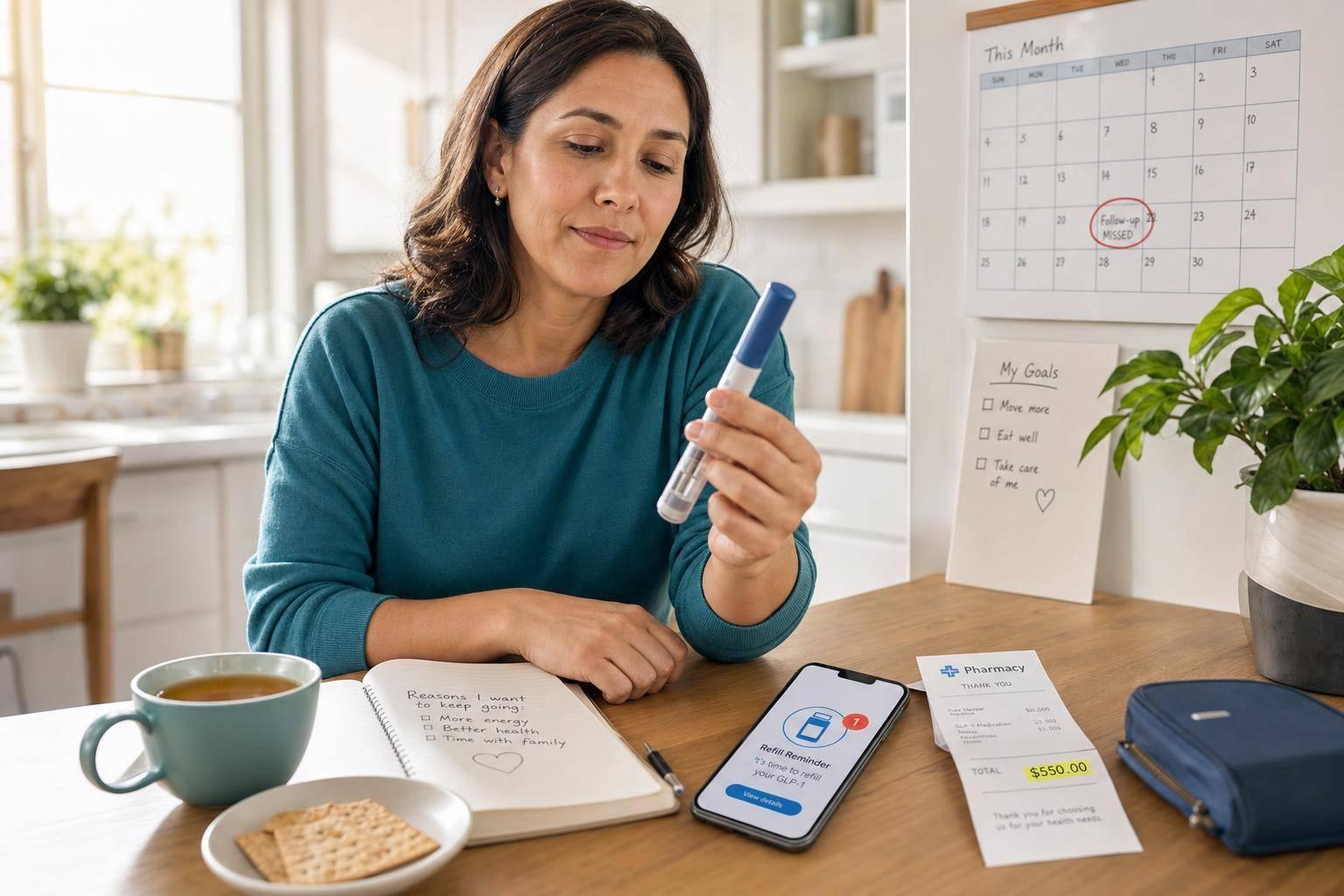
Most people don’t stop GLP-1 therapy for one reason. They stop because side effects, cost, refill problems, and poor follow-up pile up at the same time.
If I had to boil this down, I’d say this: early drop-off is often a care gap, not just a patient decision. The article shows the same pattern again and again - GI symptoms hit during dose increases, out-of-pocket costs stay high, insurance blocks refills, and some patients expect fast results that the first few weeks often don’t deliver. That helps explain why only 32.3% stayed on treatment at 12 months in one U.S. obesity cohort, while another study found 50% had stopped by 1 year.
Here’s the short version of what drives early stopping:
- Side effects: nausea, vomiting, diarrhea, constipation, and poor intake are common early on
- Cost and coverage: patients may face high copays, denied prior authorizations, or no coverage at all
- Refill and supply problems: stock issues, travel, storage mistakes, and missed-dose confusion (often addressed in practical guides for patients) can lead to gaps
- Expectation mismatch: some patients expect fast weight loss, then think the drug “isn’t working”
- Weak follow-up: no check-in after starting or after dose increases makes small problems snowball
A few numbers stand out:
- 36.1% said high cost was a reason they stopped
- 33.3% said side effects
- 28.2% said lack of insurance coverage
- 26.1% said they stopped after hitting a personal goal
What should happen instead? I’d focus on four things early:
- Check symptoms fast
- Slow titration when needed
- Fix access issues before the next dose is due
- Set plain expectations about timelines and long-term use
The big idea is simple: missed dose, short gap, lost follow-up, and full stop are not the same thing. If I treat them like the same problem, I miss the cause - and that makes the next stop more likely.
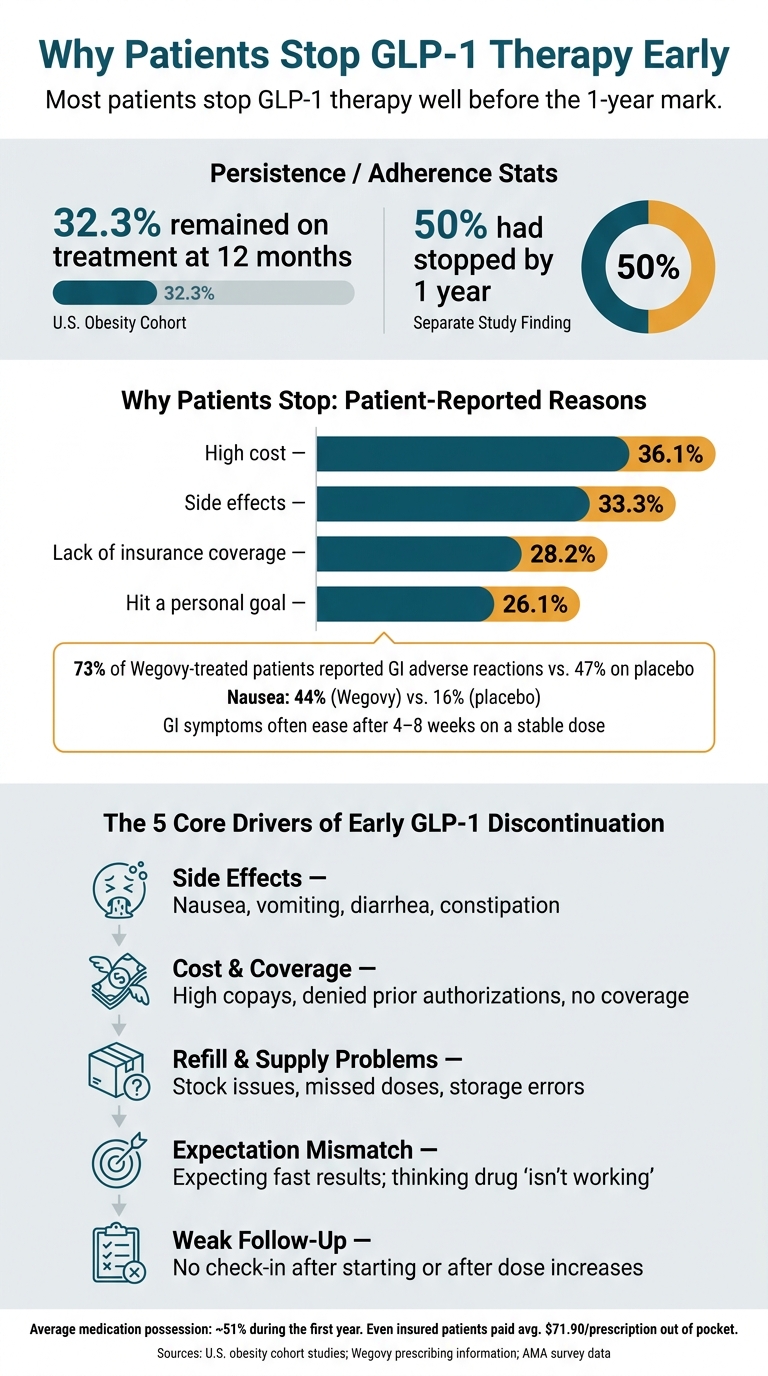
Why Patients Stop GLP-1 Therapy: Key Statistics & Drop-Off Drivers
Why are patients stopping and restarting GLP-1 meds?
sbb-itb-7164bd9
GI Symptoms and Slow Titration: The Main Early Barrier
GI symptoms are the biggest early reason people stop GLP-1 treatment during the first phase of therapy. In adult weight-management trials, 73% of Wegovy-treated patients reported GI adverse reactions, compared with 47% on placebo. Nausea was reported in 44% vs. 16%.
These symptoms tend to show up during initiation and dose escalation. In many cases, they ease after 4 to 8 weeks on a stable dose. That timing matters. Some patients quit right before the rough patch would have started to settle down.
The job at this stage is simple: figure out whether the patient is dealing with expected short-term symptoms or a level of intolerance that calls for a dose change or urgent workup.
How to Assess Symptom Pattern, Severity, and Red Flags
Use a structured review, not a quick “How are you doing?” Ask about the timing of symptoms in relation to the injection and any dose increase. Check severity, vomiting or diarrhea frequency, and whether the patient can still drink and eat. Review signs of dehydration, current medications, recent illness, diet, alcohol use, and GI history.
Some drugs can make GI symptoms worse on their own. That includes opioids, metformin, iron supplements, anticholinergics, laxatives, and other agents that affect bowel function. Also confirm the exact product, dose, and injection technique. This is especially important with compounded formulations, where confusion about dose or concentration can lead to dosing mistakes. The FDA has reported severe nausea and vomiting tied to compounded-product dosing errors.
Patients should contact the care team promptly for persistent nausea, repeated vomiting, ongoing diarrhea, worsening constipation, or trouble keeping up with fluids or nutrition. Urgent evaluation is needed for dehydration, severe abdominal pain, rigidity, distention, GI bleeding, fever, dyspnea, or suspected obstruction.
Once you've ruled out red flags and high-severity symptoms, move fast on dose adjustment before the patient checks out mentally and stops treatment.
Adjust Titration and Supportive Care Before Patients Stop Treatment
If symptoms are mild, slow the titration rather than stopping therapy. The Wegovy label allows a 4-week delay in dose escalation when the current dose is not tolerated. If symptoms come back after each increase, keep the patient at the current dose until they are comfortable there before moving up. If symptoms became clinically important after one specific increase, it may make sense to return to the last tolerated dose.
Diet advice also helps, and it doesn't need to be fancy. Encourage smaller portions, slower eating, stopping when comfortably full, and avoiding large high-fat or spicy meals during escalation. For hydration, tell patients to drink fluids regularly, not just when they feel thirsty, and to watch for darker urine or dizziness. If appetite suppression is strong, the goal is not to push large meals. It is to focus on small, nutrient-dense meals and enough protein. Reduced appetite is part of the treatment. Poor nutrition is not.
The table below matches common GI symptoms with first-line support and signs that should push care to the next step:
| Symptom | Routine Supportive Measures | Monitor For | Escalation Triggers |
|---|---|---|---|
| Nausea | Smaller meals; eat slowly; limit large high-fat or spicy foods | Intake, hydration, weight trend, severity | Persistent or worsening nausea; inability to maintain intake; dehydration |
| Vomiting | Small frequent sips of tolerated fluids; avoid large meals; contact clinic if recurrent | Episodes per day, urine output, dizziness, glucose when relevant | Inability to keep fluids down; faintness; confusion; blood in vomit; severe pain |
| Diarrhea | Replace fluids and electrolytes as appropriate; review diet and concurrent medications | Frequency, duration, hydration, fever, blood | Severe or persistent diarrhea; dehydration; blood; fever; marked weakness |
| Constipation | Adequate fluids; gradual dietary fiber and activity as tolerated; clinician-directed bowel regimen | Bowel frequency, stool consistency, abdominal distention, pain | Severe or persistent constipation; inability to pass stool or gas; vomiting; severe pain |
| Abdominal discomfort or bloating | Smaller meals; avoid overeating; review constipation and other medications | Location, severity, duration, relation to meals or injection | Sudden or severe persistent pain; fever; rigid or distended abdomen; repeated vomiting |
| Appetite suppression or early satiety | Prioritize small nutrient-dense meals and fluids; avoid forcing food; assess protein and calorie intake | Weight trend, nutrition, hydration, fatigue, functional status | Inability to meet nutritional needs; rapid unintended weight loss; weakness; dehydration |
A stop after dose escalation often points to a tolerability mismatch, not refusal.
Cost, Access, and Treatment Friction as Causes of Drop-Off
Once GI symptoms are under control, another pattern tends to show up: people stop treatment because getting the medication becomes hard. Cost, insurance rules, and supply issues can derail care even when a patient is doing fine on the drug.
A 2025 analysis found that even insured patients paid an average of $71.90 per prescription out of pocket for GLP-1 weight-loss medications, with costs ranging from about $41.15 to $78.37 depending on the patient’s demographic group. So insurance alone doesn’t tell you much about what someone will pay.
Persistence data points in the same direction. One U.S. study found that only 46.3% of patients remained persistent at 180 days and 32.3% at 1 year, with average medication possession of about 51% during the first year. That’s a big drop. If a patient misses a refill, don’t jump straight to nonadherence. First, find out what got in the way.
Identify Financial and Coverage Risks Before They Cause a Gap
Before prescribing, check the basics: expected out-of-pocket cost, prior authorization needs, and whether the pharmacy can get the product under current FDA regulatory guidelines. Then check again at each dose increase and before coverage renewals. A lot can change between fills.
An AMA report found that 47.6% of surveyed patients said cost- or insurance-related hurdles were their main reason for stopping therapy. That’s why clinics need a simple plan for the most common barriers.
| Access barrier | Primary clinic role | Recommended follow-up |
|---|---|---|
| High or unexpected out-of-pocket cost | Prescriber or benefits staff confirms coverage, discusses clinically appropriate alternatives, and documents the patient's affordability limit | Within 3–5 business days of identification |
| Prior-authorization delay or denial | Authorization staff submits documentation, tracks payer response, and updates the patient | Status update within 3–5 business days; escalate before the next dose is due |
| Refill gap or pharmacy stock problem | Nurse, MA, or pharmacist confirms the last dose, contacts pharmacies as permitted, and routes any product change to the prescriber | Same business day when the next dose is imminent |
| Coverage expiration or plan change | Benefits staff checks renewal requirements and starts reauthorization early | 2–4 weeks before expected expiration |
| Transportation or pharmacy-access difficulty | Care coordinator explores delivery or alternate in-network pharmacies | Within 1 week |
| Storage or travel concern | Nurse provides product-specific storage and transport instructions and documents teach-back | Before travel or as soon as the concern is reported |
Reduce Missed Doses With Clear, Product-Specific Instructions
Even when coverage is steady, people still miss doses for a simpler reason: the instructions never fully clicked. Sometimes it’s device confusion. Sometimes it’s travel. Sometimes life gets messy and the schedule slips.
Missed-dose rules are not the same across products. FDA labeling for Ozempic says a missed dose can be taken within 5 days. After that, the dose should be skipped and the regular weekly schedule resumed. Zepbound uses a 4-day (96-hour) window. If that window has passed, the missed dose should be skipped and the next scheduled dose taken on the regular day. Written instructions should name the exact product and spell out that product’s missed-dose window.
| Treatment-friction problem | Standardized safeguard |
|---|---|
| Patient doesn't know the next injection day | Print the weekly or daily schedule and set a calendar or text reminder |
| Patient can't explain the dose or device steps | Conduct injection teach-back and document competency using an injection site guide |
| Prior authorization started only after denial | Verify requirements before prescribing and track authorization expiration |
| Refill or stock failure | Set an automated refill reminder; confirm last dose, identify permitted pharmacy options, and route substitutions to the prescriber |
| Patient misses doses while traveling | Provide a written travel, storage, and timing plan before departure using current product labeling |
| Medication list doesn't match actual use | Reconcile product, strength, last dose, missed doses, and remaining supply at every contact |
Travel adds one more layer. Storage rules matter, and they vary by product. Wegovy is generally refrigerated at 36°F to 46°F (2°C to 8°C) and may be kept at room temperature up to 86°F (30°C) for up to 28 days. Zepbound single-dose pens or vials may be stored at room temperature up to 86°F (30°C) for up to 21 days. That means travel guidance should be tied to the exact medication the patient is using, not given as a generic handout.
When a patient reports a gap, the chart note should state the reason plainly: cost, authorization, stock, transportation, device confusion, schedule disruption, adverse effects, or patient preference. Missed doses shouldn’t be labeled as nonadherence until the cause is clear.
If access and dosing logistics look stable, the next step is to check whether the patient’s expectations and the treatment plan are out of sync.
Expectations Mismatch Can Look Like Treatment Failure
Once access and dosing are sorted out, the next thing that often pushes patients away is simpler: they expected something else to happen. The problem usually isn't the treatment itself. It's the gap between what the patient hoped for and what early treatment looks like.
A lot of people expect dramatic weight loss in the first few weeks. Others assume that once they hit a goal weight, they can stop treatment for good and keep the result with no downside. Both ideas can lead someone to quit before the medication has had a fair shot.
Set Realistic Timelines and Define Success Beyond Scale Weight
Starting doses are titration doses, not full-effect doses. That matters. Early on, it makes more sense to track baseline weight, waist size, blood pressure, and one glycemic marker, then judge response over several weeks.
The scale doesn't tell the whole story. A patient may not see much movement in body weight at first but may still show progress through lower fasting glucose, lower blood pressure, or fewer cravings. And short plateaus happen all the time. Sometimes it's hydration. Sometimes sodium. Sometimes constipation. Sometimes it's cycle-related fluctuation. In other words, a flat week doesn't always mean the drug stopped doing its job.
Reassess Adherence and Dose Exposure Before Calling Therapy Ineffective
When a patient says the medication isn't working, don't jump straight to switching therapy. Start with a structured check.
Look at:
- the exact product and strength
- the current dose
- how many doses were actually taken
- whether any doses were missed or delayed
- whether the patient is still in the titration phase
Then check how the medication is being used. Injection site rotation, storage, device use, and consistent timing can all change actual drug exposure. It also helps to review nutrition, sleep, physical activity, alcohol intake, and other medications that may blunt response, such as glucocorticoids, some psychiatric medications, or untreated sleep apnea.
One point needs direct counseling: reaching a goal weight does not mean treatment can stop without consequences. After semaglutide was stopped, participants regained substantial weight over the following year, which supports the need for maintenance therapy. Weight regain after stopping reflects loss of maintenance therapy, not drug failure.
Use this quick check to line up expectations with monitoring:
| Common patient expectation | Monitor | Clinic response |
|---|---|---|
| I should lose a lot of weight in the first few weeks, and my appetite should disappear. | Weight trend, waist circumference, hunger, portion size, dose and titration history | Early doses are titration doses; assess trends over several weeks and clarify that the goal is clinically useful appetite control, not complete absence of hunger. |
| A plateau means the medication stopped working. | Weight trajectory, waist, appetite, activity, constipation, dose exposure | Short plateaus are common; evaluate causes before changing therapy. |
| My A1C should normalize right away. | Fasting glucose or CGM trends, follow-up A1C | Glycemic improvement can precede A1C changes; timing depends on baseline and dose exposure. |
| Once I reach my goal weight, I can stop permanently. | Weight, glycemia, appetite, and cardiometabolic measures after any planned change | Discuss maintenance treatment and the risk of regain before stopping. |
Build these expectation checks into early follow-up, before patients decide the treatment isn't working.
Follow-Up Workflow: How Clinics Prevent Avoidable Discontinuation
Checks around tolerability, access, and expectations only help if the clinic has a repeatable follow-up process. Otherwise, patients run into a problem, stop taking the medication, and drift away before anyone catches it.
Once barriers are spotted, the next step is simple: have a standard workflow that flags problems before the patient drops off.
Build a Follow-Up Schedule Around High-Risk Moments
Quarterly visits and refill-only check-ins often miss the moments when patients are most likely to stop. Those moments usually aren't random. They tend to show up in the first week after starting treatment, after each dose increase, after the first report of GI symptoms, and anytime a refill, prior authorization, or shipment gets held up.
The schedule below lines up follow-up intensity with those higher-risk points:
| Follow-up point | Purpose | Key items to review |
|---|---|---|
| Before initiation or within 1 week after the first dose | Confirm understanding and identify barriers early | Medication and indication, administration technique, expected effects, common GI symptoms, red flags, cost, coverage, pharmacy access, preferred contact method |
| Before or within 1–2 weeks after each dose escalation | Assess tolerability before assuming the next dose is appropriate | Current dose, appetite and weight response, nausea, vomiting, diarrhea, constipation, hydration, nutrition, adherence, whether escalation should proceed, pause, or be modified by the prescriber |
| Within 24–72 hours after a first clinically significant GI complaint | Prevent an avoidable stop and screen for complications | Symptom onset, frequency, severity, oral intake, hydration, abdominal pain, bowel function, other medications, red flags requiring urgent evaluation |
| When a refill, prior authorization, or shipment is delayed | Prevent an unplanned treatment gap | Last dose taken, expected gap duration, insurance or pharmacy issue, financial barrier, alternate authorized access options, product-specific missed-dose instructions |
| After a missed visit or unanswered outreach | Re-engage before the gap becomes prolonged | Reason for nonattendance, current medication supply, symptoms, goals, preferred scheduling method, whether telehealth, nursing outreach, or financial-navigation support is needed |
| After a prolonged medication gap | Reassess safety before resuming | Time since last dose, prior tolerated dose, reason for interruption, current health status, pregnancy status when relevant, new medications or contraindications, whether the product label supports resuming or restarting titration |
| Periodic maintenance visits | Confirm continuation remains appropriate | Clinical response, adverse effects, adherence, weight and metabolic goals, patient-reported outcomes, affordability, ongoing need, shared decision-making about continuation, modification, switching, or discontinuation |
The exact timing should be tailored to the medication, indication, dose-escalation plan, comorbidities, and current symptoms. Think of the table as a workflow guide, not a replacement for the product label or clinical judgment.
One point matters more than it may seem: missed-dose instructions are product-specific. Using one blanket rule across all GLP-1 products can create avoidable risk. Clinics should check the current labeling for the exact product the patient is taking.
Standardize Re-Engagement and Documentation
When a patient misses a visit, start by documenting why the interruption happened. The restart plan comes after that.
A useful re-engagement note should answer a few plain questions:
- What was the main reason for the interruption?
- What other factors played a role?
- What was the last tolerated dose, and when was it taken?
- Were GI symptoms, access issues, or coverage problems still unresolved?
- What does the patient want from treatment at this point?
A note like "patient stopped medication" doesn't say much. It hides the reason, which makes the next step guesswork. A structured note that records the main cause - cost, GI intolerance, expectations mismatch, or authorization delay - makes a targeted response much easier.
For example, if the chart shows only 4 weeks of exposure at an introductory dose, no documented follow-up counseling, and a primary reason of ineffective treatment, that points more to an expectations issue than to true treatment failure.
Conclusion: Most Early GLP-1 Drop-Off Is Preventable With Better Assessment and Systems
The point of a follow-up workflow is to make sure continuation, modification, or discontinuation is a deliberate clinical decision. It should be documented, explained, and followed through, instead of happening by default because the patient stopped answering calls.
FAQs
How long should I wait before deciding a GLP-1 isn’t working?
Don’t judge a GLP-1 too soon. Early titration is there to help with tolerability, not to hit peak effect. Because of that, the upside often builds over a few months rather than showing up all at once.
It’s better to wait until the patient is on a stable dose and the drug has reached steady state, which is usually around 4 weeks. Then, at a formal review point around 8–12 weeks, you can compare results against baseline and decide whether to continue, adjust, or stop treatment.
What should I do if side effects start after a dose increase?
If side effects show up after a dose increase, start by judging how bad they are.
Mild symptoms that pass in a short time and don’t get in the way of daily life are often part of the process. If symptoms are moderate, stay at your current dose, tighten up supportive care, and check in again in 2 to 4 weeks before moving up.
If symptoms are severe, don’t brush them off. The same goes for symptoms that stick around or come with red flags, such as:
- not being able to keep fluids down for more than 24 hours
- severe abdominal pain
- vomiting blood
In those cases, seek medical care right away. If gastrointestinal symptoms keep going, it may make sense to hold the dose or lower it.
Can I safely restart GLP-1 therapy after missing doses?
If you miss a GLP-1 dose, contact your prescribing healthcare provider for advice based on your exact medication and dosing schedule.
If treatment has been paused for more than 2 weeks, it’s often recommended to restart at the lowest starting dose, such as 0.25 mg once weekly for semaglutide. That lower restart dose can help reduce the risk of rebound gastrointestinal issues or pancreatitis.