
Most GLP-1 drop-off happens in year 1 - and the main reasons are usually side effects, cost, and weak follow-up systems. If I run a clinic, the fix starts with four things: track refill gaps, prepare patients for slow early weight loss, deal with GI symptoms fast, and catch coverage problems before the first fill.
Here’s the short version:
- About 53% of adults stop GLP-1 therapy within 1 year
- About 72% stop by 2 years
- After stopping, many patients regain 60% to 90% of lost weight within a year
- Early drop-off often happens during dose increases
- Later drop-off often ties back to copays, prior auth renewals, and pharmacy access
- Patients with weak early weight loss, GI side effects, or unstable coverage are more likely to stop
If I wanted one simple takeaway, it would be this: clinics should treat discontinuation like a system problem, not just a patient choice. The biggest wins usually come from better onboarding, early check-ins, refill tracking, and implementation tools for a clear restart plan if treatment stops.
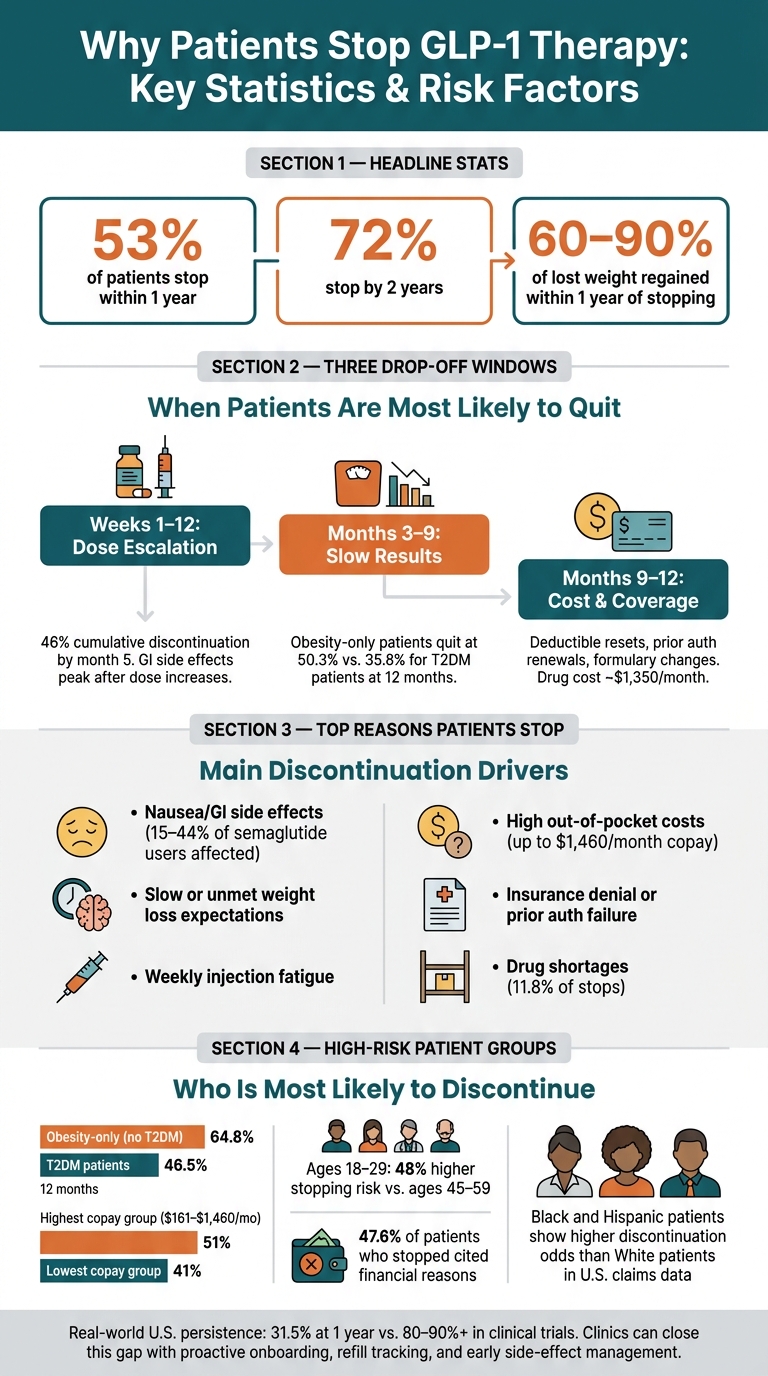
GLP-1 Therapy Drop-Off: Key Stats & Risk Factors
GLP-1 Discontinuation in Type 2 Diabetes: What Happens When Patients Stop?
sbb-itb-7164bd9
When patients tend to stop GLP-1 therapy
Using the persistence definition above, discontinuation tends to bunch up into three fairly predictable windows during year 1. In U.S. real-world data, patients don’t stop at a steady pace. The biggest drop-off shows up in the first year, with trouble points around dose escalation, mid-year slowdowns, and insurance resets. One large U.S. cohort analysis found that 53.6% of adults discontinued by 12 months and 72.2% by 24 months. Another pharmacy benefit analysis across multiple payers showed even sharper drop-off, with persistence at 31.5% at 1 year and just 15.1% at 2 years.
Common drop-off windows in the first year
Discontinuation isn’t evenly spread across the year. It tends to cluster in three phases.
The first window is dose escalation, roughly weeks 1–12. This is when GI side effects often hit hardest after dose increases. U.S. administrative data on semaglutide for weight management show a cumulative discontinuation rate of 46% by month 5. Patients who stop in this stretch are often reacting to nausea, vomiting, or injection anxiety before they’ve had much time to see results.
The second window runs from about month 3 to month 9. By then, weight loss may plateau or just feel slower than expected. That gap between expectation and day-to-day experience can matter a lot. Research shows that obesity-only patients discontinue at higher rates than those with type 2 diabetes (50.3% vs. 35.8% at 12 months), which suggests that motivation and perceived benefit play a big role.
The third window is late in the first year, around months 9–12. This is where cost and coverage problems start to bite. Deductibles reset in January, prior authorizations expire, and formulary shifts can move GLP-1s into higher-cost tiers or remove coverage altogether. With monthly costs near $1,350 and prior authorization now applying to nearly all GLP-1 prescriptions, late-year access barriers push many patients to stop. Stops in this phase are usually about access, not dosing.
Those windows reflect different causes, which is why the next section breaks out side effects, cost, and unmet expectations separately.
Trial retention versus everyday practice
Clinical trials keep more patients on treatment because the support system is built in. Access is arranged, follow-up visits are scheduled, and side effects are managed early. Landmark trials like STEP 1 and SURMOUNT-1 report retention rates of 80–90% or higher through 68–72 weeks. In everyday U.S. practice, that number falls to about one-third to 60% at 12 months, depending on payer and patient mix.
| Context | Setting | Main Indication | ~1-Year On-Treatment Rate | ~2-Year On-Treatment Rate | Key Discontinuation Drivers |
|---|---|---|---|---|---|
| Randomized trials (e.g., STEP, SURMOUNT) | Academic / industry-sponsored | Obesity ± T2DM | ≥80–90% retention | Often not treated beyond ~68 weeks; where 2-year data exist, rates remain relatively high | GI side effects, protocol withdrawal; not cost or insurance-related |
| Real-world U.S. (commercial claims) | Commercial claims | Obesity-focused GLP-1 use | ~33–61% persistent | ~15–25% persistent | Cost, insurance churn, supply shortages, unmet expectations |
| Real-world U.S. (pharmacy benefit analysis) | Multi-payer pharmacy benefit | Obesity | 31.5% persistent | 15.1% persistent | High out-of-pocket costs, benefit-year resets, prior auth lapses |
Clinics that want results closer to trial benchmarks have to build some of that support on purpose: proactive follow-up, clear titration protocols, and early action when cost or side effects start getting in the way.
Which patients are most likely to stop treatment
Not every patient faces the same odds of stopping treatment. Some patients run into clinical issues, like weak early results or side effects, which are common clinical considerations for peptide therapy. Others hit barriers that have nothing to do with the drug itself, such as insurance denials or a monthly bill they can't keep up with. If a clinic treats everyone the same, it's easy to miss the people who need more support. The patients at highest risk tend to have poor early response, GI side effects, and shaky insurance coverage.
Clinical and demographic risk factors
Patients using GLP-1s for obesity without type 2 diabetes stop treatment more often than patients with diabetes. In one real-world study, discontinuation at 12 months was 64.8% vs. 46.5%.
Early weight loss is a big signal. Real-world data show that each 1% drop in body weight from baseline is linked to about a 3% lower hazard of discontinuation. In plain English: when patients see the scale move early, they're more likely to stay on treatment. When they don't see much change by months 3 to 6, many stop. Side effects matter too. New moderate to severe nausea, vomiting, or diarrhea increase stopping risk in both obesity and diabetes groups.
Age also plays a role, but the pattern isn't the same in every dataset. Some studies show that older adults ages 65 and up have higher discontinuation rates, even after adjustment for comorbidities. At the same time, younger adults are far from low risk. One nationwide analysis found that patients ages 18 to 29 had a 48% higher risk of stopping than those ages 45 to 59, while those ages 30 to 44 had a relative risk of 1.24. Patients with cardiovascular comorbidities, including heart failure, also stop at higher rates.
Race and ethnicity also shape who is more likely to discontinue. U.S. claims and EHR data show a steady pattern: Black and Hispanic patients have higher odds of stopping at 12 months than White patients, even after accounting for clinical differences. The same trend shows up among patients living in lower-income ZIP codes or areas with high social needs. These gaps point to access and coverage problems, not just medical factors.
Financial and access risk factors
Clinical risk often turns into discontinuation when cost and coverage issues get in the way. A Cleveland Clinic cohort found that 47.6% of patients who stopped GLP-1 therapy cited financial reasons. That included insurance denial, the end of manufacturer discount programs, and out-of-pocket costs patients simply couldn't afford. In another semaglutide study, discontinuation increased from 41% in the lowest copay group ($1 to $54/month) to 51% in the highest ($161 to $1,460/month). Medicare and Medicaid enrollees also show higher stopping rates than people with commercial insurance, which lines up with tighter coverage rules and greater price sensitivity.
Price isn't the only problem. Access friction can push patients off therapy even when they want to stay on it. Prior authorization, especially for obesity treatment, can lead to delays, paperwork hassles, and treatment gaps. Drug shortages make things worse. One clinical series found that 11.8% of patients stopped primarily because of medication shortages.
Common financial and access risks include:
- High monthly out-of-pocket cost
- Medicare or Medicaid enrollment
- Commercial plan obesity exclusions
- Complex prior authorization rules
- Drug shortages or refill friction
- High social needs, such as housing instability, food insecurity, or transportation barriers
Why patients stop: side effects, cost, and unmet expectations
Patients usually stop GLP-1 therapy for a pretty simple reason: side effects, cost, and expectations start piling up at the same time. And when those barriers overlap, dropout risk goes up fast.
The good news for clinics is that these issues are often visible before a patient disappears. If you catch them early, you can often keep treatment on track.
Gastrointestinal side effects and tolerability
GI symptoms are the most common medical reason patients stop treatment or cut back their dose. Nausea affects 15% to 44% of semaglutide users and 24% to 33% of tirzepatide users. Vomiting, diarrhea, and constipation are also common, although most cases are mild to moderate. Persistent vomiting needs prompt attention because hydration can slip fast.
This is where dropout often starts. A patient may not say, “I want to stop the medication.” They may say they can’t eat much, feel sick at work, or are struggling to drink enough water. Same problem, different wording.
A practical response usually includes:
- Slowing titration
- Holding at the current dose for a bit
- Giving plain diet and hydration guidance
- Using short-term ondansetron for selected patients with marked GI sensitivity
Early follow-up matters too. A quick phone call or portal message during the first dose increases can catch trouble before the patient self-discontinues. When clinics step in early, many patients can stay on therapy instead of quitting.
Even when symptoms are under control, treatment can still fall apart if the next refill is out of reach.
Cost, coverage, and supply barriers
Cost is one of the biggest non-medical reasons patients stop. Nearly half of U.S. patients in a global survey said cost was a reason for discontinuation, compared with 9.5% in EU5 countries. Wegovy has a wholesale acquisition cost of about $1,349 per month, and even insured patients may face copays of roughly $150 to $600 per month, depending on plan tier.
That kind of cost can break treatment in two places. Sometimes the patient never starts after the prescription is written. Other times, treatment stops later because coverage changes, reauthorization fails, or a shortage delays refills.
None of this feels dramatic in the moment. It often looks like a refill gap, a delayed message, or a patient saying they’ll “pick it up next week.” Then the gap gets longer.
Clinics can cut some of that drop-off by verifying coverage before prescribing and talking through likely out-of-pocket costs upfront. Surprises are expensive, and they tend to kill follow-through.
When side effects stay manageable and coverage stays in place, another issue tends to show up: patients expect the scale to move faster than it often does.
Slow results, weekly injection fatigue, and visit and refill burden
Many patients come in expecting fast, dramatic weight loss. So when early progress looks modest, motivation can dip. Semaglutide often reaches peak weight loss at 60 to 68 weeks, and tirzepatide at 40 to 72 weeks. That timeline needs to be crystal clear from day one.
If a patient expects major change in a month or two, normal early progress can feel like failure. That’s why follow-up visits should cover more than the number on the scale. Blood pressure, waist circumference, appetite control, and other non-scale markers can show that treatment is working even before larger weight changes appear.
Weekly injection fatigue is another quiet dropout trigger. A once-weekly shot sounds simple on paper. Over time, though, it can wear people down, especially if they never feel fully at ease with self-injection. Add visit schedules, refill paperwork, and prior authorization renewals, and the whole thing starts to feel like homework.
Use the table below during follow-up calls and refill reviews.
| Discontinuation Driver | Common Signs | Clinic Response |
|---|---|---|
| GI side effects | Nausea or vomiting after dose increases; skipped meals; reports of feeling sick weekly | Slower titration; temporary dose hold; hydration counseling; dietary guidance on smaller, lower-fat meals |
| Cost and coverage barriers | First-fill abandonment; refill gaps after insurance change; prior authorization delays | Verify coverage before prescribing; discuss cash-pay costs upfront; track reauthorization deadlines |
| Drug shortages | Patient reports pharmacy out of stock; missed doses due to supply gaps | Maintain pharmacy relationships; have a re-titration protocol ready after supply interruptions |
| Slow or unmet results | Frustration with a weight plateau; slow progress early on | Review clinical timelines at onboarding; track non-scale victories; reinforce that appetite changes often precede scale changes |
| Weekly injection fatigue | Missed doses; anxiety about self-injection; requests to stop | Provide injection technique refreshers; review site rotation (abdomen, thigh, upper arm); simplify the follow-up schedule |
| Visit and refill burden | Missed labs; refill requests without scheduled visits | Set fixed check-in intervals; use portal messages during escalation; apply clear refill policies |
How clinics can reduce discontinuation and handle stopping safely
Most patients don't stop because they suddenly lose interest. They stop because side effects wear them down, coverage gets messy, or the results don't match what they expected. That means clinics need a standard process before the first dose and after any stop. Start with the three pressure points: side effects, insurance or access friction, and missed follow-up.
Onboarding, monitoring, and side-effect workflows
A lot of dropout can be prevented during the first visit. This is where clinics set expectations, explain what side effects may show up, and map out what happens next. Patients should leave that visit knowing how injections work, how to handle the logistics, what side effects may happen, and when the clinic will check in.
Monitoring also needs to be planned, not left to chance. A simple schedule works well:
- A portal or phone check-in at week 1
- An injection check at week 2
- Check-ins at each dose escalation
- A formal evaluation around weeks 8–12
That timing matters because it lines up with common drop-off points and gives the clinic a way to catch issues early.
For GI-sensitive patients, slowing things down can help. Extending the initiation phase to 6–8 weeks instead of 4, and titrating every 6–8 weeks rather than every 4, can improve tolerability.
If a patient still stops, the next step shouldn't be guesswork. The clinic needs a clear plan for either restarting treatment or monitoring after discontinuation.
What to do when a patient stops treatment
When a patient stops GLP-1 therapy, weight regain can start within weeks.
A structured response helps. First, document why the patient stopped: side effects, cost or access issues, lack of effect, or simple patient preference. That gives the chart a clear record and gives the next conversation a starting point. Then check for immediate safety concerns, including rising glucose in patients with diabetes. At the same time, step up nutrition and behavioral support to help offset the return of hunger and the loss of appetite control. If it makes sense, review other medication options too.
Follow-up shouldn't end when treatment ends. Schedule weight checks and relevant labs, such as A1c, fasting glucose, and lipids, about 3 months after stopping. After that, continue every 6–12 months based on baseline risk. This gives the clinic a steady way to track metabolic changes. Guidelines increasingly recognize documented weight regain after pharmacotherapy discontinuation as a reason to restart treatment.
Before the patient leaves, book the next visit. That one move keeps the door open for reassessment, restarting therapy, or switching to another plan. It also helps clinics stay ahead of the same drop-off points that tend to show up again and again.
Conclusion: The main reasons GLP-1 patients drop off and what clinics should fix first
GLP-1 discontinuation is fairly predictable in U.S. practice. And the pattern is hard to miss: most patient drop-off happens in the first year, much earlier than trial retention data would suggest. That matters because the main drivers of discontinuation are often things clinics can address before a patient falls away.
In most cases, drop-off comes back to three problems: GI intolerance, cost or coverage issues, and expectations that move faster than early results. GI side effects are the top medical reason patients stop, and moderate or severe GI events increase the hazard of discontinuation. On the financial side, weak coverage can turn monthly out-of-pocket costs into something patients simply can't keep paying, while prior authorization delays or formulary changes can interrupt treatment. Then there's the human side of it: some patients stop because the early progress feels slower than they hoped.
The answer is practical. Clinics tend to keep patients longer when they screen for risk early, use a clear protocol to manage GI effects, confirm coverage before treatment starts, and use the EHR to flag refill gaps.
And if a patient stops, that shouldn't be the end of the relationship. Weight often returns after GLP-1 therapy ends, so clinics should watch for regain and keep reinforcing lifestyle and behavior support. It's better to treat discontinuation as a transition point, not a failure. That way, patients stay connected to care, and the clinic can restart treatment or adjust the plan with less friction. The goal is simple: catch risk early, reduce friction, and make restarting easy.