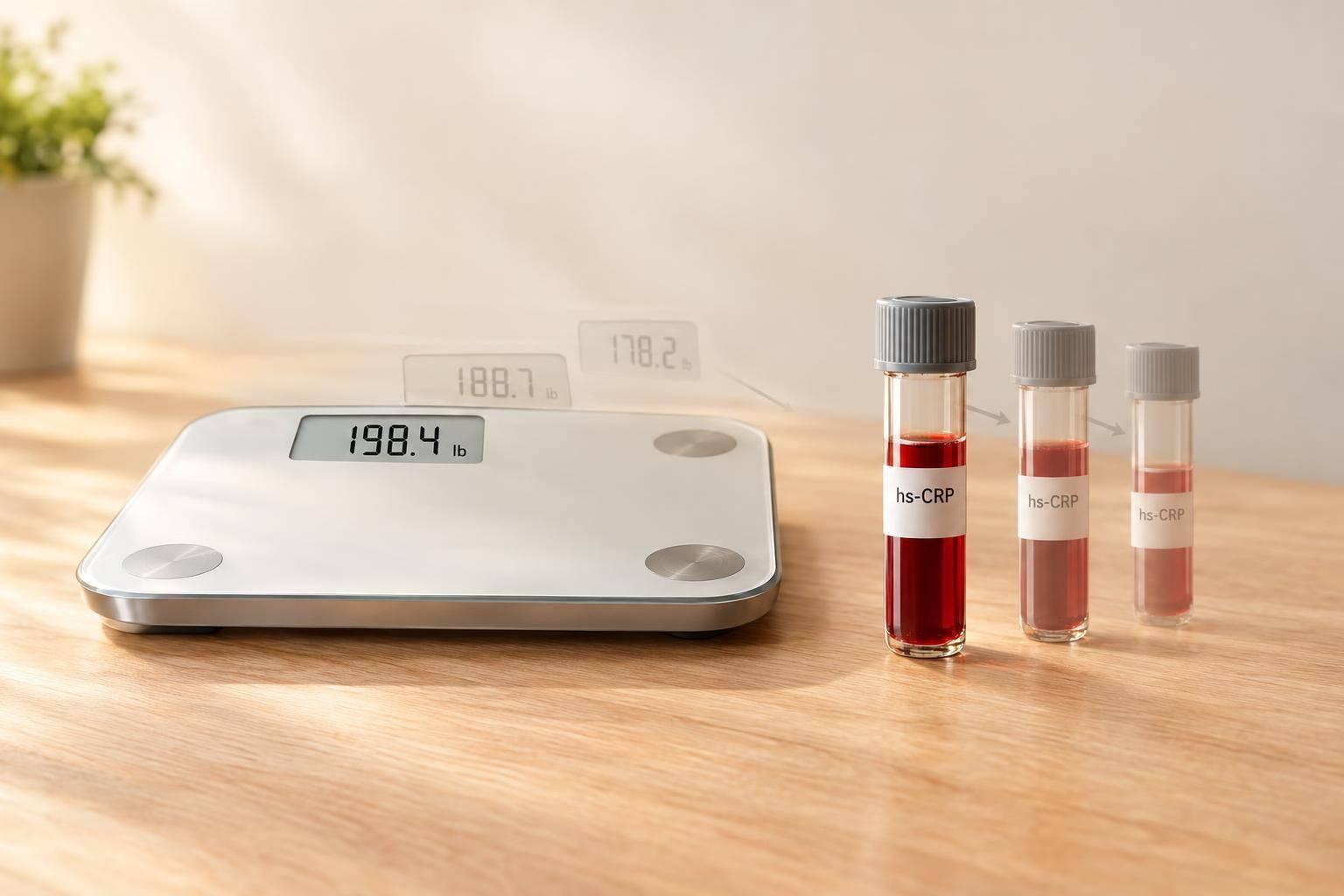
Semaglutide and tirzepatide lower weight and hs-CRP, but that does not prove they reduce inflammation independently of weight loss. My takeaway: read hs-CRP alongside weight, blood sugar, and overall health - not as a reason on its own to change treatment.
Here’s how I read the trial results:
- Semaglutide: STEP 1–3 reported hs-CRP reductions of about 39%–48% relative to placebo at 68 weeks.
- Tirzepatide: SURMOUNT-1 and SURMOUNT-2 reported placebo-relative reductions of about 51%–65% at 72 weeks. Different trial populations and peptide therapy clinical considerations mean these numbers cannot tell us which drug lowers hs-CRP more.
- Weight’s role: Post hoc SURMOUNT analyses linked 57%–87% of the modeled hs-CRP treatment difference to weight loss by week 72. The remaining share does not prove a direct drug effect.
I’ll compare the trials and their limits, keeping one rule in view: <u>hs-CRP is a response marker, not a standalone treatment target.</u>
1. Semaglutide 2.4 mg: STEP 1, STEP 2, and STEP 3
Population and Follow-up
The main question is whether hs-CRP falls in proportion to weight loss. STEP 1 and STEP 2 combined semaglutide or placebo with a reduced-calorie diet and increased physical activity. STEP 3 used a more intensive behavioral program: frequent counseling, meal planning, an initial low-calorie diet, and prescribed activity. Its results reflect semaglutide plus intensified lifestyle support, not semaglutide alone.
STEP 1 enrolled 1,961 adults without type 2 diabetes who had a BMI ≥30 kg/m², or ≥27 kg/m² with a weight-related condition. STEP 2 enrolled adults with overweight or obesity and type 2 diabetes, generally with a BMI ≥27 kg/m² and HbA1c of 7%–10%. STEP 3 enrolled adults with overweight or obesity without type 2 diabetes. These differences matter when comparing weight loss and hs-CRP results across the three trials.
Weight and hs-CRP Results
Weight change and hs-CRP reduction use different comparisons. Weight change is measured from baseline within each group; hs-CRP reduction is measured relative to placebo.
| Trial | Semaglutide 2.4 mg | Placebo | Placebo-relative hs-CRP reduction |
|---|---|---|---|
| STEP 1 | −14.9% | −2.4% | Approximately 44% |
| STEP 2 | −9.6% | −3.4% | Approximately 39% |
| STEP 3 | −16.0% | −5.7% | Approximately 48% |
Weight-Adjusted Findings
The exploratory analysis compared hs-CRP effects across subgroups defined by baseline characteristics. It did not use weight-adjusted mediation analyses, so it cannot establish a weight-independent effect.
Causal Evidence and Limits
Randomization supports a treatment-related reduction in hs-CRP. It does not, however, show that semaglutide reduces inflammation through a mechanism independent of weight loss.
Semaglutide and tirzepatide show a similar pattern, but tirzepatide typically results in greater weight loss and larger biomarker shifts.
sbb-itb-7164bd9
2. Tirzepatide: SURMOUNT-1 and SURMOUNT-2
Population and Follow-up
Both trials compared tirzepatide with placebo over 72 weeks. SURMOUNT-1 enrolled adults with overweight or obesity without type 2 diabetes; SURMOUNT-2 enrolled adults with overweight or obesity with type 2 diabetes.
Weight and hs-CRP Results
In SURMOUNT-1, mean weight changes ranged from −15.0% to −20.9% across 5–15 mg doses, compared with −3.1% with placebo. In SURMOUNT-2, changes ranged from −12.8% to −14.7% across 10–15 mg doses, compared with −3.2% with placebo. Analyses using efficacy estimands reported larger reductions.
A post hoc biomarker analysis reported week-72 hs-CRP reductions of about 51%–65% in SURMOUNT-1 and 55%–56% in SURMOUNT-2. These were reductions relative to placebo, not absolute hs-CRP values. As with semaglutide, weight loss accompanied lower hs-CRP. But how much of that drop was linked to weight loss?
Weight-Adjusted Findings
Mediation estimates attributed about 18% of hs-CRP change to weight loss at week 24 and 87% at week 72 in SURMOUNT-1. The corresponding estimates in SURMOUNT-2 were 31% and 57%.
These model-based estimates do not establish a mechanism. The portion left unexplained does not prove a direct anti-inflammatory effect.
Causal Evidence and Limits
Changes in glycemia, insulin sensitivity, adipose tissue, and other factors could also contribute. The estimates suggest that weight loss contributed more to hs-CRP reduction over time. The next section examines how closely these changes track.
How Much hs-CRP Change Is Linked to Weight Loss?
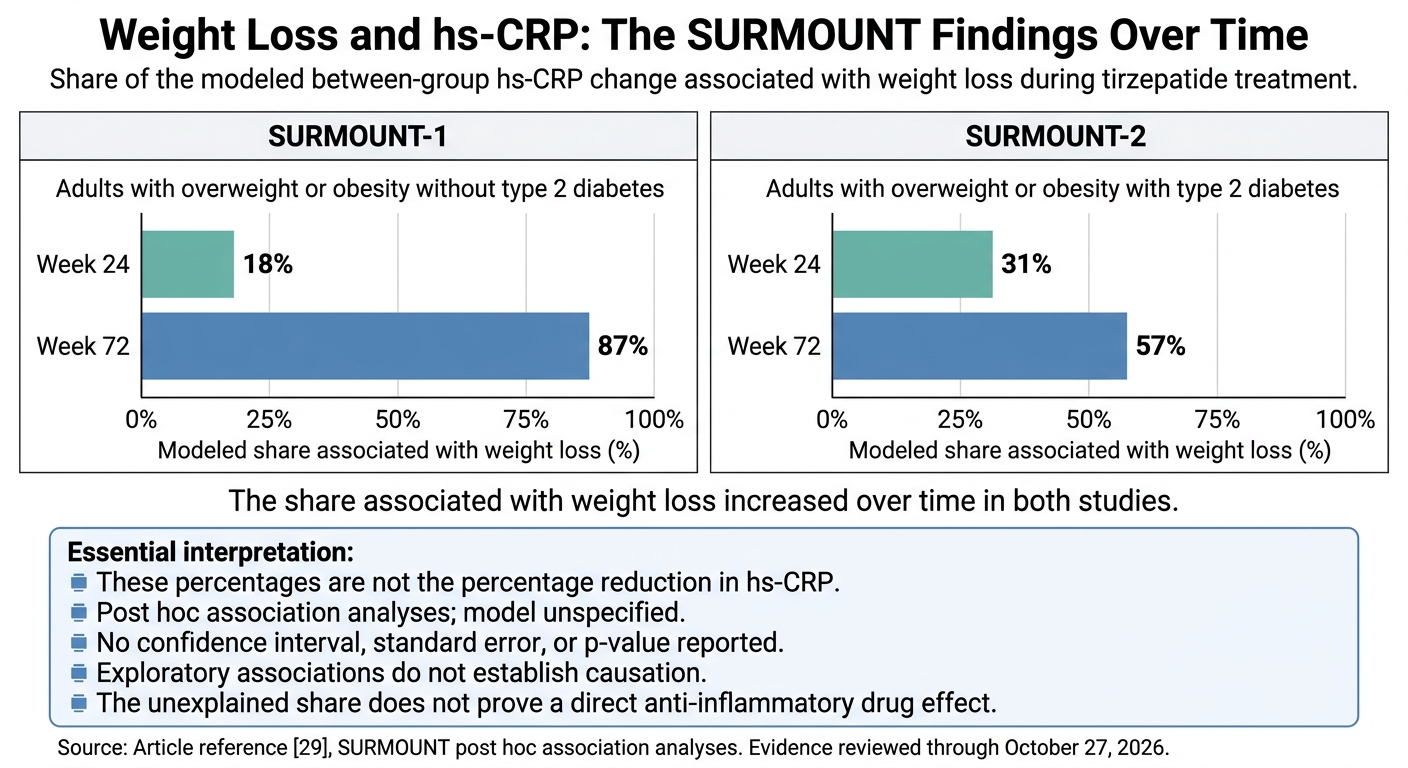
Weight Loss and hs-CRP: The SURMOUNT Findings Over Time
These percentages describe the share of the modeled between-group hs-CRP change associated with weight loss. They do not show the percentage drop from baseline hs-CRP.
The table shows how that weight-linked share changed over time in SURMOUNT-1 and SURMOUNT-2.
| Study and time point | Population | Reported analysis type | Share associated with weight reduction | Uncertainty reported | Interpretation |
|---|---|---|---|---|---|
| SURMOUNT-1, week 24 | Adults with overweight or obesity without type 2 diabetes | Post hoc association analysis; model unspecified | 18% | No confidence interval, standard error, or p-value | Weight loss explained little of the early hs-CRP difference; this finding remains exploratory. |
| SURMOUNT-2, week 24 | Adults with overweight or obesity and type 2 diabetes | Post hoc association analysis; model unspecified | 31% | No confidence interval, standard error, or p-value | Weight loss explained a minority of the early hs-CRP difference. |
| SURMOUNT-1, week 72 | Adults with overweight or obesity without type 2 diabetes | Post hoc association analysis; model unspecified | 87% | No confidence interval, standard error, or p-value | Weight loss explained most of the long-term hs-CRP difference. |
| SURMOUNT-2, week 72 | Adults with overweight or obesity and type 2 diabetes | Post hoc association analysis; model unspecified | 57% | No confidence interval, standard error, or p-value | Weight loss explained more than half of the long-term hs-CRP difference. |
The pattern matters more than the exact percentages: the share attributed to weight loss increased over time. These estimates are exploratory associations, not proof of a weight-independent anti-inflammatory effect.
Why Lower Weight and hs-CRP Do Not Establish a Direct Effect
Weight and hs-CRP both decline during treatment, but that pattern does not explain why. Semaglutide and tirzepatide lower hs-CRP compared with placebo. Randomization, however, does not identify which pathway caused the reduction.
The question is not whether hs-CRP falls, but whether it falls independently of weight loss.
| Evidence type | STEP evidence | SURMOUNT evidence | What it does not prove |
|---|---|---|---|
| Randomized comparisons | Semaglutide versus placebo | Tirzepatide versus placebo | Which pathway lowered hs-CRP. |
| Weight and hs-CRP outcomes | Both decline during treatment. | Both decline during treatment. | Whether weight loss caused the hs-CRP change. |
| Exploratory analyses | Baseline subgroup comparisons, not weight-adjusted mediation analyses. | Post hoc analyses linking weight reduction to hs-CRP change. | A direct anti-inflammatory effect; post hoc testing is vulnerable to multiplicity. |
This distinction matters when reading post hoc analyses or analyses adjusted for weight change. Adjusting for weight change can suggest an association, but it cannot prove a direct anti-inflammatory effect. Direct anti-inflammatory activity remains a hypothesis.
In practice, read hs-CRP alongside changes in weight, waist circumference, A1C, glycemia, blood pressure, and medication history. Check for illness, infection, injury, or chronic inflammatory disease around the blood draw. Also confirm that assay methods, units, and sampling times are comparable. Biological and assay variation can distort a single result, so clinical context matters.
Conclusion: Assess hs-CRP Alongside Weight and Clinical Measures
Across STEP and SURMOUNT, weight loss and hs-CRP moved in the same direction. But these trials do not prove a weight-independent anti-inflammatory effect.
Label findings clearly: unadjusted, weight-associated, or exploratory weight-independent effects. When citing SURMOUNT post hoc analyses, include the time point, effect estimate, confidence interval, and adjustment variables.
Treat hs-CRP as a response biomarker - not a standalone surrogate, treatment target, or basis for therapy changes. Current U.S. prescribing information for Wegovy and Zepbound does not establish hs-CRP lowering as an indication or dosing target.
In practice, follow clinical guides to record hs-CRP alongside weight, waist circumference, glycemia, blood pressure, medications, and intercurrent illness. Base treatment decisions on overall response, safety, and approved indications.
Evidence reviewed through October 27, 2026.
FAQs
Why might my hs-CRP stay high despite weight loss?
Changes in hs-CRP, a marker of inflammation throughout the body, are often modest and may not closely follow weight loss. Cardiovascular disease, kidney problems, or metabolic conditions can also keep hs-CRP levels high.
People respond differently to GLP-1 therapy. Even when weight and hs-CRP both decrease, that doesn’t prove the treatment directly reduces inflammation. Working with a clinician to track your metabolic health over time helps address risks beyond body weight alone.
When should I repeat an hs-CRP test during treatment?
For patients receiving GLP-1 therapy, document baseline hs-CRP before treatment and set a monitoring plan at the start. Tailor follow-up intervals to each patient’s clinical risk and disease activity rather than a fixed schedule.
Recheck hs-CRP routinely alongside other cardiometabolic markers to assess safety and treatment progress. Test sooner if symptoms worsen or the therapy’s effects need evaluation.
What evidence would prove a weight-independent anti-inflammatory effect?
To show a direct anti-inflammatory effect, randomized controlled trials must show lasting improvements in inflammatory biomarkers after accounting for weight loss. Mediation analyses must also separate the drug’s effects from changes tied to weight loss.
Weight and high-sensitivity C-reactive protein (hs-CRP) declining together aren’t enough: weight loss itself lowers inflammation. A reduction in major adverse cardiovascular events (MACE) linked to these biomarker improvements would add clinical support for a direct therapeutic effect.