
Anti-drug antibodies don’t automatically mean a peptide treatment has failed. I focus on 3 questions: Has drug exposure changed? Has treatment stopped working? Has a reaction occurred? If your response changes, review missed doses, storage, and administration with your prescriber before changing the dose.
Here’s how I frame the next steps:
- Check the product and exposure history. Formulation, impurities, patient health, and dosing can affect antibody formation. Missing safety data do not mean low risk.
- Put testing in context. ADA percentages depend on the product, assay, and sampling schedule. A positive result alone does not prove the cause; a negative result does not rule out hypersensitivity.
- Let symptoms guide urgency. Stable response without safety concerns does not call for automatic discontinuation. Suspected anaphylaxis needs immediate intramuscular epinephrine and emergency care - not a wait for test results.
My bottom line: <u>clinical effects matter more than antibody detection alone</u>. Review prior reactions and product labeling with your clinician before restarting treatment, especially after a severe reaction.
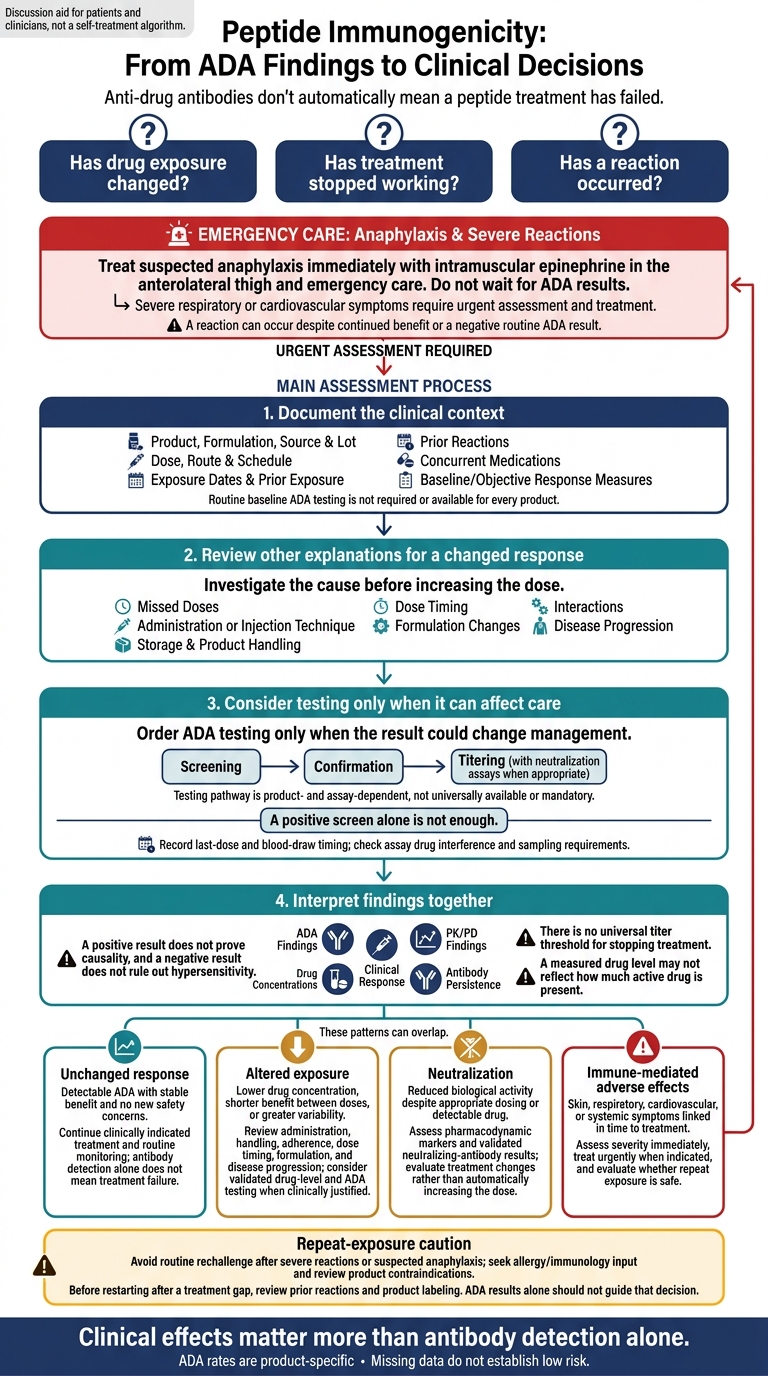
Peptide Immunogenicity: From ADA Findings to Clinical Decisions
How Anti-Drug Antibodies Form and What Affects Risk
Immune Recognition and Antibody Formation
Immunogenicity varies by product. It depends on sequence, structure, aggregation, impurities, formulation, patient biology, and exposure pattern. These factors matter because antibody formation starts when the immune system recognizes peptide epitopes.
Antigen-presenting cells can take up peptide material or peptide-containing complexes. They then display fragments, called epitopes, through major histocompatibility complex (MHC) pathways. Helper T cells may activate B cells, which can develop into antibody-secreting plasma cells. Some peptides stimulate B cells with little T-cell involvement. Aggregation, impurities, and carrier proteins or conjugates can change how the immune system recognizes a product.
In clinical practice, these responses are assessed as binding, neutralizing, or hypersensitivity-related findings.
| Immune finding | What it means | Typical detection approach | Possible clinical effect |
|---|---|---|---|
| Binding ADA | An antibody binds the peptide or a drug-related structure; binding alone does not show loss of activity | Validated screening, confirmatory, and titer assays | May cause no clinical symptoms, change exposure, or be associated with immune-complex or hypersensitivity findings |
| Neutralizing antibody | An antibody blocks the peptide’s target interaction or biological activity | Cell-based or ligand-binding neutralization assay, usually after ADA confirmation | Reduced pharmacodynamic effect, loss of response, or, rarely, cross-reactivity with an endogenous counterpart |
| Drug-specific IgE | IgE directed against the peptide or an excipient, potentially associated with immediate hypersensitivity | Drug-specific IgE testing, skin testing, specialist evaluation, and clinical assessment when appropriate | Urticaria, bronchospasm, angioedema, hypotension, or anaphylaxis |
| Non-IgE hypersensitivity | Immediate or delayed reactions involving other immune or nonimmune pathways | Clinical evaluation; targeted testing depends on the suspected mechanism | Injection or infusion reactions, rash, systemic symptoms, or anaphylaxis-like events |
Binding and neutralizing describe antibody activity; IgG and IgE describe antibody classes. Most ADA assays detect binding antibodies, often IgG-class, but assay designs differ. Routine ADA assays usually do not detect drug-specific IgE. Hypersensitivity can also involve complement, immune complexes, mast-cell activation, or excipient reactions. A negative routine ADA result therefore does not rule out a clinically important reaction.
Product, Patient, and Treatment Risk Factors
The same peptide sequence does not guarantee the same immunogenicity. Look beyond the active sequence: review the formulation, manufacturing controls, stability information, storage conditions, and regulatory status. These factors deserve assessment, but none predicts ADA formation across all peptides.
| Factor group | What to assess | Evidence limits and clinical relevance | Risk-reduction considerations |
|---|---|---|---|
| Product | Sequence changes, aggregates, degradation products, oxidation or deamidation, residual solvents or host-cell contaminants, peptide-related impurities, excipients, container interactions, and manufacturing consistency | May change immune recognition; the degree of risk requires evidence for the specific product | Use well-characterized products, verify labeling and quality information, follow storage instructions, and keep lot details |
| Patient | Prior exposure, pre-existing antibodies, genetic background, autoimmune or inflammatory disease, allergy history, active inflammation, infection, and immune-modifying medicines | Associations differ by product and population | Document history, review patient selection criteria, and tailor monitoring to the individual |
| Treatment | Dose, dose escalation, frequency, duration, route, and intermittent exposure | Higher exposure or repeated immune stimulation may matter, but relationships do not apply universally and may be confounded by indication and regimen | Follow evidence-based dosing, avoid dose escalation without prescriber approval, and maintain consistent administration when clinically appropriate |
| Immune context | Concomitant immunosuppression or immune activation | Immune-modifying therapy can reduce or change antibody responses but carries its own risks | Do not add immunosuppression solely to prevent ADAs without a clear clinical indication |
Differences in products, assays, and sampling can give the same ADA percentage different meanings.
Understanding Reported ADA Rates
An ADA percentage reflects both the product and how investigators tested for antibodies. Results depend on assay sensitivity and specificity, cut points, drug interference, neutralization methods, baseline antibodies, sampling schedules, exposure, and definitions of transient or persistent responses. FDA recommends a tiered approach using screening, confirmatory testing, titration, and neutralization assays, with baseline and post-baseline sampling matched to expected use.
Compare ADA percentages only when the products, assays, sampling schedules, populations, exposure, and definitions are sufficiently similar.
Approved labeling is product-specific. Unapproved peptides may have little or no human immunogenicity data, and missing data do not establish low risk. FDA has flagged aggregation and peptide-related impurities as potential concerns for certain compounded peptides. Therapeutic-protein assay guidance applies to peptides case by case.
These assay limits affect how well ADA data predict later loss of effect or safety problems.
sbb-itb-7164bd9
How Immunogenicity Affects Treatment Outcomes
Changes in Drug Exposure and Activity
Once anti-drug antibodies (ADAs) form, the key question is whether they change drug exposure, activity, or safety. Some antibodies clear the peptide faster. Others prolong the time the drug remains measurable without preserving its activity. Neutralizing antibodies can block activity even when the drug is still detectable. In short, a measured drug level may not reflect how much active drug is present.
| Outcome pattern | Possible findings | Clinical next step |
|---|---|---|
| Unchanged response | Detectable ADA with stable benefit and no new safety concerns | Continue clinically indicated treatment and routine monitoring; antibody detection alone does not mean treatment failure |
| Altered exposure | Lower drug concentration, shorter benefit between doses, or greater variability | Review administration, product handling, adherence, dose timing, formulation, and disease progression; consider validated drug-level and ADA testing when clinically justified |
| Neutralization | Reduced biological activity despite appropriate dosing or detectable drug | Assess pharmacodynamic markers and validated neutralizing-antibody results; evaluate treatment changes rather than automatically increasing the dose |
| Immune-mediated adverse effects | Skin, respiratory, cardiovascular, or systemic symptoms linked in time to treatment | Assess severity immediately, treat urgently when indicated, and evaluate whether repeat exposure is safe |
These patterns can overlap. Link ADAs to an outcome only when timing, exposure, and function align. Drug-level and functional tests must also be appropriate for the specific peptide therapeutic.
Signs of Loss of Effect and Hypersensitivity
An immune response may play a role when treatment benefit fades, wears off sooner, becomes erratic, or drops after treatment restarts. Compare current results with the baseline response. Then check for missed doses, injection technique, product handling, dose timing, formulation changes, interactions, and disease progression. These patterns are reasons to consider testing - not proof of immunogenicity.
Urticaria, angioedema, bronchospasm, hypotension, fever, or rash may signal immediate or delayed hypersensitivity. Record when symptoms began relative to dosing, whether they recurred, and any accompanying medications, infection, or other plausible causes. Severe respiratory or cardiovascular symptoms require urgent assessment and treatment. Hypersensitivity can occur without detectable ADAs, and continued treatment benefit does not rule out a serious reaction.
Increasing the dose without first checking the cause may not overcome faster clearance or neutralization. It may also worsen reactions and reinforce antibody responses, including immune-complex hypersensitivity. Investigate the cause before increasing the dose. After a treatment gap, review the prior reaction, the likelihood that antibodies remain or that their levels will increase with repeat exposure, and product labeling before rechallenge. These findings guide when to test for ADAs and how to approach rechallenge decisions.
Dr. Daniela Verthelyi: Regulatory Consideration in Immunogenicity for peptide & nucleic acid drugs
Clinical Monitoring, ADA Testing, and Repeat Exposure
When immunogenicity is suspected, carefully document exposure before testing or considering repeat treatment.
Document Baseline Status and Track Response
Before starting or restarting therapy, record treatment goals, prior exposure, past reactions, and regulatory status. Plan follow-up based on product labeling and the indication, following practical clinical guides for administration and monitoring. Routine baseline ADA testing is not required or available for every product.
| Clinical stage | Document or assess | Practical action |
|---|---|---|
| Baseline | Indication; product, formulation, source, and lot; dose, route, and schedule; prior exposure; allergies and past reactions; concurrent medications; objective response measures | Check for administration errors that could affect response; establish follow-up and emergency instructions |
| Response surveillance | Clinical response, adherence, dose changes, and exposure dates | Compare with baseline and record why treatment should continue, change, or stop |
| Suspected loss of effect | Missed doses, administration errors, interactions, disease progression, or product quality | Address nonimmune causes; consider validated testing only if results could change management |
| Hypersensitivity | Reaction timeline, severity, treatment, recovery, and recurrence | Assess severity immediately; preserve the timeline and arrange appropriate follow-up |
Order ADA testing only when the result could change management.
When to Test for ADAs and How to Read Results
Before ordering, confirm that an assay is available and understand its limits. Contact the manufacturer, specialty laboratory, or specialist if unexplained loss of effect, altered exposure, or a suspected immune-mediated event needs investigation. Testing may involve screening, confirmation, titering, and neutralization assays. A positive screen alone is not enough.
Record when the last dose was given and when blood was drawn. Ask whether the laboratory prefers a trough sample and how much circulating drug the assay can tolerate. Interpret confirmed results alongside drug concentrations, clinical response, pharmacokinetic or pharmacodynamic findings, and antibody persistence. Titers are assay-specific; there is no universal titer threshold for stopping treatment. Repeat testing may help if concern persists, but a positive result does not prove causality, and a negative result does not rule out hypersensitivity.
When the concern is a reaction rather than loss of efficacy, acute care comes before lab interpretation.
Manage Reactions and Evaluate Repeat Exposure
Treat suspected anaphylaxis immediately with intramuscular epinephrine in the anterolateral thigh and emergency care. Do not wait for ADA results. Record treatment timing, response, and disposition. Avoid routine rechallenge after severe reactions or suspected anaphylaxis; seek allergy/immunology input and review product contraindications. Before restarting after a treatment gap, review prior reactions and product labeling. If treatment stops, document why and counsel the patient about future exposure.
Report serious or unexpected suspected reactions and product-quality concerns through FDA MedWatch. Include the source, lot, exposure dates, treatment, and outcome. Proof of causality is not required.
Conclusion: Base Decisions on Clinical Impact
After monitoring and ADA testing, focus on clinical impact - not antibody detection alone. Check whether antibodies occur alongside reduced exposure, loss of effect, or hypersensitivity. ADA rates are product-specific, so don’t apply one peptide’s rate to another.
When response changes, use objective response trends, documented exposure, and nonimmune causes to guide decisions. Interpret ADA results alongside those findings, never on their own. Stable benefit without a safety concern supports observation, not automatic discontinuation.
Severe hypersensitivity or anaphylaxis changes future risk. Before re-exposure, review the product label and contraindications, and seek specialist input. ADA results alone should not guide that decision.
FAQs
Can anti-drug antibodies disappear after treatment stops?
Anti-drug antibodies may remain after treatment ends. Stopping therapy removes the trigger for antibody production, but how long they last depends on the patient’s immune system and previous exposure.
Clinicians should document suspected reactions or adverse events, since immunogenicity can affect a patient’s ability to tolerate future treatment and its safety. If therapy restarts, clinical supervision is recommended to check for hypersensitivity and ensure severe reactions are managed and monitored.
How can my clinician distinguish antibody-related treatment failure from disease progression?
Your clinician checks when and how treatment stopped working. First, they rule out medication errors, dosing problems, and receptor desensitization or downregulation - when receptors become less responsive or decrease in number.
Antibody-related treatment failure may cause painful injection-site reactions, hives, swelling, or a sudden loss of effect after repeat exposure. Your clinician records your symptoms, reviews the batch-specific certificate of analysis, and compares your biomarkers with baseline levels. If they still suspect an antibody-related problem, they may refer you to an allergy and immunology specialist to assess for neutralizing anti-drug antibodies.
Does a treatment break increase my risk of an immune reaction?
Yes, it can. Restarting a peptide may trigger an immune memory response from earlier exposure. The main concern is anti-drug antibodies (ADAs), which may increase hypersensitivity or make treatment less effective.
Before restarting, clinicians should document the exact product, formulation, and timing of previous reactions. These details help them assess whether treatment can safely resume or whether re-exposure could cause a severe reaction, including anaphylaxis.