If a patient reacts after a peptide injection, I would not assume the peptide is the cause. The reaction may come from the active peptide or from an inactive ingredient like PEG, polysorbate 80, gelatin, or benzyl alcohol.
Here’s the short version:
- Peptide allergy is more likely when reactions keep happening with the same peptide across different pharmacies, lots, and formulations.
- Excipient allergy is more likely when reactions happen with unrelated products that share one inactive ingredient.
- Timing matters: symptoms within 1 hour point to an immediate reaction; rashes or nodules at 24 to 48 hours fit a delayed reaction.
- One data point stands out: in one cohort, 9 of 16 patients (56.2%) who tested positive for PEG or polysorbate 80 were positive to both.
- Documentation matters: I would track the pharmacy, lot number, formulation, excipient list, and time to symptoms before labeling the allergy.
- Treatment changes based on the cause: if it’s the excipient, I would avoid that ingredient across products; if it’s the peptide, I would avoid that peptide itself.
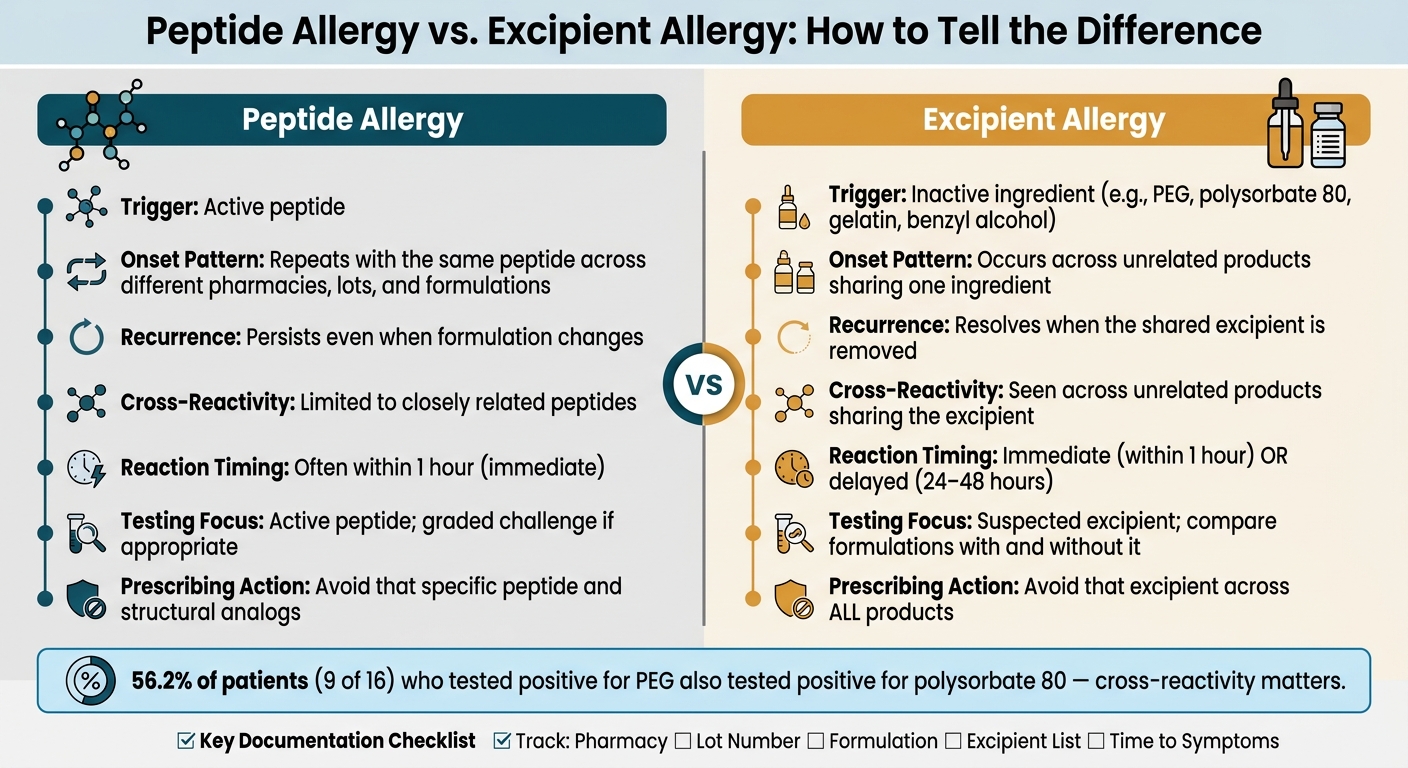
Peptide Allergy vs Excipient Allergy: Key Differences at a Glance
Quick Comparison
| Feature | Peptide Allergy | Excipient Allergy |
|---|---|---|
| Trigger | Active peptide | Inactive ingredient |
| Pattern | Repeats with the same peptide | Repeats across unrelated products with a shared ingredient |
| Across pharmacies/lots | Often still happens | May change when formulation changes |
| Common clues | Same peptide keeps causing reactions | History of reactions to PEG, polysorbate, gelatin, or preservatives |
| Testing focus | Peptide or supervised challenge | Suspected excipient first |
| Next step | Avoid that peptide | Avoid that excipient in all products |
So when I look at a case like this, I focus on timing, repeat pattern, cross-reactivity, and the full ingredient list. That approach helps avoid blaming the wrong thing and helps lower the chance of another reaction.
sbb-itb-7164bd9
Clinical clues: onset, reaction type, and reproducibility
Onset timing and reaction type after injection
Timing is the first clue. Reactions that start within 1 hour after injection suggest immediate hypersensitivity to either the peptide itself or an excipient like PEG or polysorbate 80. If that early window includes hives, swelling, throat tightness, wheeze, or hypotension, the risk is much higher.
Delayed reactions look different. Eczematous or morbilliform skin changes, pruritic plaques near the injection site, or firm nodules that show up 24 to 48 hours after dosing fit better with delayed hypersensitivity. These patterns are often linked to excipients. Fever after injection points more toward a lot issue, such as contamination, than allergy.
Mild local irritation is common and not very specific for allergy. That includes brief stinging, slight redness, or a small bump that clears within a few hours. Concern goes up when local reactions are large, painful, keep happening, are followed by systemic symptoms, or last more than 48 hours.
How lot number, pharmacy, and formulation changes affect recurrence
This is where careful notes matter. If a patient reacts to one shipment but not the next, or reacts to one pharmacy’s product but not another’s, that pattern matters. Different pharmacies often use different excipient profiles, so a reaction to one shipment does not prove peptide allergy.
When reactions keep coming back across lots, pharmacies, and formulations, the peptide becomes a stronger suspect. That kind of reproducibility across sources is one of the best bedside clues available when formal allergy testing has not been done.
Clues that point to an excipient cause
A history of reactions to unrelated products can be one of the clearest clues in the workup. PEG appears in bowel preparations, laxatives, depot corticosteroids, and mRNA COVID-19 vaccines. Polysorbate 80 is present in some vaccines and biologic agents. Gelatin is found in MMR and varicella vaccines, hemostatic agents, and some capsules.
If a patient has had prior systemic reactions to several of these products, and the only shared feature is the same excipient, excipient hypersensitivity becomes much more likely than allergy to a single peptide. Published data back this up: in one cohort, 9 of 16 patients (56.2%) who tested positive for PEG or polysorbate 80 were positive to both. That shows cross-reactivity between these two excipients can matter in day-to-day care.
That pattern should guide the testing strategy.
Use this bedside pattern to separate likely peptide allergy from likely excipient allergy:
| Bedside clue | More consistent with peptide allergy | More consistent with excipient allergy |
|---|---|---|
| Onset | Immediate reactions that recur with the same peptide product across exposures | Immediate or delayed reactions that vary with formulation changes |
| Local reaction | Recurrent large local reactions or local reactions followed by systemic symptoms, even when formulations differ | Delayed dermatitis or nodules that improve when the formulation changes |
| Systemic reaction | Urticaria, angioedema, or anaphylaxis tied specifically to one peptide product | The same symptoms, but across unrelated products sharing PEG, polysorbate, or gelatin |
| Lot/pharmacy pattern | Recurs across different lots and pharmacies even when excipients change | Limited to one lot, one pharmacy, or one formulation |
| Cross-reactivity | Reaction stays tied to the same peptide product rather than unrelated drugs | Reactions to unrelated drugs, vaccines, or injectables sharing a common excipient |
Diagnostic workup: what to test and when
History and documentation that narrow the differential
Once timing and repeat exposure point toward a likely cause, get the details down before ordering tests. Start with the exact exposure: peptide name and brand, compounding pharmacy, dose, route, time to first symptom, objective findings, and whether the patient needed epinephrine, emergency department care, or hospitalization.
If the reaction seems tied to one lot or shipment, look at the batch record next. Record the lot number, manufacturer, and full excipient list. A lot-specific certificate of analysis may help confirm a batch issue. Then compare ingredient lists to see whether the products share the same excipient.
Skin testing, patch testing, and graded challenge options
Testing should fit the reaction pattern and the suspected trigger. For immediate reactions - such as urticaria, angioedema, or anaphylaxis within 1 to 2 hours - skin prick testing followed by intradermal testing at nonirritant concentrations is a standard starting point when IgE-mediated allergy is suspected and no safe alternative is available.
If the history suggests an excipient, test that excipient first. PEG testing often includes more than one molecular weight because sensitivity can differ by chain length. Intradermal PEG testing needs extra care. Anaphylaxis has been reported during this testing, so it should only follow a negative skin prick test and should be done with highly diluted sterile solutions in a monitored setting. Polysorbate 80 testing follows a similar stepwise path, again with careful dilution.
Patch testing is used for delayed rashes, including fixed drug eruptions or maculopapular eruptions that show up days after dosing. In low- or intermediate-risk cases - like non-anaphylactic immediate reactions or negative skin tests with an unclear picture - a supervised graded challenge is often more helpful than pushing skin testing with peptide concentrations that have not been validated.
A typical graded challenge looks like this:
- Start with about 1% to 5% of the target dose
- Then give 10% to 25%
- Then give the rest, with observation between steps
When to refer to allergy and immunology
Some cases should go to allergy and immunology instead of being handled during routine peptide follow-up. Refer promptly after suspected anaphylaxis, repeat immediate reactions, reactions to unrelated products that share one excipient, or any severe delayed skin reaction with mucosal involvement or organ dysfunction.
Severe T-cell–mediated syndromes - DRESS, Stevens-Johnson syndrome, toxic epidermal necrolysis, and AGEP - call for strict avoidance. Rechallenge, graded challenge, and desensitization are not appropriate in these cases.
For other cases, the allergy specialist can choose nonirritant concentrations, sort out borderline results, and decide whether a challenge is safe. When making the referral, send the peptide name, salt form, lot number, certificate of analysis, excipient list, and reaction timeline.
How the diagnosis changes prescribing and follow-up
Once you’ve pinned down the likely trigger, the next step changes. At that point, the question isn’t just what was prescribed but which product should the patient get next.
If excipient allergy is more likely
If the lot number, pharmacy, and formulation history point to an excipient instead of the peptide, the plan is simple: avoid that excipient across all products the patient uses. That goes beyond peptide therapies. Vaccines, biologics, depot steroids, and even over-the-counter laxatives may contain the same excipients, including PEG or polysorbate 80.
Names can trip people up. PEG 3350 and macrogol 3350 are the same compound. Polysorbate 80 may also show up as polyoxyethylene sorbitan monooleate. If PEG allergy is confirmed, avoid PEG-containing products unless there is clear proof that a given formulation has already been tolerated. If benzyl alcohol is the problem, one fix may be to switch from bacteriostatic water to sterile water for injection. Another option is to ask for a lyophilized formulation so the reconstitution liquid stays under your control.
The allergy list matters a lot here. Don’t write “allergic to semaglutide” if the issue is the vehicle. Write “Polysorbate 80 – urticaria, onset 20 minutes” or “Benzyl alcohol – anaphylaxis.” Add a note that a different formulation without the culprit excipient may still be okay once checked. In the active medication list, include the exact formulation so the vehicle stays visible.
If peptide allergy is more likely
If the peptide itself appears to be the cause, avoid that peptide completely no matter which pharmacy made it or which excipients were used. Update the allergy list with the exact peptide name and reaction type, such as “Semaglutide – immediate urticaria” or “GHK-Cu – delayed urticaria.” Avoid vague entries like “peptide injections,” which can shut off unrelated treatment options for no good reason.
Before picking a substitute, think about structure. Closely related analogs may cross-react. It makes more sense to choose options with distinct amino acid sequences that still fit the treatment goal. Rechallenge or desensitization should be reserved for cases where no equally effective option exists, the likely upside is high, and the process happens in a monitored setting with immediate access to epinephrine, IV fluids, and advanced airway equipment.
Follow-up, observation periods, and allergy list accuracy
Those prescribing choices need to stay in view at every medication review. Here’s the key difference in management once the likely diagnosis is clear:
| Management Area | Excipient Allergy More Likely | Peptide Allergy More Likely |
|---|---|---|
| Allergy list entry | Specific excipient name + reaction type (e.g., "PEG 3350 – anaphylaxis") | Specific peptide name + mechanism if known (e.g., "Sermorelin – immediate urticaria") |
| Formulation strategy | Same peptide, different formulation without culprit excipient | Different peptide class with distinct sequence; avoid structural analogs |
| Post-injection observation | 15–30 minutes for a new excipient-free formulation; heightened staff awareness | 1–2 hours or more for graded challenge or re-exposure; extended if prior reaction was severe |
| Patient counseling focus | Label reading, excipient synonyms, and which product categories to avoid | Avoid the peptide and related class members; carry a written allergy list to all clinical encounters |
After systemic reactions or anaphylaxis, prescribe an epinephrine auto-injector and make sure the patient knows exactly when to use it. If they develop airway compromise, fast-spreading hives with other symptoms, or lightheadedness after injection, they should use it right away and call 911.
It also helps to supervise the first re-exposure or trial of a new formulation in clinic until tolerability is clear. And if a challenge is negative, remove ruled-out allergies from the chart while documenting the pharmacy source and lot number for any product tied to the reaction.
Conclusion: the most useful differences to remember
After looking at the history, lot review, and formulation comparison, two patterns tend to steer the diagnosis.
If reactions show up with unrelated products that all share one ingredient, the cause is more likely an excipient.
If reactions keep happening across pharmacies, lots, and formulations, the cause is more likely the peptide itself.
Key takeaways for peptide prescribers
Use excipient-focused testing when reactions involve more than two unrelated products that share one excipient.
Getting the culprit right matters. It helps prevent needless peptide avoidance and helps patients avoid getting exposed again to a hidden excipient.
Use this quick chart as a rule of thumb:
| Feature | Peptide Allergy More Likely | Excipient Allergy More Likely |
|---|---|---|
| Onset pattern | Tied to a specific peptide across exposures | Varies by product; linked to a shared ingredient |
| Recurrence | Persists despite lot, pharmacy, or formulation changes | Resolves when the shared excipient is removed |
| Cross-reactivity | Usually limited to closely related peptides | Seen across unrelated products sharing the excipient |
| Testing focus | Active peptide; graded challenge if appropriate | Suspected excipient; compare formulations with and without that ingredient |
| Prescribing implication | Avoid the active peptide; consider alternate molecules | Avoid the culprit excipient; select formulations without the culprit excipient |
FAQs
Can I be allergic to both the peptide and an excipient?
Yes. A patient may be allergic to the active peptide itself or to one of the excipients in the formulation.
Because many peptides are contraindicated in patients with known hypersensitivity to the peptide or any inactive component, it’s important to identify the exact cause of a reaction. That matters for patient safety and for meeting regulatory requirements.
What should I track after a reaction?
Document the lot number, source pharmacy, beyond-use date, clinical signs, timing, and any actions taken, such as dose adjustment or discontinuation. Put every decision and each patient response in the chart so the record is clear and easy to follow.
At follow-up, check the injection site for redness, swelling, warmth, or pain. A patient symptom diary during the first 2 to 4 weeks can help spot patterns if the same issue keeps coming back.
When should I see an allergist?
See an allergist if you suspect hypersensitivity to a peptide or an excipient, especially if the same reaction happens again with different lots or formulations.
Get immediate emergency care if you have systemic symptoms such as hives, throat swelling, or trouble breathing. An allergy evaluation also makes sense if injection-site reactions keep happening or get worse, including redness that spreads beyond 5 cm or symptoms that last more than 48 hours.