
I look for complete ulcer healing - not just a smaller wound - before judging a peptide trial. The cited ACT1 trial reported 79% versus 36% mean wound-area reduction at 12 weeks, but those figures alone don’t establish complete healing or lasting results.
Here’s what I check before applying findings to your patient:
- Trial design: Randomization, concealed assignment, blinded assessment, suitable controls, sample size, and balanced patient groups.
- Care in both groups: Comparable compression and wound care, with actual compression use documented.
- Results: Prespecified healing outcomes, effect sizes with 95% confidence intervals, and analyses that account for missing data.
- Follow-up: Enough time to assess closure, recurrence, and harms - not just treatment response.
- Clinical use: Patient fit, cost, staffing, supply, and current U.S. regulatory status for the exact peptide and formulation, following a clinical overview of peptide therapy.
My bottom line: a positive result is not enough. <u>Peptide trial findings do not replace vascular assessment, compression, dressings, or debridement.</u>
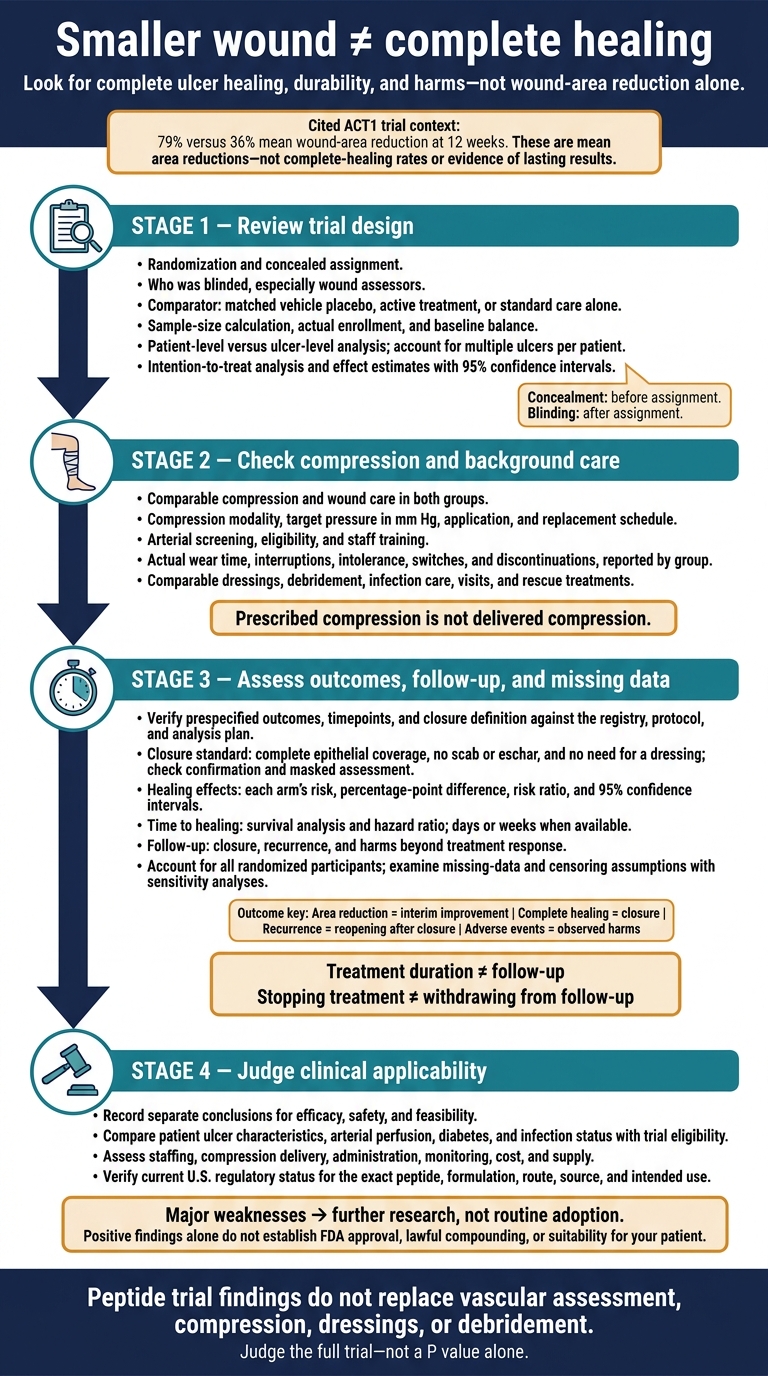
How to Assess Peptide Trials for Venous Leg Ulcers
Step 1: Review Randomization, Controls, and Sample Size
Check Randomization, Allocation Concealment, and Blinding
Look for a computer-generated random sequence and concealed assignment through a centralized web or phone system, an independent pharmacy, or sequentially numbered opaque sealed envelopes. Concealment prevents foreknowledge before assignment; blinding limits bias afterward. Labels such as “Randomized” or “double-blind” aren't enough. Check who was blinded: participants, clinicians, wound assessors, analysts, and adjudicators. When blinding isn't possible, objective, prespecified outcomes and blinded wound photography or independent adjudication matter even more.
Check whether the venous leg ulcer trial randomized and analyzed results at the patient or ulcer level. If patients contributed multiple ulcers, the study should use a prespecified index ulcer, patient-level analysis, or a clustered method that accounts for within-patient correlation. Otherwise, confidence intervals may appear narrower than the data justify. Small studies can help assess feasibility or dosing, but they rarely establish a reliable healing benefit. Next, check whether the comparator and background care were balanced.
Identify the Control Treatment
Classify the comparator as matched vehicle placebo, active treatment, or standard care alone. A matched vehicle isolates the peptide's effect. (See our clinical guides for details on handling and administration.) Standard care alone tests the treatment package, not peptide-specific activity.
To assess benefit beyond compression-based standard care, check whether the vehicle matched in appearance, packaging, application schedule, and handling. Confirm that groups received equivalent compression, dressings, debridement, infection management, and access to trained wound-care staff. Then check whether the study enrolled enough participants to detect a meaningful healing difference.
Review Study Power, Baseline Balance, and Analysis Groups
Find the sample-size calculation. It should state the assumed control healing rate, expected effect, allocation ratio, power, alpha, and allowance for dropouts or clustering. Compare planned enrollment with actual enrollment.
To judge whether healing differences can be attributed to the peptide, check for clinically important baseline imbalances in ulcer size, duration, depth, infection, recurrence, arterial status, diabetes, edema, mobility, smoking, age, and planned compression. Don't rely on baseline P values. Check whether adjusted analyses were prespecified.
Use the CONSORT flow diagram to spot post-randomization exclusions. Verify intention-to-treat analysis: participants stay in their assigned groups regardless of adherence or treatment switching.
Examine effect estimates with 95% confidence intervals, not P values alone. Wide intervals may leave both meaningful benefit and harm unresolved. Be especially cautious with small dose groups and multiple outcomes; check for multiplicity adjustments or clearly labeled exploratory analyses. Treat an imprecise null result as inconclusive.
sbb-itb-7164bd9
Step 2: Check Compression and Background Wound Care
Review Compression Delivery and Adherence
After randomization and control selection, check that compression was delivered as planned.
Compression is part of the intervention package, so document both what was prescribed and what patients received. For each group, extract the compression modality, number of layers, elastic or inelastic type, limb coverage, and target pressure in mm Hg. Record who applied it, staff training, replacement schedules, and pressure adjustments. Report the stated target pressure rather than assuming “standard compression.” Check whether arterial assessment, such as an ankle-brachial index, guided eligibility and reduced-compression protocols. These decisions affect safety and which patients the treatment suits.
Prescribed compression is not delivered compression. Record wear time, missed changes, slippage, pain, intolerance, device switches, and discontinuations, with denominators for each group. Check how adherence was measured: patient logs, application records, or device data. Without these data, you can't tell whether healing differences reflect the peptide or more consistent compression use.
Compare Compression Reporting and Other Care
| Compression reporting | Internal validity | Applicability | Confounding risk |
|---|---|---|---|
| Standardized, with delivery and adherence documented | Stronger if delivery was comparable | Clearer for similar patients and care settings | Lower, but not absent |
| Standardized, but adherence unclear | Uncertain delivered treatment | Harder to apply to patients with tolerance barriers | Moderate |
| Variable or clinician-selected | Weaker unless variation was prespecified and balanced | Broader, but difficult to reproduce | Moderate to high |
| Unreported | Comparability cannot be established | Poor | High |
Differences in debridement, dressings, infection care, or rescue treatment may explain healing gains without a peptide effect. Compare cleansing, debridement method and frequency, dressing type and change schedule, and infection-treatment thresholds. Check analgesia, elevation, mobility advice, venous procedures, and wound-clinic contact, too.
Report whether these services followed a standard protocol or were left to local clinical judgment. Record when rescue treatments occurred and why. Unequal or poorly documented care makes it harder to attribute healing to the peptide or reproduce the care provided.
Before accepting the treatment comparison, check:
- [ ] Compression type, target pressure in mm Hg, application method, limb coverage, and replacement schedule were documented by group.
- [ ] Arterial screening, compression eligibility, and staff training were documented.
- [ ] Actual adherence, interruptions, intolerance, and discontinuations were reported by group.
- [ ] Wound care, elevation, mobility advice, and visit frequency were clearly described.
- [ ] Venous procedures, rescue treatments, and protocol deviations were reported with timing and denominators.
Next, check whether the trial’s outcome measures, follow-up, and missing data support the healing claim.
Step 3: Assess Outcomes, Follow-Up, and Missing Data
Separate Complete Healing From Wound-Area Reduction
Compare the registry, protocol, and statistical analysis plan with the publication. Confirm the prespecified primary outcome, assessment timepoint, and closure definition. These help show whether the peptide improves healing that matters to patients - not just wound size.
Use complete epithelial coverage, no scab or eschar, and no need for a dressing as the closure standard. Area reduction alone isn't closure. Check whether closure required confirmation, and record the measurement method, masking, and how the study handled multiple ulcers.
| Outcome | Can establish | Cannot establish by itself |
|---|---|---|
| Complete healing | The proportion whose ulcer met the study’s closure definition | That every participant improved, that healing will last, or that the peptide caused the effect if assessment was unmasked or control care differed |
| Time to healing | Whether ulcers closed sooner and how healing accumulated during follow-up | Whether healing lasted after treatment ended, unless the study tracked recurrence |
| Percentage wound-area reduction | The extent of interim improvement and whether change differed between groups | Complete closure, symptom relief, or meaningful benefit if baseline wound areas or measurement methods were imbalanced |
| Recurrence | Whether ulcers reopened after initial closure during the observed period | Durability beyond the follow-up period or prevention of recurrence based on a short study |
| Adverse events | Observed harms, their severity and frequency, and discontinuations | The absence of harms beyond the study’s detection limits |
Extract absolute and relative effects with 95% confidence intervals. For healing, record each arm’s risk, the percentage-point difference, and the risk ratio. For time to healing, review survival analyses and the hazard ratio. Report results in days or weeks when those figures are available.
Look for effects that matter in care: earlier closure, fewer dressing changes, or less pain. Then check whether follow-up lasted long enough to assess healing, recurrence, and harms.
Review Follow-Up and Safety Reporting
Treatment duration and follow-up aren't the same. Track scheduled visits, post-dose follow-up, and recurrence after closure to see whether healing lasts after treatment ends.
For safety, extract event definitions, collection methods, reported harms, severity, seriousness, treatment interruptions, discontinuations, hospitalizations, and deaths. Record these by arm, along with the number of exposed participants used as each denominator.
“No serious adverse events”
That statement offers little reassurance without clear surveillance. Small samples and short follow-up can miss uncommon or delayed harms.
Also check whether missing data and withdrawals could distort the results.
Track Withdrawals and Test Missing-Data Assumptions
Use the CONSORT diagram and results tables to reconcile totals for eligibility, randomization, treatment exposure, discontinuation, follow-up, and analysis. Record missing assessments by arm, timing, and reason.
Stopping treatment doesn't mean withdrawing from follow-up. If outcomes are missing after ulcers worsen or adverse effects occur, the peptide's benefit may look larger than it is.
Complete-case analysis can mislead when participants with missing data differ from those observed. Last observation carried forward assumes wound status stays unchanged. Multiple imputation should include baseline ulcer size, ulcer duration, and early response.
Time-to-healing analyses should justify censoring and account for competing events such as death. Check sensitivity analyses that test plausible alternatives, including counting missing participants as unhealed and using missing-not-at-random assumptions. If those tests change the clinical conclusion enough to affect interpretation, treat the finding as fragile.
Before accepting the healing claim, check:
- [ ] Outcomes and timepoints were prespecified; closure was separated from area reduction and preferably confirmed by masked assessment.
- [ ] Effect estimates and confidence intervals support meaningful benefit over adequate follow-up.
- [ ] Follow-up assesses durability, recurrence, and safety, with arm-specific denominators for adverse events and discontinuations.
- [ ] All randomized participants are accounted for; missing-data and censoring assumptions hold up in sensitivity analyses.
VEIN Research Platform- discovering new treatments to heal venous leg ulcers and stop them returning
Conclusion: Decide Whether Findings Support Clinical Use
After applying the checklist above, judge the full trial - not a P value alone. Sound randomization, appropriate controls, precise estimates, comparable compression, meaningful healing outcomes, adequate follow-up, and proper handling of missing data must all align. Major weaknesses call for further research, not routine adoption.
Document Evidence Certainty, Patient Fit, and Regulatory Limits
Record separate conclusions for efficacy, safety, and feasibility. Describe the expected benefit, how uncertain it is, and what remains unknown about safety. Assess whether administration, monitoring, cost, and supply are feasible in your setting. Document clinical relevance and regulatory applicability. Missing reporting should lower confidence - not leave room for assumptions.
Compare the intended patient’s ulcer duration, ulcer size, arterial perfusion, diabetes, and infection status with the trial’s eligibility criteria. Check whether your setting can match the trial’s nursing support and compression delivery. Look for consistency with other studies, and treat exploratory subgroups and post hoc dose findings as ideas to test, not grounds for treatment decisions.
Even a positive trial does not establish legal or practical use. Check regulatory status separately using current FDA labeling, FDA databases, and applicable compounding guidance for the exact peptide, formulation, route, source, and intended use. Positive results do not establish FDA approval, lawful compounding, or authority to replace compression and standard wound care.
PeptidePrescriber provides supplementary monographs and regulatory references for licensed healthcare professionals. Confirm current U.S. requirements before applying the findings, and use the peptide only when the evidence, safety profile, and regulatory status all support its use in your setting.
FAQs
What healing benefit would justify adding a peptide?
Before adding a peptide, document that optimized standard care has failed or hasn’t been enough, and confirm that evidence supports its use for the specific indication.
Set a measurable healing goal that matters to the patient, such as faster ulcer closure or meaningful symptom relief - not biomarker changes alone. Pair that goal with a realistic monitoring and follow-up plan. Check for contraindications, and use only verified 503A/503B sources with certificates of analysis (COAs).
How should I weigh conflicting peptide trial results?
Give the most weight to systematic reviews and meta-analyses of randomized controlled trials (RCTs). Next, favor well-designed human RCTs over smaller trials, cohort studies, or animal models. Treat uncontrolled studies and findings from a single research source with caution.
Focus on patient-centered outcomes rather than surrogate markers. When the evidence is inconclusive, use established clinical guidelines and documented patient response to guide decisions - not theoretical mechanisms.
Which trial flaws should rule out clinical use?
For venous leg ulcers, rule out clinical use if peptide research lacks randomized, controlled human trials or relies only on animal data. Also decline use when studies lack appropriate controls, preregistration, or measurable clinical endpoints that matter to patients.
Product issues also rule out use: no verified, high-quality source backed by third-party testing or a valid Certificate of Analysis, or a label stating the product is for research use only.