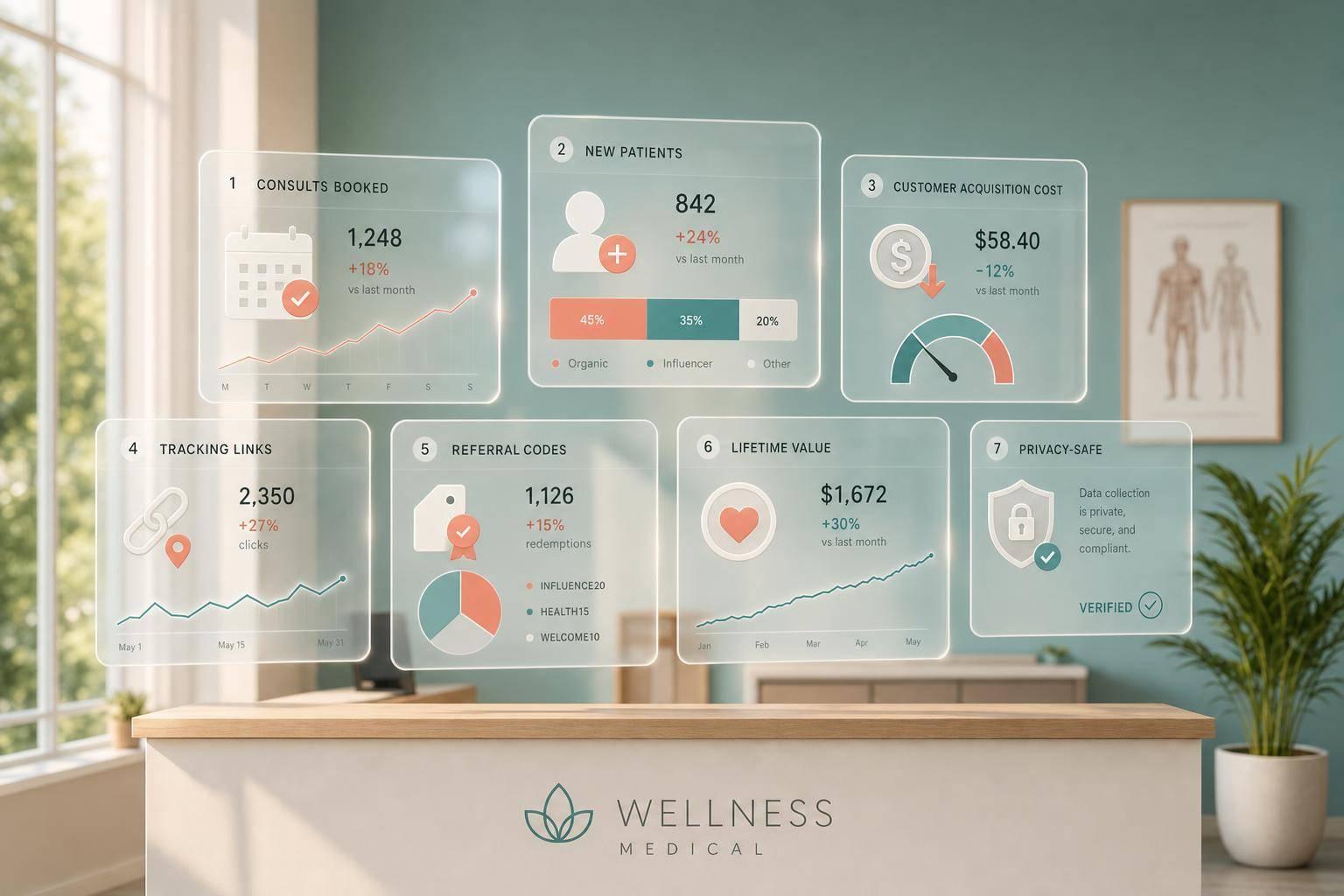
Most medical practices track the wrong numbers. I’d judge an influencer campaign by consults booked, new patients, and patient acquisition cost, not likes or follower count.
If I were setting this up, I’d keep the focus on a short list:
- Pick one main goal: booked consults, qualified leads, or new patient starts
- Track source cleanly: UTMs, referral codes, CRM fields, and intake dropdowns should match
- Measure lead quality: consult booking rate shows whether leads are worth pursuing
- Calculate full CAC: include creator fees, staff time, production, tech, and any free services
- Check profit math: compare CAC against patient LTV over 12–36 months
- Watch intent signals: saves, shares, DMs, form starts, and call clicks matter more than likes
- Protect patient data: keep PHI out of analytics and use only de-identified reporting
- Keep records: approvals, disclosures, claims review, BAAs, and tracking changes should all be logged
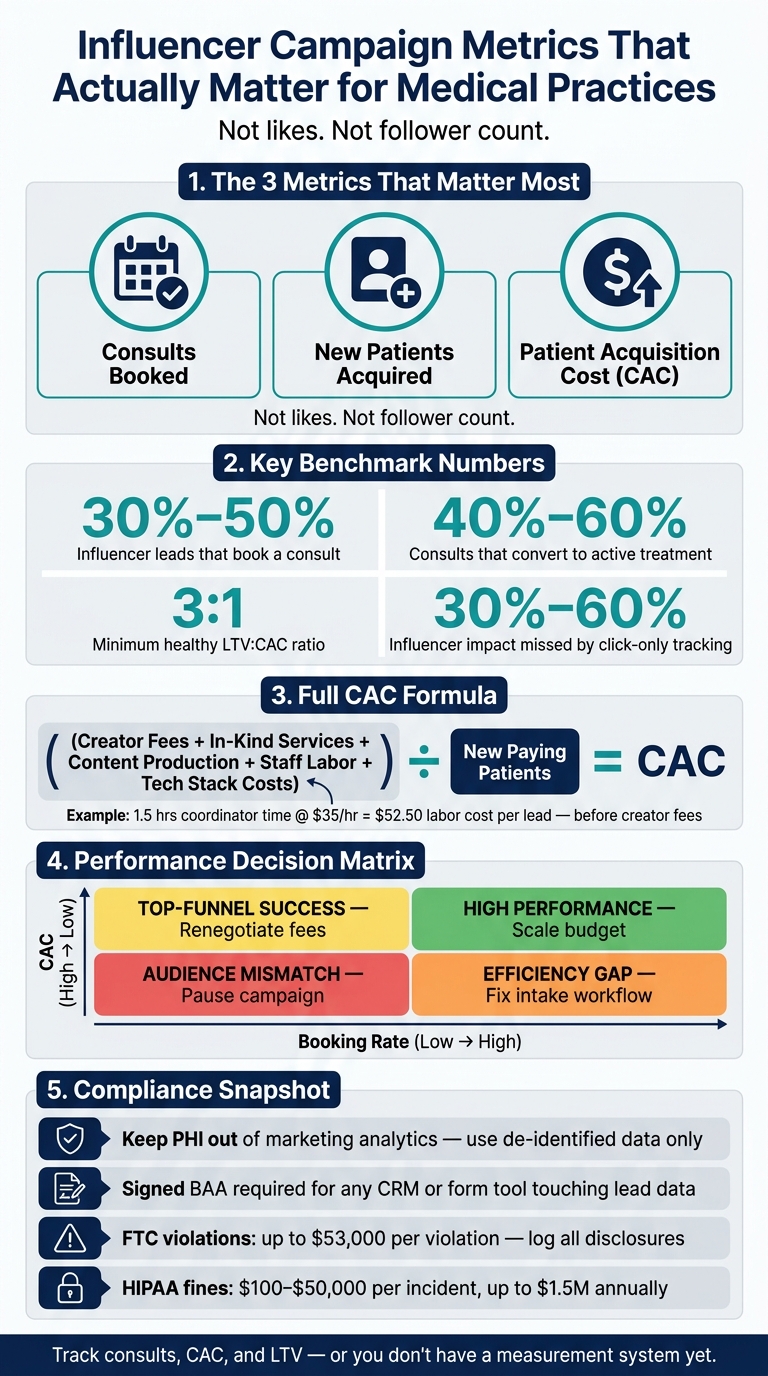
A few numbers stand out fast: influencer leads often book consults at 30%–50%, consults may turn into treatment at 40%–60%, and many practices aim for at least a 3:1 LTV:CAC ratio. Also, if you rely only on click tracking, you may miss 30%–60% of influencer impact from people who later search, call, or book another way.
So the simple takeaway is this: if I can’t tie an influencer to consults, patients, and cost, I don’t have a measurement system yet. The rest of the article shows how to track that without putting HIPAA compliance at risk.
Influencer Campaign Metrics That Actually Matter for Medical Practices
Build a Lead Source Tracking System for Accurate Attribution
You need to track every inquiry back to its source without exposing PHI in your marketing reports.
Set Up Lead Source Fields in Your CRM, Scheduling, and Intake Workflows
Use the same source labels across UTM links, hidden form fields, intake dropdowns, and CRM fields.
On the intake side, swap any open-text “How did you hear about us?” field for a structured dropdown. Be specific. For example, use “Instagram - [Influencer Name]” or “TikTok - [Influencer Name]” instead of broad labels like “social media.” Open-text answers are messy and tough to report on, so those dropdown values should map straight to the same lead source fields your UTM parameters fill in.
Use a unique promo code for each influencer to catch offline referrals and untracked shares.
Keep PHI out of marketing analytics. Use hashed IDs and anonymized stage events like “Consultation Booked” for optimization.
Lead count and CPL can point you in the right direction, but they’re still proxy metrics. Consults booked and CAC are what matter.
Once your source data is clean, booking rate tells you if those leads are actually qualified.
Measure Consult Booking Rate From Influencer-Generated Leads
After your lead source fields are set up, the first metric to calculate is consult booking rate: (Consults Scheduled ÷ Total Influencer Leads) × 100. This tells you whether an influencer is driving qualified leads or just sending low-intent volume.
Measure it over a defined 30-day reporting window to account for the usual lag between first inquiry and scheduled appointment.
After that, compare cost against revenue to find CAC.
Compare Platform and Influencer Performance With One Reporting Table
Once you have 30 days of clean data, pull everything into one reporting table. This is where the story starts to show itself. An influencer with a high lead count but a weak booking rate is a very different bet from one with fewer leads and a stronger conversion rate.
| Influencer | Platform | Leads | Consults Booked | Booking Rate | New Patients | CPL | CAC | Notes |
|---|---|---|---|---|---|---|---|---|
Use this table to rank sources before you calculate CAC in the next section.
That comparison sets up CAC and LTV, which show whether the campaign is profitable.
sbb-itb-7164bd9
Calculate CAC and Financial Return From Influencer Campaigns
Calculate Patient Acquisition Cost Using Total Campaign Spend
Use the same source-tracked table to add up every acquisition cost, not just what you paid the creator.
CAC = (Total influencer fees + cost of in-kind services + content production + internal sales/coordinator labor + tech stack costs) ÷ Number of new paying patients acquired
This is where many practices get it wrong. They count creator fees, maybe production, and stop there. But labor adds up fast.
If your patient coordinator spends 1.5 hours per lead at $35/hour, that's $52.50 in labor cost per lead before creator fees. Miss that number, and your campaign can look cheaper than it is. That's one of the main reasons clinics overspend on influencer campaigns.
You should also include the retail value or COGS of any in-kind services. And keep influencer CAC separate from Google or Meta spend, so you can see which channel is pulling its weight.
Review Lead-to-Patient Conversion Rate and LTV:CAC Together
CAC by itself doesn't tell you much. To know if a campaign makes sense, compare it with Lifetime Value (LTV) - the amount the average patient brings in over 12–36 months of care.
Some specialties can handle a higher CAC because the patient value over time is much higher. A 3:1 LTV:CAC ratio is the healthy minimum for medical practices. So if a surgical patient brings in $15,000 to $25,000 in LTV, a CAC in the $400 to $1,200 range can still work.
You also need to watch how influencer leads move through the funnel. Influencer leads usually convert to consultations at 30%–50%, and consultations convert to active treatment at 40%–60%.
If you're under those ranges, don't blame reach too fast. The problem may be lead quality, slow intake, or both.
Use a Simple Decision Framework to Act on the Numbers
Look at CAC, booking rate, and LTV together, all from the same lead-source data. That gives you a much clearer read on what to do next.
| Scenario | Key Metrics | Action |
|---|---|---|
| High Performance | Low CAC + High Booking Rate | Scale: Increase budget with this creator and find similar influencers. |
| Top-Funnel Success | High CAC + High Booking Rate + High LTV | Refine: Negotiate lower flat fees or move to a hybrid commission model. |
| Efficiency Gap | Low CAC + Low Booking Rate | Adjust: Review the intake and scheduling workflow - the handoff is failing. |
| Audience Mismatch | High CAC + Low Booking Rate | Pause: The influencer's audience likely doesn't align with your target patient demographic. |
Don't judge a campaign on CAC alone. Pair it with booking rate and LTV every time.
If CAC looks fine but results still lag, check engagement quality and landing page performance next.
Measure Engagement Quality, Referral Codes, and Landing Page Performance
Evaluate Engagement Quality, Not Just Like Counts
If consult bookings are lagging, look at the engagement signals that point to actual patient intent. A post can rack up likes and still produce zero consult bookings. That’s a vanity metric, not a business outcome. The signals that matter more are patient-intent signals: saves, shares, meaningful comments about treatment details, and direct messages that show clear interest in a service.
The strongest early signs of conversion are when someone starts your intake form, joins your email list, or views several treatment pages in one session. Those actions usually mean the person is weighing care, even if they haven’t booked yet.
There’s another wrinkle here: some influencer traffic never clicks a link. People may see a post, take a screenshot, and search for your practice later. That untracked screenshot-and-share effect can make you undercount influencer performance by 30%–60% if you depend on click tracking alone. In plain English, click data tells part of the story, not the whole thing.
Last-click reporting has the same problem. It often misses influencer impact because many patients come back later through search, direct visits, or phone calls.
Use Referral Codes and UTM Links for Cleaner Attribution
Use both UTM links and unique referral codes. If engagement looks strong, you need a clean way to tie those signals back to booked consults.
For UTMs, stick to a strict naming setup: utm_source=[platform], utm_medium=influencer, utm_campaign=[campaign_name], and utm_content=[creator_name]. GA4 does not automatically treat utm_medium=influencer as its own channel, so you need to create a custom GA4 channel group by hand. If you don’t, that traffic may end up under "Unassigned".
UTMs should be paired with unique referral codes as a backup record for bookings, including phone-ins and walk-ins. Keep the codes short and easy to remember. A code like DRSMITH20 is much more likely to be entered right than a random string of letters and numbers, especially when a patient sees the post on one device and books on another. Use one code per creator, not per campaign.
Track Landing Page Sessions, Form Starts, and Completion Rates Safely
Landing-page behavior shows where interest falls off before a booking happens. Traffic volume matters, but the bigger clue is form starts vs. form completions. If starts are high and completions are low, that points to friction in the intake process, not just a reach issue. It also helps to track scroll depth and call clicks, especially for practices where phone calls are a major conversion signal.
The compliance side isn’t optional. Send influencer traffic to educational pages, not intake pages, such as those found in our practical clinical guides, and use server-side tracking for conversion events.
| Tracking Method | What It Measures | Compliance Risk |
|---|---|---|
| Referral Codes | Direct bookings, phone-ins, walk-ins | Low - no pixels required |
| UTM Links | Clicks, sessions, digital source attribution | Moderate - ensure no PHI is appended to the URL |
| Landing Page Events | Form starts, completions, scroll depth, call clicks | High - pixels must not fire on PHI-collecting pages |
Record each UTM, pixel, and CRM change in your audit log before the next launch.
Keep Compliance Audit Logs and Use a Practical Measurement Checklist
Once attribution is set up, you need to lock down approvals, disclosures, and review roles. If you skip that step, your reporting gets messy fast, and your numbers stop being useful.
Document Approvals, Claims Review, and Tracking Changes
Every campaign needs a clear audit trail. Keep pre-approvals, claim reviews, disclosure proof, referral code assignments, UTM maps, live landing pages, launch dates, budgets, and KPI targets in one place.
If a post includes a therapeutic claim, log it and route it for medical or regulatory review. This is especially critical when managing clinical considerations for peptide therapeutics or other specialized treatments. Under the FTC Act, your practice is directly responsible for claims an influencer makes on your behalf - even if you didn't write the caption.
Hold on to briefs, scripts, redlines, approvals, and final assets for at least three years. FTC violations tied to weak disclosures can reach $53,000 per violation.
You also need a person watching comments every day. Off-label questions and adverse event mentions need same-day clinical review, and each one must be logged.
All of that recordkeeping helps only if patient data stays separate from your marketing stack.
Keep PHI Out of Marketing Analytics and Assign Clear Review Roles
Any identifiable lead connected to treatment interest counts as PHI under HIPAA. That means patient-level data should stay out of marketing tools. In analytics, use only de-identified, aggregate data.
Keep systems separate. Patient-level data belongs inside your EMR or another secure clinical system. If a CRM, form builder, or email platform touches lead data, you need a signed Business Associate Agreement (BAA) before connecting it. HIPAA violations can lead to fines from $100 per violation up to $50,000 per incident, with annual maximums as high as $1.5 million.
Three roles make this work:
- Your clinician or medical director signs off on content accuracy before anything goes live.
- Your compliance officer handles monthly PHI audits and keeps BAA records in order.
- Your marketing manager owns UTM naming, referral code logs, and disclosure screenshots.
Clear ownership matters. When each person knows their lane, fewer details get missed.
Conclusion: The Metrics That Matter Most for Medical Practices
For medical practices, influencer measurement comes down to a short list: one North Star metric, clean lead source capture, consult booking rates, CAC checked alongside LTV, engagement quality signals, referral code and UTM data, landing page behavior, and a maintained audit trail. Each part supports the next one.
Use this checklist every campaign cycle.
| Audit Item | Owner | Review Frequency | Evidence Retained |
|---|---|---|---|
| Content Approval | Medical/Compliance | Per campaign/post | Signed review form; approved scripts |
| Claim Review | Clinical Director | Pre-launch | Peer-reviewed data; clinical references supporting the claim |
| FTC Disclosure Verification | Marketing Manager | Real-time | Screenshots of #ad / #sponsored placement |
| HIPAA Authorization | Privacy Officer | Once per influencer | Signed patient marketing authorization |
| PHI Audit | Compliance Officer | Monthly | Data flow log; BAA verifications |
| Referral Code & UTM Assignment | Marketing Analyst | Per influencer | UTM parameter map; referral code log; landing pages launched |
| Adverse Event Monitoring | Clinical Staff | Daily | Comment/DM logs; escalation reports |
| Change Log | Compliance Officer | As needed | Records of edits, corrections, or removed posts |
FAQs
How long should I track results before judging an influencer campaign?
Set your attribution window around your actual sales cycle, not a random cutoff.
For impulse-driven services, 7 to 14 days is often enough. For higher-ticket or more considered medical consults, 30 to 60 days usually does a better job of reflecting the full patient journey.
The key is to define that window before launch. That keeps tracking consistent and helps you credit conversions that happen after the first round of research.
What if patients book by phone or search later instead of clicking the link?
That creates an attribution gap, and it’s a common problem in medical marketing. Use dynamic call tracking with dedicated phone numbers so you can tie calls back to the exact ad or influencer campaign that drove them.
Without that setup, those conversions can look like direct traffic or organic search, which can make ROI seem lower than it is. It also helps to train front-desk staff to ask every new patient how they first heard about your practice.
Which tools do I need to track influencer leads without risking HIPAA issues?
Skip standard browser-based tracking pixels. They can send PHI to third parties by accident.
A safer path is server-side tracking through a CDP with a signed BAA. With that setup, you can filter, strip, or hash PHI before any data goes to platforms like Meta or Google. You still get clean measurement, but with more control over what leaves your system.