
A lawful prescription is not the same as informed consent. My takeaway: document what you’re prescribing, why you chose it, what the patient understands, and when you’ll reassess.
Two court cases frame the discussion - but neither sets a nationwide rule:
- Canterbury v. Spence (1972): Addresses disclosure of material risks. The court reversed and remanded; it did not make a final liability ruling.
- Southard v. Temple University Hospital (2001): Addresses FDA device-status disclosure under Pennsylvania law, not a blanket exemption from medication-risk disclosure.
- California board guidance: Addresses examinations and records. The sources here do not establish findings against an individual clinician.
For peptide care, I focus on three charting tasks: identify the exact product and FDA status; explain risks, alternatives, and evidence gaps; and record dosing, monitoring, and refill decisions. An FDA-approved drug used off-label is not the same as a compounded product, which is not FDA-approved.
<u>A signed form cannot replace sound care.</u> Templates can help organize the discussion, but you still need patient-specific records and current state, FDA, prescribing, and compounding checks.
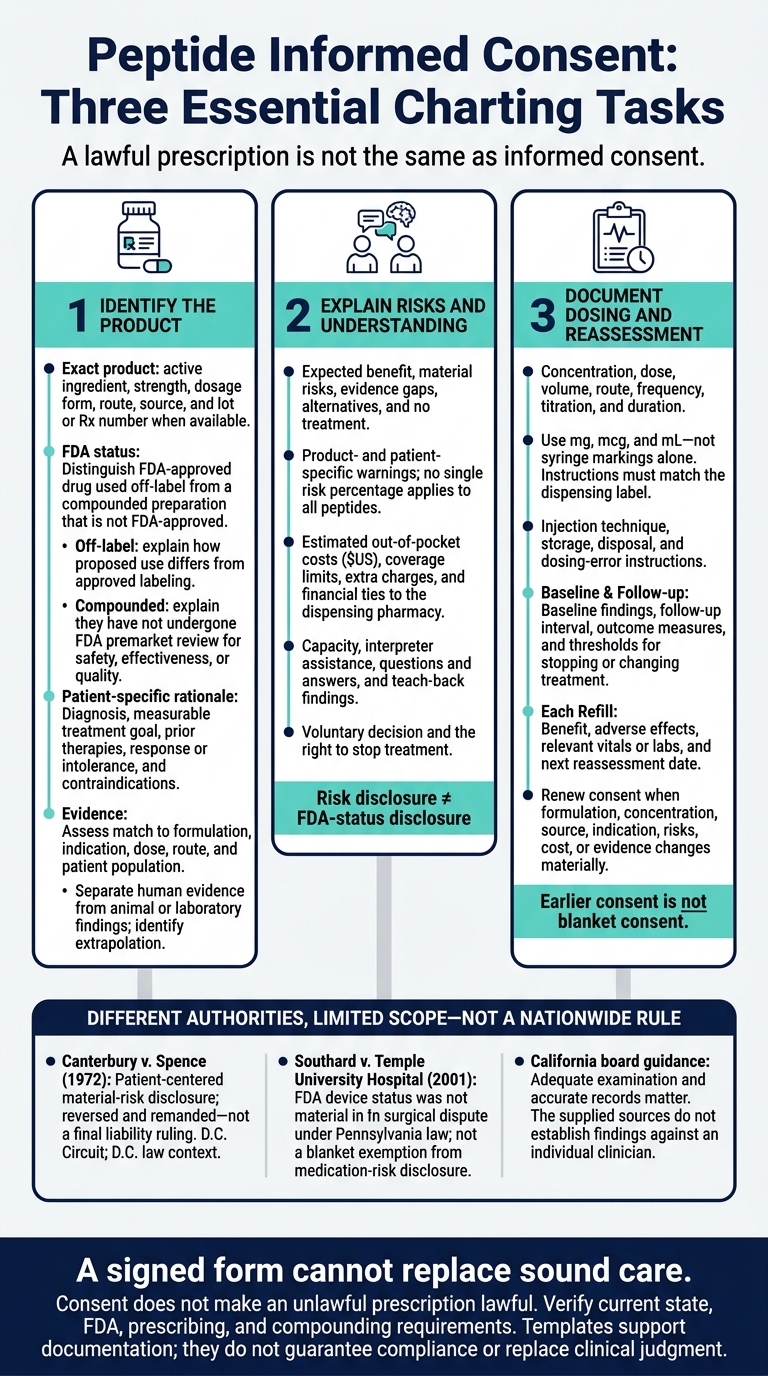
Peptide Informed Consent: Three Essential Charting Tasks
#111 Off-Label Drug Use During Anesthesia Care
sbb-itb-7164bd9
Court Cases on Risk and Off-Label Disclosure
Risk disclosure and FDA-status disclosure answer different questions. Risk disclosure covers serious adverse effects, expected benefit, alternatives, and the consequences of refusing treatment. FDA-status disclosure addresses whether the use is on-label. Consent shouldn't come down to label status alone.
Canterbury v. Spence: Disclosing Material Risks
In Canterbury v. Spence, 464 F.2d 772 (D.C. Cir. 1972), the court applied a patient-centered materiality standard. A risk is material when a reasonable person in the patient's position would likely consider it important when deciding whether to undergo treatment. The court linked disclosure to material risks, alternatives, and the consequences of declining treatment. It reversed and remanded, rather than making a final decision on liability.
For peptide consent, that reasoning means naming serious risks even when they're uncommon, separating human data from preclinical findings, and explaining gaps in the evidence. Record the patient's questions or concerns, too - not just that risks were discussed. These are ways to apply the reasoning, not peptide-specific rules established by the case.
Southard v. Temple University Hospital: Disclosing FDA Status
FDA-status disclosure is narrower than risk disclosure. Document FDA status separately from risks, alternatives, and uncertainty.
In Southard v. Temple University Hospital, 781 A.2d 101 (Pa. 2001), the court held that a spinal device's FDA status was not a material fact in that surgical dispute. The holding was limited to Pennsylvania law and the device context.
For peptides, explain the clinical purpose and limits of the evidence separately from whether the proposed use appears in FDA-approved labeling.
Compare Court Holdings and Their Limits
| Case | Jurisdiction | Legal issue | Holding | Peptide-practice limitation |
|---|---|---|---|---|
| Canterbury v. Spence (1972) | D.C. Circuit; D.C. law context | Material-risk disclosure | Patient-centered standard; reversed and remanded. | Document material risks under applicable state standards. |
| Southard v. Temple University Hospital (2001) | Pennsylvania Supreme Court | FDA device-status disclosure | FDA status was not a material fact in that surgical dispute. | Device-specific; does not eliminate medication-risk disclosure. |
Before relying on either decision, check the applicable state's disclosure standard, expert-testimony requirements, causation rules, and treatment of FDA status. Also review licensing-board rules and institutional policies.
The next question is whether the record reflects the disclosure actually made. Prescribers can access standardized consent forms to ensure documentation meets these legal standards.
Board Actions on Prescribing and Records
A signed consent form does not prove medical necessity or protect negligent care. The chart must support the examination, treatment choice, and follow-up on its own. California board materials identify prescribing without an adequate prior examination and poor recordkeeping as disciplinary risks.
Verified Board Disciplinary Actions
The supplied sources do not identify a citable individual order. Treat board guidance as practice standards, not proof of misconduct.
Use precise procedural language: “the board alleged” for accusations not adjudicated, “the order found” for formally established conclusions, and “the parties stipulated” for settlements. A board newsletter may report “no admissions but charged with” specific violations, which must not be rewritten as proven misconduct.
Compare Board Findings and Documentation Lessons
| Authority and jurisdiction | Legal issue | Documented conduct | Disposition or principle | Peptide-practice lesson |
|---|---|---|---|---|
| Medical Board of California, California | Prescribing without an adequate prior examination | Board disciplinary guidelines identify prescribing without an adequate prior examination. | Board guidance, not an individual order. | Document the patient selection criteria, treatment need, contraindications, and patient-specific rationale before prescribing. |
| Medical Board of California, California | Inadequate or inaccurate medical records, including consent documentation | Incomplete or inaccurate records, including consent documentation. | Record deficiencies may warrant discipline, but not every missing item does on its own. | Keep a complete record of counseling, product status, dosing, monitoring, follow-up, and adverse events. |
| American Medical Association, national ethical guidance | Off-label treatment and monitoring | Physicians should critically assess evidence, set reasonable expectations, disclose how the plan differs from standard care, explain risks, benefits, alternatives, experience, and conflicts, and monitor treatment. | Ethical guidance, not a board sanction. | Consent must support - not replace - documented clinical reasoning and reassessment. |
Each peptide refill should be a documented clinical decision, not an automatic continuation. Record the treatment’s benefit, adverse effects, relevant vitals or labs, and the next reassessment date.
When a patient misses follow-up, document outreach, warning instructions, and decisions to refill or withhold treatment. Promptly record adverse-event assessments, interventions, patient instructions, and follow-up. Correct errors transparently rather than carrying forward unsupported text.
Apply Case Lessons to Peptide Consent
These case lessons point to three charting tasks: identify the product, explain the risks, and document follow-up. They apply Canterbury’s material-risk reasoning and Southard’s FDA-status distinction without stretching either holding beyond its limits.
Record Product Status, Rationale, and Evidence
Use a product-specific patient handout and a separate clinician note. Identify the exact product and its regulatory status, including the active ingredient, strength, dosage form, route, source, and lot or Rx number when available.
For an FDA-approved drug used off-label, explain how the proposed use differs from its labeling. For a compounded preparation, state that it is not FDA-approved and has not undergone FDA premarket review for safety, effectiveness, or quality. Keep off-label use of approved drugs separate from compounded or otherwise unapproved products.
Link the diagnosis and measurable treatment goal to prior therapies, the patient’s response or intolerance, and contraindications. Identify the supporting evidence and whether it matches the exact formulation, indication, dose, route, and patient population. Note where you’re extrapolating. Separate human data from animal or lab data, and explain the gaps plainly.
Document prescribing, compounding, and sourcing limits separately. Consent does not make an unlawful prescription lawful.
Discuss Risks, Alternatives, and Patient Understanding
Once you’ve identified the product and evidence, record what the patient was told about expected benefit, risks, and uncertainty.
The handout should explain those points, along with alternatives and the option of no treatment. Tailor warnings to the product and patient; don’t assign one risk percentage to all peptides. Include estimated out-of-pocket costs in U.S. dollars, coverage limits, extra charges, and any financial tie to the dispensing pharmacy.
In the clinician note, record the patient’s capacity, interpreter assistance, questions and answers, and teach-back findings. Document that the decision is voluntary and that the patient has the right to stop treatment.
Record Dosing, Monitoring, and Reassessment
Dose and formulation affect both risk and patient understanding, so document administration details with the same care.
Record concentration, dose, volume, route, frequency, titration, and duration using mg, mcg, and mL - not syringe markings alone. Check that the instructions match the dispensing label. Document demonstrated injection technique, storage, disposal, and instructions for handling dosing errors. FDA’s July 26, 2024, alert linked dosing errors in compounded injectable semaglutide to differences in strength labeling.
Record baseline findings, the follow-up interval, outcome measures, and thresholds for stopping or changing treatment. At reassessment, compare the benefit with the original treatment goal.
Renew consent when the formulation, concentration, source, indication, risks, cost, or evidence changes materially. Earlier consent is not blanket consent. Assess serious or unexpected events and complete any applicable reporting or notification. Document and correct any material misunderstanding before continuing treatment.
Conclusion: Clinical Judgment, Consent, and Follow-Up
The cases and board guidance point to a simple rule: legality alone does not justify treatment. Documentation must show disclosure, a patient-specific rationale, a reasonable expectation of benefit, and care that meets the applicable standard. Record the treatment goal, dose and route, monitoring plan, adverse effects, response, reassessment, and reasons to continue, change, or stop treatment.
What you must disclose depends on the state, treatment, and uncertainty, as the limits of Canterbury and Southard illustrate. For novel, weakly supported, experimental, or higher-risk treatment, seek jurisdiction-specific legal or risk-management review. Check local disclosure, board, prescribing, and compounding requirements before relying on a signed consent form alone.
Structured templates can help teams document care consistently and save time.
PeptidePrescriber Documentation Resources
PeptidePrescriber provides licensed healthcare professionals with peptide monographs, dosing protocols, editable consent templates, regulatory references, calculators, and injection guidance. These resources can support patient discussions and documentation. Consent materials include general peptide, GLP-1-specific, off-label, and compounded-medication templates.
Treat templates as working drafts, not compliance guarantees. Tailor them to each patient and verify current regulatory information. These tools do not establish legal compliance or the standard of care. They also do not replace clinical judgment, current FDA and state regulatory review, or individualized legal advice.
FAQs
How do I check my state's off-label disclosure requirements?
Check your state board of pharmacy and state medical board regulations for off-label use and compounding disclosure requirements. Rules differ by state, so verify requirements for prescribing authority, telemedicine, and compounding pharmacy oversight.
Use National Association of Boards of Pharmacy (NABP) resources to confirm pharmacy licensing and state-specific compliance requirements. Document your clinical rationale and informed consent process in detail in patient charts.
How should I explain uncertain peptide risks to patients?
State clearly that the peptide is compounded, is not FDA-approved, and may have limited long-term safety data. Explain which regulatory channel applies, such as a 503A pharmacy or 503B facility, rather than relying on reassurances.
If asked, explain that “Research Use Only” labels reflect the bulk substance’s regulatory channel - not a specific safety finding. Support the discussion with concrete evidence, such as a batch-specific Certificate of Analysis. Record the discussion, clinical rationale, and risk disclosures in the progress notes.
What should I do if a patient refuses monitoring?
If a patient refuses required monitoring, decline the prescription. Safe peptide therapy requires a monitoring plan the patient can follow. Do not proceed if they can’t or won’t complete it.
If the patient declines required monitoring or informed consent, stop or refer them elsewhere. Don’t reconsider under pressure. Declining to prescribe is part of patient selection and professional practice.