
LH and hCG act on the same receptor, but they are not interchangeable. LH supports follicle growth with FSH in selected fertility treatments. hCG provides longer-lasting stimulation to trigger final egg maturation or support testosterone production in selected men with hypogonadotropic hypogonadism.
There is no universal LH-to-hCG dose conversion. Treatment requires the exact product’s U.S. labeling, a clear diagnosis, and monitoring tied to the goal. Normal testosterone does not confirm sperm production, just as follicle growth does not confirm pregnancy or live birth.
Quick Comparison
| Comparison | LH | hCG |
|---|---|---|
| Natural source | Pituitary gland | Placenta |
| Receptor | LHCGR | LHCGR |
| Duration | Shorter acting | Longer acting |
| Female fertility role | Supports follicle development with FSH in selected patients | Triggers final egg maturation or ovulation |
| Male treatment role | Recombinant LH is not labeled for male replacement | Certain products treat selected male hypogonadotropic conditions; FSH may also be needed |
| Monitoring | Follicle growth and hormone levels | Ovarian response and hyperstimulation risk; testosterone and semen testing in male fertility care |
The treatment goal matters more than shared receptor activity: choose the product for the diagnosis, and measure the outcome - not just the hormone level.
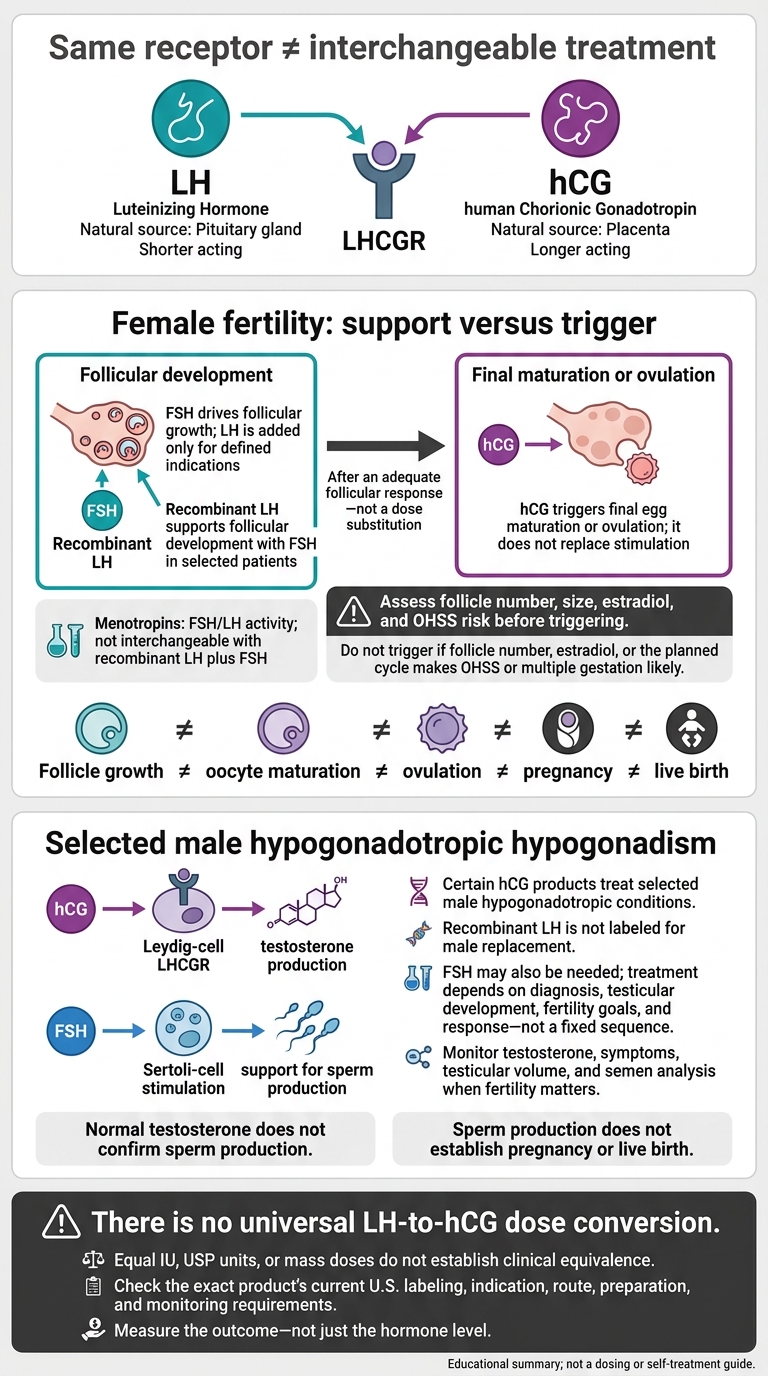
LH vs. hCG: Same Receptor, Different Clinical Roles
Activation of LHHCG receptors on granulosa cells by LH & HCG | Simoni
sbb-itb-7164bd9
2. Fertility Care: Follicular Support vs. hCG Triggering
In fertility care, LH and hCG bind the same receptor, but they serve different phases of treatment.
Recombinant LH and Menotropins for Follicular Development
FSH drives follicular growth; LH is added only for defined indications. Reserve adjunct LH for severe LH deficiency or protocol-specific use - not routine supplementation. A Cochrane review found no clear live-birth benefit from recombinant LH plus FSH compared with FSH alone: odds ratio 1.32, 95% CI 0.85–2.06, across 499 participants. The review also found no clear difference in ovarian hyperstimulation syndrome (OHSS).
| Treatment | Activity and protocol role | Timing and intended outcome | U.S. labeling and monitoring |
|---|---|---|---|
| Recombinant LH: lutropin alfa | Adds LH activity alongside FSH in selected protocols | During stimulation; supports steroid production and follicular development | Monitor follicles and estradiol; follow the exact product label. |
| LH-containing menotropins: MENOPUR | Provides urinary FSH/LH activity; not interchangeable with recombinant LH plus FSH | During stimulation; develops multiple follicles | U.S. labeling includes multiple-follicle development in ovulatory women undergoing ART. Follow product-specific preparation and dosing, ultrasound, and hormone monitoring. |
| hCG triggers: urinary or recombinant hCG | Triggers final maturation or ovulation | After an adequate follicular response; does not replace stimulation | Verify the product’s female fertility indication and instructions. Assess follicle number, size, estradiol, and OHSS risk before triggering. |
Much of the “LH activity” in menotropins may come from hCG rather than LH itself. Product labeling does not justify substituting doses between products.
Once the follicular response is adequate, the next decision is whether to use hCG to complete maturation.
hCG Triggers: Timing and Ovarian Safety
Before triggering, confirm an appropriate response with transvaginal ultrasound and, when indicated, serum estradiol. Start monitoring after 4–5 days of stimulation, then repeat every 1–3 days, depending on the response.
Ovulation generally occurs 36–48 hours after hCG, which guides the timing of intercourse or intrauterine insemination. ART retrieval follows a separate, precisely scheduled plan before expected ovulation. Follow the exact product label for contraindications, including pregnancy, uncontrolled thyroid/adrenal disease, hormone-sensitive disease, and non-PCOS ovarian cysts or enlargement.
Do not trigger if follicle number, estradiol, or the planned cycle makes OHSS or multiple gestation likely. In appropriate high-risk ART settings, ASRM supports GnRH-antagonist protocols, GnRH-agonist triggering, and selected use of cabergoline. Simply lowering an hCG-only trigger dose does not reliably prevent moderate-to-severe OHSS.
Give clear instructions for symptoms after the trigger:
- Report promptly: rapid weight gain, worsening abdominal swelling or pain, persistent vomiting, or reduced urination.
- Seek emergency care: shortness of breath, chest pain, one-sided leg swelling, or sudden neurologic symptoms.
Keep the endpoints separate: oocyte maturation, ovulation, pregnancy, and live birth are different outcomes.
The same receptor biology also guides selected male hypogonadotropic treatment, where hCG stimulates Leydig cells. For more clinical insights on evolving treatment protocols, stay current with evidence-based updates.
3. Male Care: hCG for Testosterone and Sperm Production
In fertility care, hCG can help time ovulation. In men with hypogonadotropic hypogonadism (HH), it is used to restore testosterone and, when possible, sperm production.
Low testosterone with low or normal LH/FSH suggests HH. Elevated gonadotropins suggest primary testicular failure, where hCG rarely restores sperm production. Repeat morning total testosterone testing and review LH, FSH, testicular volume, pubertal and reproductive history, medications, and possible pituitary or genetic causes. Check prolactin when indicated.
Leydig-Cell Stimulation and FSH Treatment Decisions
In men with HH, hCG stimulates Leydig-cell LHCGR to increase testosterone within the testes and in the blood. Restoring testosterone does not mean sperm production has returned; FSH may still be needed. Treatment depends on the cause of HH, testicular development, fertility goals, and response - not a fixed sequence.
| Strategy | Patient selection | Role and fertility endpoints | U.S. labeling and sequence | Monitoring |
|---|---|---|---|---|
| hCG alone | Selected men with HH who seek testosterone restoration or have adequate residual FSH activity | Restores testosterone; sperm production must be confirmed | Certain products, including Pregnyl, have selected male HH indications. | Testosterone, symptoms, testicular volume, estradiol-related effects, and semen analysis when fertility matters |
| hCG followed by FSH | Men whose testosterone has normalized but whose sperm production remains absent or inadequate | Adds Sertoli-cell stimulation to support sperm production | A U.S. GONAL-f label specifies 3–6 months of hCG pretreatment to normalize testosterone, followed by FSH 150 IU three times weekly while continuing hCG. | Testosterone during dose adjustment, serial semen analyses, tolerability, and reproductive outcomes |
| Combined hCG–FSH | Selected men with severe or longstanding HH, childhood-onset disease, or very small testes | Can induce sperm production; starting both drugs together has not been proven superior to sequential treatment. | Specialist-directed simultaneous therapy may differ from product labeling; verify the exact product. | Testosterone, testicular volume, semen analysis about every 3 months, and adverse effects |
Follow the exact product label; many male infertility uses remain off-label. Exogenous testosterone can suppress LH and FSH, lower testosterone within the testes, and impair or stop sperm production. Counsel patients before treatment. Access clinical resources for peptide-prescribing professionals to support evidence-based care. Adding hCG is not an established way to preserve fertility for every testosterone user.
Male Treatment: Outcomes and Adverse Effects
Track serum testosterone, clinical symptoms, and testicular volume, along with baseline and serial semen analyses. A meta-analysis of 50 studies involving 1,583 men with HH and azoospermia found that treatment induced sperm production in 74% (95% CI, 66%–82%) after a mean of 11.8 months. This result does not predict pregnancy or live birth for an individual patient.
Assess gynecomastia, estradiol-related symptoms, acne, edema, mood or libido changes, and injection-site reactions. Check estradiol when indicated. Tailor hematocrit, prostate, liver, or other testing to the patient’s age, symptoms, risk, and selected product.
After dose changes, reassess testosterone, symptoms, and semen. Normal testosterone alone is not the treatment endpoint. Product labels guide dosing and sequence; shared LHCGR activity does not justify dose conversion, as the next section explains.
4. U.S. Labeling and Dose-Conversion Limits
Once the indication is set, check whether the exact product is labeled for that use. FDA labeling defines each product’s approved uses. Professional guidance may support off-label use, but it does not change the label.
Check the Exact Product Before Prescribing
Review the current prescribing information for concentration, units, vial size, reconstitution, route, storage, and dosing instructions. A product name alone isn’t enough. Confirm current approval and marketed presentation through FDA records and the manufacturer.
Products that act on the same receptor can still differ in labeled use, formulation, route, and monitoring.
| Clinical role | Product and labeled use | Route and required combination or sequence | Monitoring and key limits |
|---|---|---|---|
| Female LH support | Luveris: infertile women with hypogonadotropic hypogonadism and profound LH deficiency (LH below 1.2 IU/L). | Subcutaneous, with GONAL-f | Ultrasound and estradiol; assess OHSS and multiple-gestation risk. The female indication is not a male LH-replacement indication. |
| Female hCG trigger | Ovidrel: ovulation induction and final follicular maturation/early luteinization in ART. Pregnyl/Novarel: selected ovulation-induction uses. | Ovidrel: subcutaneous after appropriate FSH pretreatment. Urinary hCG: follow product-specific preparation and route after follicular stimulation. | Follicular response, OHSS symptoms, and multiple-gestation risk |
| Male hCG use | Pregnyl/Novarel: selected male hypogonadotropic hypogonadism. | Follow product-specific instructions. Pregnyl is supplied as a dried powder for intramuscular use in a 10,000 USP-unit multidose vial. | Testosterone, symptoms, gynecomastia, androgen effects, and semen parameters when fertility is the goal |
| Menotropins/FSH support | MENOPUR: multiple-follicle development and pregnancy in ovulatory women undergoing ART. GONAL-f: female ovulation induction/ART and spermatogenesis in selected men with hypogonadotropic hypogonadism, excluding primary testicular failure. | Subcutaneous. For male GONAL-f use, normalize testosterone with hCG first, then continue hCG support. | Women: ultrasound, estradiol, and OHSS risk. Men: testosterone, semen parameters, and clinical response. |
Why Shared Receptor Activity Does Not Mean Equal Doses
A shared receptor target does not establish equal clinical outcomes - or interchangeable doses. Equal IU, USP units, or mass doses do not establish clinical equivalence. Any conversion requires product-specific pharmacokinetic/pharmacodynamic (PK/PD) and clinical validation.
For off-label care, document the diagnosis, treatment goal, exact product, route, units, and planned monitoring endpoints. When applicable, also document the lack of a validated conversion.
5. Conclusion: Match Treatment to the Indication and Goal
LH and hCG both activate LHCGR, but they serve different clinical roles. Within the labeling limits described above, match treatment to the diagnosis, labeling, and evidence for the specific indication. A shared receptor explains how these hormones work - not whether they can replace each other.
In fertility care and male hypogonadotropic hypogonadism, confirm the diagnosis and reproductive goal. Review baseline hormones and any imaging or semen data relevant to the indication. Check for contraindications and possible causes of treatment failure, then review current U.S. labeling and product-specific evidence. Define treatment endpoints, safety monitoring, and criteria for reassessment.
Measure the outcome that matters for the indication. Surrogate measures, such as testosterone levels or follicle growth, do not establish sperm production, pregnancy, or live birth. If the response falls short or adverse effects occur, revisit the diagnosis and protocol rather than automatically increasing the dose or converting LH to hCG. Keep treatment tied to the patient’s reproductive goal.
FAQs
How do I know if I need LH support during fertility treatment?
Deciding whether you need LH support takes a full hormonal evaluation - not one lab result. LH and FSH should be checked alongside sex steroid levels, with attention to blood draw timing, age, cycle phase, stress, nutrition, and medications.
Low gonadotropins - or levels that fall within the normal range but are too low for the situation - paired with low sex steroids may point to central or functional suppression. High gonadotropins often suggest primary gonadal failure. Borderline or inconsistent results need to be reviewed in context and checked with repeat testing.
What happens if hCG normalizes testosterone but sperm remain absent?
If hCG brings testosterone back to normal but sperm are still absent, clinicians should check for testicular dysfunction, including Sertoli-cell impairment. hCG alone may not resolve these issues.
One lab result doesn’t tell the whole story. Clinicians should measure inhibin B to help assess Sertoli-cell health and review the full clinical picture. Receptor activity alone should not justify continuing treatment.
What should I ask before using hCG off-label?
Before prescribing hCG off-label, start with the clinical rationale. Receptor activity alone does not establish safety or efficacy. Review current FDA labeling and established evidence from human studies.
Confirm that there’s a specific, measurable treatment goal and that FDA-approved or standard therapies have been exhausted or judged inappropriate. Make sure the patient understands the differences between FDA-approved use, off-label use, and compounded products. Document informed consent covering risks, alternatives, and monitoring criteria.