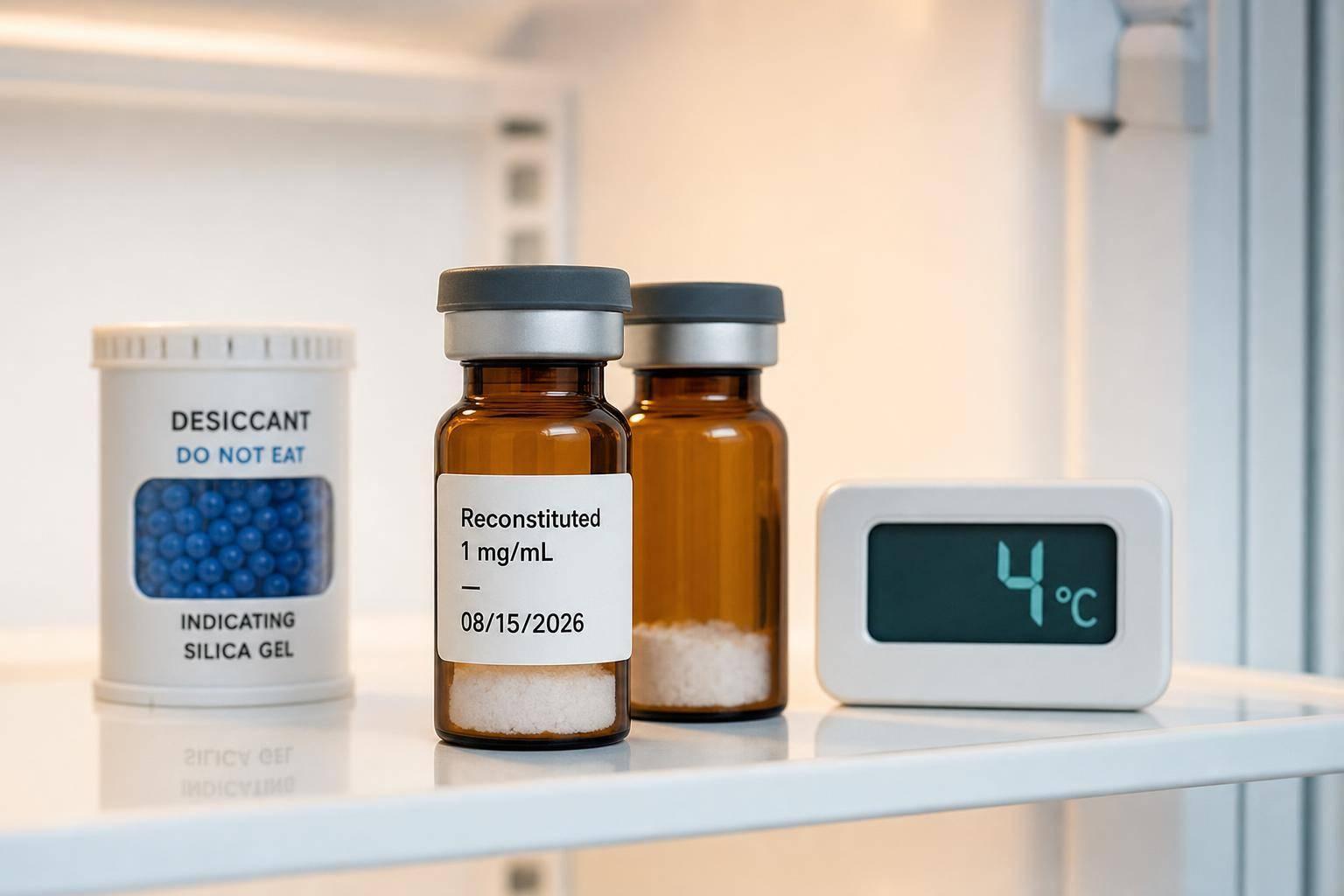
A lyophilized peptide can lose stability even while it still looks normal. In most clinics, the main storage mistakes are simple: too much light, too much moisture, and too many temperature swings.
If I had to boil this down, I’d say this:
- Keep vials dry
- Keep them sealed
- Keep them out of light
- Keep them at a steady temperature
- Let cold vials warm up before opening
- Refrigerate after reconstitution and never freeze the solution
A few numbers matter right away:
- Refrigerated lyophilized storage: 36–46°F (2–8°C)
- Frozen lyophilized storage: about -4°F (-20°C) if the label allows it
- Room temperature handling: 68–77°F (20–25°C) for brief sealed handling only
- Humidity target: around 30%–40% RH
- Indoor humidity in humid areas: often 55%–65% RH
- Reconstituted with bacteriostatic diluent: often up to 28 days refrigerated
- Reconstituted with sterile water: use within 24 hours
Here’s the short version of what matters most:
- Light can damage amino acids like tryptophan, tyrosine, phenylalanine, and methionine
- Humidity speeds breakdown, even in sealed vials if moisture gets in
- Condensation is a common failure point when cold vials are opened too soon
- Amber glass, tight seals, original cartons, opaque bins, and desiccant help cut risk
- Door shelves, benchtops, windows, and shared staff refrigerators are bad storage spots
- Reconstitution changes the clock fast, so dating, labeling, and discard timing matter
| Storage state | Best routine setup | Main risk |
|---|---|---|
| Lyophilized | Interior medication fridge shelf, sealed, dark storage | Light, humidity, condensation |
| Lyophilized long-term | Manual defrost freezer, sealed secondary container | Freeze-thaw cycling |
| Reconstituted | Refrigerated right away, labeled with discard date | Microbial growth and faster chemical breakdown |
So the bottom line is simple: freeze-drying helps, but it does not stop light, moisture, oxygen, or poor handling from cutting shelf life short. The rest of this article and our Peptide Storage & Handling Guide explain how I’d store, handle, and monitor these vials in a clinic so the labeled stability assumptions still make sense.
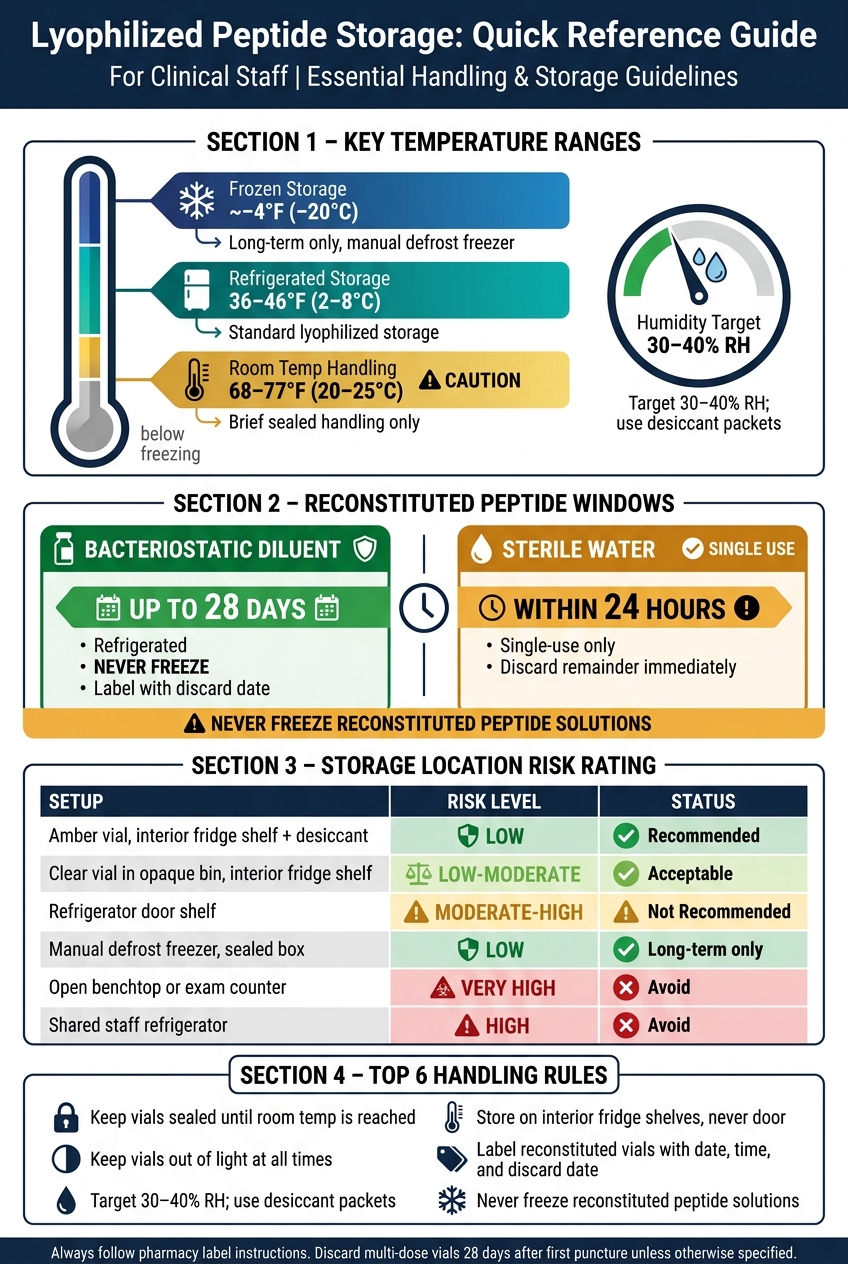
Lyophilized Peptide Storage: Temperature, Humidity & Handling Quick Reference
The Complete Peptide Storage & Handling Guide for Beginners
sbb-itb-7164bd9
How Light and Humidity Degrade Lyophilized Peptides
The two routine threats in clinic use are light and humidity.
Light Exposure: Clear Vials, Benchtops, Windows, and Exam Room Lighting
Light damage doesn’t need direct sun. Standard LED and fluorescent exam-room lighting can still drive oxidation in light-sensitive peptides.
The amino acids most at risk include tryptophan, tyrosine, phenylalanine, and methionine. When light hits these side chains, it can set off oxidation reactions that break the peptide apart, change its structure, and create inactive or potentially immunogenic by-products. And here’s the problem: the powder may show no visible warning signs. A vial can look fine while potency slips in the background.
Clear vials make that risk worse because they block far less light than amber glass. If a vial sits on an open benchtop or medication-room counter under fluorescent lighting, it keeps picking up photon exposure all day long. In that setting, potency loss can show up within days to weeks. So the practical move is simple: keep vials protected from room light whenever they aren’t being used. That’s why container opacity and storage location matter so much.
Humidity and Condensation: Common Moisture Failure Modes
Lyophilized peptides pull in moisture fast. Even short exposure to humid air can increase water content and speed degradation. Most technical guidance points to a storage environment around 30%–40% RH to help keep residual water content near the level linked to maximum shelf life. In the U.S., clinics in humid areas can easily hit indoor RH levels of 55%–65% without active dehumidification. If vials aren’t sealed tightly and stored with desiccation in secondary packaging, degradation moves faster.
Condensation during temperature changes is a separate issue, and it’s common. When a cold vial comes out of a freezer or refrigerator and gets opened right away in warm room air, moisture can condense onto and into the cake. That can lead to partial rehydration and uneven hydrolysis. Staff may call the sticky, shrunken, or collapsed cake a "bad batch" when the actual cause was the handling step. The fix is straightforward: keep cold vials sealed until they reach room temperature before opening.
Moisture also makes light damage worse. So a humid, brightly lit storage area is pretty much the worst setup possible. In practice, these moisture-related failures come down first to seal integrity, then to where the vial is kept.
Container Choice and Storage Location in Clinical Practice
Once you know light and moisture are the main threats, the next move is simple: use packaging and storage that keep both in check.
Recommended Container Setups: Amber Glass, Tight Closures, and Desiccated Secondary Storage
Use Type I borosilicate glass. For light-sensitive peptides, choose amber glass. Pair the vial with a butyl rubber stopper and an aluminum crimp seal to help hold the seal and limit moisture and oxygen entry.
If a vial arrives in clear glass, keep it in the original carton or place it in an opaque bin. That extra layer helps block light without much extra work.
There’s another issue clinics run into: overpunctured stoppers. After too many needle entries, tiny leak paths can form over time. In practice, that means it helps to:
- Inspect crimps when the vial arrives
- Use the smallest compatible needle
- Avoid puncturing the same spot again and again
- Discard multi-dose vials 28 days after first puncture unless the label says otherwise.
For secondary containment, many clinics store vials in their original cartons inside labeled, opaque bins. If humidity or condensation is a concern, add a silica gel desiccant packet inside the storage container for another layer of moisture control.
Recommended Storage Locations: Medication Refrigerator, Freezer, and Dark Cabinet
Most lyophilized peptides should be stored in a medication-only refrigerator at 36–46 °F (2–8 °C). Put vials on the interior shelves. Skip the door shelves and the back wall. A medication-only unit helps cut down temperature swings caused by frequent opening and loading.
If the label calls for long-term frozen storage, a manual defrost freezer set around −20 °C is usually a better fit than a frost-free model, which cycles heat on and off. Vials going into the freezer should stay in sealed secondary containers to lower condensation risk during removal and thawing.
For products stored at room temperature, use a dark, lockable cabinet in a controlled medication area kept at 68–77 °F (20–25 °C). Keep vials away from windows, sinks, and heat sources. Countertops and exam room surfaces may look convenient, but they should be treated as workspaces, not storage spots.
Storage Location and Container Risk Levels: Comparison Table
Use the setups below as a quick clinic reference.
| Setup | Light Protection | Moisture Control | Temperature Stability | Practical Suitability |
|---|---|---|---|---|
| Amber vial in original carton, interior medication fridge shelf | High | High (with desiccant) | High | ✅ Recommended standard |
| Clear vial in opaque bin, interior medication fridge shelf | Good | Moderate | High | ✅ Acceptable with secondary protection |
| Any vial on refrigerator door shelf | Moderate | Moderate | Low | ⚠️ Not recommended - temperature fluctuates with every opening |
| Lyophilized vial in sealed box, manual defrost freezer interior | High | High | High | ✅ Appropriate for long-term storage only |
| Clear vial on open benchtop or exam counter | None | Low | Low | ❌ Avoid - high risk |
| Any vial in staff refrigerator | Moderate | Variable | Variable | ❌ Avoid - contamination and excursion risk |
These storage choices set up the handling errors covered next.
Practical Storage Ranges and Common Clinic Errors
Typical U.S. Storage Ranges for Lyophilized and Reconstituted Peptides
Once you've picked the right container and storage spot, temperature is the next thing to lock down. In U.S. clinics, the product label should guide storage, following established clinical best practices. For lyophilized stock, that usually means 36–46°F (2–8°C) in the refrigerator. If the label allows frozen storage, keep it at about −4°F (−20°C). Room temperature is only for short, sealed handling, not routine storage.
After reconstitution, the rules shift. The solution should go back into the refrigerator right away. If it's mixed with a bacteriostatic diluent, the usual in-use window is up to 28 days at 36–46°F (2–8°C), though some pharmacy labels set a shorter limit, such as 7–14 days. If sterile water is used, treat the solution as single-use and discard it within 24 hours. Reconstituted peptides should not be frozen, since ice crystals can damage the solution.
Common Handling Errors That Reduce Stability
Most storage mistakes are simple, and that's the good news. They're also easy to fix.
Benchtop staging leaves vials sitting in light and drifting temperatures. Refrigerator door storage causes extra temperature swings every time someone opens the door, which is why peptide stock belongs on interior shelves. Shared refrigerators can create the same problem because temperature control tends to be less steady.
Another common issue is repeated temperature cycling. A simple habit helps here: let cold vials warm inside a closed secondary container before opening them. That cuts down on condensation. It's also smart to record the reconstitution date and time, then document any temperature excursion with the duration, peak temperature, lot number, and disposition.
Lyophilized vs. Reconstituted Storage Requirements: Comparison Table
Use the ranges below as clinical resources for your practice.
| Product State | Acceptable Temp Range | Typical Duration | Primary Risks | Key Handling Restrictions |
|---|---|---|---|---|
| Lyophilized – room temp | 68–77°F (20–25°C) | Short-term only | Light exposure, humidity ingress, warmth | Brief handling only; keep sealed and protected from light. |
| Lyophilized – refrigerated | 36–46°F (2–8°C) | Months (per pharmacy label) | Condensation from door cycling | Store on an interior shelf; minimize in-and-out movement |
| Lyophilized – frozen | ~−4°F (−20°C) | 2+ years | Freeze–thaw cycling | Use only when pharmacy documentation supports it; thaw once before reconstitution |
| Reconstituted – refrigerated (bacteriostatic diluent) | 36–46°F (2–8°C) | Up to 28 days (or per label) | Microbial growth, chemical degradation | Never freeze; label with reconstitution date and time; discard at BUD |
| Reconstituted – refrigerated (sterile water) | 36–46°F (2–8°C) | 24 hours | Rapid bacterial contamination | Single-use only; discard remainder immediately |
| Reconstituted – room temp | 68–77°F (20–25°C) | Immediate use only | Accelerated degradation, microbial growth | Use only for brief handling; not for routine storage |
Clinic SOPs and Conclusion: Standardizing Safe Peptide Storage
Core SOP Elements for Receiving, Monitoring, and Reconstitution
The three main failure points are simple: receiving, storage monitoring, and reconstitution. If you want storage to stay safe day after day, you need more than a set temperature range. You need an SOP that people can follow without guesswork. Storage only works when the process is written down and used the same way every time.
A practical SOP should cover what happens when a shipment arrives, how temperatures are checked during storage, and how vials are handled at reconstitution.
On receipt, staff should confirm the product name, lot number, and expiration date against the purchase order right away. That information should be logged with the date and time the shipment arrived. If the package includes a temperature monitor, record its status before the vials go into storage. Any shipment with warm gel packs, visible moisture inside the packaging, or a triggered alarm should be quarantined at once, labeled "Quarantined – Do Not Use," and moved to controlled storage until the prescriber or pharmacy reviews it.
During storage, use calibrated digital thermometers or data loggers in every medication refrigerator and freezer. Readings should be documented at least twice a day. Put probes in the center of the storage area, not near doors or vents, where readings can swing. If staff find a temperature excursion, they should document when it was found, how long it seems to have lasted, which device was involved, which lots were affected, and the final disposition decision.
At reconstitution, allow sealed vials to reach room temperature before opening so condensation does not form. Add diluent slowly down the vial wall, then gently swirl. Never shake. As soon as reconstitution is done, apply a label with the peptide name, final concentration, diluent used, reconstitution date and time, and discard date. That label must match the medication log or EMR.
Key Takeaways for Prescribers
Once the workflow is standardized, the day-to-day rule is straightforward.
Keep every vial protected from light, protected from moisture, and held at a stable temperature. Amber glass, tight closures, desiccant, and interior refrigerator shelves are the baseline. That is not overkill. It's just sound handling.
After reconstitution, refrigerate the vial right away, label it fully, and never freeze the solution. Use bacteriostatic water when you need a longer multi-dose window. If sterile water is used, the reconstituted product should be used within 24 hours unless the pharmacy gives different instructions. Document receiving, storage checks, reconstitution, and excursions so every handling decision is traceable and defensible.
FAQs
How can I tell if a lyophilized peptide is damaged if the powder still looks normal?
It’s hard to tell just by looking at it. In most cases, signs like cloudiness, discoloration, or floating particles don’t show up until after reconstitution.
Because degraded peptides can be ineffective or even harmful, storage matters. Keep vials away from light, humidity, and temperature swings, and refrigerate them at 36–46°F (2–8°C). Store them away from the fridge door and the freezer. If you’re not sure whether a vial is still good, discard it.
What should I do if a refrigerated or frozen vial is left out too long?
If a reconstituted peptide vial is left out, put it back at 36–46°F (2–8°C) as soon as you can. A short period at room temperature during handling or shipping is usually fine. But if it stays out too long, it can start to break down within hours.
Before use, check the solution closely. It should look clear and free of any signs that it has started to degrade. If it was reconstituted with non-preservative sterile water and left out for more than a few hours, discard it.
Why should reconstituted peptides never be frozen?
Freezing a reconstituted peptide can cause ice crystals to form. Those crystals may physically shear the peptide chains and denature them in a way that can’t be reversed. When that happens, potency drops and may be lost altogether.
If a reconstituted solution is frozen by accident, discard it. There’s one narrow exception: a properly aliquoted solution stored in single-use, low-protein-binding polypropylene tubes. Even then, it should never be refrozen after thawing.