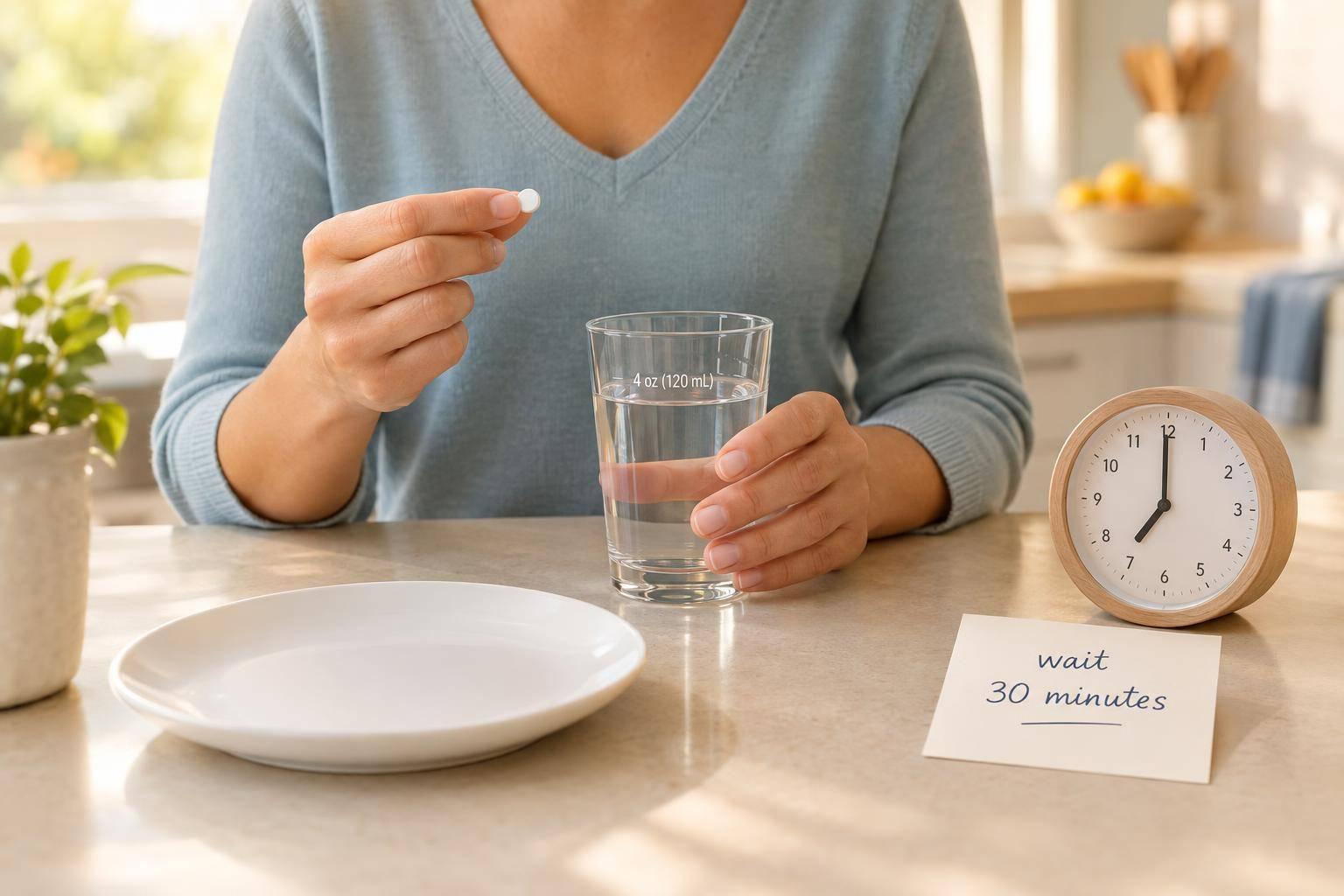
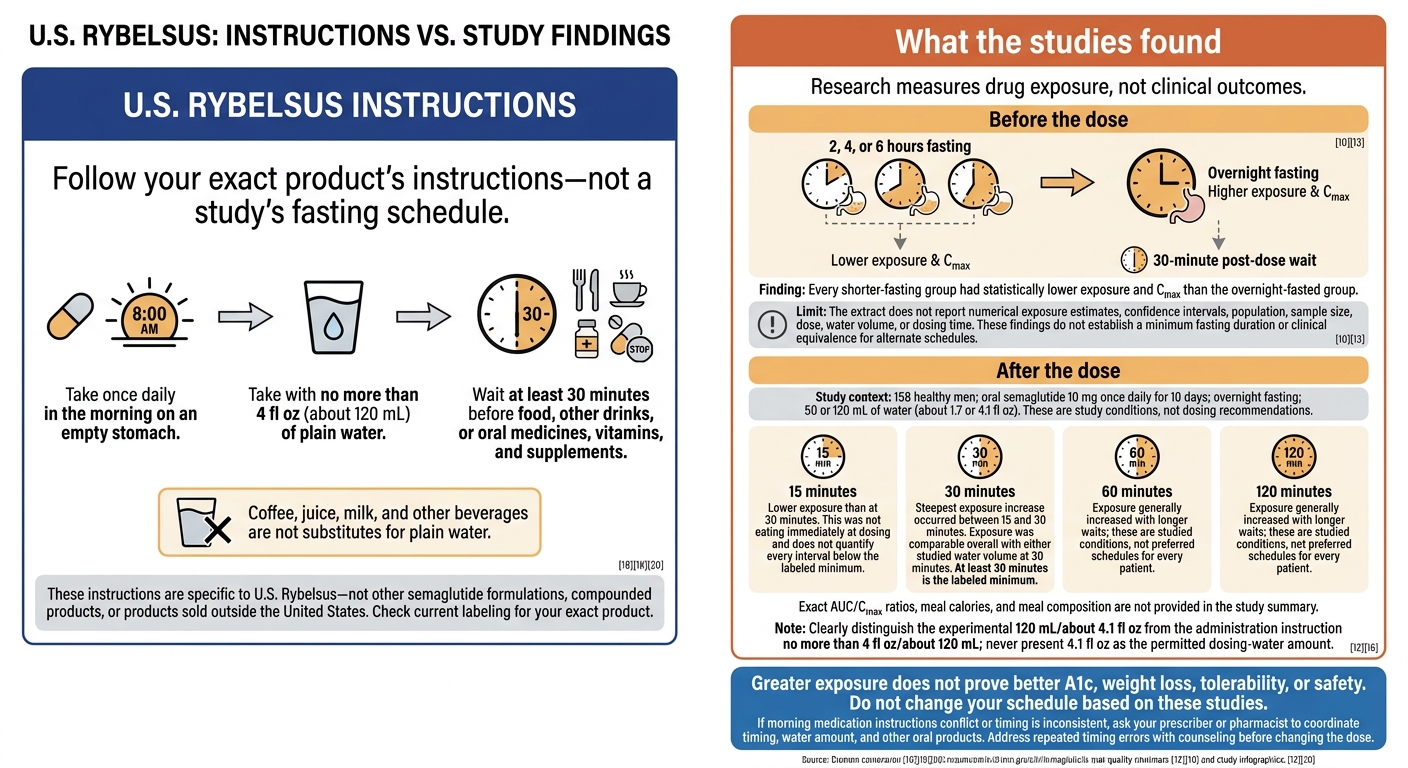
My takeaway: Follow your exact product’s instructions - not a study’s fasting schedule. For U.S. Rybelsus, take it in the morning on an empty stomach with no more than 4 fl oz of plain water, then wait at least 30 minutes before food, other drinks, or oral medicines.
Here’s how I read the research:
- Before the dose: Fasting for 2, 4, or 6 hours led to lower drug exposure than overnight fasting.
- After the dose: A study of 158 healthy men found greater exposure with longer waits, with the steepest increase between 15 and 30 minutes.
- For daily use: More absorption does not prove better blood sugar control, weight loss, or safety - and does not justify changing your schedule.
I’ll separate the study findings from dosing instructions, explain the clinical considerations and limits, and show why <u>timing, water amount, and other oral medicines</u> belong in any discussion with your prescriber or pharmacist.
Oral Semaglutide Timing: Research vs. U.S. Rybelsus Instructions
The 1% Problem Behind Oral GLP-1
sbb-itb-7164bd9
2. Fasting Before Dosing: Study Protocols and Exposure
Labeling specifies waiting at least 30 minutes after dosing. A separate question is how fasting before the dose affects exposure.
Overnight Fasting and Shorter Fasting Periods
One study compared shorter fasts with overnight fasting, keeping the post-dose wait the same to isolate the effect of pre-dose fasting. The extract does not include publication details, sample size, dose, water volume, timing, or confidence intervals. Check the source study before citing exact effects.
Pre-Dose Fasting Studies Compared
| Study | Pre-dose fasting interval | Post-dose wait | Finding |
|---|---|---|---|
| Direct fasting-duration comparison | 2, 4, or 6 hours versus overnight | 30 minutes | Every shorter-fasting group had statistically lower exposure and Cmax than the overnight-fasted group. |
The extract does not report the population, sample size, dose, water volume, dosing time, numerical exposure estimates, or confidence intervals.
Other studies conducted after overnight fasting examined water volume or post-dose meal timing - not the minimum fasting duration. These findings do not establish a minimum fasting duration or prove clinical equivalence for alternate dosing schedules, despite the lower exposure seen with shorter fasts.
3. Meal Timing After Dosing: Effects on Exposure
Post-Dose Wait Time and the 30-Minute Minimum
When pre-dose fasting stays the same, the wait after dosing becomes the main variable. This section compares study timing with U.S. labeling - not everyday breakfast habits.
A pharmacokinetic study of 158 healthy men tested oral semaglutide 10 mg once daily for 10 days, with post-dose waits of 15, 30, 60, or 120 minutes. Exposure increased as the wait lengthened, with the steepest increase between 15 and 30 minutes. The study tested waiting after dosing, not eating immediately. So the 15-minute group should not be treated as a food-at-dosing group.
Thirty minutes is the labeled minimum. Although longer waits increased exposure in the study, the trial did not establish a routine benefit from waiting 60 or 120 minutes. The table compares the study conditions.
Post-Dose Wait Times Compared
All rows describe the same repeated-dose study in healthy men after overnight fasting.
| Post-dose wait time | Water volume | Exposure trend | Clinical takeaway |
|---|---|---|---|
| 15 minutes | 50 or 120 mL (about 1.7 or 4.1 fl oz) | Lower exposure than at 30 minutes. | Does not quantify every interval below the labeled minimum. |
| 30 minutes | 50 or 120 mL (about 1.7 or 4.1 fl oz) | Comparable exposure overall with either water volume. | Supports the labeled minimum, but does not represent every prescribed dose. |
| 60 or 120 minutes | 50 or 120 mL (about 1.7 or 4.1 fl oz) | Exposure generally increased with longer waits. | A studied exposure condition - not a preferred schedule for every patient. |
The study summary does not provide exact AUC/Cmax ratios, meal calories, or meal composition.
These findings describe exposure, not clinical outcomes. Longer waits did not prove better A1c, weight loss, tolerability, or persistence. The study also does not show how usual breakfasts, coffee, or inconsistent timing affect exposure. If absorption seems inconsistent, ask about the actual dose-to-breakfast interval, water amount, and timing of other oral products before recommending schedule changes based on clinical guides.
4. Applying the Evidence to U.S. Prescribing
Study Conditions vs. Product Instructions
The table below connects pharmacokinetic study conditions with U.S. Rybelsus counseling instructions. These instructions do not apply to other semaglutide formulations, compounded products, or products sold outside the United States.
| Administration factor | Study conditions | U.S. Rybelsus instructions | Clinical interpretation |
|---|---|---|---|
| Fasting state | Studies may use overnight fasting or shorter pre-dose fasts of 2, 4, or 6 hours. | Take once daily in the morning on an empty stomach. | Study fasting schedules standardize exposure data. They do not set new fasting requirements for routine use. |
| Water volume | Protocols may precisely control water volume and use different amounts across studies. | Use no more than 4 fl oz (about 120 mL) of plain water. | Results do not mean patients can take the dose with any amount of water. |
| First meal | Studies may delay the first meal or compare meals at fixed intervals after dosing. | Wait at least 30 minutes before eating. | Findings support the 30-minute minimum, not routine longer fasting. |
| Other beverages | Studies control beverage intake during the absorption window. | Take with plain water. Wait at least 30 minutes before drinking other beverages. | Coffee, juice, milk, and other drinks are not substitutes for plain water. |
| Oral medicines, vitamins, and supplements | Studies may exclude other oral products or schedule them separately. | Wait at least 30 minutes before taking them. | Study schedules may not account for conflicting medication instructions. Check each product’s timing requirements. |
When morning medication instructions conflict, the prescriber or pharmacist should coordinate the schedule. Address repeated timing errors with counseling before changing the dose.
Study Limits and Unanswered Questions
Small, selected samples and short, supervised protocols limit how well the findings apply to routine care. Differences in dose, formulation, fasting duration, and meal size or composition also make studies harder to compare. Exposure varies from person to person.
Several questions remain unanswered: How much does day-to-day timing variation matter? Can patients maintain longer fasts? Does greater exposure improve outcomes or increase gastrointestinal adverse effects? These limits are why product labeling remains the standard for counseling.
Clinical Resources for Prescribers
Start with the current FDA-approved prescribing information for the exact product and formulation. Then review the original study publications.
PeptidePrescriber offers licensed clinicians peptide monographs, dosing protocols, clinical tools, and regulatory references. These resources support - not replace - product labeling, original research, and clinical judgment.
Conclusion: Follow Product-Specific Instructions
Assess exposure findings alongside food intake, timing, water volume, and formulation. Longer waits may increase exposure, but that alone does not justify changing labeled dosing or adding fasting rules.
FAQs
What should I do if I eat too soon after taking Rybelsus?
Eating or drinking too soon after taking Rybelsus may make it less effective. Take the tablet on an empty stomach with no more than 4 ounces of plain water. Then wait at least 30 minutes before eating, drinking anything else, or taking other medications. Taking Rybelsus with other items can reduce absorption by up to 50%.
How should I schedule Rybelsus with other fasting medications?
Take Rybelsus on an empty stomach with no more than 4 ounces of plain water. Wait at least 30 minutes before eating, drinking, or taking any other oral medications.
Oral semaglutide slows stomach emptying, which may affect how other medications are absorbed. If you take other medications that require an empty stomach, ask your healthcare provider exactly when to take them. This is especially important for narrow-therapeutic-index drugs, such as levothyroxine.
Can I take Rybelsus correctly if I work night shifts?
Yes, as long as you follow the fasting requirements. Take Rybelsus on an empty stomach with no more than 4 ounces of plain water. Wait at least 30 minutes before eating, drinking, or taking other medications.
Your shift schedule should not affect how well Rybelsus works if you consistently follow these requirements after waking up or before your first meal of the day.