FKC may reduce TNFR1 signaling without blocking TNF binding - but its proposed allosteric mechanism remains unproven. This 12-amino-acid peptide is a preclinical research compound, not an FDA-approved treatment.
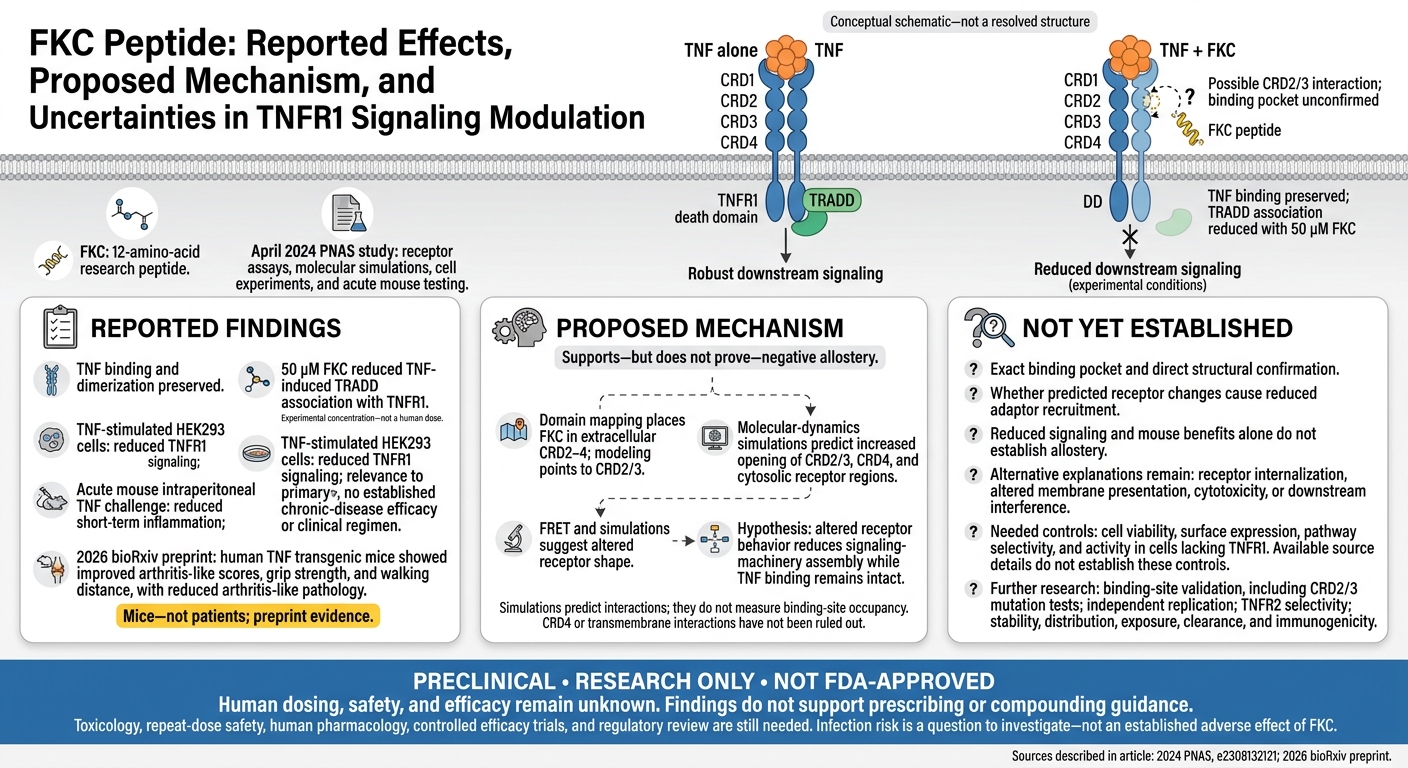
An April 2024 PNAS study reported reduced signaling-protein recruitment, including TRADD association at 50 µM FKC. Receptor assays and computer models support a possible change in receptor shape, but the binding site has not been confirmed.
- Cell and mouse findings: Reduced signaling and inflammation; a 2026 preprint also reported improved arthritis-like outcomes in mice.
- Main limits: Animal results do not establish human efficacy or prove how FKC works.
- Clinical status: Human dosing, safety, and efficacy remain unknown. The findings do not support prescribing or compounding guidance.
FKC and TNFR1: Evidence vs. Proposed Mechanism
How FKC May Bind and Change TNFR1
Earlier evidence shows that FKC does not block TNF binding. Here, the focus shifts to how FKC may change receptor movement and adaptor recruitment.
CRD2/3 Binding and Predicted Receptor Opening
Domain mapping places FKC in TNFR1’s extracellular CRD2–4 region. Modeling points to CRD2/3, but no binding pocket has been confirmed.
Molecular-dynamics simulations predict greater opening of CRD2/3 and CRD4. These changes suggest a receptor state less able to assemble signaling machinery. Whether those predicted changes in shape lead to weaker signaling-complex assembly remains an open question.
Preserved TNF Binding With Reduced Signaling-Protein Recruitment
TNF increased TRADD association with TNFR1, while 50 µM FKC reduced that association. This finding shows impaired adaptor recruitment - not just weaker downstream signaling.
The findings support a negative allosteric model, but they do not prove it. The next section separates evidence for allostery from evidence of inhibition alone.
sbb-itb-7164bd9
What Supports Allostery - and What Shows Inhibition
Findings That Support an Allosteric Mechanism
TNF binding remains intact while TRADD recruitment drops. The question is whether FKC changes receptor behavior or simply reduces signaling.
| Evidence supporting negative allosteric modulation | Evidence showing inhibition only |
|---|---|
| Preserved TNF binding and dimerization, paired with reduced signaling-protein recruitment, support an allosteric model. | Reduced signaling in HEK293 cells shows activity, not the binding mechanism. |
| Modeling points to a possible CRD2/3 interaction site, but the contacts remain unconfirmed. | Effects on TNF-triggered inflammation in mice show in vivo activity, not the mechanism. |
| Fluorescence resonance energy transfer (FRET) and simulations suggest a change in receptor shape. | Improved scores in human TNF transgenic mice show a phenotype benefit, not allostery. |
These methods test different parts of the model: biochemistry tests binding and recruitment, while FRET and simulations suggest a change in receptor shape.
Why Reduced Signaling Alone Does Not Prove Allostery
Preserved TNF binding fits with a separate regulatory site, but it does not prove allostery. Reduced signaling could also result from receptor internalization, altered membrane presentation, cytotoxicity, or interference downstream. Controls for cell viability, surface expression, pathway selectivity, and activity in cells lacking TNFR1 would help separate these explanations.
Whether these structural changes also occur in cell and mouse models remains an open question. The next section examines HEK293 cells and mouse inflammation models, separating functional effects from evidence about the mechanism.
Experimental Models and Reported Results
Molecular Assays, Simulations, and HEK293 Cell Results
The 2024 PNAS study (e2308132121) combined receptor assays, molecular simulations, cell experiments, and acute mouse testing. The table separates evidence about how FKC may work from its measured effects.
| Model | Endpoint | Reported result | Limits |
|---|---|---|---|
| Biophysical and biochemical assays - 2024 study | Peptide binding and signaling-protein recruitment | FKC bound TNFR1 and reduced downstream protein recruitment. | Receptor contacts remain unconfirmed. |
| Molecular-dynamics simulations - 2024 study | Predicted receptor movements | Modeling placed FKC near CRD2/3 and predicted increased opening of CRD2/3, CRD4, and cytosolic receptor regions. | No direct structural confirmation; CRD4 or transmembrane interactions were not ruled out. |
| TNF-stimulated HEK293 cells - 2024 study | TNFR1 signaling | FKC reduced TNFR1 signaling. | Findings may not extend to primary human cells. |
| Acute mouse TNF challenge - 2024 study | Short-term inflammatory response | FKC reduced inflammation after intraperitoneal TNF exposure. | No established efficacy in chronic disease or clinical regimen. |
| Human TNF transgenic mice - 2026 bioRxiv preprint | Arthritis-like scores, function, and pathology | Improved scores, grip strength, and walking distance, with reduced arthritis-like pathology. | No established human efficacy or proof of allostery. |
The simulations predict binding-site occupancy; they do not measure it. The available source details also do not establish specific findings from HEK293 viability or receptor-specificity controls. Those controls should not be assumed.
The key distinction is between experiments that support the proposed binding model and those that show inhibition alone.
Acute TNF-Induced Inflammation in Mice
The record confirms an intraperitoneal TNF challenge and short-term anti-inflammatory activity. It does not confirm the exact preparation, dosing schedule, or cytokine changes. These results support a short-term effect on inflammation, not clinical use. For more on the evolving landscape of peptide research, see our clinical insights.
Arthritis-Like Disease in Human TNF Transgenic Mice
The later arthritis study remains a bioRxiv preprint in the supplied sources.
These were human TNF transgenic mice, not patients. The findings add to the preclinical evidence but do not prove efficacy in humans, restoration of joint structure, or the proposed mechanism.
Conclusion: Preclinical Evidence and Clinical Limits
FKC is a TNFR1-directed research peptide that preserves TNF binding while reducing signaling-protein recruitment. These findings support - but do not prove - negative allostery, rather than general inhibition alone.
Research Needed Before Clinical Use
Before FKC can move into clinical use, researchers must confirm its mechanism in independent models. Studies need to identify its binding site and the receptor changes it causes, including whether CRD2/3 mutations eliminate FKC activity. Researchers must also assess selectivity, including effects on TNFR2, along with stability, tissue distribution, exposure, clearance, and immunogenicity.
Development also requires toxicology studies, repeat-dose safety testing, human pharmacology studies, controlled efficacy trials, and regulatory review. Infection risk and other effects of suppressing TNF signaling remain questions to investigate - not established adverse effects of FKC.
What US Prescribers Should Know
Until human data are available, FKC remains a research-only peptide. These findings establish neither efficacy nor dosing in humans and do not support prescribing or compounding guidance.
PeptidePrescriber provides licensed healthcare professionals with educational monographs, dosing tools, regulatory references, and clinical resources. These materials do not validate FKC’s safety, efficacy, availability, or suitability for prescribing.
FAQs
Why might preserving TNF binding matter?
The TNF-alpha/TNFR1 pathway helps drive inflammation, but it also serves protective roles. Blocking this pathway can reduce inflammation driven by NF-kappaB and MAPK. The trade-off? NF-kappaB also helps repair epithelial tissue and maintain the mucosal barrier.
An allosteric inhibitor that adjusts TNFR1 activity without preventing TNF binding may allow more selective control of harmful signaling. It could also preserve protective functions that help the body fight infections and maintain tissue.
What experiments could confirm FKC’s allosteric mechanism?
Researchers should pair structural mapping through cryo-EM or X-ray crystallography with functional assays, such as Schild analysis or tests that vary agonist concentrations. Together, these methods can help distinguish competitive binding from non-competitive modulation at TNFR1.
Receptor mutation studies or genetic knockdowns could help test whether FKC acts at a separate allosteric pocket rather than the primary ligand site.
Direct binding evidence should be evaluated separately from signaling effects.
Why can’t the 50 µM result guide human dosing?
A 50 µM laboratory result cannot guide human dosing. Assay conditions don’t reflect how the human body works. Results also depend on receptor density, temperature, and differences between species.
These findings lack the pharmacokinetic and safety data needed for human use, including how a substance spreads through tissues, how the body clears it, and whether it acts on unintended targets. Establishing a safe human dose requires controlled clinical trials - not just converting or scaling preclinical values.