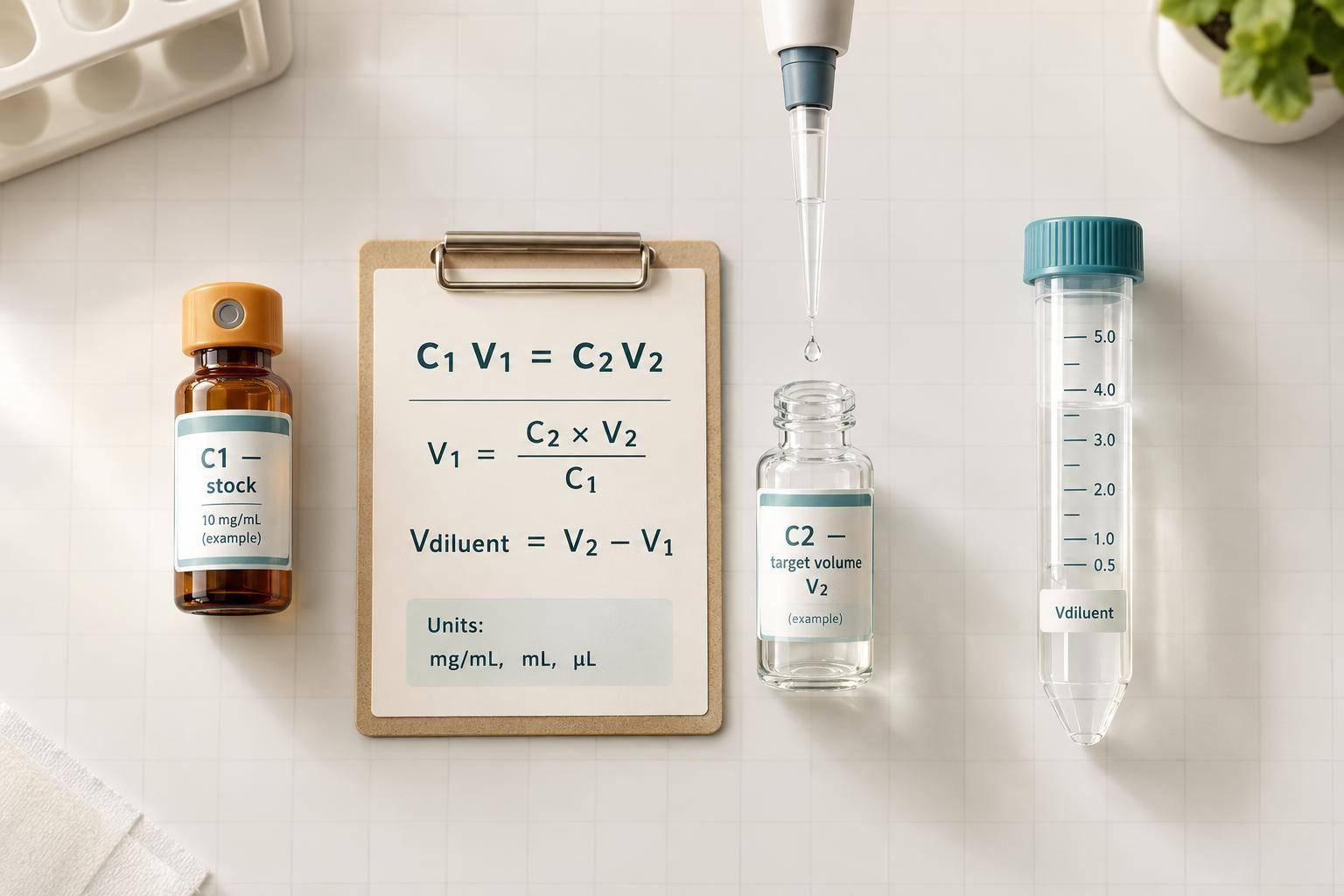
To calculate a peptide dilution, use V₁ = (C₂ × V₂) ÷ C₁ to find the stock volume needed. Then subtract that volume from the total final volume to find the diluent amount, assuming volumes are additive.
For example, making 4 mL at 0.5 mg/mL from a 2 mg/mL stock requires 1 mL of stock plus 3 mL of diluent.
Before accepting the result:
- Match units: 1 mg = 1,000 mcg.
- Check the target: Adding diluent cannot increase concentration.
- Verify the math: C₁V₁ and C₂V₂ should give the same peptide amount.
- Follow product-specific instructions: The equation does not confirm sterility, stability, or diluent compatibility, and it does not replace reconstitution instructions.
Record the inputs and results, and use calculators only as a secondary check.
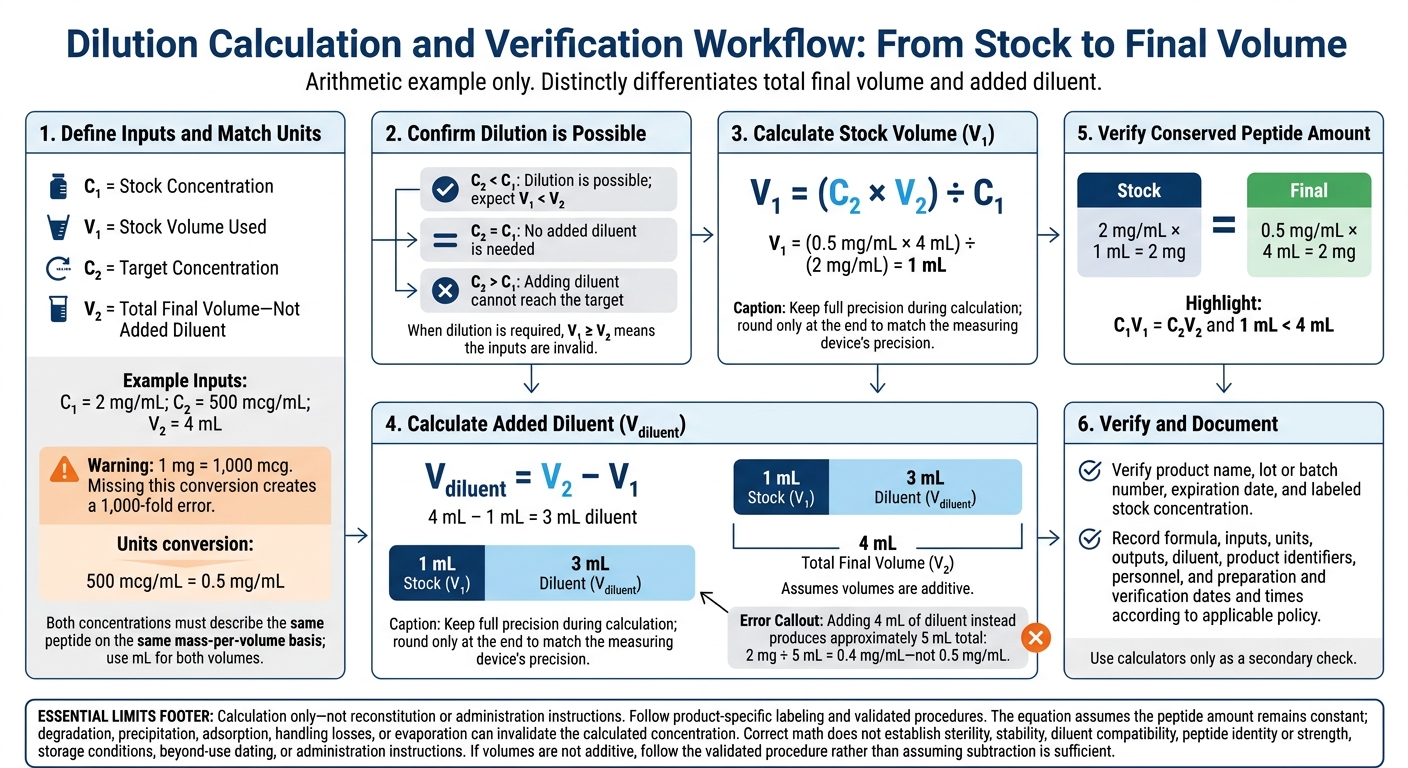
Peptide Dilution Calculations: C₁V₁ = C₂V₂
The C1V1 = C2V2 Equation Explained
sbb-itb-7164bd9
Understand C1V1 = C2V2 and Its Limits
Before calculating, check that the task is a dilution - not a preparation step with different instructions.
C₁V₁ = C₂V₂ works only when the amount of peptide stays constant during dilution. Degradation, precipitation, adsorption to equipment, and other handling losses can make the calculated concentration inaccurate. Evaporation can also change the volume.
Define the Variables and Match Units
C₁ and V₁ are the starting concentration and stock volume used. C₂ and V₂ are the final concentration and total final volume. V₂ is not the amount of diluent added.
Match the concentration units and use mL for both volumes. 1 mg = 1,000 mcg. Missing that conversion creates a 1,000-fold error. Both concentrations must refer to the same peptide and use the same mass-per-volume basis.
Check Whether Dilution Is Possible
Once the units match, check whether dilution can reach the target.
For dilution, C₂ < C₁ and V₁ < V₂. If C₂ = C₁, no added diluent is needed. If C₂ > C₁, adding diluent won't reach the target. Check the peptide dosing protocols or use a higher-concentration stock. When the target requires dilution, V₁ ≥ V₂ means the inputs are invalid.
Reconstitution is a separate step. Follow the product label or a validated protocol for reconstitution - not C₁V₁ = C₂V₂.
Calculate the Stock Volume
Match the concentration units, then calculate V₁ = (C₂ × V₂) / C₁.
Write down the formula, the substituted values, and the result with its unit. Keep full precision during the calculation. Round only at the end to match the measuring device’s precision.
Example: Dilute 2 mg/mL to 0.5 mg/mL
Arithmetic example only.
V₁ = (C₂ × V₂) / C₁
Use C₁ = 2 mg/mL, C₂ = 500 mcg/mL, and V₂ = 4 mL.
500 mcg/mL = 0.5 mg/mL
V₁ = (0.5 mg/mL × 4 mL) / (2 mg/mL)
V₁ = 1 mL
Units cancel to mL. So V₁ = 1 mL in a 4 mL final volume.
Check That Peptide Amounts Match
Verify by comparing C₁V₁ and C₂V₂.
Stock: C₁V₁ = 2 mg/mL × 1 mL = 2 mg
Final solution: C₂V₂ = 0.5 mg/mL × 4 mL = 2 mg
V₁ < V₂, which fits dilution.
Next, subtract V₁ from V₂ to get the diluent volume.
Calculate Added Diluent and Check for Errors
After solving for V₁, calculate the added diluent using V_diluent = V₂ − V₁, provided the volumes are additive. V₂ is the final total volume, and V₁ is the stock volume.
Continuing the arithmetic example: V_diluent = 4 mL − 1 mL = 3 mL. Adding 4 mL of diluent instead would produce approximately 5 mL. The resulting concentration would be 2 mg ÷ 5 mL = 0.4 mg/mL, below the intended 0.5 mg/mL.
Separate Added Diluent from Final Volume
When volumes are additive, stock volume + added diluent = final volume. If that assumption doesn’t apply to your preparation, follow its validated procedure.
The equation does not confirm diluent compatibility. Check that the diluent is approved for the specific peptide, route, formulation, and procedure. Follow the applicable product information or pharmacy instructions. Correct math alone does not establish sterility or stability.
Avoid Common Calculation Errors
Check the subtraction result before measuring.
| Error | Consequence | Corrective Check |
|---|---|---|
| Treating V₂ as added diluent | Final volume is too large, and concentration is too low. | Calculate V_diluent = V₂ − V₁. |
| Rounding too early | Measured volume and final concentration can shift from the target. | Keep extra precision until the final measurement. Round only when the device and procedure justify it. |
| Unverified stock concentration | Final concentration may be wrong even when the math is correct. | Verify the stock concentration against the approved label or record. |
Conclusion: Verify and Document Results
Complete the Verification Checklist
Before accepting the calculated stock and added diluent volumes, confirm the product name, lot or batch number, expiration date, and labeled stock concentration. Check that the units are compatible. Then verify the math both ways: confirm C₁V₁ = C₂V₂ and calculate V₍diluent₎ = V₂ − V₁.
Record the formula, inputs, units, outputs, diluent, product identifiers, personnel, and preparation and verification dates and times according to applicable policy.
Use Calculators for Secondary Checks
Use calculators only as a secondary check, after manual verification. Licensed healthcare professionals can use PeptidePrescriber calculators to double-check unit conversions and reconstitution. Reconstitution tools do not replace stock-to-target dilution calculations.
Manual calculation and product-specific protocol verification remain the primary checks. Calculator output does not establish sterility, compatibility, peptide identity or strength, storage conditions, beyond-use dating, or administration instructions. Verify each against applicable labeling and validated procedures.
Keep both formulas visible for quick review.
Keep Both Formulas at Hand
C₁ is the stock concentration, C₂ is the target concentration, and V₁ is the stock volume. V₂ is the total final volume - not the added diluent. Use V₂ − V₁ only when volumes are additive.
[ V_1 = \frac{C_2 \times V_2}{C_1} ]
[ V_{\text{diluent}} = V_2 - V_1 ]
FAQs
What if my calculated stock volume is too small to measure?
Stop and check with a pharmacist or supervising clinician before proceeding. Do not estimate or round the volume. Even small measurement errors can affect the dose.
When planning, choose a volume of bacteriostatic water that makes the dose easy to measure using standard syringe markings. Ideally, aim for 10–50 U-100 units per draw. A 0.3 mL syringe can help measure smaller doses more precisely.
How do I calculate a serial peptide dilution?
For each dilution step, use C1V1 = C2V2, where:
- C1 is the stock concentration: peptide mass ÷ solution volume, in mg/mL.
- V1 is the volume of stock solution to transfer.
- C2 is the target lower concentration.
- V2 is the total final volume.
Calculate the stock volume with V1 = (C2 × V2) ÷ C1, then add diluent equal to V2 − V1. Keep concentration and volume units consistent throughout the calculation.
How do I find the concentration after adding too much diluent?
Adding too much diluent lowers the concentration, but it doesn’t change the total amount of peptide. Calculate the new concentration using this formula:
Concentration (mg/mL) = Total Peptide (mg) ÷ Final Volume (mL)
Use the final solution volume, not just the amount of diluent added.
Then use the new concentration to recalculate your injection volume:
Injection Volume (mL) = Prescribed Dose (mg) ÷ New Concentration (mg/mL)