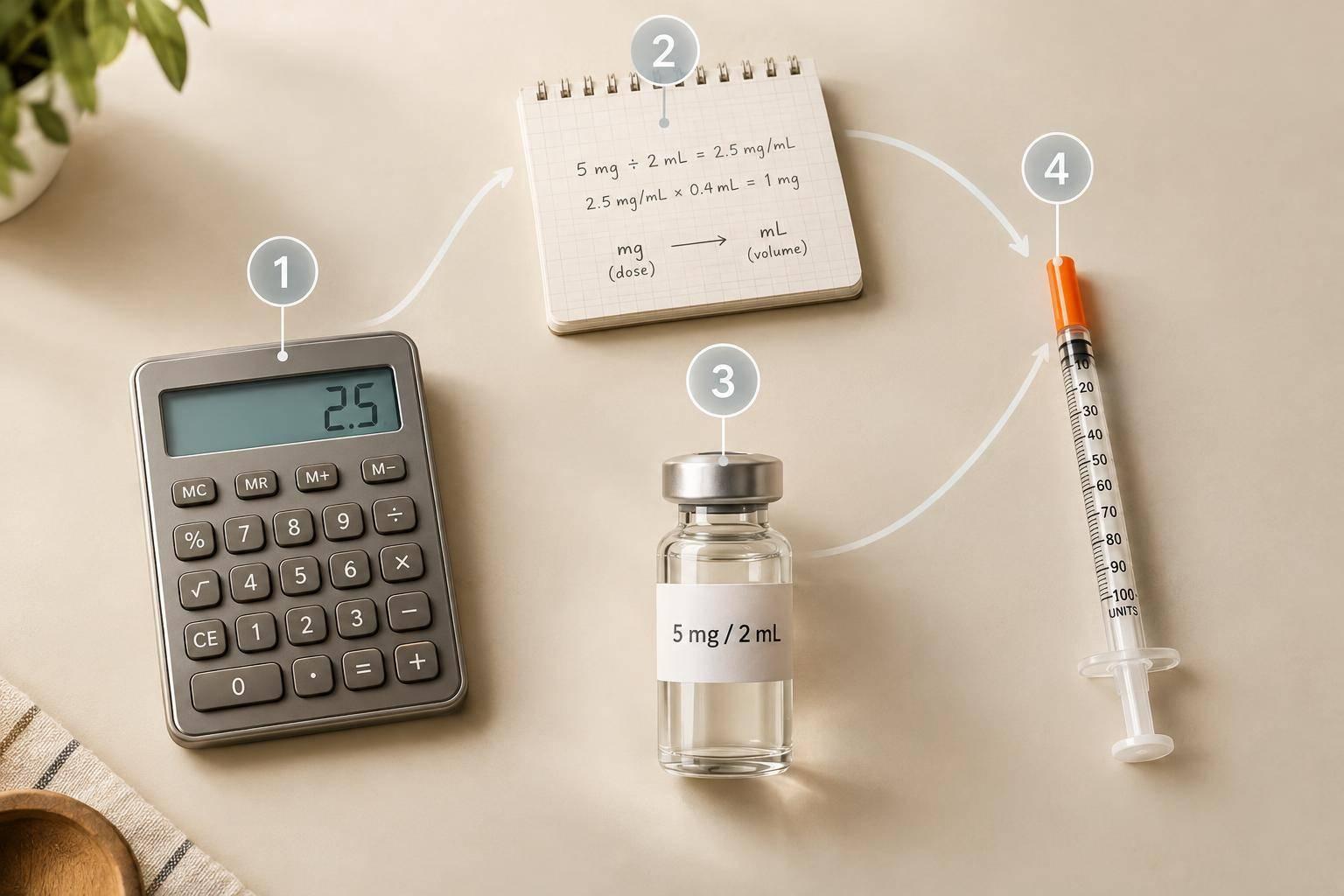
I calculate injection volume by dividing the prescribed dose by the verified concentration - with matching mass units. Syringe markings measure volume, not peptide mass: on a U-100 syringe, 20 units = 0.2 mL, not 20 mcg.
Here’s the check I use:
- Verify the inputs: vial content, final solution volume, prescribed dose, and syringe scale.
- Do the math: calculate concentration, match mg or mcg, then calculate mL.
- Check before use: confirm the device, route, preparation instructions, storage, and beyond-use date; document the preparation and get an independent check when required.
Correct math does not confirm that a product or dose is safe, sterile, or legal. <u>If any input is unclear, I stop and check with the pharmacist or prescriber before drawing up the dose.</u>
Peptide Dosing for Beginners (Stop Guessing!)
sbb-itb-7164bd9
Step 1: Calculate the Solution Concentration
Peptide Concentration vs. Injection Volume
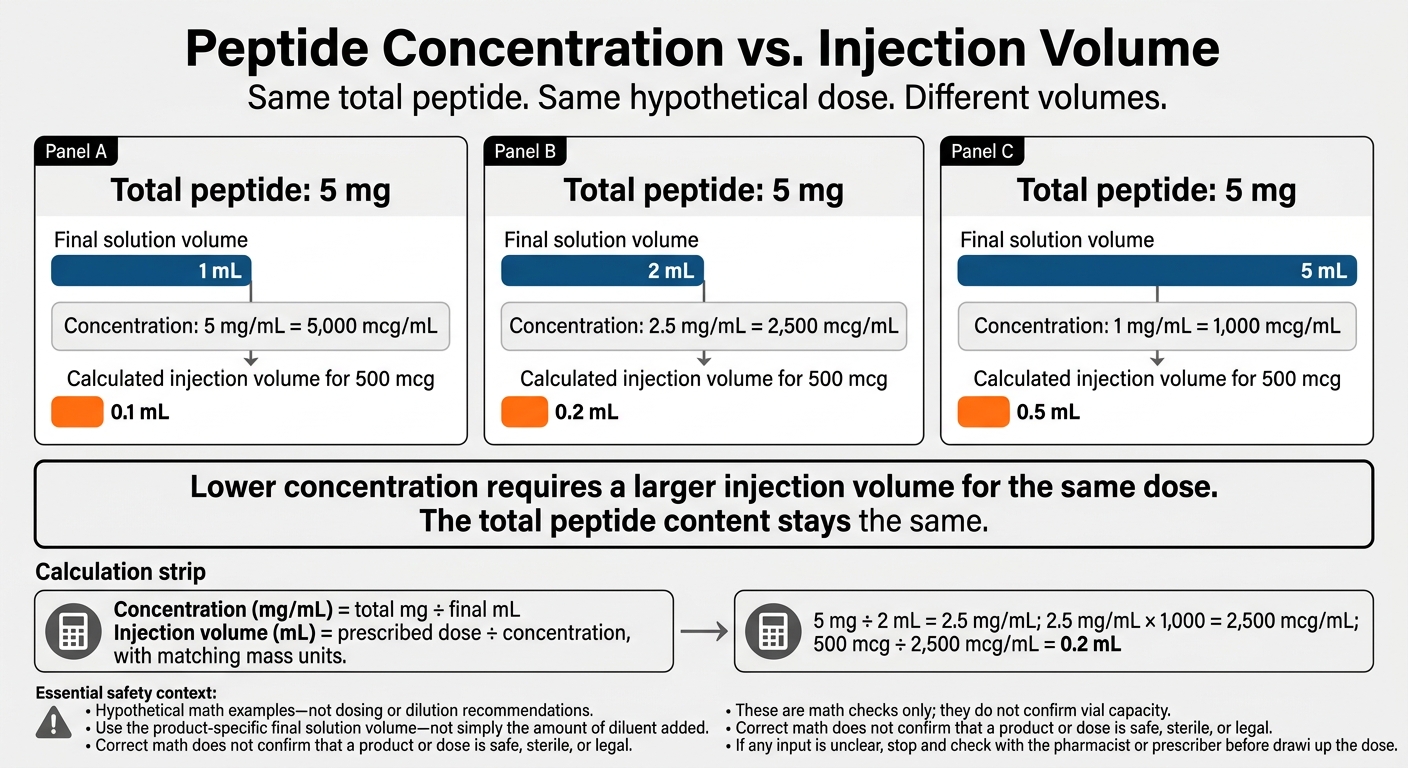
Once you’ve confirmed the vial content and final volume, calculate concentration: mg/mL = total mg ÷ final mL. Use the product-specific final volume - not simply the amount of diluent added.
Calculate mg/mL and mcg/mL From a 5-mg Vial
For a hypothetical 5-mg vial with a final volume of 2 mL:
5 mg ÷ 2 mL = 2.5 mg/mL
2.5 mg/mL × 1,000 = 2,500 mcg/mL
Each 0.1 mL therefore contains 250 mcg.
This calculates concentration only, not a dose.
Displacement or formulation factors can make the final volume different from the amount of diluent added. Always use the stated final volume.
Compare Final Volume and Injection Volume
A larger final volume lowers concentration; a smaller final volume increases it. The total peptide content stays the same.
The table shows how final volume affects the injection volume for a hypothetical 500-mcg dose. Calculate it using injection volume (mL) = prescribed dose ÷ concentration, with matching mass units.
| Total peptide | Final solution volume | Concentration | Injection volume for 500 mcg |
|---|---|---|---|
| 5 mg | 1 mL | 5 mg/mL = 5,000 mcg/mL | 0.1 mL |
| 5 mg | 2 mL | 2.5 mg/mL = 2,500 mcg/mL | 0.2 mL |
| 5 mg | 5 mL | 1 mg/mL = 1,000 mcg/mL | 0.5 mL |
These are math checks only; they do not confirm vial capacity. To check whether the results make sense, remember that a lower concentration requires a larger injection volume for the same dose.
Use this concentration in Step 2 to convert the prescribed dose to mL.
Step 2: Convert the Prescribed Dose to mL
Using the concentration from Step 1, calculate the volume to draw: mL = prescribed dose ÷ concentration.
Calculate the Same Dose Volume Using mcg and mg
Continuing with the hypothetical preparation from Step 1, a prescribed 500-mcg dose can be calculated three ways:
Using mcg: 500 mcg ÷ 2,500 mcg/mL = 0.2 mL
Using mg: 0.5 mg ÷ 2.5 mg/mL = 0.2 mL
Using desired-over-have: (0.5 mg ÷ 5 mg) × 2 mL = 0.2 mL
All three methods should give 0.2 mL. If they don't, recheck the units, transcription, and concentration.
Check Units and Measurement Precision
Include units in your calculation: 500 mcg × (1 mL ÷ 2,500 mcg) = 0.2 mL. The mcg units cancel, leaving mL. If your setup doesn't leave mL, correct it before preparing the dose.
Keep full precision during intermediate steps. Round only the final volume according to syringe markings and policy. If you can't measure the volume accurately, pause and consult the pharmacist or supervising clinician. Don't improvise a dilution.
Document 0.5 mg and 0.2 mL, using a leading zero and no trailing zeros. ISMP recommends leading zeros and avoiding unnecessary trailing zeros to reduce decimal-point errors.
Use this volume in Step 3 to read the syringe correctly. This ensures accuracy during the injection procedure.
Step 3: Check the Syringe Reading
Convert mL to a U-100 Syringe Reading
Use the volume in mL from Step 2 to check the syringe reading. Confirm the syringe’s calibration, capacity, graduation interval, and suitability for the prescribed route.
U-100 units = mL × 100.
0.2 mL = 20 units.
This conversion applies only to U-100 syringes. Document the dose in mg or mcg and mL. Use the syringe reading only as a draw-up check.
Correct Common Dose Calculation Errors
Check for these errors before drawing the dose. Even if the syringe reading looks familiar, verify the current concentration.
Error Incorrect Correct Confusing markings with mass Calling a U-100 reading of 20 “20 mcg” 20 units = 0.2 mL; the delivered dose depends on concentration. Using the wrong calibration Applying mL × 100 to any syringe Use this conversion only for U-100; read other devices according to their own calibration. Rounding upward unsafely Rounding 125 mcg ÷ 2,500 mcg/mL from 0.05 mL to 0.1 mL 0.05 mL is the calculated volume; 0.1 mL delivers 250 mcg - double the dose.
If the syringe reading is unclear or the volume is too small to measure accurately, stop and recheck the calculation.
Complete the Final Check and Document Preparation
Before administration, work through these checks in order:
- Verify the peptide identity, vial strength, and vial content against the order.
- Confirm the prescribed dose, diluent identity, amount added, preparation instructions, and final volume.
- Verify the prepared concentration and draw-up volume against the order.
- Check the device calibration, graduation interval, and whether the volume can be measured reliably. Stop for guidance if it cannot.
- Recheck the route, frequency, dose limits, patient restrictions, storage, beyond-use, and expiration information.
- Use an independent double-check for unfamiliar or high-alert preparations. The second clinician must calculate separately. Label and document the preparation before use.
Document the vial content, diluent and volume added, final volume, concentration, prescribed dose, calculated mL, syringe calibration and reading, preparation date, storage, beyond-use, and expiration information. Prepare aseptically with new sterile injection equipment.
Conclusion: Calculate, Verify, and Document
After the final syringe check, confirm that every step is complete: verify inputs, match units, calculate concentration and volume in mL, check syringe calibration and reading, get an independent check when required, and document. The result must match the authorized order.
Correct math gives you a volume. It does not establish clinical appropriateness, sterility, legality, or route suitability. Follow the authorized order, product-specific instructions, and current U.S. legal and pharmacy requirements. Compounding alone does not establish legality or suitability.
Use Clinical References With Calculation Tools
Clinical references and calculation tools can help clinicians verify calculations and document their work. Licensed clinicians can use PeptidePrescriber for monographs, dosing protocols, calculators, injection guides, and regulatory references.
These tools support verified inputs and clinical judgment. They do not replace prescriber authority, product instructions, independent checks, or current U.S. regulatory requirements.
If an input is uncertain, resolve it before drawing up the dose.
FAQs
How do I verify a vial’s final volume?
Record the exact volume of bacteriostatic water added during reconstitution. The concentration depends on both the peptide mass and the diluent volume. Label the vial with its concentration and reconstitution date right away.
Recalculate the volume to draw for each new vial, even when the prescribed dose stays the same. Diluent volumes provided by pharmacies can vary. Check your manual calculations against a verified reconstitution calculator regularly.
What if my calculated volume falls between syringe markings?
Do not estimate or round the measurement yourself. Even small measurement errors can greatly affect the dose when working with small volumes. Ask a pharmacist or clinician whether you need to change your technique or equipment.
When planning, choosing an amount of bacteriostatic water that makes the dose easy to measure with standard syringe markings can help prevent this problem.
Should I recalculate when switching pharmacies?
Yes. Always recalculate how much to draw into your insulin syringe when switching pharmacies. Your prescribed dose in milligrams may stay the same, but a different amount of bacteriostatic water can change the solution’s concentration - and the volume you need. Before administering your dose, check the new concentration and calculate the syringe units needed for your specific vial to avoid dosing errors.