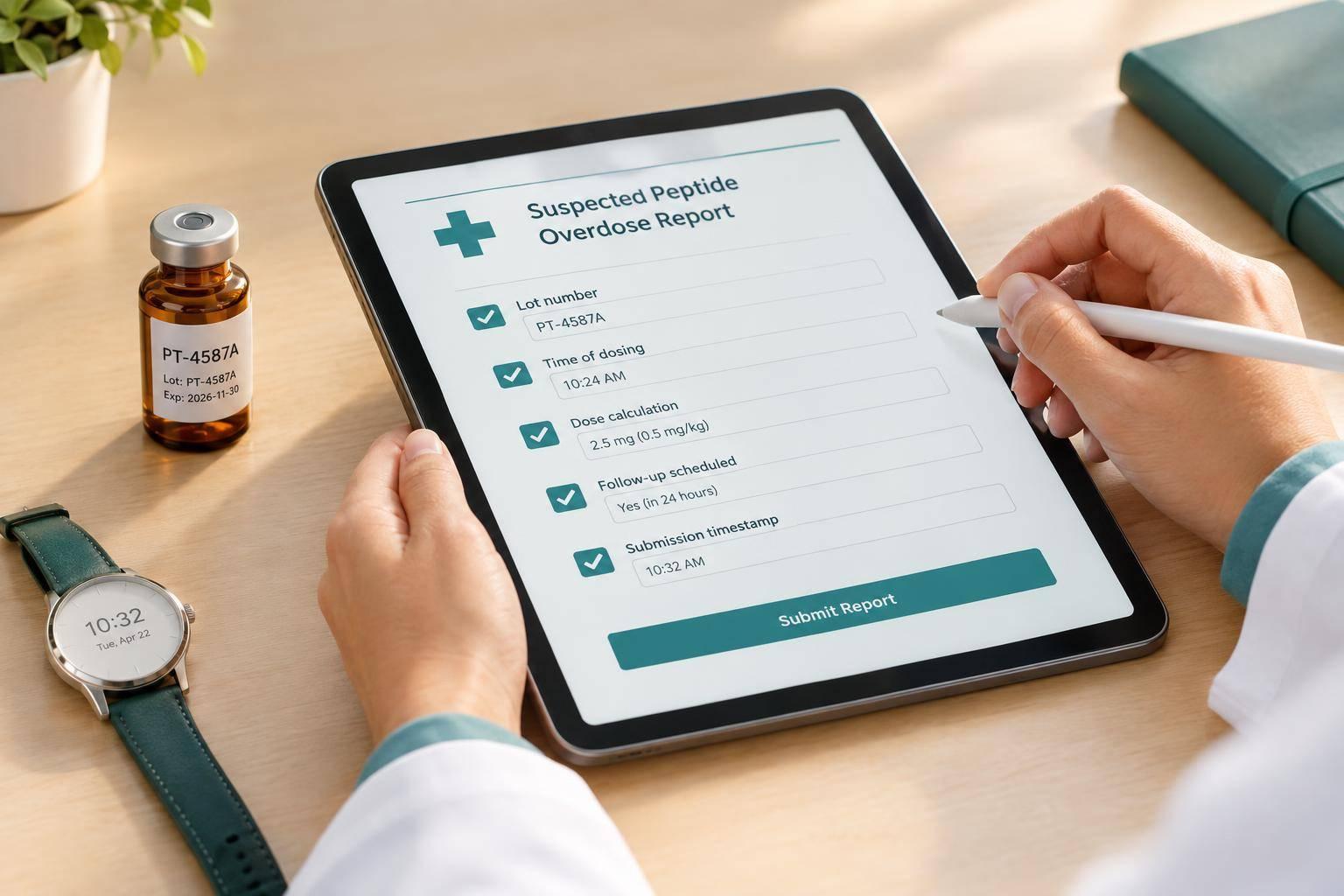
I put patient care first, then report the facts available without waiting for a finished review. If you’re documenting a peptide overdose, separate the prescribed peptide dosing protocols from the amount received - and describe symptoms without assuming the overdose caused them.
I check for 5 common reporting errors:
- Missing product details: Record the exact product, source, lot number, and expiration date. Keep the vial, label, and related records.
- Unclear timing: List dose times, symptom onset, treatment, and follow-up. Mark estimated times.
- Incomplete dose math: Include concentration, volume, device markings, and total amount received in mg or mcg.
- Missing follow-up: Record treatment response, current status, and the next contact date.
- Delayed reporting: Submit available facts through the appropriate channels, then update the original case.
My rule: <u>report now, verify gaps, and add updates</u>. Use unknown or estimated rather than guessing. Internal reports do not replace external submissions, and the 15-calendar-day FDA deadline for certain 503B facility reports does not apply to every prescriber.
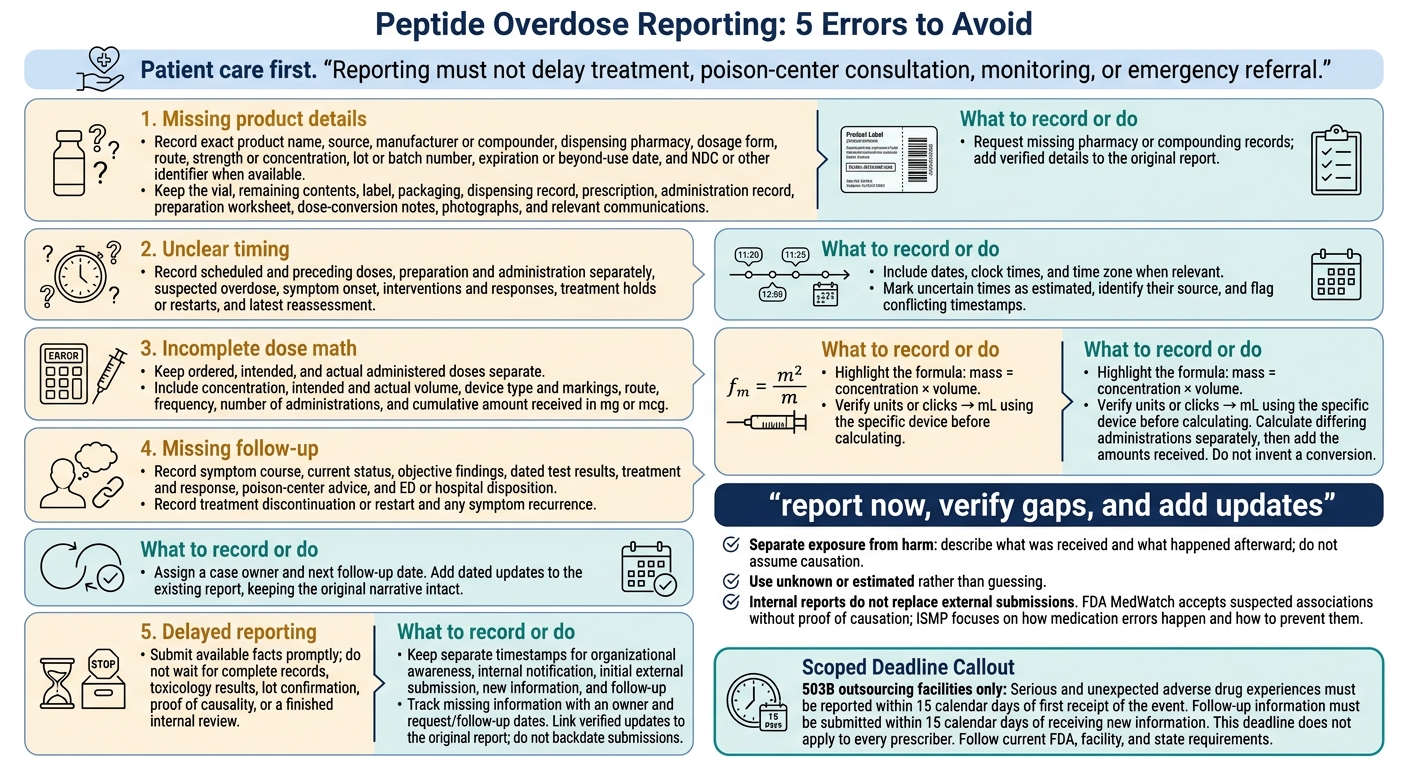
Peptide Overdose Reporting: 5 Errors to Avoid
Reporting Basics: Exposure, Harm, and Reporting Channels
Stabilize the patient first. Reporting must not delay treatment, poison-center consultation, monitoring, or emergency referral. Document the assessment, treatment, disposition, and follow-up in the medical record.
Separate exposure from harm in every report: describe what the patient received, then what happened afterward. FDA MedWatch accepts suspected associations without proof of causation. Report what you observed; do not infer causation.
Report the actual amount administered or taken - not just the intended dose - to FDA MedWatch. Include frequency, route, exact dates, and clock times, adding the time zone when relevant. Health professionals can submit reports through online MedWatch or Form FDA 3500.
ISMP’s Medication Errors Reporting Program focuses on how errors happen and how to prevent them. It requests the medication identity, manufacturer when known, dosage form, strength or concentration, dose, contributing factors, and prevention strategies. Describe where the process failed and list steps to prevent the error.
Keep clinical records, internal safety reports, and external reports separate. An internal report does not replace a MedWatch or ISMP submission. Follow institutional policy and any reporting requirements that apply to manufacturers or other regulated entities. The most common failure is incomplete product traceability, often stemming from a lack of understanding peptide therapy fundamentals and clinical oversight.
sbb-itb-7164bd9
1. Missing Lot Numbers and Product Details
Common Omissions
Traceability starts with the label and batch details. Reports often leave out the exact label name, dosage form, route, strength or concentration, manufacturer or compounder, dispensing pharmacy, lot or batch number, expiration or beyond-use date, compounded status, and NDC or other identifier.
Effects on Clinical and Safety Review
Without product and lot details, reviewers can't confirm the formulation, source, or batch-specific risk. They also can't connect reports involving the same batch.
What to Document
Record the exact label name. Retrieve label, batch, and compounding records to fill gaps in traceability.
Keep the vial, remaining contents, label, packaging, and dispensing record. Also retain the prescription, administration record, preparation worksheet, dose-conversion notes, photographs, and relevant communications.
Don't discard or relabel the product before review. Document where it's stored and any transfers.
How to Correct the Report
Request missing records from the dispensing pharmacy or compounder. Submit what you have, then add verified details under the original report reference. Note who verified each change and which source they used.
Once the product record is complete, check the event timeline next.
2. Unclear Event Timelines
Common Omissions
Complete product details don’t make up for unclear timing, which can still block review. Reports often leave out the prescribed schedule, preceding dose timing, symptom onset, interventions, treatment holds or restarts, and latest reassessment date. Record preparation and administration times separately.
Effects on Clinical and Safety Review
Exact timing helps reviewers tell whether symptoms followed the overdose, repeat dosing, or a treatment interruption. They also need to know whether symptoms improved while treatment was held or returned after it restarted.
What to Document
Create a chronological record covering scheduled administration, the preceding dose, preparation, the suspected overdose, first symptoms, elapsed time to symptom onset, interventions and responses, and treatment holds or restarts. Finish with the latest assessment date, current symptoms, relevant test results, and treatment status.
How to Correct the Report
Label uncertain times as estimates and name the source, such as patient recall or an administration record. Use the patient’s local time zone. Flag conflicting timestamps instead of quietly choosing one, and make clear which entries were revised or confirmed.
FDA MedWatch accepts actual or best-estimate dates. If exact dates aren’t available, use a duration such as 1 dose or 1 hour for an IV. Add the best available chronology to the narrative without making the timing seem more precise than it is. Submit the report now, then add verified timestamps later.
3. Incomplete Dose and Unit Details
Once timing is clear, the next place to check is dose math.
Common Omissions
Reports often combine the ordered, intended, administered, and total received doses into one field. Without the concentration, device scale, intended and actual volume, or number of administrations, the exposure is unclear. Units, clicks, or mL alone do not tell reviewers how much peptide was delivered. Record the device type, size, and markings, along with any amount spilled, used for priming, left in the device, or administered more than once.
Effects on Clinical and Safety Review
Missing details make it hard to distinguish a concentration mismatch from a measurement error or duplicate dose. That limits dose-response review and makes monitoring decisions harder.
What to Document
Keep the prescription, prepared dose, and administered dose separate. Include reconstitution or dilution instructions, who prepared the product, and where each value came from. FDA MedWatch requests strength, dose or amount, frequency, and route.
Incomplete entry versus report-ready entry
Field Incomplete entry Report-ready entry Dose per administration “Extra dose” Ordered dose; intended dose; actual administered dose in mg or mcg Concentration Strength omitted Labeled or prepared concentration in mg/mL or mcg/mL, with product and preparation source Volume “One syringe” Intended and actual volume in mL; device type, size, and markings Route “Injection” Specific route; injection site when relevant Frequency “Regular dose” Prescribed interval, actual interval, number of administrations, and any duplicate or missed doses Total amount “Overdose” Cumulative received amount across all administrations, with formula and uncertainty
How to Correct the Report
Calculate mass = concentration × volume. For units or clicks, verify the device conversion to mL first. If concentrations or volumes differed, calculate each administration separately, then add the amounts received. Mark uncertain values as estimated or unknown and explain the basis for each estimate. Do not invent a conversion. Use metric units consistently, and avoid unsafe abbreviations or unclear decimal notation.
Submit corrected fields and supporting records through the same reporting channel. Link them to the original report number or submission date. Keep the original report and note any changes to the exposure estimate or clinical interpretation.
4. Missing Clinical Follow-Up Details
Common Omissions
Once exposure details are recorded, reviewers need to know what happened afterward. Reports often leave out the symptom course, objective findings, vital signs, labs or imaging, treatment response, poison-center advice, and emergency department (ED) or hospital disposition. FDA guidance recommends documenting signs and symptoms, clinical course, treatment, outcome, and supporting hospital or office records.
Effects on Clinical and Safety Review
Without follow-up data, reviewers may not know whether the event resolved, worsened, led to hospitalization, or continued. These gaps also make it harder to separate overdose effects from underlying disease, interactions, product problems, or unrelated illness.
What to Document
Record how symptoms progressed, resolved, or recurred, along with their current status. Include objective findings, vital signs with units and collection times, and labs or imaging with dates and times. Document any poison-center, ED, or hospital care, plus each post-event treatment’s name, dose, route, timing, and response. For outside care, include the facility, contact date and time, advice or interventions, and admission or discharge status.
Also document whether the peptide was discontinued or restarted. If restarted, record the date, dose, reason, and any symptom recurrence. Include concomitant medications and relevant conditions, such as diabetes, kidney disease, liver disease, pregnancy, or dehydration. Every follow-up contact should include the date, method, author, source, unresolved questions, and next step.
How to Correct the Report
Assign a case owner and set the next follow-up date. Add findings to the existing report through dated corrections or addenda, keeping the original narrative intact. Do not close an unresolved case as unknown. Keep it open until the outcome is confirmed or failed follow-up is documented. Submit the information available promptly, then update the report as follow-up continues. Do not delay reporting for internal review.
5. Reporting Delays During Internal Review
The final common error is waiting until internal review is complete to report an event.
Common Delays
Teams often hold reports while waiting for a complete record, toxicology results, pharmacy confirmation, lot data, or a final causality assessment. Do not wait. Treat the patient, notify internal safety staff, and submit external reports in parallel.
Effects on Clinical and Safety Review
Delays can hide problems with the product, concentration, labeling, preparation, or administration that may affect other patients, including those who did not meet patient selection criteria. Records may be overwritten, and samples may be discarded. For outsourcing facilities, missing a reporting deadline may also lead to a Form FDA 483 inspection observation.
What to Document
Keep separate timestamps for symptom onset, clinical escalation, internal notification, first organizational awareness, initial external submission, receipt of new information, and follow-up submission.
Record who was notified and when. Clearly mark exposure details that have not been verified. Keep a missing-information log that names an owner and includes a request date and follow-up date for each missing item.
How to Correct the Report
Submit verified facts now, even if the review is incomplete. Add new details later. If reporting was delayed, state when the organization first learned of the event and briefly explain that additional details were pending internal review. Do not backdate the submission. Send newly confirmed details as updates, keeping the original record intact.
For 503B outsourcing facilities, serious and unexpected adverse drug experiences must be reported within 15 calendar days of first receipt of the event. Follow-up information must be submitted within 15 calendar days of receiving new information. This deadline does not apply to all prescribers. Follow current FDA, facility, and state requirements, and link updates to the original report.
Peptide Overdose Reporting Checklist
Gather these minimum facts before filing, then update the report as you verify more details.
- Patient assessment and evidence: Document the patient’s condition, treatment, and disposition before submitting. Include symptoms, vital signs, lab results, history, and concomitant medications. Keep the vial, label, packaging, delivery device, dispensing record, prescription, preparation records, photographs, and relevant EHR records. Do not alter, discard, or return these materials until you receive appropriate instructions.
- Exposure and product verification: Record intended and actual exposure separately. Include dose (mg or mcg), concentration, volume, units, route and administration, frequency, and administrations. Document the product name, formulation, strength, manufacturer or compounder, pharmacy, lot number, expiration or beyond-use date, and product identifiers.
- Timeline and clinical course: Document the sequence: prescribing → dispensing → reconstitution → administration → symptom onset → assessment → treatment → follow-up. Include dates, times, time zones, treatment doses, consultations, test results, and disposition.
- Follow-up: Record the patient’s current status and next follow-up date. Add verified test results, treatment responses, and outcomes to the original report.
- Reporting and updates: Follow your institution’s reporting steps, notify the pharmacy or compounder, and promptly file FDA MedWatch or required state reports. Keep the reporter’s contact details, submission, and case number. File the initial report first, then add verified details to the original case.
Conclusion: Report Promptly and Update Follow-Up
These gaps weaken review and delay action. Create one traceable report that links the product, dose, clinical course, and follow-up.
Patient care comes first. Report a suspected overdose or adverse event to FDA MedWatch without waiting for proof of causality or an internal review. Mark uncertain details as unknown, estimated, or pending.
Submit the facts you have now. Then update the original report with confirmed lot data, corrected exposure details, and clinical changes as new facts are verified.
FAQs
Should I report a peptide overdose if no symptoms occur?
Yes - document a peptide overdose even if there are no symptoms. Medication errors, including incorrect doses, belong in your internal adverse event log because they depart from the prescribed treatment plan.
Record the dose, lot number, and absence of symptoms. These details help maintain a complete clinical history, support internal quality reviews, and help ensure compliance and patient safety.
How do I report conflicting dose records?
Keep the original entry visible. Add a dated, signed update that explains the discrepancy and why you made the correction. Make sure your electronic record system keeps an audit trail of both entries. If the conflict remains unresolved, document the steps you took to investigate it and why the discrepancy remains.
PeptidePrescriber offers clinical resources and dosing protocols to help healthcare professionals standardize documentation and reduce reporting errors.
Who handles reporting when multiple providers are involved?
Your clinic’s written policy must name the person responsible for submitting reports. This could be the medical director, prescribing clinician, or safety officer.
Assign one primary contact for each case, save the confirmation number in the internal file, and maintain a follow-up tracker until the event is fully resolved. Spell out when handoffs should happen and who has reporting authority so reports aren’t delayed.