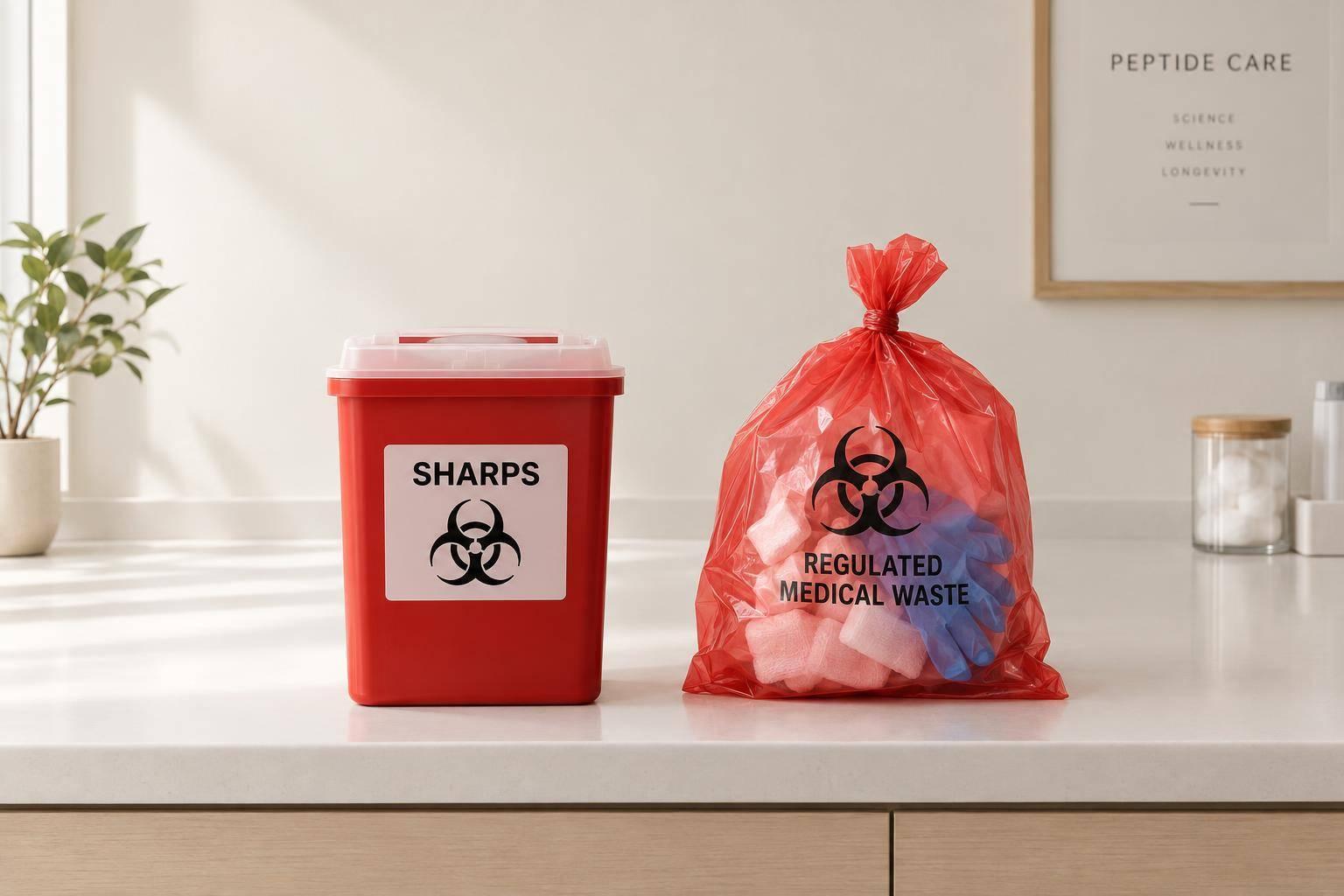
Red bags cannot replace sharps containers. I recommend sorting peptide-care waste by puncture risk first, then blood contamination and medication residue. Discard used needles and attached syringes together, without recapping, and replace sharps containers at the fill line - or 75% full if no line is marked.
Here’s the basic split:
- Sharps containers: Needles, lancets, and broken glass that could puncture a bag.
- Red bags: Non-sharp waste that meets regulated-waste criteria, such as blood-saturated gauze. Blood contact alone isn’t enough.
- Ordinary trash: Clean wrappers and other permitted, non-sharp waste.
- Pharmaceutical-waste containers: Unused peptides, leftover solution, and drug-contaminated materials, as required. Mixed hazards need an approved disposal route.
Quick Comparison
| Container | Main purpose | Keep out |
|---|---|---|
| Sharps container | Contain puncturing items in a rigid, puncture-resistant container | Soft waste and loose liquids |
| Red bag | Contain regulated non-sharp waste without leaks | Needles and broken glass |
| Ordinary trash | Collect permitted, nonregulated waste | Sharps and regulated waste |
| Pharmaceutical-waste container | Collect medication waste under drug-disposal rules | Sharps unless approved for both hazards |
<u>Keep the right containers at the point of use.</u> Refer to our clinical guides for detailed injection and handling protocols. I also recommend staff training, secure closure before transfer, and checks against OSHA requirements, state and local rules, and your clinic’s written waste plan.
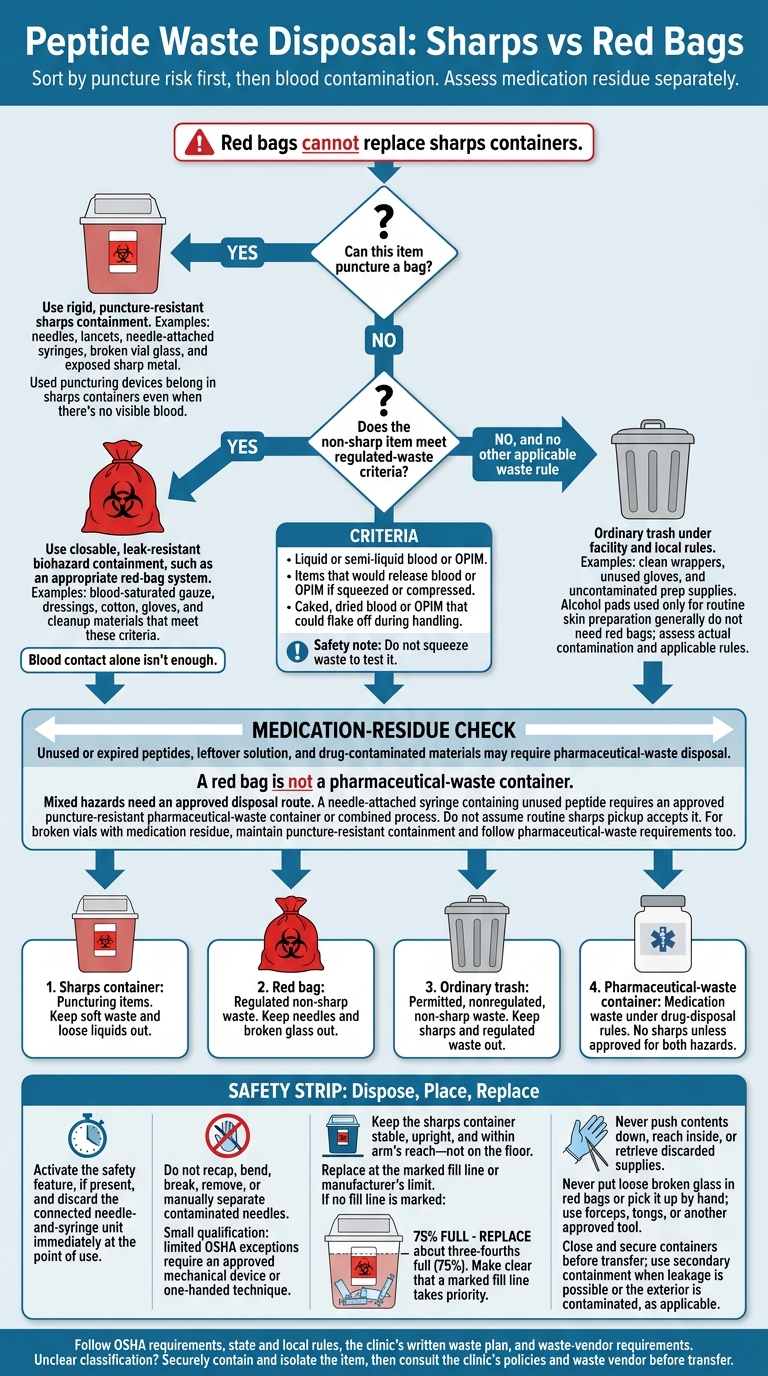
Peptide Waste Disposal: Sharps vs Red Bags
Biohazard Waste Disposal Part 1: What REALLY Belongs in a Sharps Container?
sbb-itb-7164bd9
What Goes in Sharps Containers
After separating sharps from red-bag waste, make clear which peptide-care items go in sharps containers.
Pen needles, safety needles, lancets, transfer needles, reconstitution needles, and other used puncturing devices belong in sharps containers - even when there’s no visible blood.
Dispose of Used Needles and Attached Syringes Immediately
After use, activate the safety feature, if present, and discard the entire needle-and-syringe assembly at the point of use. This also applies to syringes with attached needles used for diluent transfer. Do not recap, bend, break, remove, or manually separate contaminated needles.
OSHA permits limited exceptions only when no alternative is feasible or a procedure requires it. In those cases, use a mechanical device or a one-handed technique.
If a sterile sharp has been opened, is damaged or expired, or can’t be used for another reason, place it in the clinic’s approved sharps or medical-waste stream - not ordinary trash.
Safe disposal also depends on the container’s design, placement, and fill level.
Select, Place, and Replace Sharps Containers
Choose an FDA-cleared healthcare sharps container that is closable, puncture-resistant, leakproof on the sides and bottom, and properly labeled or color-coded. The opening must let the sharp drop in without forcing it. Secure the container upright on a stable surface or wall mount, ideally within arm’s reach of the injection or reconstitution station - not on the floor.
Replace the container at its marked fill line or the manufacturer’s limit. If there’s no fill line, replace it when it’s about three-fourths full (75%). Never push contents down, reach inside, or retrieve discarded supplies.
Close and secure the container before removal, and add secondary containment if leakage is possible. Do not reopen, empty, or hand-clean containers in ways that expose staff to puncture injuries.
What Goes in Red Bags vs Ordinary Trash
After removing sharps, sort the remaining injection waste by contamination and puncture risk.
Blood contact alone doesn’t mean an item belongs in a red bag. Use red bags only for non-sharp waste that meets regulated-waste criteria.
| Waste category | Contamination or definition | Container and handling |
|---|---|---|
| Regulated non-sharp waste | Liquid or semi-liquid blood or other potentially infectious material (OPIM); items that would release blood or OPIM if squeezed or compressed; caked, dried material that could flake off during handling | Use closable, leak-resistant biohazard containment. Close it before removal. |
| Ordinary trash | Non-sharp material that does not meet regulated-waste criteria or other applicable waste rules | Dispose of it in ordinary trash under facility and local rules. |
Red-bag examples: Blood-saturated gauze, dressings, cotton, gloves, and cleanup materials that meet regulated-waste criteria.
Ordinary-trash examples: Clean wrappers, unused gloves, and uncontaminated prep supplies.
Keep sharps out of red bags. For medication or chemical spill waste, follow facility policy and the product’s waste instructions.
Blood-Contaminated Gauze, Gloves, and Cleanup Waste
Use the criteria above - not blood contact alone - to decide whether waste needs a red bag. Do not squeeze waste to test it. Check its visible condition and whether it could release blood or OPIM during handling. State rules may require more waste to be separated.
Containment must prevent leaks during handling, storage, and transport. Close it before removal, with no spills or contents sticking out. If the outside becomes contaminated or the container could leak, place it in a closable, leak-resistant secondary container.
Clean Wrappers, Alcohol Pads, and Prep Waste
Alcohol pads used only for routine skin preparation generally don’t need red bags. Choose disposal based on actual contamination, clinic policy, and local rules.
Vial Caps, Rubber Stoppers, and Broken Glass
Clean vial caps and rubber stoppers usually belong in ordinary trash if policy allows. Contaminated stoppers need assessment under medical- and pharmaceutical-waste rules. Sharp metal parts and broken vials require sharps containment.
Never put loose broken glass in red bags or pick it up by hand. Use forceps, tongs, or another approved tool. When broken vials contain medication residue, follow pharmaceutical-waste requirements too.
Apply these same sorting rules at the point of disposal, before waste leaves the treatment area.
Waste Disposal in the Peptide Clinic
Apply the container rules above to everyday peptide clinic supplies.
Disposal Guide for Common Injection Supplies
Keep this guide at injection and reconstitution stations. Classify items by puncture risk and blood or OPIM contamination, then assess medication residue separately.
| Supply | Sharp status | Blood/OPIM contamination | Container choice | Handling instructions |
|---|---|---|---|---|
| Used needle | Sharp | Possible or present | Sharps container | Discard immediately in a sharps container. |
| Needle-attached syringe | Sharp | Possible or present | Sharps container | Discard the connected unit immediately in a sharps container. |
| Syringe barrel without a needle | Usually non-sharp | Variable | Ordinary trash or red bag | Check whether it meets regulated-waste criteria. |
| Unused sterile needle, lancet, or similar sharp | Sharp | Usually absent | Appropriate sharps container | Keep packaged when possible. |
| Intact plastic vial cap | Non-sharp | Usually absent | Ordinary trash or red bag | Check for contamination before disposal. |
| Broken vial glass or exposed metal | Sharp | Variable | Sharps container | Contain without further handling. |
| Rubber stopper | Non-sharp | Variable | Ordinary trash or red bag | Check for contamination before disposal. |
| Broken vial | Sharp | Variable | Sharps container or approved rigid broken-glass container | Use tools, not hands. |
| Gauze | Non-sharp | Variable | Ordinary trash or red bag | Check whether it meets regulated-waste criteria. |
| Alcohol pad | Non-sharp | Usually absent after skin prep | Ordinary trash or red bag | Check whether it meets regulated-waste criteria. |
| Gloves | Non-sharp | Variable | Ordinary trash or red bag | Check whether it meets regulated-waste criteria. |
| Clean vial wrapper | Non-sharp | Absent | Ordinary trash or accepted recycling | Keep packaging separate from regulated waste. |
| Cleanup materials | Depends on contents | Variable | Container for the specific hazard | Use the container designated for that hazard. |
State, local, and facility rules can override this guide.
Medication-residue exception: A red bag is not a pharmaceutical-waste container. Unused or expired peptides, leftover solution, and drug-soaked cleanup materials may need pharmaceutical disposal instead. Mixed hazards need special handling. For example, a needle-attached syringe containing unused peptide requires an approved puncture-resistant pharmaceutical-waste container or combined process. Don’t assume a routine sharps pickup accepts it.
After classifying items, place the required containers at the point of use.
Point-of-Use Disposal and Waste Transfer
Before treatment, place a stable, upright sharps container within arm’s reach. Have any needed red-bag or pharmaceutical-waste containers ready, too. Immediately after injection, discard the connected needle-and-syringe unit without recapping or taking it apart. Separate clean, permitted trash from contaminated soft waste and materials containing medication where the waste is generated. Never leave needles on trays, carts, countertops, or loose in the work area.
Assign a staff member to inspect containers and close and replace sharps containers at the marked fill line. If there’s no line, replace them when they’re approximately three-quarters full. That staff member should also manage required labeling, secure storage, and transfer to an authorized vendor.
If an item’s classification is unclear, securely contain and isolate it. Don’t force it through a container opening. Before transfer, consult the exposure-control plan, medical-waste policy, jurisdictional rules, and waste vendor.
Staff Training and PeptidePrescriber Resources
Document initial and periodic training on waste segregation, sharps safety, lid and mounting inspections, fill limits, and spill response. Training must also cover prompt exposure reporting and medical evaluation. Record competency checks, inspections, pickups, incidents, and corrective actions.
PeptidePrescriber provides injection guides and regulatory references to support written waste workflows. These resources do not replace waste-specific regulatory guidance, required occupational-safety training, vendor instructions, or the clinic’s exposure-control plan.
Conclusion: Choose the Correct Waste Container
A red bag does not replace a sharps container. In peptide clinics, sort waste by puncture risk first and contamination second. Handle pharmaceutical residue separately.
Discard sharps immediately. Close and replace containers when they reach the marked fill line - or about three-quarters full if there’s no line. Train staff on this workflow, and check disposal practices against state, local, facility, and waste-vendor requirements.
FAQs
What should I do if a needle ends up in a red bag?
Do not try to retrieve the needle by hand. Immediately notify your facility supervisor or designated safety officer so the waste can be handled according to your clinic’s incident-reporting protocols and safety policies.
Red bags are for biohazardous soft waste - not sharps. To prevent needlestick injuries, always place sharps directly into an FDA-cleared, puncture-resistant sharps container at the point of use.
How do I classify waste with both blood and peptide residue?
Treat waste containing both blood and peptide residue as biohazardous waste. Follow your facility’s policy and applicable state and local rules for pharmaceutical and biohazardous waste.
Place syringes or needles contaminated with blood or medication immediately into an FDA-cleared, puncture-resistant sharps container at the point of use. For blood-soiled soft materials, such as gauze, follow your clinic’s red bag waste protocols. Don’t put them in regular trash.
How can I verify my clinic’s waste vendor accepts peptide waste?
Ask your clinic’s waste vendor whether they accept “pharmaceutical/peptide waste” from clinics. Also ask where to take sealed, puncture-resistant sharps containers when they’re about 75% full. Use FDA-cleared sharps containers and follow state and local drop-off rules.
Make sure your clinic’s standard operating procedures (SOPs) match the vendor’s packaging and drop-off requirements for contaminated supplies, including injection prep waste.