
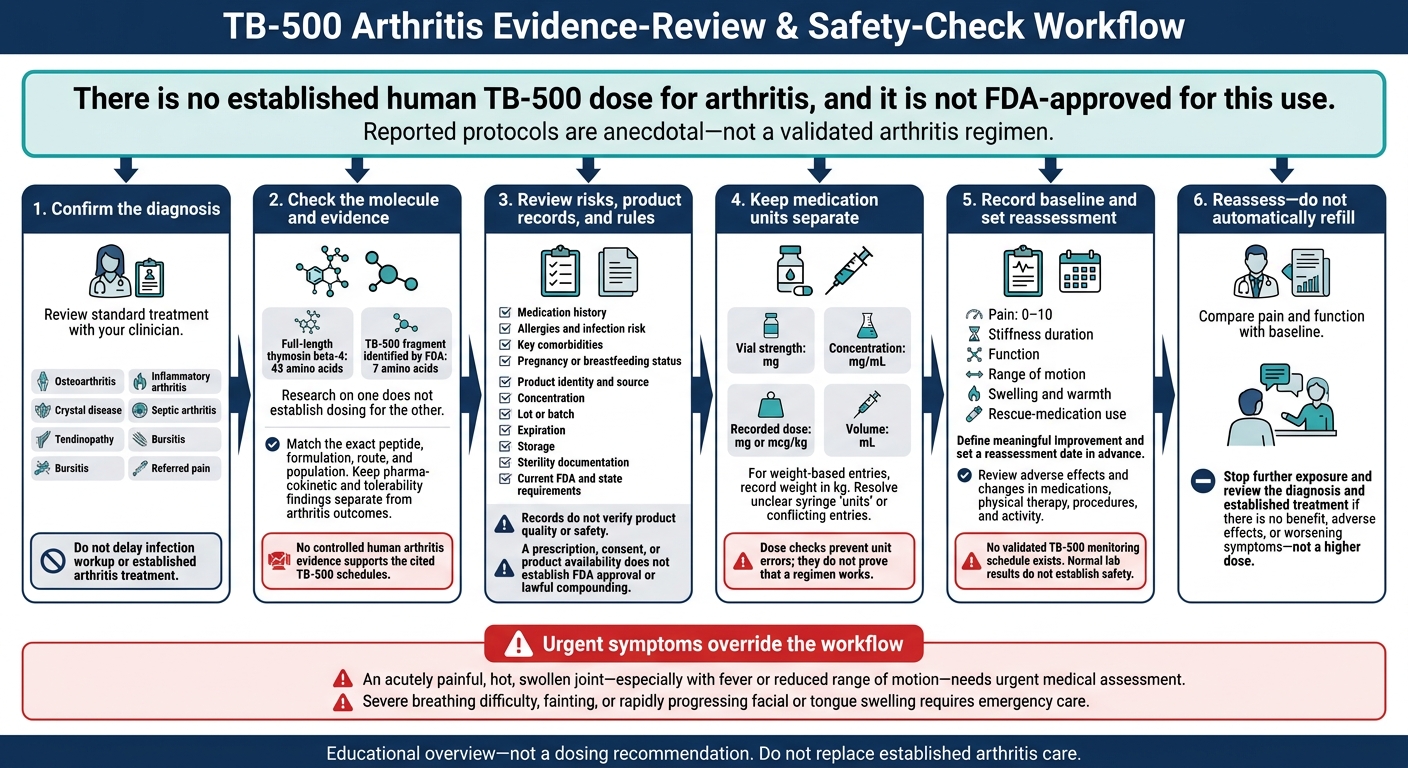
There is no established human TB-500 dose for arthritis, and it is not FDA-approved for this use. My starting point: confirm your diagnosis and review standard treatment with your clinician - not choose an injection schedule from online reports.
Here’s how I separate dosing claims from clinical support:
- Check the molecule. Full-length thymosin beta-4 has 43 amino acids; the TB-500 fragment identified by FDA has 7. Research on one does not establish dosing for the other.
- Treat reported schedules as anecdotal. “Loading,” maintenance, and intravenous, subcutaneous, or joint injections do not have a validated TB-500 arthritis regimen.
- Review risks and records. Product identity, dose units, medication history, FDA rules, and state requirements all need checking. Clinical tools and calculators do not establish safety or lawful prescribing.
- Set limits before exposure. Track pain and function, plan reassessment, and stop for adverse effects or lack of improvement. Normal lab results do not prove safety.
<u>A hot, swollen joint, fever, or severe new pain needs prompt medical evaluation - not a higher dose.</u> I use these limits to frame the dosing discussion without replacing established arthritis care.
TB-500 and Arthritis: Evidence and Safety Checks
Reported Dosing Schedules, Routes, and Phases
Published Studies and Reported Schedules
These schedules describe reported practice - not an established arthritis regimen. Community reports commonly describe 2–2.5 mg injected subcutaneously twice weekly for 4–6 weeks, then weekly or less often. Some anecdotal sources describe lower doses of 1–1.5 mg twice weekly.
| Source category | Peptide identity | Formulation | Route | Units | Frequency | Phase | Population / indication | Evidence level | Key limitation |
|---|---|---|---|---|---|---|---|---|---|
| Human Phase I study | Recombinant thymosin beta-4 | Research formulation | Intravenous | 0.05–25 micrograms/kg | Single ascending doses; separate 10-day repeated dosing | Phase I safety/pharmacokinetic study | Healthy volunteers | Human safety and pharmacokinetic evidence | Not an arthritis trial or a study of TB-500 fragment dosing |
| Secondary peptide-practice protocols | TB-500 fragment | Community-reported product | Subcutaneous | 2–2.5 mg per administration | Twice weekly | Loading phase (4–6 weeks) | Community-reported arthritis use | Anecdotal/community-derived | No human arthritis dose-finding support |
| Secondary peptide-practice protocols | TB-500 fragment | Community-reported product | Subcutaneous | 2–2.5 mg per administration | Weekly or less often after loading | Maintenance | Community-reported arthritis use | Anecdotal/community-derived | Maintenance dose, benefit, and duration are not validated |
The intravenous study’s single-ascending-dose range is not its repeated-dose regimen. Micrograms per kilogram and fixed milligram doses also represent different dosing approaches; they aren’t interchangeable. Do not use another formulation’s results to derive a TB-500 schedule or convert animal doses into human arthritis doses.
The route matters, too: each has its own gaps in evidence. Clinicians should ensure patients understand proper injection technique for any prescribed route.
Intravenous, Subcutaneous, and Intra-Articular Routes
An injection route does not, by itself, validate arthritis use. Intra-articular TB-500 remains unsupported as routine arthritis care.
| Route | Studied or discussed formulation | Arthritis-specific human evidence | Principal limitations |
|---|---|---|---|
| Intravenous | Full-length or recombinant thymosin beta-4 in early human studies | The identified studies do not establish arthritis efficacy | Safety findings in healthy volunteers cannot validate subcutaneous or intra-articular TB-500. |
| Subcutaneous | TB-500 products in anecdotal protocol discussions | No controlled human arthritis evidence supports the cited schedules | Product identity, dose, frequency, and long-term safety remain unresolved. |
| Intra-articular | TB-500 fragment in practice discussions | Insufficient human safety and efficacy evidence | No established joint dose or injection interval; sterility does not establish peptide safety or benefit. |
Loading Phases, Duration, and Reassessment
The 4–6-week loading period followed by less frequent maintenance comes from the secondary protocols above - not a validated arthritis trial. “Loading” describes a reported schedule, not a validated treatment phase. There is also no validated treatment duration, cycling schedule, or washout interval.
Rather than continuing automatically, document why a reported phase is being discussed using patient selection criteria and set a reassessment date in advance. Compare pain and function with baseline, review adverse effects and changes in other treatments, and record the reason for stopping or continuing. A lack of benefit or any safety concern calls for reassessment - not more loading.
That review depends on baseline measures and clear stop criteria.
sbb-itb-7164bd9
Patient Assessment, Monitoring, and When to Stop
Diagnosis and Pre-Treatment Review
At the planned reassessment, compare the current symptoms, function, and adverse effects with baseline findings, and review the diagnosis before any further exposure.
Confirm the diagnosis before discussing TB-500. Distinguish between osteoarthritis, inflammatory arthritis, crystal disease, septic arthritis, tendinopathy, bursitis, and referred pain. Document symptoms, exam findings, and any indicated imaging, synovial-fluid analysis, or lab tests. A reported response to TB-500 must not delay an infection workup, aspiration, surgery, physical therapy, or disease-modifying therapy.
Review allergies, infection risk, immunosuppression, malignancy history, pregnancy or breastfeeding status, bleeding risk, and key comorbidities. Record current and previous treatments, especially anticoagulants, antiplatelet drugs, corticosteroids, biologic agents, and conventional disease-modifying antirheumatic drugs.
If exposure is still being considered, document the product’s source and handling details. Include its stated identity, whether it is full-length thymosin beta-4 or a TB-500 fragment, labeling, concentration, lot or batch number, expiration date, storage conditions, and sterility documentation. These records do not verify product quality or safety. FDA materials state that human safety data for TB-500 administered by any route have not been identified.
Baseline Measures and Follow-Up
Record pain on a 0–10 scale, stiffness duration, function, range of motion, swelling, warmth, and rescue-medication use. Repeat these measures at follow-up, and check injection sites and systemic symptoms.
No validated TB-500 monitoring schedule exists. Tailor follow-up timing and lab tests to the diagnosis and clinical risks. Document medication changes, physical therapy, procedures, and activity changes so that improvement is not automatically credited to TB-500.
Normal lab results do not establish safety. Human immunogenicity and other risks remain unknown. Any worsening trend should trigger the stop criteria below.
Stop Criteria and Urgent Care
Stop use and seek urgent evaluation for infection, fever, worsening redness or drainage, rash, facial or throat swelling, wheezing, worsening joint inflammation, or other unexpected systemic symptoms.
Severe breathing difficulty, fainting, or facial or tongue swelling that progresses quickly requires emergency care. An acutely painful, hot, swollen joint - especially with fever or reduced range of motion - needs urgent assessment for septic arthritis. Do not dismiss it as a normal reaction.
Define meaningful improvement and set a reassessment date in advance. Persistent pain, no functional gain, continued swelling, increasing rescue-medication use, or worsening disease activity should prompt stopping further exposure and reviewing the diagnosis and established treatment - not increasing the dose. Include these findings in the evidence review and clinical record, along with an accurate dose history.
What Is the Wolverine Stack? BPC-157, TB-500 and the Evidence
Evidence Review, Dose Checks, and Clinical Records
After describing a protocol, verify the evidence and record the dose correctly.
Study Review and U.S. Regulatory Checks
Before discussing another schedule, separate published evidence from anecdotal protocols. Check that each cited source addresses the exact peptide, route, and formulation.
For each source, record the peptide identity and formulation, species and population studied, route, dose units, sample size, comparator, follow-up period, and predefined clinical endpoints. Keep pharmacokinetic (PK) and tolerability data separate from arthritis outcomes.
FDA had identified no human exposure data for drug products containing thymosin beta-4 fragment (LKKTETQ), also known as TB-500. It also flags possible immunogenicity risk from aggregation and impurities. Do not transfer findings across molecules, formulations, species, or routes. Label unsupported human arthritis claims as anecdotal or speculative.
Check current FDA notices, approval status, federal bulk-substance requirements, and state pharmacy and medical-practice rules. Section 503A generally covers patient-specific compounding. Section 503B covers FDA-registered outsourcing facilities, which must meet additional requirements, including current good manufacturing practice.
Under 503A, bulk substances must meet applicable USP or National Formulary requirements, be components of approved drugs, or appear on the applicable bulks list. Additional requirements include a valid certificate of analysis and manufacture by an FDA-registered establishment. Record the official sources and review date. A prescription, consent, product availability, or advisory opinion does not establish FDA approval or lawful compounding.
Once you’ve checked the evidence, confirm that the dose units and record fields agree.
Dose Units and Required Record Fields
Dose checks prevent unit errors; they do not prove that a regimen works. Keep these four medication fields separate:
- Vial strength: mg
- Concentration: mg/mL
- Recorded dose: mg or mcg/kg
- Volume: mL
For weight-based entries, verify and record weight in kg. Preserve the original units and document conversions.
Independently reconcile dose, concentration, and volume using a reconstitution calculator. Use a second qualified reviewer when local policy requires one. Resolve unclear syringe “units” or conflicting entries before proceeding, and document the unit reconciliation. Records support continuity and traceability; they do not prove efficacy or compliance.
PeptidePrescriber Educational Resources
PeptidePrescriber provides prescriber-focused monographs, calculators, injection guides, regulatory references, and workflow tools. Treat them as educational and workflow aids, not treatment evidence or authorization.
Cross-check the underlying claims against primary research and current FDA, federal compounding, and state sources. Use the tools to document and verify the discussion, not to validate efficacy.
Conclusion: Dosing Discussions Must Reflect Evidence Limits
TB-500 has no established human arthritis dose. Reported protocols are anecdotal; they neither replace published evidence nor establish a dosing regimen.
Care should follow the diagnosis and should not replace standard arthritis treatment. Before prescribing, review current FDA and state requirements, discuss the evidence gaps with the patient, and document that discussion.
Decide whether to continue at the planned reassessment - not through automatic refills. Define meaningful benefit by comparing pain and function with baseline. Stop if there’s no benefit, adverse effects occur, or symptoms worsen.
FAQs
What evidence would establish a safe TB-500 arthritis dose?
No safe TB-500 dose for arthritis has been established. Evidence comes from animal models and small, uncontrolled human case series. No randomized trials have validated its safety or efficacy.
Clinicians must treat TB-500 as investigational, obtain formal informed consent, and document the lack of long-term safety data. Safety measures include patient monitoring, baseline lab testing, and sourcing from 503A/503B pharmacies with verified Certificates of Analysis. These steps do not establish safety. Reassess each patient’s response regularly using functional assessments and pain scores.
How can I tell whether TB-500 actually helped?
Track progress against the measurable goals set at the start of therapy. Record pain scores, functional assessments, and photographs. Compare your range of motion, strength, and pain levels with your baseline, then reassess at 4 to 6 weeks.
If pain or function stops improving despite following the plan consistently and completing rehabilitation correctly, treatment may not be producing the intended response. Your care team may need to review the protocol or consider a dose adjustment.
What should I ask my clinician about TB-500?
Ask about TB-500’s investigational status and the clinical reasoning behind its use. Find out why standard therapies weren’t appropriate, when a response is expected, and which measurable goals will guide treatment.
Discuss potential risks, including theoretical concerns about angiogenesis and cell migration. Ask how screening will address contraindications, such as active or recent malignancy, what the loading and maintenance phases involve, and how progress will be monitored.
Clarify informed consent, the compounded product’s status, and the criteria for continuing, adjusting, or stopping therapy at reassessment.