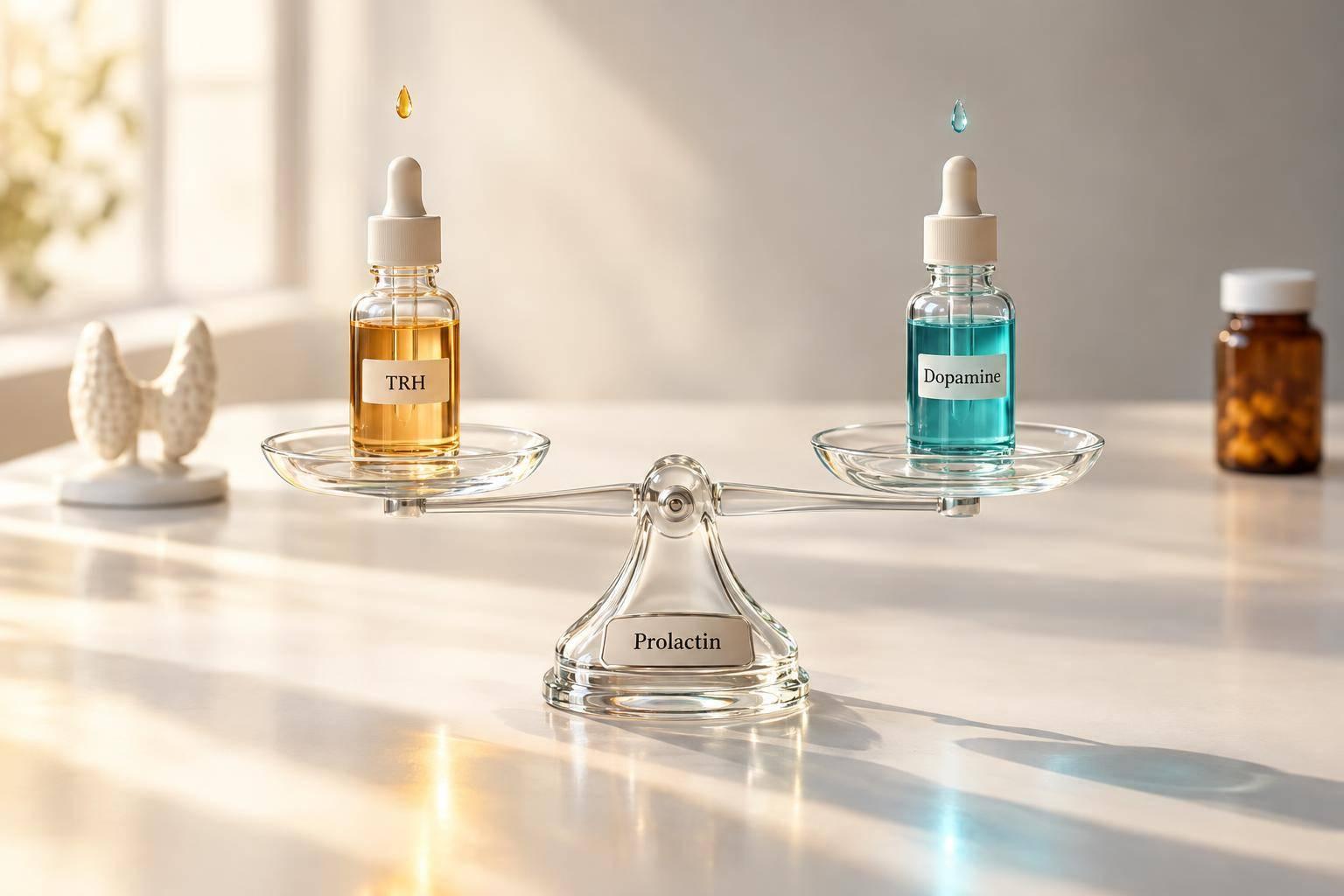
TRH stimulates prolactin release; dopamine limits it through D2 receptors. When prolactin is elevated, checking TSH and free T4 can help identify a thyroid cause before assuming a pituitary tumor.
Hyperprolactinemia has been reported in 20%–40% of people with primary hypothyroidism, though rates vary across studies. The next steps depend on the cause:
- Confirm the result: Repeat mild or unexpected elevations and review pregnancy, stress, medications, kidney function, and macroprolactin.
- Treat the diagnosis: Levothyroxine may normalize prolactin when hypothyroidism is the cause. Dopamine agonists, such as cabergoline, require a specific indication. TRH testing is not treatment.
- Do not delay urgent care: Vision changes or a sudden severe headache need immediate assessment.
An elevated prolactin level is a reason to investigate - not proof of a prolactinoma.
Endocrinology | Prolactin
sbb-itb-7164bd9
TRH and Dopamine: Opposing Effects on Prolactin
TRH vs Dopamine: How Prolactin Is Controlled
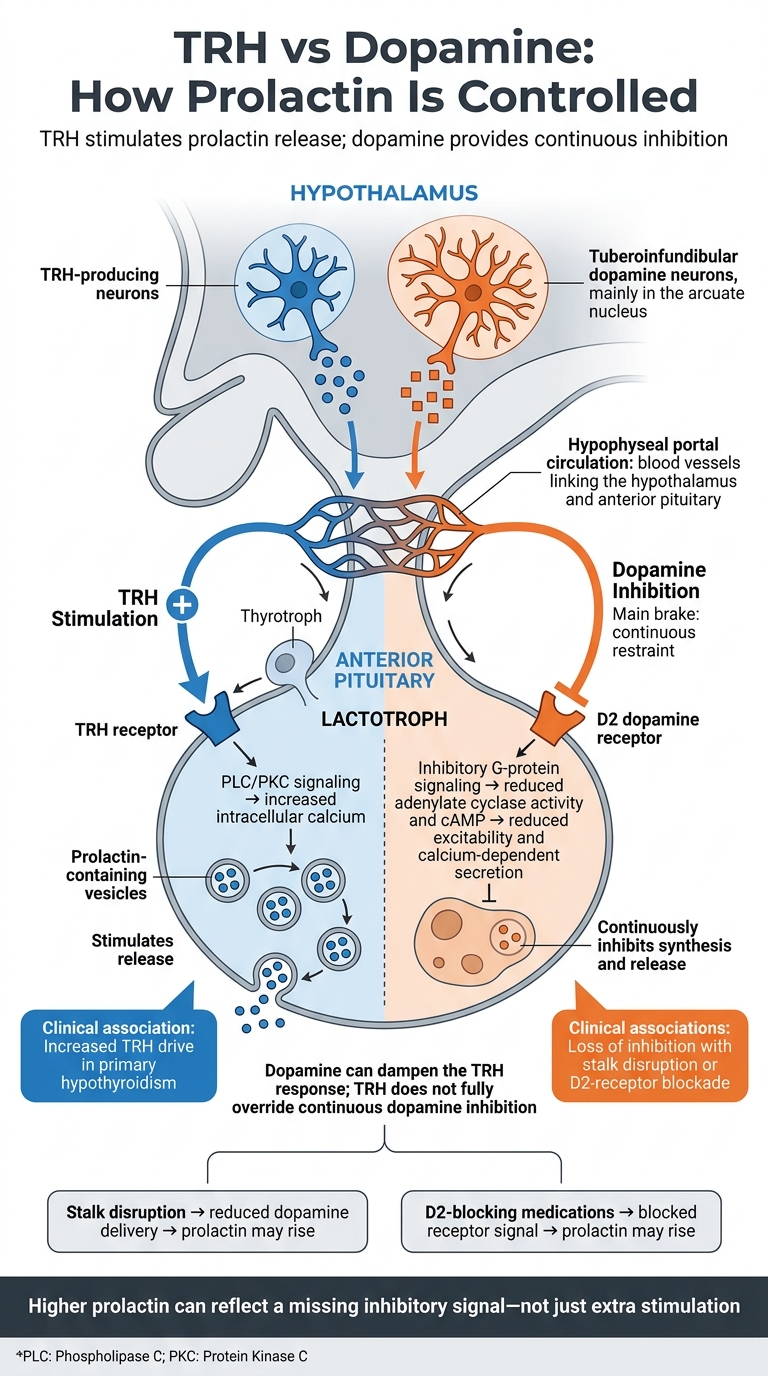
Both signals reach the anterior pituitary through the hypophyseal portal circulation, a network of blood vessels linking the hypothalamus and pituitary. Dopamine acts as the main brake, keeping prolactin secretion under continuous restraint.
| Feature | TRH pathway | Dopamine pathway |
|---|---|---|
| Hypothalamic origin | TRH-producing neurons | Tuberoinfundibular dopamine neurons, mainly in the arcuate nucleus |
| Main pituitary targets | Thyrotrophs and lactotrophs | Primarily lactotrophs |
| Receptor | TRH receptor | D2 dopamine receptor |
| Intracellular signaling | PLC/PKC signaling and increased intracellular calcium | Inhibitory G-protein signaling, reduced cAMP, and reduced calcium-dependent secretion |
| Prolactin effect | Stimulates release | Continuously inhibits synthesis and release |
| Clinical associations | Increased TRH drive in primary hypothyroidism | Loss of inhibition with stalk disruption or D2-receptor blockade |
TRH Stimulates TSH and Prolactin Secretion
TRH receptors activate phospholipase C (PLC) and protein kinase C (PKC). In lactotrophs, this increases intracellular calcium and triggers exocytosis - the release of stored prolactin. But dopamine can dampen this response, so TRH stimulation does not fully override dopamine’s continuous inhibition.
Dopamine Provides Continuous Prolactin Inhibition
Dopamine acts at lactotroph D2 receptors through inhibitory G proteins. These proteins reduce adenylate cyclase activity and cAMP signaling, make the cells less excitable, and limit calcium-dependent secretion. Together, these mechanisms control prolactin release and synthesis.
Higher prolactin can reflect a missing inhibitory signal - not just extra stimulation. Compression or interruption of the pituitary stalk can reduce dopamine delivery, causing stalk-effect hyperprolactinemia. D2-blocking medications interrupt the signal at the receptor instead. Reviewing medications and understanding peptide therapy helps distinguish D2 blockade from reduced dopamine delivery and TRH-driven hyperprolactinemia.
Why Primary Hypothyroidism Can Increase Prolactin
High prolactin can have a thyroid cause - not just a pituitary cause. In primary hypothyroidism, low thyroid hormone reduces feedback inhibition, increasing TRH drive. This can increase prolactin even when dopamine inhibition remains intact. Severe untreated hypothyroidism can also enlarge the pituitary, making it look like a mass on imaging.
Reported rates of hyperprolactinemia in primary hypothyroidism range from 20%–40%, depending on disease severity, the population studied, and the assay used.
Confirm the Prolactin Result and Check Reversible Causes
Repeat mild or unexpected prolactin elevations under low-stress conditions. Results below about 5 times the upper limit of normal should be confirmed. Account for stress, pregnancy, recent breast stimulation, and medications. Check TSH, free T4, and kidney function. Consider macroprolactin, especially when there are no symptoms. If prolactin remains elevated without an explanation, obtain a pituitary MRI after ruling out common reversible causes.
Visual-field loss, changes in vision, or a sudden severe headache require urgent evaluation for pressure from a mass or pituitary apoplexy.
Distinguish Thyroid, Medication, and Pituitary Causes
Interpret prolactin alongside TSH, free T4, medication history, and symptoms. An elevated result alone does not establish a tumor diagnosis, and more than one cause may be present. Coordinate any medication changes with the prescribing clinician.
The lab pattern helps separate thyroid, medication, and pituitary causes.
| Cause | Mechanism | Typical laboratory findings | Distinguishing symptoms | Initial management |
|---|---|---|---|---|
| Primary hypothyroidism | Low thyroid hormone increases TRH and TSH | High TSH and low free T4 in overt disease; prolactin may be mildly or moderately elevated | Cold intolerance, constipation | Treat with levothyroxine and reassess prolactin |
| Medication-related dopamine blockade | D2 blockade removes tonic prolactin inhibition | Elevated prolactin; thyroid and pituitary testing otherwise variable | Galactorrhea, menstrual disruption, sexual dysfunction, or no symptoms | Review with the prescriber; do not stop needed therapy without coordination |
| Prolactinoma | Autonomous prolactin secretion from a lactotroph adenoma | Persistently elevated prolactin; levels are often higher, but overlap remains | Galactorrhea, hypogonadism, infertility | Endocrinology evaluation, pituitary MRI when indicated, and diagnosis-specific therapy |
Recheck Prolactin After Thyroid Replacement
If hypothyroidism is confirmed, treatment helps clarify the cause of the elevated prolactin. Treat with levothyroxine, then recheck thyroid function and prolactin once thyroid hormone levels return to normal. Prolactin often falls and may normalize as TRH drive returns to normal. Concerning symptoms still require immediate evaluation.
Physiologic Signaling Is Not the Same as Treatment
TRH stimulates prolactin release, while dopamine inhibits it. But treatment depends on what caused the elevated prolactin, not simply on how these signals work.
Normal signaling explains prolactin control. The table below shows how treatment follows the diagnosis.
| Treatment | Clinical action |
|---|---|
| Thyroid-hormone replacement | Restores thyroid feedback and reduces TRH drive; can normalize prolactin in hypothyroidism. |
| Dopamine agonists | Cabergoline or similar agents lower prolactin in prolactinomas and selected persistent symptomatic cases. |
TRH Testing Does Not Treat Hyperprolactinemia
TRH stimulation testing is a specialized test that checks the pituitary’s response. Giving TRH can stimulate TSH and prolactin release, but it does not correct excess prolactin.
The Endocrine Society recommends against routine TRH stimulation testing because it adds no diagnostic value beyond a properly obtained serum prolactin level. Diagnosis should rely on serum prolactin and the clinical context - not a stimulation test.
Dopamine Agonists Require a Specific Diagnosis
Cabergoline is a drug treatment, not a physiologic signal. It treats prolactinomas and selected persistent symptomatic cases of hyperprolactinemia. Prescribing should follow a diagnostic evaluation, not a single abnormal result.
Counsel patients about nausea, dizziness, symptoms upon standing, headache, and possible psychiatric or impulse-control changes. After treatment starts, monitor prolactin, symptoms, and adverse effects. Follow drug labeling and specialty guidance for cardiac surveillance when indicated.
Conclusion: Check Thyroid Function and Treat the Cause
TRH increases prolactin; dopamine suppresses it. Elevated prolactin is a finding to investigate - not proof of prolactinoma. Thyroid testing belongs in that workup.
Check TSH and free T4. If testing confirms primary hypothyroidism, treat with levothyroxine and recheck prolactin once thyroid function returns to normal. If prolactin stays elevated, reassess medications, macroprolactin, and pituitary causes. Visual symptoms or concerning headaches need urgent assessment - don’t wait for thyroid function to normalize.
Treatment should target the cause, followed by reassessment. Dopamine agonists need a specific indication; an elevated prolactin level alone isn’t enough. For more clinical insights on managing complex endocrine cases, stay updated with our latest evidence-based reviews.
FAQs
Can mild hypothyroidism raise my prolactin?
Primary hypothyroidism can increase prolactin levels, though the evidence originally cited here concerns severe cases. Excess thyrotropin-releasing hormone (TRH) stimulates the release of both thyroid-stimulating hormone (TSH) and prolactin.
When prolactin is mildly elevated alongside fatigue or menstrual irregularities, clinicians should check thyroid function. The recommended approach is to treat any underlying hypothyroidism and recheck prolactin before attributing the elevation to a pituitary lesion.
How soon can levothyroxine lower my prolactin?
The available information doesn’t give an exact timeline. In primary hypothyroidism, elevated TRH can increase prolactin levels. As thyroid hormone levels return to normal, prolactin levels tend to improve.
Clinicians generally treat hypothyroidism first, then recheck prolactin to see whether it has returned to normal before investigating pituitary lesions.
What if my prolactin stays high after thyroid treatment?
If prolactin stays high after thyroid treatment, the thyroid may not have been the cause. TRH stimulates prolactin release, while dopamine inhibits it.
Your clinician can review your medications - including antipsychotics, antiemetics, antidepressants, and opioids - and check for pregnancy, impaired kidney function, or pituitary stalk disruption. If the cause is still unclear, they may consider repeat lab tests or dynamic testing.