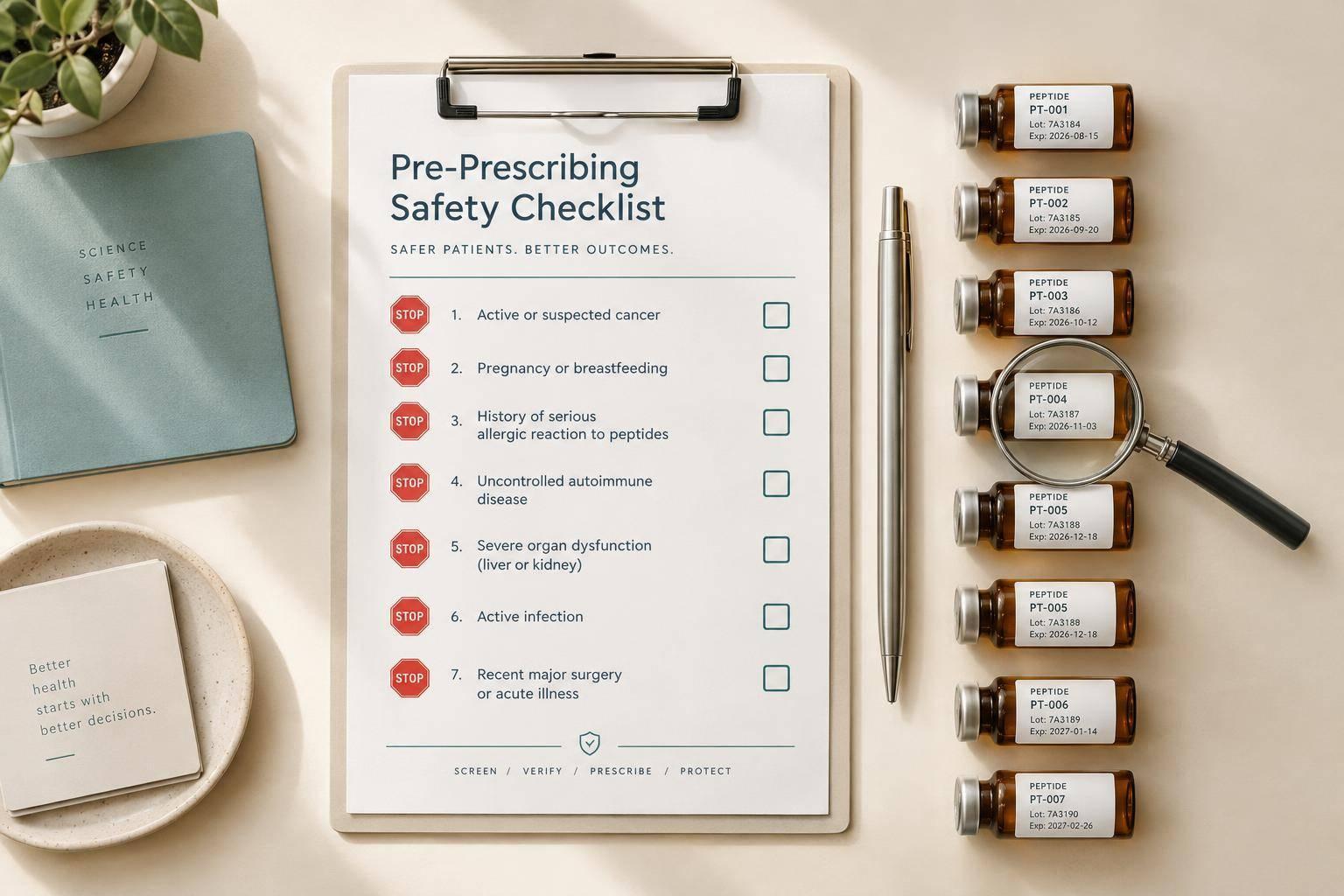
A contraindication means do not use the affected product - not avoid every peptide. I use these 7 product-specific stop rules as a starting screen, then check the exact product’s current FDA labeling before prescribing:
- Medullary thyroid carcinoma (MTC): Personal or family history rules out the listed semaglutide, liraglutide, and tirzepatide products.
- Multiple endocrine neoplasia type 2 (MEN 2): Confirmed MEN 2 rules out those same GLP-1-based products; suspected or unclear family findings need review before treatment.
- Pregnancy: Do not use tesamorelin.
- Serious hypersensitivity: Do not use a product when its label contraindicates a prior serious reaction to its ingredient or excipients.
- Active malignancy: Do not use tesamorelin.
- Uncontrolled hypertension or known cardiovascular disease: Do not use bremelanotide (PT-141).
- Confirmed gastroparesis: Do not use pramlintide.
Warnings and unanswered questions are not automatically absolute contraindications. If records are missing, I defer treatment while clarifying the history. I also check the product’s source, storage, and identity separately.
<u>Normal test results do not cancel a labeled contraindication.</u> Before choosing an alternative, I check its own label, document the decision, and arrange follow-up when needed.
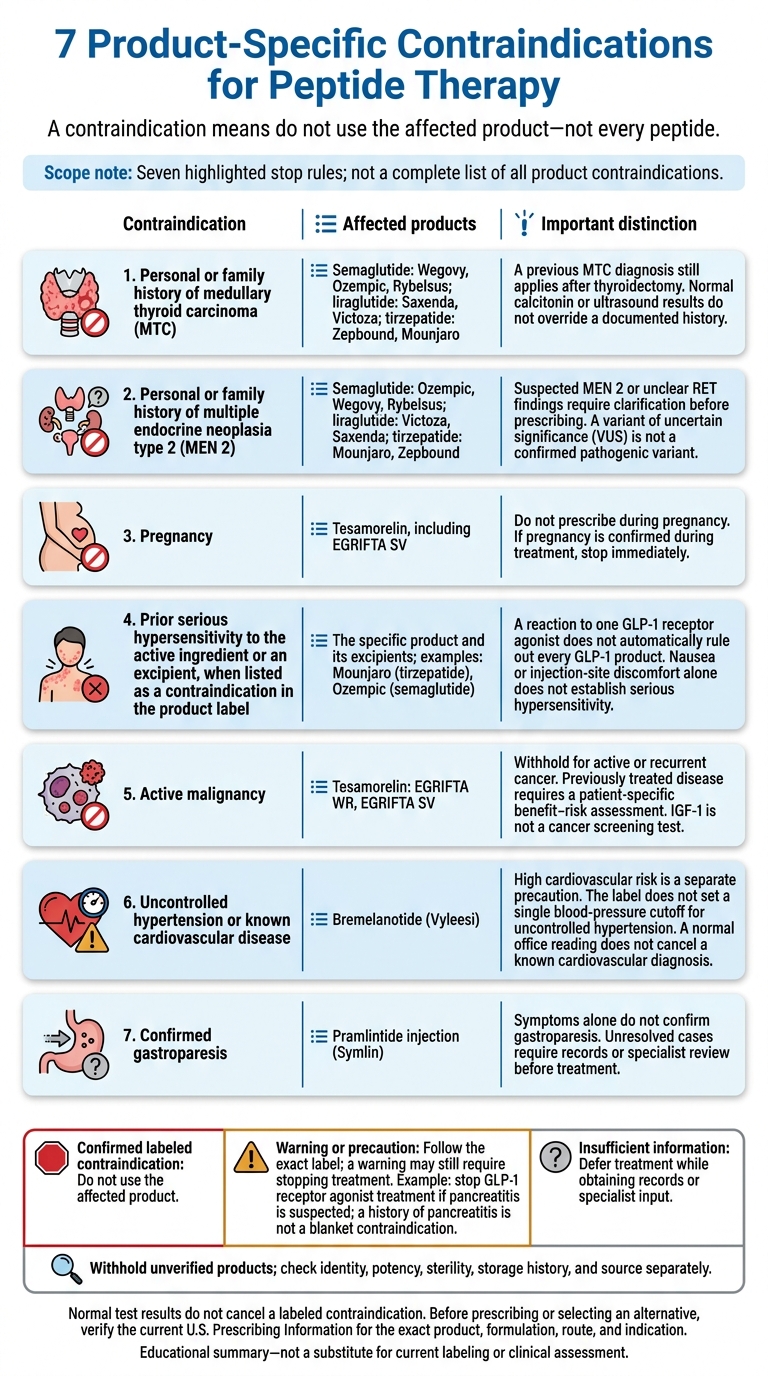
7 Product-Specific Contraindications for Peptide Therapy
Contraindications, Warnings, and Precautions
The label category guides the clinical response. Review the contraindication, warning, interaction, and population sections for the exact ingredient, dosage form, route, and patient population. Record the date of the label reviewed.
A warning may still require stopping treatment. For GLP-1 receptor agonists, stop treatment if pancreatitis is suspected. A history of pancreatitis, however, is not a blanket contraindication.
Uncertain evidence for an investigational or off-label peptide calls for informed consent and specialist review - not an absolute contraindication.
Check product quality separately. Withhold any product if its identity, potency, sterility, storage history, or source cannot be verified. Quarantine the unverified stock and check whether any doses were given. Once product integrity is verified, screen for the contraindications below.
If a possible contraindication remains unclear, defer treatment initiation while obtaining relevant records or specialist input. Document the result as confirmed, excluded, or insufficient information - treatment deferred. Use these label rules to distinguish true stop rules from warnings and uncertainty before reviewing the seven product-specific contraindications below.
sbb-itb-7164bd9
1. Medullary Thyroid Carcinoma History: Affected GLP-1-Based Products
Affected Products and Labeling
A personal or family history of medullary thyroid carcinoma (MTC) contraindicates Wegovy, Ozempic, Rybelsus, Saxenda, Victoza, Zepbound, and Mounjaro. A previous MTC diagnosis still applies after thyroidectomy.
Clinical Rationale
Rodent studies found thyroid C-cell tumors, but the risk in humans is unknown. FDA labeling therefore treats MTC history as an absolute contraindication.
Screening
Ask about MTC in the patient and family. For affected relatives, confirm their relationship to the patient and the tumor subtype. Also ask about any MEN 2 or genetic testing history. Clarify any report of “thyroid cancer” before prescribing, and obtain pathology or oncology records when needed.
Routine calcitonin testing or thyroid ultrasound is not required for every patient. Labeling states that their value for detecting MTC is uncertain. A normal result does not override a documented personal or family history of MTC.
Follow-Up
If the diagnosis is unclear, defer treatment until records or specialist input confirm the history. If MTC is confirmed, choose an option that is not contraindicated and document the reason for that decision. If MTC is ruled out, proceed to MEN 2 screening.
2. Multiple Endocrine Neoplasia Type 2: Affected GLP-1-Based Products
Affected Products and Labeling
A personal or family history of MEN 2 is a contraindication to semaglutide (Ozempic, Wegovy, Rybelsus), liraglutide (Victoza, Saxenda), and tirzepatide (Mounjaro, Zepbound). Check the current product label before prescribing.
Clinical Rationale
MEN 2 may explain a history of MTC, so screen separately for the syndrome and its RET variant status. MEN 2 is an inherited endocrine tumor syndrome linked to pathogenic RET variants. Depending on the subtype, it may involve MTC, pheochromocytoma, and primary hyperparathyroidism.
Screening
Ask specifically about MEN 2A, MEN 2B, MEN 2-associated tumors, and RET testing in both the patient and their family. Obtain the RET report: a variant of uncertain significance (VUS) is not a confirmed pathogenic variant. Verify the family’s MEN 2 subtype and RET status rather than relying on a vague history of thyroid cancer. If RET results are unclear, hold off on prescribing until genetics or endocrinology clarifies the risk.
Follow-Up
Withhold treatment until suspected MEN 2 or unresolved RET findings are clarified. Refer to endocrinology or medical genetics for interpretation and risk assessment. If MEN 2 is confirmed after treatment begins, stop further doses and refer for follow-up. Document the product, dose, dates, RET findings, and specialist recommendations.
3. Pregnancy: Tesamorelin
Do not prescribe tesamorelin during pregnancy.
Affected Products and Labeling
Pregnancy is a labeled contraindication for tesamorelin, including EGRIFTA SV. Check the exact product’s current U.S. prescribing information.
Clinical Rationale
Tesamorelin has no known benefit during pregnancy. In animal studies, it caused fetal harm at exposures above clinical levels.
Screening
Before prescribing, document pregnancy status, the last menstrual period, contraception, breastfeeding, and pregnancy plans. Obtain a urine or serum pregnancy test when clinically appropriate, especially when pregnancy status is uncertain.
Explain that a negative test does not rule out a later pregnancy. Tell patients to promptly report a missed period, suspected pregnancy, or a positive home pregnancy test.
If pregnancy is confirmed, stop treatment immediately and document the date of the last dose.
Follow-Up
Document the formulation, dose, and estimated gestational age. Review other medications and exposures, and arrange prenatal care. Include a maternal-fetal medicine consultation when indicated.
Discuss possible fetal risk without predicting the outcome for an individual pregnancy.
4. Serious Hypersensitivity to the Product or Its Excipients
Affected Products and Labeling
This stop rule applies to the specific product and its excipients. A history of serious hypersensitivity to the active ingredient or an excipient is a contraindication only when the product’s U.S. label lists it.
Mounjaro (tirzepatide) and Ozempic (semaglutide) are examples.
Clinical Rationale
Serious hypersensitivity may involve anaphylaxis, angioedema, bronchospasm, hypotension, or another severe allergic reaction. Either the peptide or an inactive ingredient may trigger it. A reaction to one GLP-1 receptor agonist does not automatically rule out every GLP-1 product. Cross-susceptibility remains uncertain, so assess each case individually.
Screening
Document the exact product, formulation, dose, route, reaction date, and time between the dose and symptom onset. Record objective signs and any treatment required. Obtain emergency records when available.
Nausea or injection-site discomfort alone does not establish serious hypersensitivity. Review the excipients, and record any confirmed excipient allergy separately in the chart.
Follow-Up
Once serious hypersensitivity is confirmed, stop treatment and document the event. Avoid re-exposure, remove active orders, and notify the patient, pharmacy, and care team. Refer to allergy/immunology if the trigger is unclear or an excipient allergy is suspected. Do not rechallenge in the office.
If a serious reaction develops, stop the product immediately and follow the anaphylaxis protocol. Suspected anaphylaxis requires emergency management; epinephrine is the first-line treatment.
5. Active Malignancy: Tesamorelin
Affected Products and Labeling
Tesamorelin products, including EGRIFTA WR and EGRIFTA SV, are contraindicated in active malignancy.
Clinical Rationale
Tesamorelin increases growth hormone (GH) and insulin-like growth factor 1 (IGF-1). Both are growth factors, so treatment may support the growth of an existing cancer.
Screening
Document the cancer type, stage, treatment status, recurrence history, and most recent oncology review.
Follow-Up
Withhold tesamorelin for active or recurrent cancer. Coordinate care with oncology, and document the last dose and referral plan.
For previously treated disease, document the patient-specific benefit–risk assessment.
Monitor IGF-1 during treatment and consider stopping tesamorelin if levels stay elevated. IGF-1 is not a cancer screening test and does not replace oncology surveillance.
Next, review whether cardiovascular or blood pressure history affects the safety of other peptide products.
6. Uncontrolled Hypertension or Known Cardiovascular Disease: Bremelanotide
Affected Products and Labeling
Bremelanotide (Vyleesi) is contraindicated in patients with uncontrolled hypertension or known cardiovascular disease. The labeling also advises against use in patients at high cardiovascular risk. This is a separate precaution, not the labeled contraindication.
Clinical Rationale
Each dose can briefly increase blood pressure and decrease heart rate. These effects peak 2–4 hours after injection and usually resolve within 12 hours.
Screening
Record baseline blood pressure and pulse. Follow standard clinical best practices for patient assessment. Repeat elevated readings and review home measurements when appropriate. The label does not set a single blood-pressure cutoff for “uncontrolled” hypertension.
Ask about coronary artery disease, MI or acute coronary syndrome, angina, heart failure, stroke or TIA, peripheral arterial disease, and significant arrhythmias. A normal office reading does not cancel out a known cardiovascular diagnosis.
Follow-Up
Withhold bremelanotide if either contraindication is present. Refer the patient for a blood-pressure or cardiovascular evaluation, and document the reason. Delay prescribing if the patient has unexplained chest pain, syncope, or shortness of breath until those symptoms have been evaluated.
If treatment remains appropriate, tell patients to seek urgent care for chest pain, severe shortness of breath, syncope, or new neurologic symptoms. Recheck blood pressure and symptoms periodically. Hold further doses after significant blood-pressure elevation, symptomatic bradycardia, or another concerning reaction until assessment.
Next, review confirmed gastroparesis as the contraindication that rules out pramlintide.
7. Confirmed Gastroparesis: Pramlintide
Affected Products and Labeling
Pramlintide injection (Symlin) is contraindicated in confirmed gastroparesis.
Clinical Rationale
Pramlintide slows gastric emptying. This can worsen nausea, vomiting, early fullness, abdominal discomfort, and unpredictable carbohydrate absorption. When carbohydrate absorption and mealtime insulin action don't line up, hypoglycemia risk increases - especially within 3 hours after injection.
Screening
Review GI notes, gastric-emptying studies, current symptoms, and drugs that slow gut motility, including opioids and anticholinergics.
Mild bloating or nausea alone does not confirm gastroparesis. A negative symptom screen also does not rule out an unresolved prior diagnosis. Do not prescribe if gastroparesis is confirmed. For unresolved cases, obtain records or request specialist review before treatment.
Follow-Up
Do not start pramlintide until gastroparesis is excluded. Document the finding and work with the diabetes-care team to review glucose trends, meal tolerance, nutrition, and insulin needs.
Document the plan. Advise urgent evaluation for persistent vomiting, inability to keep fluids down, severe abdominal pain, confusion, or suspected severe hypoglycemia.
If gastroparesis is excluded, review other reasons pramlintide may still need to be withheld.
Other Reasons to Withhold Treatment
Temporarily withhold treatment when product integrity or the patient’s status remains unresolved.
Pause dosing until you verify the product’s identity and concentration. Confirm the ingredient, formulation, concentration, final volume, route, lot number, and expiration or beyond-use date. Resolve any discrepancies with the dispensing pharmacy.
Do not use a questionable injectable product. Quarantine products with damaged seals, unexpected particles or discoloration, uncertain sterile handling, or undocumented storage excursions until the pharmacy or manufacturer reviews them. Obtain a replacement if suitability cannot be confirmed. Verify the dispensing source’s license and lawful authorization. Do not use research-use-only material as routine patient medication.
If pregnancy or malignancy is suspected, defer treatment until the exact product label and specialist input confirm the plan.
Before prescribing, apply these same verification steps in the safety checklist.
Safety Checklist Before Prescribing
Use this final checklist before prescribing.
Product: Record the ingredient, brand, formulation, route, strength, indication, and dose. Review current FDA contraindications, warnings, interactions, and monitoring requirements. Document the label version, review date, and whether use is on-label, off-label, or compounded. For compounded therapy, record the clinical justification and legal compounding pathway. Compounded drugs are not FDA-approved.
Once you verify the product, check the patient’s history against its labeled stop rules.
History: Screen for product-specific risks, including a personal or family history of MTC or MEN 2, pregnancy possibility and plans, breastfeeding, allergies, cancer, and pituitary disease. Also check:
- Tesamorelin: Pituitary surgery or tumors, hypopituitarism, head irradiation, and head trauma.
- Bremelanotide: Cardiovascular disease and blood pressure.
- Pramlintide: Confirmed gastroparesis, hypoglycemia unawareness, and the ability to follow glucose-monitoring and insulin-adjustment instructions.
For prior allergic reactions, record the product, symptoms, severity, and timing.
Medications/Tests: Reconcile prescriptions and supplements, including insulin, sulfonylureas, antihypertensives, and drugs that affect blood pressure or gastrointestinal motility. Obtain indicated pregnancy, glucose/A1C, renal, or hepatic tests. Normal results do not override a labeled contraindication. Verify pharmacy and product details, and specify the prescribed dose, injection volume, and syringe calibration.
If screening is incomplete or findings conflict, document the gap and defer prescribing.
Documentation: Record whether treatment must not start, must be held, or must be discontinued - and why. Document alternatives, referrals, warning symptoms, monitoring dates, and conditions for reconsideration.
Licensed clinicians can use PeptidePrescriber for educational monographs, dosing tools, injection guides, and regulatory references.
Conclusion: Apply Contraindications to the Exact Product
After screening and documentation, check the label for the exact product. Contraindications are product-specific, not class-wide. A contraindication means do not use that product.
If a labeled contraindication applies, do not start the product. If treatment has already begun, follow the label’s instructions for discontinuation and urgent symptoms. Give the patient clear instructions on what to do next.
Document the decision and arrange specialist follow-up when needed. Before choosing another product, check its label and risks. Before prescribing, verify the current U.S. Prescribing Information for the exact product, formulation, route, and indication.
FAQs
Does non-medullary thyroid cancer affect peptide eligibility?
Non-medullary thyroid cancer is not explicitly listed as an absolute contraindication for GLP-1 and dual agonist therapies in the provided clinical guidelines. However, medullary thyroid carcinoma (MTC) and multiple endocrine neoplasia syndrome type 2 (MEN 2) are strict contraindications for these therapies.
Before deciding whether a patient is eligible, prescribers should carefully review the patient’s medical history and assess their individual risk factors.
Can I restart tesamorelin after cancer remission?
Restarting tesamorelin after cancer remission requires formal clearance from your oncologist. Tesamorelin can stimulate IGF-1 pathways and is strictly contraindicated in active malignancy.
Remission may change your risk profile, but tesamorelin’s potential effects on cell growth still call for a thorough cancer-related evaluation before you restart treatment. Your oncologist should base the decision on your cancer history and current clinical status, and document their clearance in your medical record.
What if I discover a contraindication after starting treatment?
Stop therapy immediately and perform a clinical evaluation to assess the patient’s condition. Record the specific contraindication, the reason for stopping therapy, and the clinical steps taken in the patient’s chart.
Set discontinuation criteria at the start of treatment rather than making decisions on the fly. Some findings, such as major laboratory abnormalities, require therapy to stop immediately. Let clinical judgment and patient safety guide the decision - not a desire to continue a regimen that no longer meets safety standards.