
Under USP <797>, personnel need initial qualification before compounding, then reassessment at least every 6 months for Categories 1 and 2 or every 3 months for Category 3. I recommend scheduling early enough to finish incubation and review before the due date.
Here’s what I’d put on your checklist:
- Test the whole process: Include observed aseptic technique, media fill, glove sampling, and surface sampling - not just the media fill.
- Allow time for results: Media-fill incubation takes at least 14 days. Pending results do not extend the deadline.
- Use the strictest applicable schedule: Check state rules, accreditation requirements, and facility policies. Peptides follow the same category-based intervals.
- Track permission to compound: Record results, approval, and the next due date. Overdue personnel must stop affected independent compounding; failed assessments require investigation, retraining, and successful requalification.
My bottom line: <u>a clear media fill alone is not enough</u>. Every required assessment component must pass - and passing does not prove sterility.
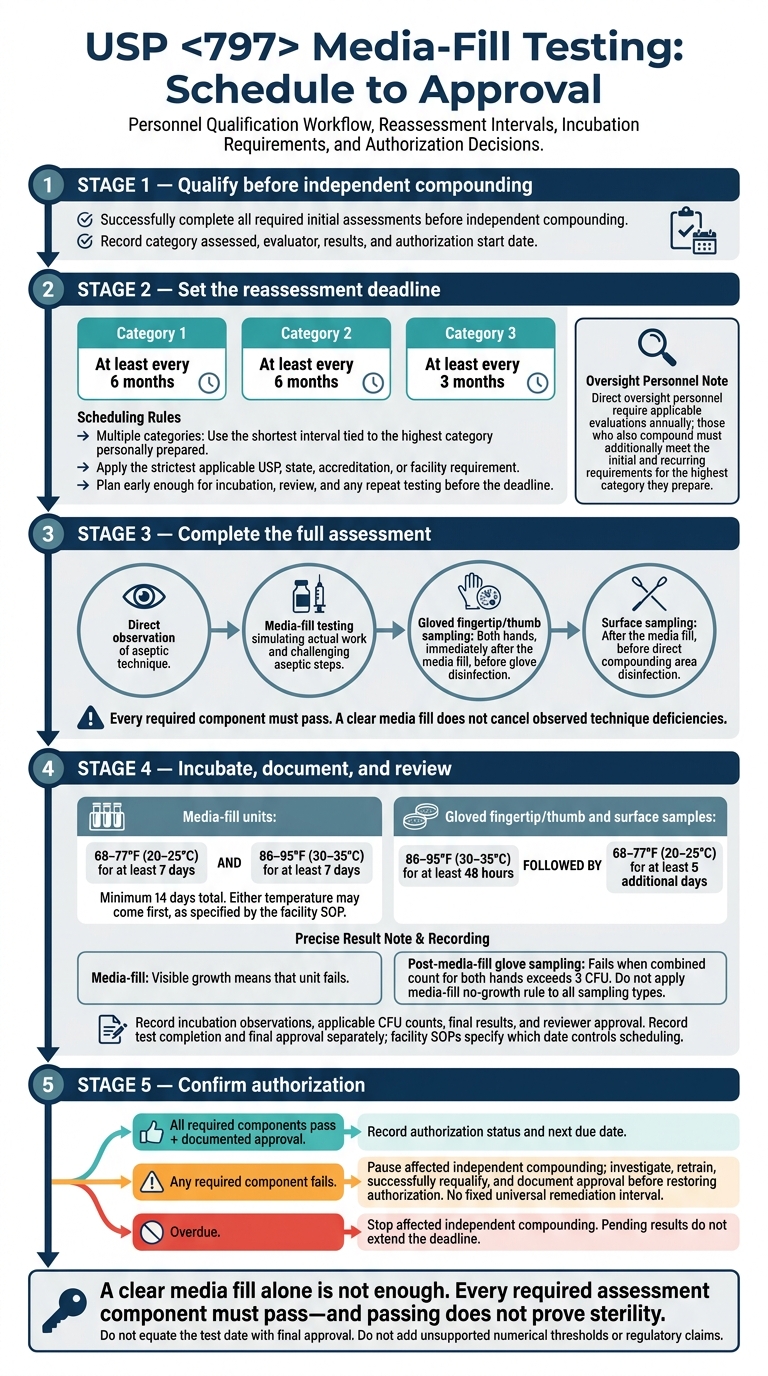
USP <797> Media-Fill Testing: Schedule to Approval
Media-Fill Testing Frequency by CSP Category
Categories 1 and 2: Every 6 Months; Category 3: Every 3 Months
USP <797> sets these minimum intervals for the full competency reassessment package, including media-fill testing. Use them to schedule the entire package - not just the media fill.
| CSP category | Personnel covered | Minimum reassessment frequency | Scheduling action |
|---|---|---|---|
| Category 1 | Personnel preparing Category 1 CSPs | At least every 6 months | Complete before 6 months |
| Category 2 | Personnel preparing Category 2 CSPs | At least every 6 months | Complete before 6 months |
| Category 3 | Personnel preparing Category 3 CSPs | At least every 3 months | Complete before 3 months |
Track due dates in an employee-level competency calendar. For each person, record the categories they prepare, their last successful assessment, their next due date, and their authorization status. Allow enough time for incubation, review, and any repeat testing before the deadline.
Initial Qualification, Multiple Categories, and Oversight Roles
Before allowing anyone to compound independently, document successful completion of all required initial assessments. The qualification record should identify the category assessed, the evaluator, the results, and the date authorization begins - not just when the media fill took place.
For employees who prepare more than one category, use the shortest interval tied to the highest category they personally prepare.
Supervisory qualification follows a separate annual schedule; it does not replace compounder reassessment. Personnel with direct oversight duties must complete the applicable evaluations annually. If they also prepare CSPs, they must meet the initial and recurring assessment requirements for the highest category they prepare.
sbb-itb-7164bd9
Understanding USP 797 Microbiology Testing Requirements
Required Assessment Steps and Test Conditions
When the reassessment date arrives, the evaluation must cover every required competency component.
Media Fills, Glove Sampling, and Surface Sampling
Each reassessment must include direct observation, media fill, gloved fingertip/thumb sampling, and surface sampling. The evaluator should check hand hygiene, garbing, disinfection, supply placement, device use, container access, transfers, manipulations, and first air. A clear media fill does not cancel out observed technique deficiencies.
Each required component serves a separate purpose - and each must pass.
| Component | Purpose | Timing within assessment |
|---|---|---|
| Media-fill testing | Evaluate aseptic manipulation through process simulation | Initial qualification and category-specific reassessment |
| Gloved fingertip and thumb sampling | Assess glove contamination after manipulation | Immediately after the media fill, on both hands, before glove disinfection |
| Surface sampling | Assess contamination of the direct compounding area (DCA) | After the media fill, before DCA disinfection |
Failure of any required component means failure of the full competency assessment. Post-media-fill glove sampling fails when the combined count for both hands exceeds 3 CFU. Routine environmental monitoring and initial garbing qualification are separate requirements. Neither replaces this assessment.
Match Actual Work and Document Incubation Results
Use an appropriate growth medium, such as Soybean–Casein Digest Medium. Simulate the compounder’s equipment, transfers, closures, and most challenging aseptic steps. The simulation should match the facility’s actual work - not a simplified version of it. For detailed protocols on maintaining sterility during preparation, refer to our practical guides on storage and handling.
Incubate media-fill units at 68–77°F (20–25°C) and 86–95°F (30–35°C) for at least 7 days at each temperature, for a minimum of 14 days total. The facility SOP determines which temperature comes first.
Gloved fingertip, thumb, and surface samples follow a different schedule: 86–95°F (30–35°C) for at least 48 hours, followed by 68–77°F (20–25°C) for at least 5 additional days. Visible growth during incubation means the unit fails.
Record sample identifiers, media details, incubator identification, temperatures, start and stop dates, observations, CFU counts where applicable, and final results. Keep the checklist, sampling records, incubation records, and final results together. Use this documentation to confirm the next due date and maintain authorization to compound.
Scheduling, Applicable Rules, and Failed Assessments
Check USP, State Rules, and Facility Policies
Set the schedule using the strictest applicable requirement. USP <797> sets the baseline, but state rules, facility SOPs, and accreditation requirements may require shorter intervals. Document each source, its effective date and jurisdiction, and the reason for the schedule. Check the rules where compounding takes place and in any other applicable jurisdictions. Don’t rely on outdated training materials. Stay informed with regulatory updates to ensure compliance.
| Requirement source | What to verify | Scheduling effect |
|---|---|---|
| USP <797> | Current official, effective provisions and category-specific intervals | Sets the chapter baseline |
| Facility policy | Written SOPs, reassessment triggers, and risk-based schedules | May require more frequent testing |
| State rules | Adoption, amendments, effective dates, and applicable jurisdiction | May impose additional or stricter obligations |
| Accreditation or contract | Applicable assessment and documentation provisions | May add obligations beyond the chapter baseline |
Apply the governing interval to each employee’s next due date and record their authorization to compound.
Track Due Dates and Authorization to Compound
Maintain a personnel assessment register that records authorized CSP categories, assessment dates, due dates, procedures and challenging conditions tested, equipment used, incubation observations, sampling results, reviewer approval, corrective actions, and authorization status.
Record test completion and final approval separately. SOPs should specify which date controls the schedule. Plan testing early enough to allow time for incubation and review - pending results must not extend the due date. Before assigning work, supervisors should check category-specific authorization and remove overdue personnel from affected independent compounding duties.
Define when a work lapse or leave requires requalification before the next due date. Reassess personnel when changes to the work, equipment, or process mean the current evaluation no longer reflects their practice. Base these triggers on applicable rules or facility policy; don’t treat them as universal USP intervals.
Investigate Failures and Requalify Personnel
If any component fails, pause authorization until requalification is complete. Restrict unsupervised sterile compounding while investigating technique, garbing, hand hygiene, equipment, materials, environmental conditions, test execution, and incubation and reading procedures. Also check for shared causes that could affect other personnel or batches.
Document the findings, corrective training, repeat-test results, reviewer approval, and decision to restore authorization. Follow any jurisdiction-specific repeat-testing requirements. Keep mandatory requalification separate from facility-selected controls, such as using a second assessor or temporarily increasing testing. Don’t apply a fixed remediation interval: the required response depends on the governing rules, investigation findings, and written SOPs.
Conclusion: Media-Fill Scheduling Checklist
Use this checklist to turn frequency rules into a scheduling record:
- Confirm successful initial qualification. Record each person’s CSP category, qualification date, results, reviewer approval, and authorization status.
- Reassess at least every 6 months for Categories 1 and 2 and every 3 months for Category 3. For personnel preparing multiple categories, use the shortest interval. Check for stricter applicable state rules, accreditation requirements, and facility policies.
- Record incubation results, reviewer approval, authorization status, and the next due date. Immediately remove overdue personnel from affected compounding duties. After a failed qualification, block affected compounding until investigation, retraining, and successful requalification are complete.
FAQs
How do I determine which CSP category applies to my work?
A compounded sterile preparation (CSP) is classified as Category 1, 2, or 3 based on the risk levels and storage conditions defined by USP <797>. State adoption and enforcement may vary.
Check your state board of pharmacy’s requirements, including which USP version it has adopted and whether it has stricter beyond-use dating or environmental monitoring rules. Verify which standards apply to both your practice location and the pharmacy preparing your compounds.
Can my media-fill qualification transfer to another pharmacy?
Generally, no. Media-fill qualification is specific to each pharmacy’s compounding environment and standard operating procedures. Each pharmacy must confirm that staff can perform the work under the conditions they’ll encounter on the job.
Check the new pharmacy’s training and documentation requirements, including its policies, USP <797> requirements, and applicable state rules.
How do I verify my state's media-fill testing requirements?
Check the pharmacy board’s website in the state where the compounding pharmacy is licensed. Requirements vary by state: some enforce the latest USP <797>, others follow an older version, and some set stricter rules.
Confirm that the pharmacy’s license is active through the National Association of Boards of Pharmacy (NABP) or the state board’s official database. If you work across state lines, also check which rules the pharmacy’s home state enforces.