
A peptide refill request should never turn into an automatic renewal. If I want a safer workflow, I need to do five things every time: set written refill rules, collect the right intake details, review the chart and labs in order, use stop dates and early renewal timing, and route each case to the right person.
Here’s the core idea in plain English:
- A refill request is an admin step
- A renewal is a prescriber decision
- Staff can log, check, and route
- Staff should not decide continued treatment on their own
- Any red flag - like missing labs, new symptoms, dose mismatch, pregnancy changes, or an early refill ask - should pause routine processing
- Compounded peptides need closer review, because they are not FDA-approved and FDA does not review them for safety, effectiveness, or quality before marketing
If I boil the article down, the workflow looks like this:
- Write refill rules before requests come in
- Use a structured intake for every request
- Review chart, med list, labs, symptoms, and follow-up status
- Track run-out date, renewal-review date, and stop date
- Send the final decision to the prescriber and document the reason
A few points stand out.
First, timing matters. Opening renewal tasks 2 to 4 weeks before the patient runs out gives time for labs, follow-up, prior auth, and pharmacy delays.
Second, current labs alone do not equal approval. A lab result still needs clinician review.
Third, stop dates matter. Without them, treatment can keep going far past the planned review window.
I’d frame the whole process this way: make the admin side smoother without removing prescriber oversight. That is the line the article keeps drawing, and it’s the right one.
The rest of the piece shows how to build that line into daily workflow, so refill handling stays clear, consistent, and safe.
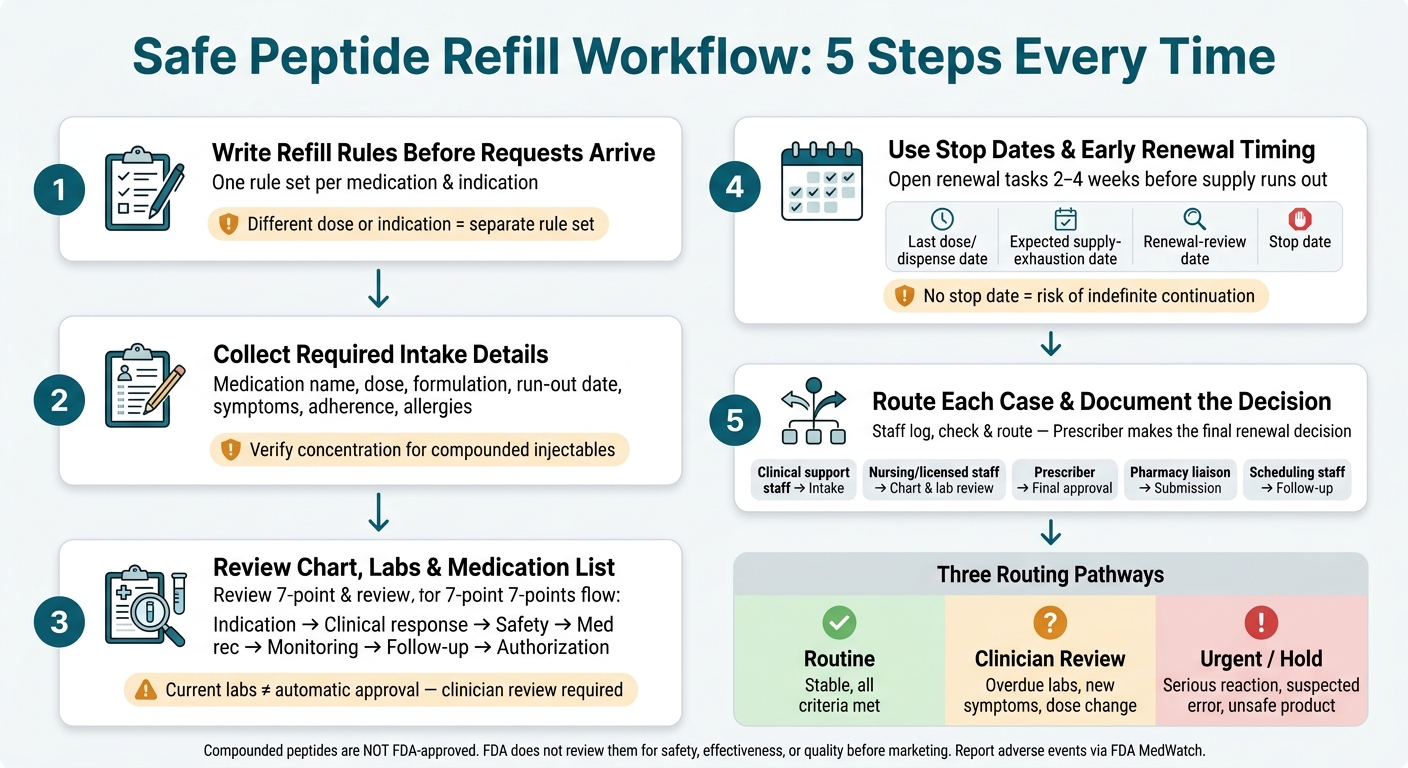
Peptide Refill Workflow: 5-Step Safety Process for Clinics
Set Refill Rules Before Requests Arrive
Create one written refill rule set for each medication and indication. That rule set decides what can move ahead and what needs a closer look. For every therapy, document the indication, formulation, concentration, route, dose, instructions, required monitoring, contraindications, patient risk factors, and the maximum refill period. If the same product is used at a different dose or for a different indication, use a separate rule set. Put the gate in place before staff open the chart.
Use the routine pathway only when the patient is stable, the dose matches the active plan, follow-up is current, and no escalation trigger is present. If a therapy involves titration, tighter monitoring, a recent dose change, a higher chance of adverse events, pregnancy-related concerns, or unclear product details, it should go straight to clinician review.
Set the Minimum Data Required for Every Request
Every refill request should begin with a structured intake record. Capture:
- medication name, formulation, concentration, route, directions, and current dose
- recent dose changes, last administration date, expected run-out date, and remaining supply
- indication, active treatment plan, and pharmacy or dispensing site
- allergies, medication changes, clinical changes, symptoms, adverse effects, dosing or injection problems, missed doses, and any uncertainty about the dose
For compounded injectable peptides, verify the concentration and intended dose before routing the request.
Define When Routine Processing Must Stop and Escalate
Escalate any request with overdue or missing labs, abnormal results, new or worsening symptoms, suspected adverse effects, pregnancy-related changes, dose or concentration discrepancies, conflicts with the treatment plan, a recent hospitalization or major diagnosis, missed or unclear administrations, early replacement requests, pharmacy changes that create product or concentration uncertainty, or any legal or prescribing concern. Escalate it as well when the patient is overdue for required clinical follow-up.
The rule is simple: when a trigger appears, staff document it, gather the facts they have, and route it. They do not sort it out on their own.
Routine, Clinician-Review, and Urgent-or-Hold Pathways Compared
Three clear pathways help keep refill work organized and stop requests from drifting into a gray area.
| Pathway | Trigger | Required Documentation | Routing Destination | Expected Outcome |
|---|---|---|---|---|
| Routine | Stable treatment; medication, dose, concentration, indication, timing, labs, and follow-up all meet written criteria; no new symptoms or discrepancies | Completed intake, checklist, med rec, lab status, staff/date | Designated refill queue or authorized prescriber workflow | Request is prepared for clinician authorization; dispense only after valid authorization |
| Clinician Review | Overdue follow-up or labs, abnormal results, new symptoms, adverse effects, dose change, pregnancy-related change, medication discrepancy, early refill, or uncertain administration | Intake record, chart excerpts, lab results, symptom details, patient communications and a clear question | Prescribing clinician or designated qualified reviewer | Clinician approves, modifies, declines, orders testing, schedules a visit, or provides documented instructions |
| Urgent or Hold | Possible serious reaction, severe or rapidly worsening symptoms, suspected overdose or medication error, inability to verify the product, unsafe dispensing issue, or legal/prescribing concern | Event note, time, product/dose, symptoms, actions, escalation | Prescriber urgently; emergency services or urgent evaluation when clinically indicated; pharmacy or compliance lead when appropriate | Hold refill pending review; patient receives documented safety instructions; event is managed or reported as required |
Staff can route and document requests, but they should not independently authorize continued treatment at any pathway level. FDA also encourages reporting adverse events and product-quality problems tied to compounded medications through the right safety-reporting channels.
Once a request fits the routine pathway, send it to intake and chart review.
sbb-itb-7164bd9
Capture the Refill Request and Complete the Safety Review
Once a request clears routing, log it in a structured EHR task and review the chart in a set order. This step is the main safety check before any renewal moves ahead. After the request is entered, go straight to the chart and lab review.
Use a Structured Intake Process
Each refill request should start with a new EHR task linked to the right patient and the right prescription. The task should also have a named owner and a due date based on how many days of medication the patient has left and the clinic's turnaround standard.
Start by confirming at least two patient identifiers. Full name and date of birth are the usual pair. Then verify the preferred phone number, email address, pharmacy, and whether the patient has given permission for clinical messages to be left.
After that, focus on what may have changed since the last fill. That includes new diagnoses or hospital stays, medication changes, new or worse symptoms, side effects, trouble taking the medication, storage issues, or missed doses. Use open-ended questions here. Ask how the patient is taking the medication and what else they are taking, including over-the-counter products and supplements. Open-ended questions often catch mismatches that yes/no questions miss.
Do not treat a request as routine just because the patient has had the medication before. Keep the task active until the review is done and the clinician approves the prescription. If there is any change in dose, form, route, or quantity, send it to the prescriber before moving ahead.
Complete Chart Review and Lab-Status Checks
Lab results are a checkpoint, not permission to refill on their own. The chart review should follow the same sequence every time so nothing gets missed, even when a different staff member handles the task.
1. Indication, goals, and prescription details
Confirm the peptide clinical monograph for the indication and whether the documented goal still applies. Compare the medication, concentration, formulation, dose, route, frequency, quantity, refills, original prescription date, and any prior stop or review date with what the patient is requesting.
2. Clinical response and adherence
Review the documented benefit, plus weight or symptom trends when those matter. Check reported adherence too.
3. Safety information
Review side effects, allergies, interval diagnoses, hospitalizations, and emergency visits since the last fill.
4. Medication reconciliation
Compare all prescription drugs, over-the-counter products, and supplements, including anything ordered by another clinician. If you find a mismatch, send it to the prescriber instead of changing it quietly.
5. Monitoring status
Check both protocol-required and patient-specific labs or other required monitoring. A protocol-required check applies to every patient at a set interval, such as IGF-1 for GH-axis peptides or A1c and a lipid panel for GLP-1 agents. A patient-specific check is added because of the person's comorbidities, concurrent medications, past abnormal results, or clinician instructions.
6. Follow-up plan
Confirm the last visit date, the next scheduled appointment, whether any required follow-up is overdue, and the clinician's prior follow-up plan.
7. Access and authorization
Verify prior authorization status, pharmacy availability, and any insurance or dispensing barrier.
A request can move ahead only when the chart, labs, and follow-up line up with the written protocol. If the chart shows one dose but the patient reports another, document both and send a direct question to the prescriber. For example:
Chart lists 0.25 mg weekly; patient reports taking 0.5 mg weekly for the past 4 weeks. Please confirm intended dose, quantity, and next review date.
Do not change the order to match the patient's report before authorization.
Match Common Findings to the Next Action
A current lab result does not mean the refill is approved. Use clear status labels instead of a vague labs reviewed field.
| Finding at intake or chart review | Immediate action | Routing destination |
|---|---|---|
| All required data present; no discrepancies, new symptoms, or overdue monitoring | Prepare the existing prescription for authorized renewal; document review completion | Prescriber or authorized clinician for final approval |
| Required lab is current but has not been clinically reviewed | Attach or link the result; hold the refill task | Prescriber or authorized clinician |
| Required lab is overdue, missing, or unavailable | Notify the patient of the required testing step; do not promise approval | Clinical support staff for follow-up; prescriber if the prescription will lapse |
| Lab result is abnormal, conflicting, or clinically concerning | Place the refill on clinical hold; document the finding | Prescriber or urgent clinical review |
| New or worsening symptoms, or suspected adverse effect | Follow the clinic's symptom-triage protocol; direct emergency symptoms to emergency services | Nurse or clinician triage; prescriber for the medication decision |
| New diagnosis, hospitalization, pregnancy, or medication change | Pause routine processing; reconcile the clinical change | Prescriber or designated clinician |
| Patient requests a changed dose, concentration, formulation, route, or quantity | Preserve the request verbatim; do not modify the order | Prescriber |
| The stop date, refill limit, or follow-up interval has been reached | Do not treat the request as an automatic renewal | Prescriber for reassessment and new authorization if appropriate |
Use named owners and visible due dates so each request moves to the next step without getting stuck. The next step is to add symptom review, stop dates, and renewal timing before final routing.
Add Symptom Review, Stop Dates, and Renewal Timing
After the chart review, make sure nothing has changed clinically since the last fill.
Screen for Symptoms That Require Clinician Review
Use the same symptom screen for every refill request. That keeps the process steady and makes it easier to spot changes that matter. Ask whether any symptoms started or got worse since the last review, including after a dose change or a new medication.
The screen should cover new or worsening nausea, vomiting, diarrhea, abdominal pain, dehydration, dizziness, fainting, reduced urination, rash, facial or throat swelling, trouble breathing, glucose-related symptoms, new diagnoses, emergency visits, hospitalizations, procedures, medication changes, or pregnancy-status changes.
Staff should document the answers, while clinicians decide what counts as a red flag and what needs follow-up. Any positive red-flag response - severe abdominal pain, repeated vomiting with inability to maintain hydration, suspected serious allergic reaction, suspected pancreatitis, or symptoms requiring emergency evaluation - should go to urgent or emergency care, not the routine refill queue.
Less urgent but still meaningful changes, such as a new rash, persistent nausea, or a new diagnosis, should go to the prescriber for review. The FDA advises reporting adverse reactions and quality problems associated with compounded drugs to a healthcare professional and to FDA's MedWatch program.
If symptoms are stable, move to the stop-date review.
Use Stop Dates to Prevent Indefinite Continuation
Track both the expected refill date and the stop date. The stop date gives the workflow a clear endpoint. It keeps refill requests from turning into automatic renewals.
Calculate the stop date from the prescribed quantity, directions, and authorized refills - not from a fixed 30-day interval. When the authorization ends, the next step should be a new decision: renew, adjust, hold, or discontinue. Show the stop date clearly in the medication record, refill queue, and clinician task list.
If a short bridge supply is approved while an appointment is being arranged, document it separately. Include the exact quantity or duration, the clinical reason, the approving prescriber, and the follow-up date required.
Then schedule the renewal task before the patient runs out.
Time Renewal Tasks Before the Patient Runs Out
Set renewal timing based on the actual dispensed quantity and dosing frequency, not a fixed 30-day interval. Also, verify the patient's remaining doses instead of assuming the prescription date is the next refill date.
Open renewal tasks 2–4 weeks before expected exhaustion. Start 2–3 weeks early when labs are required. For GH-axis peptides that need IGF-1 monitoring or GLP-1 agents that need A1c monitoring, make sure results are back before the prescriber reviews the chart. Leave room for weekends, holidays, prior authorization, and pharmacy delays.
Track at least four dates in the medication record for every patient on peptide therapy:
| Date field | Purpose |
|---|---|
| Last dose or dispense date | Confirms the starting point for supply calculation |
| Expected supply-exhaustion date | Drives the renewal-review trigger |
| Renewal-review date | Ensures labs, chart review, and prescriber sign-off happen before run-out |
| Stop date | Requires a new clinical decision; prevents indefinite continuation |
Only route the task after the symptom review, stop-date check, and renewal timing are done.
Route, Document, and Put the Workflow Into Practice
Once the routing rules are set, give each step one clear owner. That way, the workflow moves forward without guesswork or overlap.
Assign Each Workflow Step to the Right Role
A refill workflow only works when every step belongs to a specific person or team.
| Workflow Step | Responsible Role | Key Responsibility |
|---|---|---|
| Intake | Clinical support staff | Verify patient identity, capture request source and date, confirm medication and current dose |
| Chart review and lab check | Nursing or licensed clinical staff | Review lab status, assess symptom screen, flag exceptions |
| Final approval | Prescriber | Approve, modify, deny, or hold; document rationale |
| Pharmacy submission | Pharmacy or dispensing liaison | Confirm formulation, quantity, directions, and transmission |
| Follow-up scheduling | Scheduling staff | Arrange required visits and lab appointments before supply runs out |
The prescriber makes the final renewal decision after reviewing the clinical record.
Document the Decision and Follow-Up Plan
After roles are assigned, the next step is standardizing documentation. Every review should be recorded the same way, so the team isn't left piecing things together later.
Documentation should show that the chart review, lab check, symptom screen, stop date, and follow-up plan were completed before the renewal. Each refill record needs to show both the decision and the reason behind it. The prescriber's note should include the decision, the medication and dose reviewed, the clinical findings that mattered, and the rationale.
If the request is denied or placed on hold, document why and spell out the next step, such as scheduling an evaluation or getting missing labs. The note should clearly separate verified clinical data from patient-reported information. It also should never suggest that a protocol checklist took the place of individual clinical judgment.
A complete, auditable refill record should include:
- Request date, source, staff member completing each step, and patient notification method and date
- Medication details and last clinical review date
- Lab status and symptom-screening result
- Prescriber decision and rationale
- Stop date and follow-up or lab orders
- Any unresolved issues with an assigned owner and due date
If a correction is needed, keep the original entry visible and show who made the change, when they made it, and why.
Conclusion: Routing and Documentation in Daily Practice
Once the workflow is live, check whether people are actually following it and fix repeat trouble spots.
Audit a small sample of refills on a regular basis. Track protocol adherence, prescriber disposition, and overdue tasks. If the same exception keeps causing confusion, update the protocol so the team has a clear path the next time it comes up.
PeptidePrescriber provides peptide monographs, dosing protocols, calculators, and injection guides that can support clinic protocols.
A strong refill workflow keeps prescriber oversight in place at every step. Written rules, visible stop dates, and clear role assignments help turn the process into safe, timely renewals.
FAQs
Who can approve a peptide renewal?
A peptide renewal must be approved by a licensed healthcare professional who has completed a documented clinical assessment.
Refills should never be automatic. At planned intervals, the clinician should review treatment goals against baseline, check safety labs, and document whether therapy should continue, be adjusted, or be stopped based on established stop criteria.
What should trigger a refill hold?
A refill hold should be triggered by clinical, safety, or adherence concerns found during review.
Pause or stop therapy if there are major lab changes from baseline, including:
- IGF-1 above 300 ng/mL
- Fasting glucose 20–30 mg/dL above baseline
- Organ-stress markers
- ALT/AST above 5 times normal
Refills should also be held for:
- Injection-site infection
- Severe abdominal pain
- Vision changes
- Severe headaches
- Recurrent vomiting
- Dehydration risk
- Poor adherence, until the patient receives re-education on technique and storage
This is the kind of checkpoint that helps prevent small warning signs from turning into bigger problems.
How early should clinics start refill review?
Start each refill review by comparing the expected refill date with the patient’s actual fill history. That side-by-side check helps you spot gaps, late fills, and other signs that the patient may not be taking the medication as planned.
It also helps to set a fixed follow-up schedule at the start of therapy instead of waiting for ad hoc refill requests. For maintenance therapy, reassess every 3 months. Some patients need closer check-ins. For example, metabolic peptides often call for follow-up every 4 to 8 weeks.