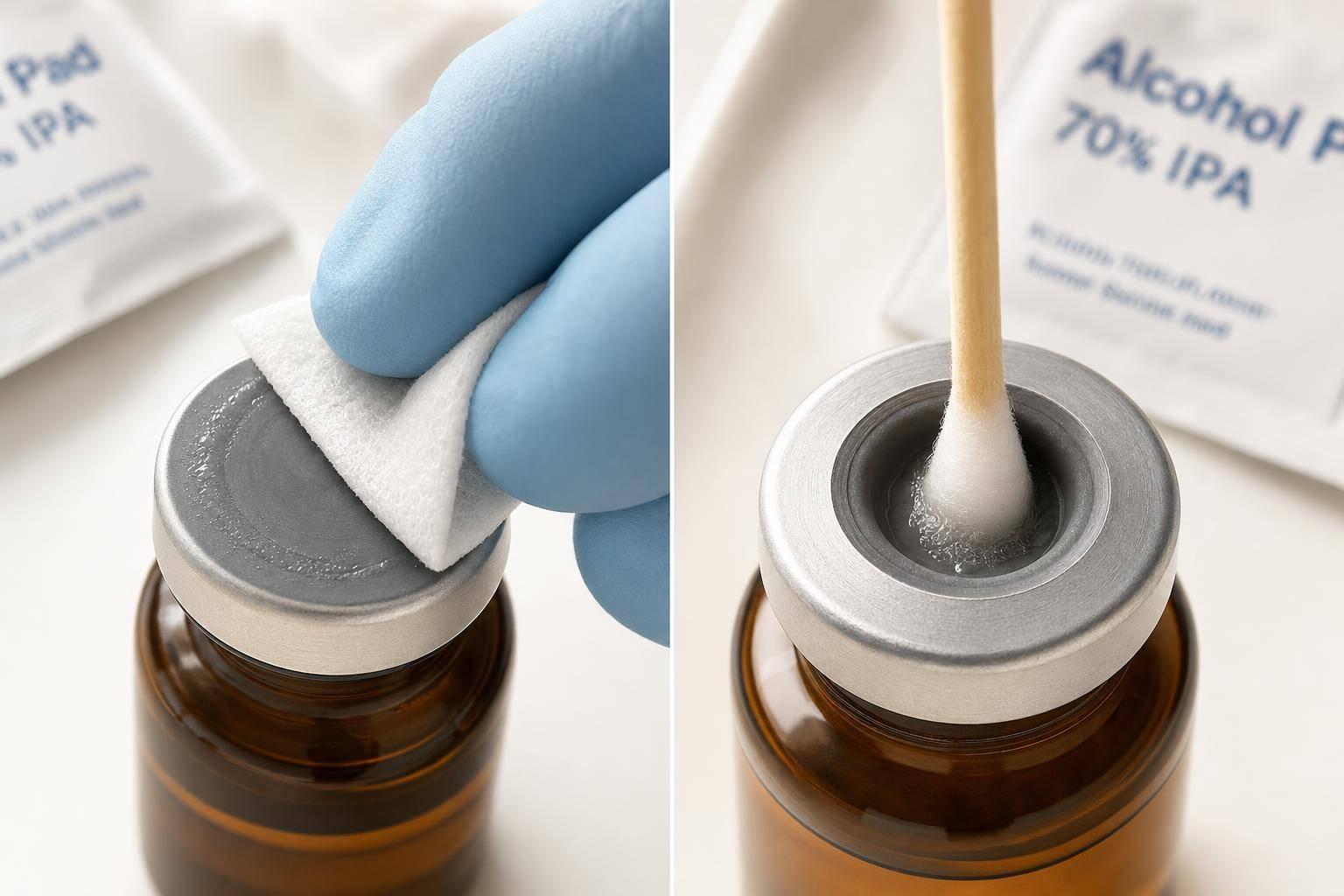
If you use 70% isopropyl alcohol, the format does not change the disinfecting standard. The main choice is simple: use pads for bigger, flat areas and swabsticks for small, tight spots.
If I had to sum up the whole article in a few lines, it would be this:
- Pads are usually the better pick for skin prep and flat vial stoppers
- Swabsticks are often easier for recessed vial tops, syringe hubs, and narrow access points
- For both, the same rules apply: scrub with friction, use one applicator per task, and let it air-dry fully
- Most products use 70% isopropyl alcohol, so this is more about handling, surface area, and material waste than alcohol strength
- Common dry times in the article are about 10 seconds wet contact for vial stoppers and about 30 seconds air-dry for skin
This matters in peptide clinics because the same prep step happens again and again: wipe the vial, prep the skin, draw the dose, and repeat according to practical clinical guides. Small differences in size, control, and how much material gets tossed can shape day-to-day flow.
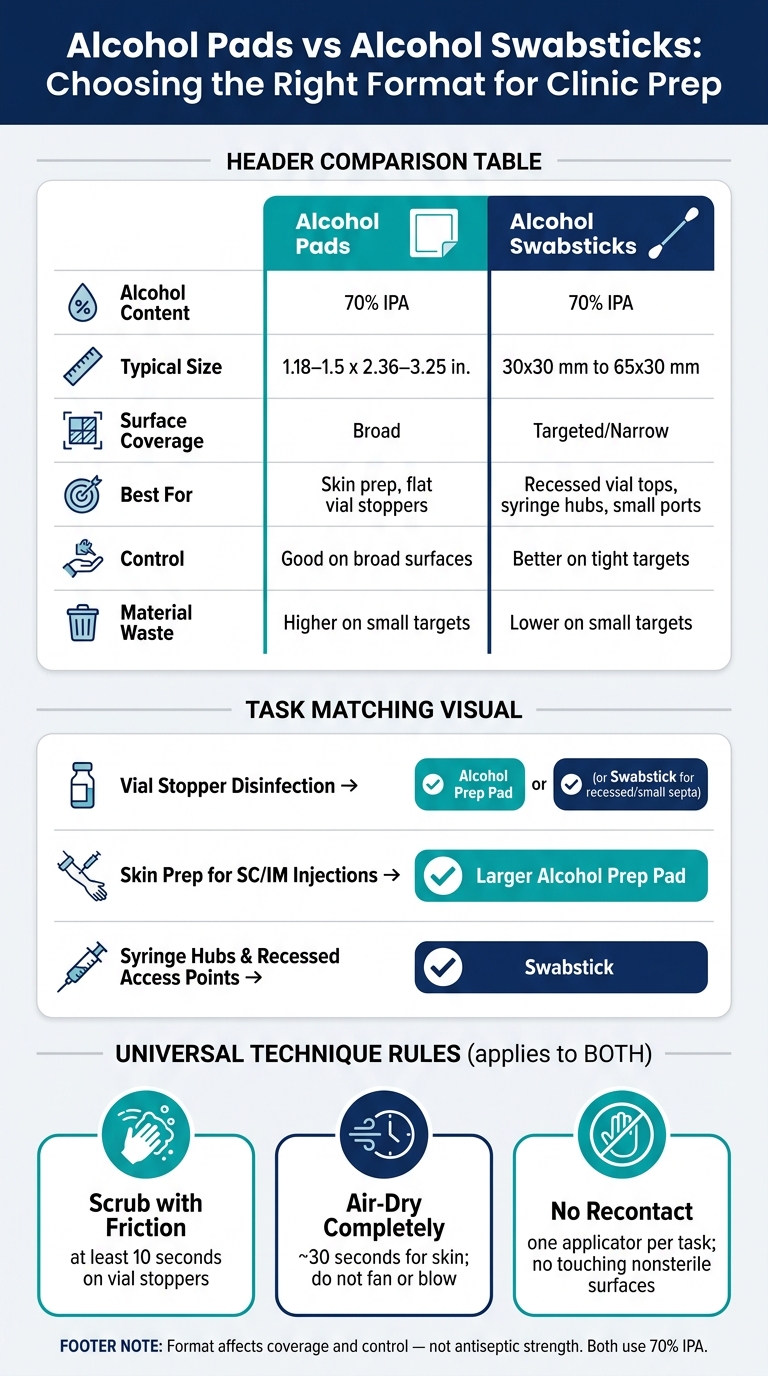
Alcohol Pads vs Swabsticks: Which to Use for Vial & Skin Prep
Quick Comparison
| Criteria | Alcohol Pads | Alcohol Swabsticks |
|---|---|---|
| Alcohol content | Usually 70% IPA | Usually 70% IPA |
| Best use | Skin prep, flat vial stoppers | Recessed tops, syringe hubs, small ports |
| Surface area | Larger | Smaller |
| Control | Good on broad surfaces | Better on tight targets |
| Moisture | More alcohol, more coverage | Less alcohol, narrower wipe path |
| Waste on small targets | More likely | Less likely |
| Main point | Better for coverage | Better for precision |
So if you want the short answer: pick the applicator based on the surface you need to clean, not because one is “stronger” than the other.
sbb-itb-7164bd9
Definitions and Shared Clinical Standard
Start with the formats, then look at where each one fits best in the clinic.
Alcohol prep pads
An alcohol prep pad is a sterile, nonwoven pad soaked with 70% isopropyl alcohol (IPA) and sealed in its own foil or plastic pouch. Most pads are about 1 to 1.5 inches square, which gives them a flat, broad surface that works well for wiping vial stoppers and routine skin prep. That broad surface is most useful when full coverage matters more than pinpoint control.
Alcohol swabsticks
In U.S. clinical settings, "alcohol swab" often refers to the same flat pad. Here, the term "swab" is used more broadly, with a clear split between the two formats: a swabstick is a handled applicator with a smaller foam or nonwoven tip, also soaked with IPA. That smaller tip gives you tighter control, which helps with recessed vial tops or narrow access points where a flat pad can be awkward to use. This format makes the most sense when access and precision matter more than surface area.
What stays the same between both formats
The format changes how you handle the applicator, not the disinfection standard. For clinic prep, the main factors are coverage, control, and waste.
Both formats depend on the same core technique: friction, full air-dry, and no recontact.
- Scrub with friction - use firm back-and-forth or circular pressure for at least 10 seconds on vial stoppers.
- Air-dry completely - allow about 30 seconds for skin; let the site air-dry and do not blow, fan, or wipe.
- No recontact - once opened, the pad or swabstick should not touch any nonsterile surface before it reaches the target site.
Use one fresh applicator for each task, and spell out the exact format in the SOP. The next section looks at how those format differences play out with vial stoppers, syringe access points, and skin prep.
Alcohol Pads vs Swabs: Direct Comparison for Vial, Syringe, and Skin Prep
Once the antiseptic standard is the same, the choice comes down to surface area, control, and waste. So the main issue isn’t disinfecting power. It’s matching the tool to the job.
Size, coverage, and saturation
Alcohol prep pads are larger by design. Common medium pads measure about 1.18 x 2.36 in. or 1.2 x 2.6 in., and large pads can reach 1.5 x 3.25 in. That extra area helps in day-to-day use. A pad can cover a typical abdominal or thigh injection site in one smooth wipe, and it sits flat on a standard vial stopper without folding up or bunching.
Swabsticks are smaller and more precise. Many are about 30 x 30 mm or 65 x 30 mm. That makes them easier to aim at a small target, but less handy when you need to prep a bigger area.
There’s also a wetness difference. Larger pads hold more alcohol, so they stay wet across more surface area. Swabsticks put alcohol on in a narrower strip, which can mean less extra moisture on a vial stopper and, in many cases, a shorter dry time.
| Factor | Alcohol Pads | Alcohol Swabs |
|---|---|---|
| Typical size | 1.18–1.5 x 2.36–3.25 in. | 30 x 30 mm to 65 x 30 mm |
| Coverage | Broad; suits skin fields and standard vial tops | Targeted; suits small or recessed surfaces |
| Saturation | Higher fluid volume; stays wet across larger areas | Lower volume; dries quickly on small targets |
| Best-fit task | Skin prep for subcutaneous/IM injections | Vial stopper disinfection; tight access points |
Handling, workflow speed, and waste
Pads are usually easier to hold steady. You can press the full pad against skin or a vial top with two or three fingers, which helps keep pressure even. That matters when you want steady friction instead of a sloppy wipe.
Some swabstick styles need more of a fingertip grip. In a one-handed setup, where the other hand is already holding a syringe or vial, that tighter hold can make it easier to brush the tip against a nonsterile surface.
Packaging waste is about the same. Both are commonly packed in single-use foil or sachet wrappers. The bigger difference is material waste. If you use a large pad on a small vial stopper, you throw away more nonwoven material than the task calls for. In a busy clinic, that can add up fast, especially when each injection session needs at least two applicators: one for the vial and one for the skin.
Best fit by task
This is where the split becomes pretty clear.
For routine skin prep, pads tend to be the better fit. Their size lines up with the recommended ~2-inch (5 cm) prep field, and the broader surface makes the center-outward wipe easier to do in one pass instead of several.
For vial stopper disinfection, either option can work on a standard rubber diaphragm. But a swabstick gives tighter control over the puncture area and helps limit extra moisture.
That control matters even more with recessed or narrow vial ports. A swabstick can reach into those shapes more easily than a flat pad. The same idea applies to syringe hubs and other narrow access points, where swabsticks are often easier to guide with care.
Those differences shape stocking choices and SOPs.
How to Choose the Right Format for a Peptide Clinic
Pick the format based on the task, not on “strength.” What matters most is coverage, friction, and dry time. That’s what turns a simple wipe into the right tool for the job.
Choosing a format for vial stopper disinfection
For vial stopper disinfection, a sterile alcohol prep pad is usually the best fit. It gives broad, even coverage across flat rubber septa. If the access point is recessed or tight, a swabstick makes more sense because it can reach the septum with better control.
Either way, technique is the part that counts. Scrub with friction, then let the site air-dry before puncture. ASHP sterile compounding guidance says to wipe the septum with enough 70% isopropyl alcohol to keep it wet for 10 seconds, then allow it to air-dry completely before needle insertion. That dry time matters just as much as the wipe itself. If you push a needle through wet alcohol, you can carry liquid antiseptic into the vial.
Choosing a format for skin prep and routine injections
For skin prep before routine injections, use a larger alcohol pad. It covers the usual 2-inch field in one pass. After wiping, let the site air-dry for 30 seconds. Don’t fan it, blow on it, or touch it after prep.
Going through a site that’s still wet does two things you don’t want: it causes extra stinging and cuts into the antiseptic effect.
Building the choice into SOPs and staff training
Build these choices straight into the SOP so staff don’t have to guess in the moment. A simple task-based setup works well:
| Task | Preferred Format | Key Technique Requirement |
|---|---|---|
| Vial stopper disinfection | Sterile alcohol prep pad (or swabstick for small septa) | Firm friction; air-dry at least 10 seconds before puncture |
| Skin prep (SC injections) | Larger alcohol prep pad | Center-outward wipe; air-dry ~30 seconds |
| Syringe hubs and recessed access points | Swabstick | Target the access point without touching surrounding surfaces |
This kind of standardization also helps stop repeat swabbing, when someone swabs, pauses, then swabs again because they’re unsure. That burns through supplies without making the process safer. One well-done wipe, with proper friction and enough dry time, is the standard.
Conclusion: Choosing for Workflow Fit, Not Antiseptic Potency
Pads and swabs use the same antiseptic - 70% isopropyl alcohol - so one isn't stronger than the other. The main differences are surface area, control, and waste.
In clinical peptide therapy, the choice is mostly about matching the applicator to the job. That applies to vial stoppers, syringe hubs, and skin prep. Pads work well on broader surfaces, such as vial stoppers and skin prep. Swabsticks make more sense for syringe hubs, recessed vial ports, and other narrow access points. In both cases, use sterile, individually packaged 70% IPA, apply firm friction, and let the area fully air-dry before puncture or injection. Use pads for broad surfaces, and swabsticks for narrow or recessed access points.
Technique matters more than format. Standardize the format in SOPs, train staff on friction and dry time, and match the applicator to the surface.
FAQs
When should I choose a swabstick over a pad?
In the cited clinical resources, alcohol pad and alcohol swab mean the same thing: a 70% isopropyl alcohol wipe. The sources do not give a separate clinical reason to pick a swabstick instead of a pad.
What matters most is the technique. Clean the area with a single-direction wipe or a circular motion, then let it air-dry completely.
Why does air-drying matter before puncture or injection?
Letting alcohol air-dry all the way helps make sure the rubber septum or skin is disinfected before puncture or injection. It also helps stop contaminants from getting into the vial or injection site.
For best results, wait 10 to 30 seconds for the alcohol to evaporate. Do not blow on the surface, since that can introduce new contaminants.
Can I use one alcohol applicator for both the vial and the skin?
No. Use a new alcohol swab for each task.
Use one clean swab for the vial stopper and a separate one for the injection site. This helps maintain sterility and lowers the risk of contamination.