
My main advice: get same-day care for worsening injection pain or spreading redness. Mild soreness that improves may be monitored as directed, but redness alone can’t tell you what’s wrong.
- Contact your clinician the same day for increasing warmth, swelling, drainage, or a fever of 100.4°F (38°C) or higher. Don’t wait for a fever if symptoms are worsening.
- Go to the ER now for fast-spreading skin changes, extreme pain, blisters, numbness, or purple, gray, or black skin.
- Call 911 for trouble breathing, throat swelling, fainting, confusion, or severe illness. If prescribed, use epinephrine as directed for a suspected severe allergic reaction, then call 911.
While arranging care, I recommend keeping the site clean, avoiding injections into the affected area, and asking your prescriber about the next dose. Record your symptoms and product details, including the dose and lot number. Photos can help track changes, but <u>never delay care to take them</u>. Once you’re safe, review storage and injection technique with your clinician.
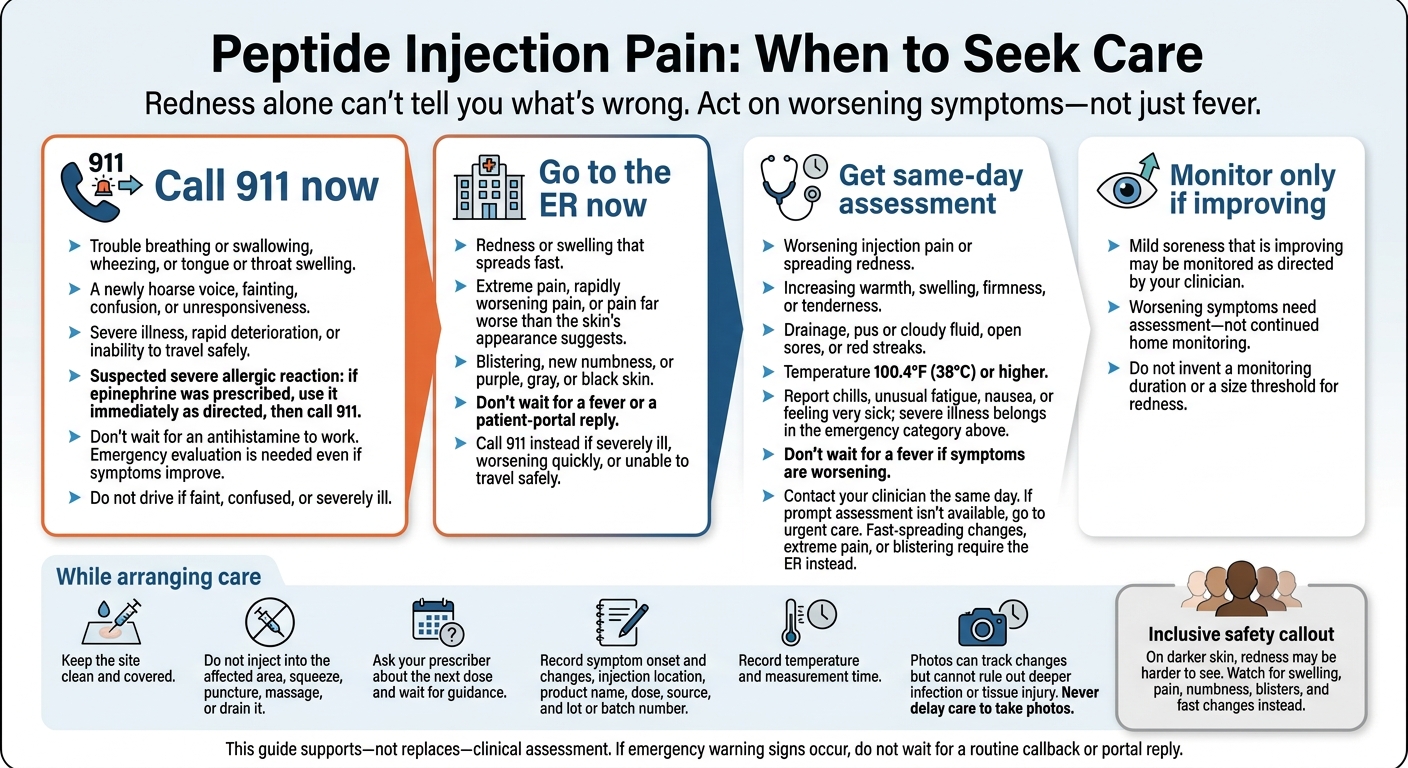
Peptide Injection Pain: When to Seek Care
🚨 STOP! Injection Site Redness: Is It Normal or a Dangerous Infection? 💉
sbb-itb-7164bd9
Symptoms That Need Same-Day Assessment
Symptoms that worsen rather than improve need a clinical assessment - not just home monitoring. Redness, warmth, swelling, and tenderness may point to infection or another complication. An exam is needed to determine the cause, even without fever or drainage.
Patients should describe whether symptoms are getting better or worse rather than guess what's causing them. A clinician determines the cause.
Report Worsening Pain, Spreading Redness, or Drainage
Report worsening pain, spreading redness, increasing warmth, swelling, firmness, tenderness, pus or cloudy fluid, open sores, blisters, or red streaks. Chills, unusual fatigue, nausea, or feeling very sick also need to be reported. Report a temperature of 100.4°F (38°C) or higher the same day, but don't wait for a fever before seeking care.
If the prescriber can't assess the patient promptly, direct them to urgent care. Redness that spreads fast, severe pain or pain that worsens fast, or severe illness requires emergency evaluation. Call 911 for breathing trouble, collapse, or inability to travel safely.
Share Symptom Timing and Injection Details
Record when symptoms started and how they've changed. Include the exact injection location and side of the body, product name, dose, and lot or batch number, if available. Note whether the product was compounded. Ask about storage problems, changes in the product's appearance, damaged packaging, reused needles, or concerns about sterile technique. Reviewing clinical guides on injection technique can help identify potential errors. These details help determine how soon the site needs an exam.
Request the thermometer reading in °F and the time it was measured, even if the reading is normal. If photos are sent, include a view of the full area and a close-up with a size reference, along with the time the photos were taken. This information helps clinicians assess severity, exposure risks, and possible injection-related causes. Photos can't rule out deeper infection or tissue injury and shouldn't delay an exam.
Emergency Warning Signs: When to Call 911
If symptoms go beyond redness and soreness around the injection site, get help right away.
Call 911 for Breathing Trouble, Collapse, or Severe Illness
Call 911 now for trouble breathing or swallowing, wheezing, tongue or throat swelling, fainting, confusion, or unresponsiveness. A newly hoarse voice can also signal throat swelling.
With a suspected allergic reaction, every minute matters. If epinephrine was prescribed, use it immediately as directed, then call 911. Don't wait for an antihistamine to work or delay treatment to contact the office. Emergency evaluation is still needed even if symptoms improve, because they can return or worsen. Don't give anything by mouth to someone struggling to breathe.
Seek Emergency Care for Fast-Spreading Symptoms or Extreme Pain
Go to the emergency department now for redness or swelling that spreads fast, pain far worse than the skin's appearance would suggest, blistering, new numbness, or purple, gray, or black skin discoloration. Extreme pain can signal a deep infection, including rare but life-threatening necrotizing fasciitis. Don't wait to find out what's causing it.
On darker skin, redness may be harder to see. Watch for swelling, pain, numbness, blisters, and fast changes instead. These signs need emergency care. Don't wait for a fever or a reply through the patient portal.
Call 911 if the patient is getting worse quickly, is severely ill, or can't travel safely. Someone who feels faint, is confused, or is severely ill should not drive. Tell responders what was injected using your injection site guide and whether epinephrine was used. Bring the packaging if doing so won't delay care.
What to Do While Arranging Assessment
If the patient is stable but symptoms are getting worse, take these steps while arranging care.
Protect the Site and Ask About the Next Dose
Contact the prescribing clinician or after-hours service. Keep the site clean and covered. Do not inject into the site, squeeze, puncture, massage, or drain it. Don’t apply nonprescribed creams or ointments unless a clinician tells you to.
Ask the prescriber what to do before the next dose, and wait for their guidance. Switching injection sites won’t address a possible infection, product-quality problem, allergic reaction, or dosing error. The prescriber should decide whether to pause treatment, change it, or examine the patient in person. This matters especially with compounded products, which may cause harm if contaminated or made at the wrong strength.
Review the Reaction, Product, and Patient Risks
Record when symptoms began, how they’ve changed, any pain or drainage, and the patient’s overall condition. Don’t ask the patient to diagnose the cause. Possible causes include local irritation, an allergic or hypersensitivity reaction, hematoma, sterile inflammation, tissue injury, cellulitis, abscess, or another injection-related complication.
Review diabetes, immune suppression, poor circulation, past skin infections, impaired wound healing, obesity, pregnancy when relevant, and medication allergies. Also check for other conditions or medicines that could change the care plan. These findings guide whether the patient needs an examination, drainage, testing, medication, observation, or hospital care.
Have the product name, dose, source, and lot or batch number ready. Check its instructions for preparation, storage, route, and injection technique. If a compounded-product problem is suspected, clinicians should save the label and packaging. They should also consider contacting the pharmacy and reporting the suspected adverse event or quality defect through FDA MedWatch.
Check Sterile Technique and Site Selection
If the reaction isn’t an emergency, review injection technique once the patient is safe. Check hand hygiene, use of a clean workspace, and a new sterile needle and syringe for every injection. Clean the skin as directed and let it dry completely.
Use only sites approved for the prescribed product and route, and rotate them as instructed. Avoid skin that is red, swollen, bruised, painful, scarred, open, or infected. Put used sharps in a sharps container immediately; don’t recap them. Correct technique lowers risk, but it doesn’t rule out a complication.
Conclusion: Give Patients a Clear Care Plan
Give patients a clear next step based on their symptoms. Mild soreness that’s improving can be monitored. Worsening pain, spreading redness, warmth, drainage, or fever calls for same-day clinical contact. Ask patients to report changes - not diagnose themselves.
Provide Office and After-Hours Contact Details
Every patient should leave with a written contact plan. Include monitoring timeframes, the office phone number, an after-hours contact route, and clear instructions for seeking urgent care if the office is unreachable.
Add a short checklist for patients to record: date and time, product and dose, injection site, symptoms, and temperature.
For emergency warning signs, seek emergency care or call 911 as directed above - do not wait for a portal reply or routine callback. Use teach-back to check that patients understand when to monitor symptoms, call, or seek emergency care.
Support Patient Education With PeptidePrescriber
Prescribers can reinforce the care plan with standard patient handouts and dosing references.
Licensed healthcare professionals can use PeptidePrescriber for peptide monographs, injection guides, dosing protocols, calculators, and regulatory references. Prescribers can also find clinical insights on emerging therapy trends. These tools support patient education but do not replace clinical assessment, product labeling, or emergency care.
FAQs
What if injection-site redness improves, then returns?
Redness that fades and then returns shouldn’t be brushed off as routine. It may point to delayed inflammation, a problem with the injection technique, or an infection that’s developing.
Contact your healthcare provider if redness lasts, gets worse, or comes back - especially if you also have warmth, pain, or a fever above 100.4°F. A clinician should check for infection or a sterile inflammatory reaction, rather than leaving you to figure out the cause yourself.
Does immune suppression change when I should seek care?
Yes. If you’re immunosuppressed, worsening symptoms after a peptide injection carry a higher risk. Seek medical care if you notice spreading redness with intense pain, increasing redness or warmth, pus, a fever above 100.4°F (38°C), or symptoms that last more than 48 hours.
Call 911 for signs of an emergency allergic reaction: trouble breathing, throat or facial swelling, or hives across your body.
What should I expect during an injection-site exam?
A clinician examines the injection site for redness, swelling, warmth, tenderness, firm areas, rash, drainage, scarring, or broken skin. This helps them check whether the site is suitable for injection and spot reactions or complications from earlier doses.
They also check for persistent lumps, worsening pain, or skin changes that could point to lipohypertrophy or infection. A symptom diary can help them track reaction patterns and spot possible problems with injection technique.